Fruit juice calories come to 126 for 1 cup (248 g) and 51 per 100 g, ready to drink. Almost all of that energy is sugar. A cup carries 25.8 g of sugars and only 0.5 g of fiber, so the glass adds up quickly without doing much to fill you up.
126kcal
1 cup · 248 g, ready to drink
2%protein
0.7 gProtein
30 gCarbs
0.6 gFat
How to burn off 126 kcal
—Walking, brisk
—Jogging
—Cycling, moderate
—Swimming
Skip the math. BodyPal counts these calories from your steps and workouts automatically.
Nutrition facts
Ready to drink · per 248 g
Calories
126 kcal
Protein
0.7 g
Carbohydrate
30 g
Fat
0.6 g
Saturated fat
0 g
Cholesterol
0 mg
Sodium
12 mg
Potassium
258 mg
Iron
0.2 mg
Source: USDA FoodData Central
🛡️
Verified nutrition data
Numbers on this page come from USDA FoodData Central, the U.S. Department of Agriculture’s food composition database, and from manufacturer labels where a branded product is named. Last verified September 2026. How we verify our data →
Fruit juice: calories, protein and sodium by serving
Percent of daily value uses the FDA reference of 2,000 kcal a day.
Serving
kcal
Protein
Carbs
Fat
Sodium
% DV kcal
1 cup (248 g)
126
0.7 g
30 g
0.6 g
12 mg
6%
Juice box (209 g)
107
0.6 g
25.3 g
0.5 g
10 mg
5%
100 g
51
0.3 g
12.1 g
0.3 g
5 mg
3%
3 × 1 cup (248 g)
379
2.2 g
37 mg
5 × 1 cup (248 g)
632
3.6 g
62 mg
A juice box is 107 calories, and refills stack fast
The smallest common portion is a juice box of 209 g, which delivers 107 calories and 21.7 g of sugars. A standard 1 cup (248 g) pour comes to 126 calories, about 6% of the daily value used on this page. On their own, neither number looks alarming. The trouble is how easily one glass turns into several.
Two cups bring you to 253 calories. Three cups reach 379, and five cups, the kind of volume you can drink across a long day without noticing, land at 632 calories. That last figure is a full meal's worth of energy with almost no protein to show for it: just 3.6 g across all five cups.
Glass size matters more than the juice itself. Many home glasses hold well over a cup, so a single pour can quietly become two servings. If you track intake, weigh or measure the first few pours to learn what your usual glass really holds. BodyPal can also log the drink from a photo.
Carbs supply 93% of every calorie
The calorie split is about as lopsided as food gets: 93% carbs, 5% fat and 2% protein. Per 100 g, fruit juice has 12.1 g of carbs, and 10.4 g of those are sugars. Protein and fat sit at 0.3 g each, which barely registers.
In practice, a cup gives you 30 g of carbs and 0.7 g of protein, which covers about 1% of the daily protein value. There is close to nothing here to slow digestion or keep you satisfied. You get quick energy and very little else in the macro columns.
This is not a flaw so much as a description. Juice is fruit with the pulp and most of the fiber removed, so what remains is water, sugar and some minerals. Treat it as a carb source and plan the rest of the plate around it, rather than counting it as a light extra that does not matter.
Sugar is the row to watch, not sodium
Each cup carries 25.8 g of sugars against just 0.5 g of fiber. The daily value for fiber used here is 28 g, so a glass of juice does almost nothing for that target. Whole fruit keeps its fiber; juice mostly leaves it behind.
Sodium is a non-issue. A cup holds 12 mg, about 1% of the daily value, and even five cups total only 62 mg. Cholesterol and saturated fat are both 0. If you are scanning the label for a problem, the sugars line is the one that stands out.
Potassium is the quiet plus. Fruit juice has 104 mg per 100 g, a modest contribution toward the 4700 mg daily value used on this page. It is a small benefit, not a reason to drink more. If you watch sugar, the simplest move is a smaller glass rather than a different juice.
Drink it with a meal, not as a snack
Because juice brings carbs and almost nothing else, it works best next to foods that supply what it lacks. Pair a glass with eggs, yogurt, cottage cheese or a nut butter on toast, and the protein and fat round out a breakfast that juice alone cannot.
As a standalone snack, juice is hard to justify if you are watching calories. You drink 126 calories in a minute and feel about as hungry as before. A piece of whole fruit, or water with a meal, usually does the job better between meals.
Branded options such as Arizona Fruit Punch or Arizona Watermelon Fruit Juice Cocktail are sold as juice cocktails, so check their labels for serving size and added sugar rather than assuming they match the numbers here. For plain fruit juice, the rule is simple: measure the glass, keep it with food, and count it like the carb serving it is.
How does fruit juice compare?
Here is how fruit juice stacks up against juice, orange juice and mango juice, per 100 g and per usual serving.
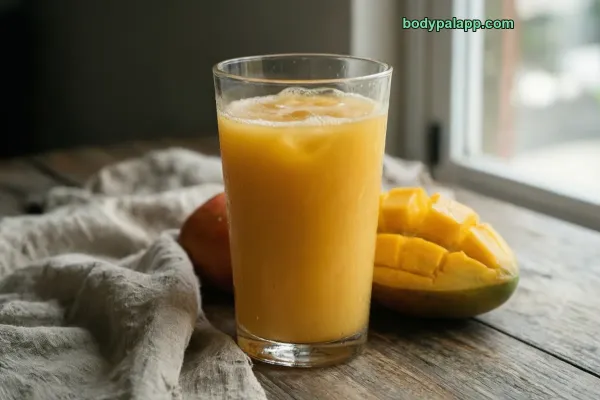
Verdict: All four sit within a whisker of each other, from 49 to 51 calories per 100 g, so pick by taste and portion, not by label. If you want a slight edge, choose orange juice for its 0.7 g of protein and 2 mg of sodium per 100 g, and skip mango juice if you watch sodium, since it carries 28 mg per 100 g.
Most popular fruit juice brands in the United States
Ranked by popularity in the BodyPal database
# Productkcal / 100 g
1Arizona Fruit Punch Fruit Juice Cocktail6.75 fl oz · 200 g30 kcal
2Arizona Fruit Punch Fruit Juice Cocktail, 8 fl oz8 fl oz · 240 g38 kcal
3Arizona Watermelon Fruit Juice Cocktail8 fl oz · 240 g42 kcal
4Arizona Watermelon Fruit Juice Cocktail, 11 fl oz11 fl oz · 325 g34 kcal
These bottled drinks are juice cocktails cut with water, so their labels read 30 to 42 calories per 100 g instead of the 51 of straight juice. Source: manufacturer labels / USDA FoodData Central.
Fruit juice FAQs
How many calories are in a cup of fruit juice?
One cup (248 g) has 126 calories. That works out to 51 calories per 100 g.
Is fruit juice good for weight loss?
A cup carries 126 calories, 30.0 g of carbs and 25.8 g of sugar, with only 0.5 g of fiber. A 6.75 fl oz juice box keeps it to 107 calories.
Fruit juice or orange juice: which has fewer calories?
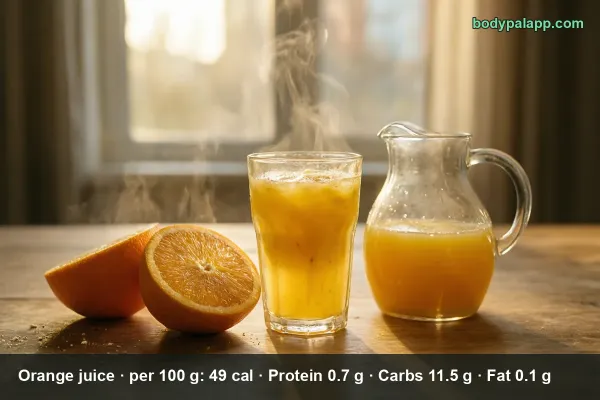
Orange juice is 49 calories per 100 g against 51 for mixed fruit juice, so a cup differs by about 4 calories.
How much sugar is in fruit juice?
10.4 g per 100 g, which is 25.8 g in a 248 g cup. Protein is 0.29 g per 100 g, about 0.7 g per cup.
How many calories are in a juice box of fruit juice?
A juice box of 209 g has 107 calories, about 5% of the daily value. It also carries 21.7 g of sugars and 25.3 g of carbs, with only 0.4 g of fiber.
How many calories are in two cups of fruit juice?
Two cups (496 g) of fruit juice come to 253 calories. Three cups reach 379 calories, so larger glasses and refills add up quickly while giving you just over a gram of protein.
Does fruit juice have any protein?
Barely. Fruit juice has 0.3 g of protein per 100 g and 0.7 g per cup, about 1% of the daily value. Protein makes up just 2% of its calories, so pair it with eggs or yogurt.
Is fruit juice high in sodium?
No. A cup of fruit juice has 12 mg of sodium, about 1% of the daily value, and 100 g has 5 mg. Sugar, at 25.8 g per cup, is the number worth watching instead.
How many carbs are in a cup of fruit juice?
A cup of fruit juice has 30 g of carbs, and 25.8 g of that is sugars. Carbs supply 93% of its calories, with just 0.5 g of fiber per cup.