
How many calories are in a cup of Greek yogurt?
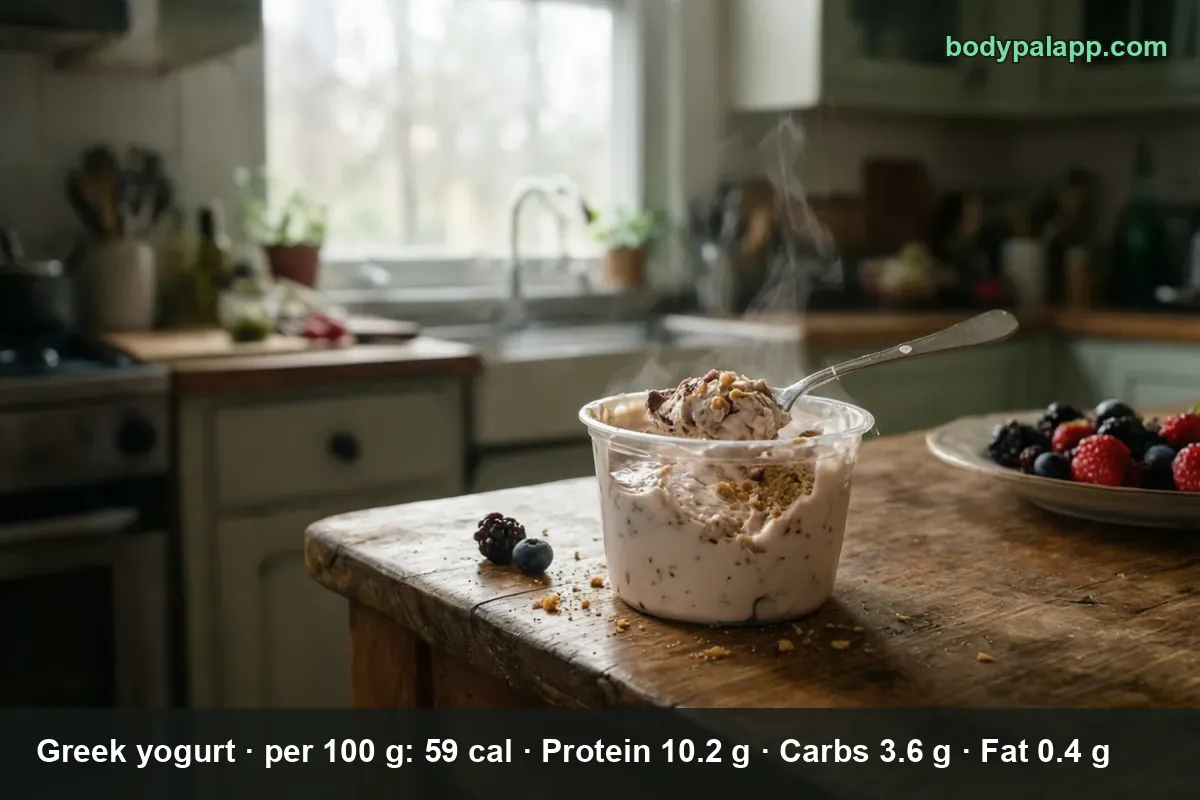
A 1-cup (227 g) serving of plain nonfat Greek yogurt is 134 calories, and the yogurt itself runs 59 calories per 100 g. The same cup carries 23.1 g of protein, nearly half a day's worth, for under 7% of a 2,000-calorie day. Straining is what makes those two numbers sit together.
On this page
- Greek yogurt quick facts
- US servings from a snack cup to a full cup
- Low-fat whole-milk and flavored Greek yogurt
- Protein is the row that makes the cup worth it
- How does Greek yogurt compare?
- Most popular greek yogurt brands
- FAQ
Greek yogurt quick facts
The record behind this page is SR Legacy 170894, "Yogurt, Greek, plain, nonfat". It is the plain tub most people are actually holding, and it is the only SR Legacy profile of that food with sugars and fiber both filled in. The newer Foundation sample of the same yogurt, 330137, reads 61 calories per 100 g but leaves sugars and fiber blank, so it cannot carry a nutrition table on its own.
The USDA survey version of the same food lands at the same place, 59 calories per 100 g. That agreement is worth noting, because plain strained yogurt has very little room to vary: milk, cultures, and whey removed.
| Nutrient | Per 100 g | Per 1 cup (227 g) | % Daily Value |
|---|---|---|---|
| Calories | 59 | 134 | — |
| Total fat | 0.39 g | 0.9 g | 1% |
| Saturated fat | 0.12 g | 0.3 g | 1% |
| Carbohydrate | 3.6 g | 8.2 g | 3% |
| Dietary fiber | 0 g | 0 g | 0% |
| Total sugars | 3.24 g | 7.4 g | — |
| Protein | 10.19 g | 23.1 g | 46% |
| Sodium | 36 mg | 82 mg | 4% |
% Daily Value is based on a 2,000-calorie diet.
Verified nutrition data
Numbers on this page come from USDA FoodData Central, the U.S. Department of Agriculture’s food composition database, and from manufacturer labels where a branded product is named. Last verified September 2026. How we verify our data →
There is no added sugars row here, because USDA does not publish an added sugars figure for this record. It would read zero anyway: every one of those 7.4 g is lactose that came in with the milk. Two more rows worth knowing sit outside the label block. A cup has 11 mg of cholesterol, 4% of the FDA Daily Value, and 320 mg of potassium, 7%.
The sodium is low enough to ignore: 82 mg in a cup is less than a twentieth of a teaspoon of table salt.
US servings from a snack cup to a full cup
| Serving | Weight | Calories |
|---|---|---|
| 1 oz | 28 g | 17 kcal |
| 5.3 oz single-serve cup | 150 g | 89 kcal |
| 6 oz container | 170 g | 100 kcal |
| 1 cup (8 oz by weight) | 227 g | 134 kcal |
| 1 cup (8 fl oz measured) | 245 g | 145 kcal |
| Per 100 g | 100 g | 59 kcal |
USDA gives two household measures for this record directly: the 227 g cup and the 6 oz container at 170 g. The 150 g snack cup, the 245 g measured cup and the ounce are our own arithmetic from the USDA 100 g figure, not USDA servings.
Now the trap, and it is the reason cup logging goes wrong. The word "cup" means two different weights here. The label cup, 8 ounces by weight, is 227 g and 134 calories. A dry measuring cup filled with yogurt holds about 245 g, because Greek yogurt is denser than water, and that cup is 145 calories. Eleven calories is nothing once, but it is the same eleven every morning.
The 6 oz tub at 100 calories is the tidiest number in the whole table, which is probably why so many people default to it.
Low-fat whole-milk and flavored Greek yogurt
| Version | Per 100 g | Typical serving | Calories |
|---|---|---|---|
| Plain nonfat | 59 kcal | 1 cup (227 g) | 134 kcal |
| Plain low-fat, 2% | 73 kcal | 1 cup (227 g) | 166 kcal |
| Plain whole milk | 97 kcal | 1 cup (227 g) | 220 kcal |
| Vanilla nonfat | 78 kcal | 5.3 oz cup (150 g) | 117 kcal |
| Strawberry nonfat | 82 kcal | 5.3 oz cup (150 g) | 123 kcal |
| Strawberry low-fat | 105 kcal | 5.3 oz cup (150 g) | 158 kcal |
| Greek yogurt with oats | 149 kcal | 1 cup (227 g) | 338 kcal |
Milk fat is the biggest single lever. Whole-milk Greek yogurt is 97 calories per 100 g against 59 for nonfat, a 64% jump, and the cup goes from 134 to 220. Protein barely notices, sliding from 10.19 g to 9 g per 100 g. So the whole-milk cup costs 86 extra calories and gives back nothing except texture, which is a fair trade if texture is what keeps you eating breakfast.
Flavor is the second lever, and it works on the sugar line rather than the fat line. Plain nonfat has 3.24 g of sugar per 100 g; vanilla nonfat has 9.54 g and strawberry nonfat 11.27 g. In a 5.3 oz cup that is roughly 4.9 g of sugar plain against 16.9 g strawberry, our arithmetic from the USDA 100 g figures. The calorie gap looks small, 89 against 123, but almost all of it arrived as sugar.
Combine both levers and you get the strawberry low-fat cup at 158 calories for 150 g, or nearly two plain snack cups. The oat blend is a different food altogether at 149 calories per 100 g, since the grain rides along with the yogurt.
Store tubs sit close to the USDA plain record. Across US branded labels, plain Greek yogurt runs 53 to 67 calories per 100 g, so a 150 g container lands between 80 and 101 calories depending on the brand. Add vanilla and the same 150 g container climbs to 110.
Protein is the row that makes the cup worth it
One cup of plain nonfat Greek yogurt gives 23.1 g of protein, 46% of the 50 g Daily Value, against 3% of the carbohydrate DV and 1% of the saturated fat DV. There is almost no other row on the label doing work. Per 100 calories, that cup delivers about 17 g of protein.
That skew matters more than the calorie count for anybody using yogurt as a breakfast or a post-workout snack. MyPlate counts a 1-cup serving of yogurt as a full cup from the dairy group, so one tub covers a third of the 3-cup daily dairy target for most adults while spending 134 calories.
The saturated fat picture flips with the whole-milk version. A 227 g whole-milk cup carries about 5.4 g of saturated fat, 27% of the Daily Value, against 0.3 g and 1% for nonfat, our arithmetic from the USDA 100 g figures. The Dietary Guidelines for Americans suggest keeping saturated fat under 10% of daily calories, which is about 22 g on a 2,000-calorie day. One whole-milk cup uses a quarter of that before lunch. If you are watching saturated fat, nonfat or 2% is the better pick; if you are not, the whole-milk tub is a legitimate choice that simply costs more calories.
How does Greek yogurt compare?
| Dairy | Per 100 g | US serving | Calories |
|---|---|---|---|
| Greek yogurt, plain nonfat | 59 kcal | 1 cup, 227 g | 134 kcal |
| Regular yogurt, plain nonfat | 50 kcal | 1 cup, 227 g | 114 kcal |
| Regular yogurt, plain whole milk | 78 kcal | 1 cup, 227 g | 177 kcal |
| Whole milk, 3.25% | 60 kcal | 1 cup, 244 g | 146 kcal |
Our take: Greek yogurt is not the low-calorie yogurt, and the internet keeps getting this backwards. Plain nonfat regular yogurt is lighter per gram and per cup, 50 against 59 and 114 against 134. What Greek yogurt wins is density of the useful stuff: 23.1 g of protein a cup versus about 9.6 g for the regular nonfat cup, which is just over double the protein per calorie. If you want the smallest number in the log, take regular nonfat. If you want the cup to hold you until lunch, take Greek and pay the 20 calories.
Most popular greek yogurt brands in the United States
Ranked by how widely each product appears among foods sold in the United States, from the BodyPal food database of over 3.3 million products. Calories are the figures printed on each Nutrition Facts label, checked against USDA FoodData Central.
| Product | Calories (per 100 g) |
|---|---|
| Lidl Plain Greek Yogurt | 60 cal |
| Chobani Plain Non-Fat Greek Yogurt | 53 cal |
| Upstate Farms Nonfat Greek Yogurt Plain | 62 cal |
| Sunnyside Farms Plain Nonfat Greek Yogurt | 60 cal |
| Prairie Farms Strained Nonfat Greek Yogurt | 67 cal |
| Chobani Vanilla Non-Fat Greek Yogurt | 73 cal |
Brand popularity: BodyPal food database. Nutrition: manufacturer labels / USDA FoodData Central.
Greek yogurt FAQs
How many calories are in a cup of Greek yogurt?
A 1-cup (227 g) serving of plain nonfat Greek yogurt has 134 calories, since the yogurt runs 59 calories per 100 g. The same cup carries 23.1 g of protein and 8.2 g of carbohydrate. Low-fat 2% pushes the cup to 166 calories and whole milk to 220.
How much protein is in 1 cup of Greek yogurt?
A 227 g cup delivers 23.1 g of protein, which is 46% of the 50 g Daily Value on the US label. That works out to about 17 g of protein for every 100 calories. A 5.3 oz snack cup (150 g) still gives 15.3 g, our own arithmetic from the USDA 100 g figure.
How many calories in a 5.3 oz Greek yogurt cup?
The 5.3 oz single-serve cup weighs 150 g and comes to 89 calories plain and nonfat, our own arithmetic from the USDA 100 g figure. Vanilla in the same size is 117 calories and strawberry 123, because the flavoring adds sugar, not because the cup got any bigger.
How many calories in whole milk Greek yogurt?
Whole-milk Greek yogurt is 97 calories per 100 g, so a 227 g cup is 220 calories against 134 for the nonfat version. The fat does the work, 5 g per 100 g versus 0.39 g. Protein barely moves, dropping from 10.19 g to 9 g per 100 g.
Does plain Greek yogurt have added sugar?
No: the 7.4 g of sugar in a 227 g cup is lactose from the milk itself. USDA does not publish an added sugars figure for this record, and plain strained yogurt has nothing stirred in. Vanilla is the tell: the same style jumps to 9.54 g of sugar per 100 g.
Is Greek yogurt lower in calories than regular yogurt?
No, it is higher per gram: plain nonfat regular yogurt is 50 calories per 100 g against 59 for Greek, so a 227 g cup is 114 versus 134. Greek yogurt wins on protein instead, 23.1 g a cup against about 9.6 g, our arithmetic from the USDA 100 g figures.
How many carbs are in a cup of Greek yogurt?
A 227 g cup has 8.2 g of carbohydrate, 3% of the Daily Value, and 7.4 g of that is milk sugar. Fiber is zero. Straining is why: a same-size cup of plain nonfat regular yogurt carries about 18.3 g of carbohydrate, our arithmetic from the USDA 100 g figures.
Is Greek yogurt good for weight loss?
Plain nonfat is the version to reach for, 134 calories a cup with 23.1 g of protein, just over double the protein per calorie of plain nonfat regular yogurt. MyPlate counts that cup as a full dairy serving. Flavored tubs are where calories creep back, 158 for a 5.3 oz strawberry low-fat cup.
Similar foods
- Glass Of Milk — 149 cal per glass
- Yogurt — 104 cal per container (6 oz)
- Milk — 149 cal per cup
- Full-Fat Plain Yogurt — 149 cal per cup
- Plain Yogurt — 149 cal per cup
- Chocolate Milk — 161 cal per cup
Count it without the math
Point the camera at the tub and BodyPal counts the cup for you, plain or flavored.


How long does it take to burn off Greek yogurt?
A 1-cup (227 g) serving is 134 kcal. Enter your weight and the amount you ate to see how long it takes you to burn that off:
lb
| Activity | Time to burn 134 kcal |
|---|---|
| Walking, brisk | 27 min |
| Cycling, moderate | 17 min |
| Swimming, moderate | 19 min |
| Jogging | 16 min |
| Weight training, moderate | 30 min |
Times are for a 155 lb adult at a steady pace; change the weight to see yours. The amount is set to the portion in the text (227 g); change it to what you actually ate. BodyPal works this out from your steps automatically.
One food is easy to picture; a whole day is harder. See how many calories you need a day and what a deficit actually looks like.