
How many calories are in grain pasta?
A cooked cup of whole grain pasta, 140 g drained, is 223 calories, and plain boiled pasta runs 159 calories per 100 g. Straight out of the box, dry, the same pasta reads 362 per 100 g. That is why the two numbers on your kitchen scale never agree. Weigh one, not both.
On this page
- Grain pasta quick facts
- US servings, from one ounce to a two-cup plate
- Dry, cooked, salted and sauced
- Fiber is the row that stands out
- How does grain pasta compare?
- Most popular grain pasta brands
- FAQ
Grain pasta quick facts
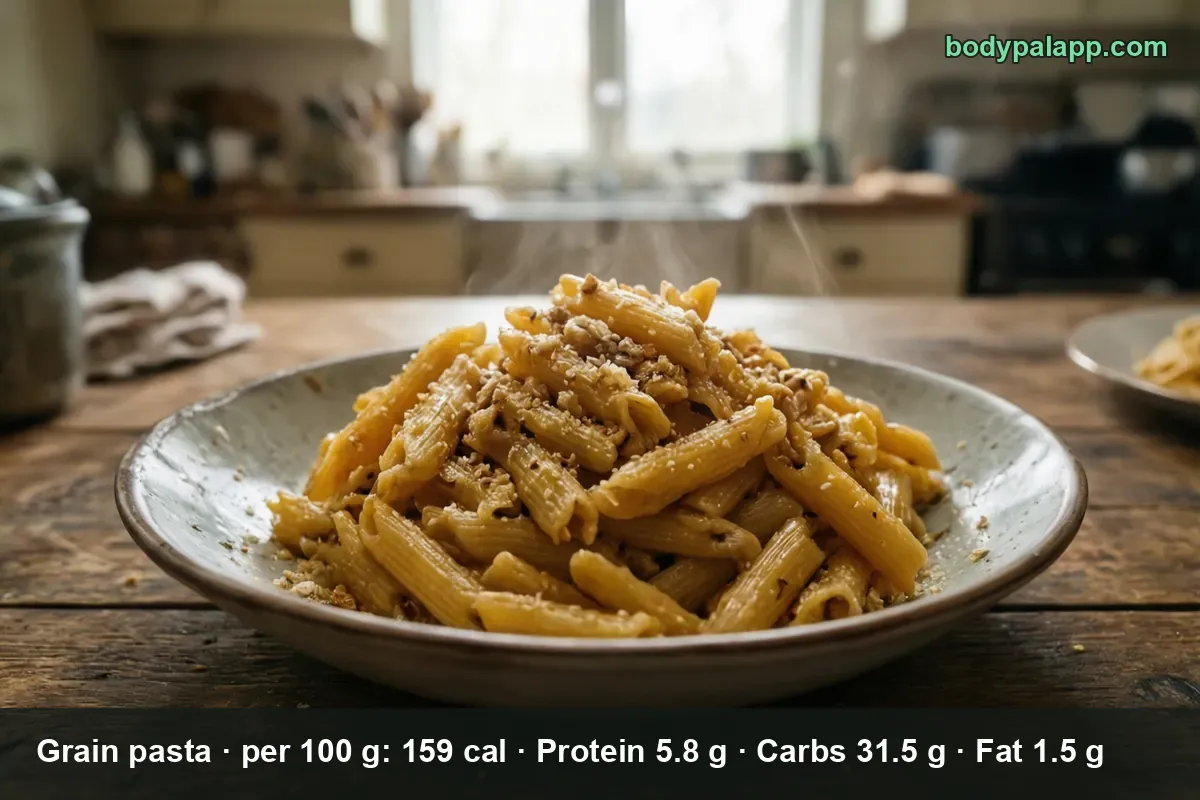
The row behind every figure on this page is SR Legacy 168916, "Pasta, whole grain, 51% whole wheat, remaining unenriched semolina, cooked". It is the pasta you actually put on a fork: boiled, drained, no salt in the water, no sauce. Anything with sauce is a different record, and those get their own section further down.
The 1-cup weight of 140 g is our own arithmetic from the USDA 100 g figure, not a USDA household serving. It is the measure most American recipes and restaurant plates are built around, so it is the one used here throughout.
| Nutrient | Per 100 g | Per 1 cup cooked (140 g) | % Daily Value |
|---|---|---|---|
| Calories | 159 | 223 | — |
| Total fat | 1.5 g | 2.1 g | 3% |
| Saturated fat | 0.24 g | 0.3 g | 2% |
| Carbohydrate | 31.51 g | 44.1 g | 16% |
| Dietary fiber | 4.6 g | 6.4 g | 23% |
| Total sugars | 0.85 g | 1.2 g | — |
| Protein | 5.82 g | 8.1 g | 16% |
| Sodium | 6 mg | 8 mg | <1% |
% Daily Value is based on a 2,000-calorie diet.
Verified nutrition data
Numbers on this page come from USDA FoodData Central, the U.S. Department of Agriculture’s food composition database, and from manufacturer labels where a branded product is named. Last verified September 2026. How we verify our data →
Two label rows are missing on purpose. USDA does not publish added sugars or cholesterol for this SR Legacy record, and neither would change the picture: durum wheat and water carry no cholesterol, and the 0.85 g of sugar per 100 g is what the grain itself brings, not anything stirred in. Potassium is worth a line, though: 77 mg per 100 g, or 108 mg in a cup, about 2% of the Daily Value.
The sodium row is the one people misread. Six milligrams per 100 g is essentially nothing, because unsalted boiling water adds nothing. Salt the pot and the same cup jumps to 329 mg. The pasta is not salty; the cook is.
US servings, from one ounce to a two-cup plate
| Serving | Weight | Calories |
|---|---|---|
| 1 oz cooked | 28.3 g | 45 kcal |
| 3 oz cooked | 85 g | 135 kcal |
| 1/2 cup cooked | 70 g | 111 kcal |
| 1 cup cooked | 140 g | 223 kcal |
| 2 cups cooked, dinner plate | 280 g | 445 kcal |
| Per 100 g | 100 g | 159 kcal |
Every line in that table is our own arithmetic scaled from the USDA 100 g figure, since the cooked record carries no household measure of its own. The weights are the standard American ones: a measuring cup of drained short pasta lands near 140 g, and the plate most people build at dinner is closer to two of them.
That second cup is where the counting goes wrong. A single cup at 223 calories is a modest side. Two cups, the way pasta usually gets served, is 445 before a spoonful of anything else touches it. Add half a cup of sauce and a dusting of cheese and the bowl that felt like a light dinner climbs higher still.
An ounce is useful only for cooked pasta, at 45 calories. For dry pasta the ounce means something completely different, which is the next section.
Dry, cooked, salted and sauced
| Version | Per 100 g | Typical serving | Calories |
|---|---|---|---|
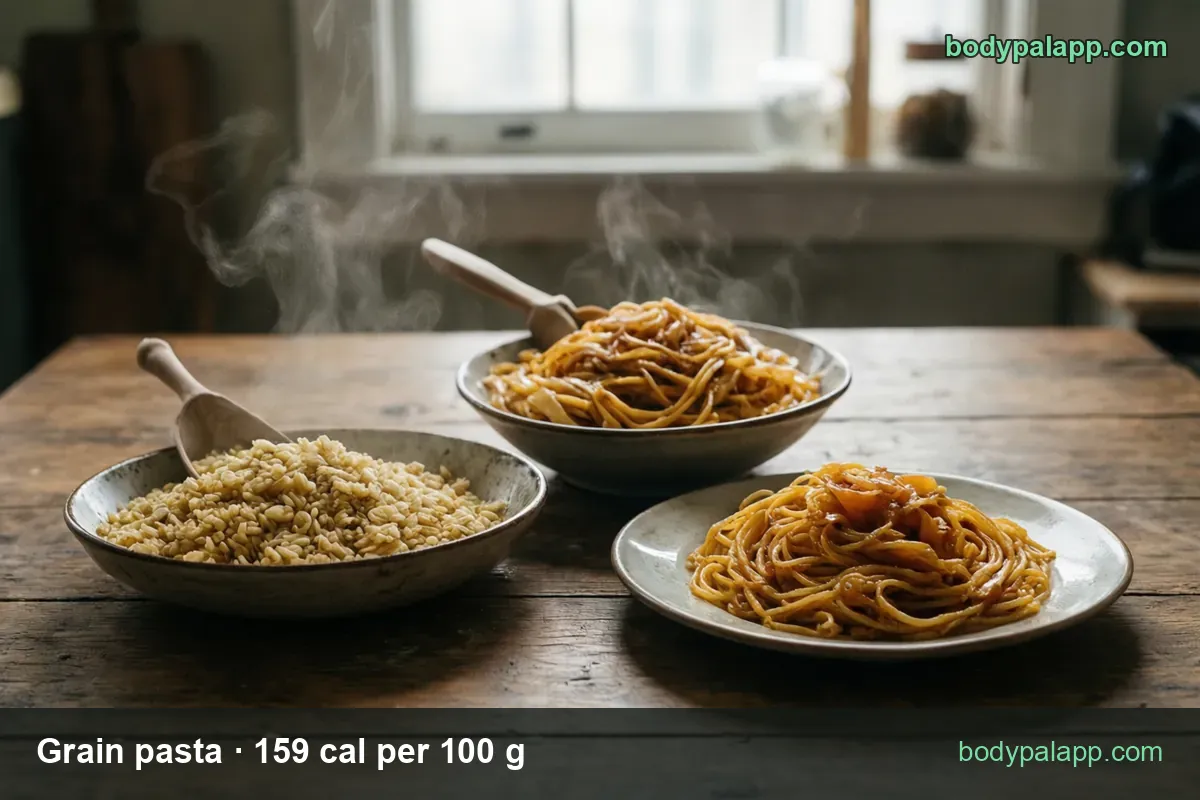
| Whole grain pasta, cooked, unsalted | 159 kcal | 1 cup (140 g) | 223 kcal |
| Whole grain pasta, dry | 362 kcal | 2 oz (56 g) | 203 kcal |
| Whole grain pasta, enriched semolina, cooked | 156 kcal | 1 cup (140 g) | 218 kcal |
| Whole grain pasta boiled in salted water | 148 kcal | 1 cup (140 g) | 207 kcal |
| Whole grain pasta with tomato sauce | 116 kcal | 1 cup (250 g) | 290 kcal |
| Whole grain pasta with cream sauce | 163 kcal | 1 cup (250 g) | 408 kcal |
Dry versus cooked. This is the single biggest trap on the page. Dry whole grain pasta is 362 calories per 100 g; cooked, it is 159. Nothing burned off. The pasta simply took on water and more than doubled its weight, so the same calories are spread across more grams. Two ounces dry, 56 g, is 203 calories by our own scaling of that 362 figure, and it swells to roughly a cup on the plate. USDA's cooked record puts that cup at 223, and the small gap is two separate records talking, not calories appearing out of the pot.
Salted water. Boiling in salted water drops the calorie count slightly, to 207 per cup, because a little more water stays in the strands. What it adds is sodium: 235 mg per 100 g against 6 mg unsalted, so 329 mg in a cup. Still modest, but no longer a rounding error.
Sauce. Tomato sauce lowers calories per gram, to 116 per 100 g, since the sauce is mostly water. The serving grows instead, and a 250 g cup lands at 290 calories with 850 mg of sodium, 37% of the Daily Value in one bowl. Cream sauce goes the other way: 163 calories per 100 g and 408 in the same cup, with 24.4 g of fat and 11.0 g of saturated fat, which is 55% of the day's limit.
Boxes on the shelf. Dry whole grain and ancient grain brands cluster tightly. Barilla Whole Grain Angel Hair is 357 calories per 100 g, Jovial's einkorn penne and spaghetti 351, truRoots Ancient Grain 357, and Raley's 100% Whole Grain the lightest at 321. Every one of them prints 180 to 200 calories on its 2 oz dry serving, so the brand you pick barely matters. The scoop size does.
Fiber is the row that stands out
Whole grain pasta earns its name in exactly one column. A cooked cup delivers 6.4 g of fiber, 23% of the Daily Value of 28 g, while total fat sits at 3% and saturated fat at 2%. Dry, the same pasta is 10.1 g of fiber per 100 g. Few everyday dinner starches quietly hand over a quarter of the day's fiber at 223 calories.
Protein is the quiet second place: 8.1 g per cup, 16% of the Daily Value, and 13.51 g per 100 g dry. That is not a protein food, but it is meaningfully more than a plain side of rice or potatoes contributes at the same calorie count.
The Dietary Guidelines for Americans ask that at least half of daily grains be whole grains, and MyPlate counts a cooked cup of pasta as two ounce-equivalents from the grains group. A cup of this pasta covers a solid share of that target in one move. If you are watching sodium, the plain boiled version at 8 mg a cup is as clean a base as a starch gets, and everything after that comes from the pot and the jar.
How does grain pasta compare?
| Dish | Per 100 g | US serving | Calories |
|---|---|---|---|
| Grain pasta, cooked plain | 159 kcal | 1 cup, 140 g | 223 kcal |
| Pasta with tomato-based sauce, restaurant | 160 kcal | 1 cup, 250 g | 400 kcal |
| Pasta with cream sauce and seafood | 165 kcal | 1 cup, 250 g | 413 kcal |
| Pasta with tomato sauce, seafood and vegetables, restaurant | 164 kcal | 1 cup, 250 g | 410 kcal |
Our take: per gram these four are almost the same food. Grain pasta is the lightest of the four at 159 per 100 g, but only by a single calorie against the restaurant tomato plate at 160, and the two seafood dishes sit within six. The gap on the plate has nothing to do with density and everything to do with volume, because a sauced restaurant cup weighs 250 g against 140 g for drained pasta. If you want the lower number, order the same dish and eat less of it, or cook the pasta plain at home and dose the sauce yourself. Swapping to whole grain buys you fiber, not fewer calories.
Most popular grain pasta brands in the United States
Ranked by how widely each product appears among foods sold in the United States, from the BodyPal food database of over 3.3 million products. Calories are the figures printed on each Nutrition Facts label, checked against USDA FoodData Central.
| Product | Calories (per 100 g) |
|---|---|
| Barilla Whole Grain Angel Hair | 357 cal |
| Jovial Einkorn Whole Wheat Penne | 351 cal |
| Jovial Einkorn Whole Wheat Spaghetti | 351 cal |
| truRoots Ancient Grain Pasta | 357 cal |
| Eating Right Whole Grain Pasta | 357 cal |
| Raley's 100% Whole Grain Pasta | 321 cal |
Brand popularity: BodyPal food database. Nutrition: manufacturer labels / USDA FoodData Central.
Grain pasta FAQs
How many calories are in a cup of whole grain pasta?
A 1-cup cooked serving of 140 g holds 223 calories, since whole grain pasta runs 159 calories per 100 g once boiled and drained. That cup also carries 8.1 g of protein and 6.4 g of fiber. Sauce is extra: a tomato-sauced cup of 250 g reaches 290 calories.
How many calories in 2 oz of whole grain pasta?
Two ounces of dry whole grain pasta, 56 g, is 203 calories, our own arithmetic from the USDA figure of 362 calories per 100 g for the dry record. Cooked, an ounce is far lighter: 28 g of boiled pasta is only 45 calories, because most of the extra weight is water.
How much dry pasta is one serving?
Two ounces, 56 g, is the standard dry serving, and it comes to 203 calories. Box labels agree closely: Barilla Whole Grain Angel Hair lists 200 calories per 56 g and Jovial's einkorn penne the same. That dry handful boils up to roughly one cup on the plate.
Does cooking pasta change its calories?
No calories are created or lost, but the number per 100 g falls from 362 dry to 159 cooked, because the pasta absorbs water and more than doubles in weight. Weigh it dry and use the box figure; weigh the drained plate and use 159 per 100 g. Never both.
How many calories in whole grain pasta with tomato sauce?
A 1-cup serving of 250 g is 290 calories, from the USDA figure of 116 calories per 100 g for the ready-to-heat version. The sauce lowers calories per gram but raises sodium sharply: that single cup carries 850 mg, which is 37% of the Daily Value.
How much protein is in whole grain pasta?
A cooked cup of 140 g gives 8.1 g of protein, 16% of the Daily Value, from 5.82 g per 100 g. Dry, the same pasta is 13.51 g per 100 g, so a 2 oz portion supplies about 7.6 g before it ever meets the water. Not a protein food, but not nothing.
Is whole grain pasta good for weight loss?
A cup is 223 calories with 6.4 g of fiber, 23% of the Daily Value, so it fills a plate for far less than the sauced restaurant dishes at 400 or more per cup. If you are managing calories, the portion size and the sauce decide the outcome, not the grain.
Is ancient grain pasta the same as whole grain pasta?
Not quite: ancient grain blends run 351 to 357 calories per 100 g dry, essentially the same as whole wheat pasta at 362. They lean on einkorn, quinoa or spelt instead of whole wheat, but truRoots Ancient Grain Pasta and Jovial's einkorn both print 200 calories on a 2 oz dry serving.
Similar foods
- Penne pasta — 169 cal per cup
- Pasta — 168 cal per cup penne
- Baba ganoush — 110 cal for 1/4 cup
- Rice — 205 cal per cup, cooked
- Prosciutto — 55 cal for 3 thin slices
- Quinoa — 222 cal per cup cooked
Count it without the math
Point the camera at the bowl and BodyPal counts the pasta for you, sauce and all.


How long does it take to burn off grain pasta?
A 1-cup (140 g) cooked serving is 223 kcal. Enter your weight and the amount you ate to see how long it takes you to burn that off:
lb
| Activity | Time to burn 223 kcal |
|---|---|
| Walking, brisk | 45 min |
| Cycling, moderate | 28 min |
| Swimming, moderate | 32 min |
| Jogging | 26 min |
| Weight training, moderate | 50 min |
Times are for a 155 lb adult at a steady pace; change the weight to see yours. The amount is set to the portion in the text (140 g); change it to what you actually ate. BodyPal works this out from your steps automatically.
Burning it off is one side of it. The other is knowing your number: work out how many calories you need a day, with macros and a goal date.