
How many calories are in wheat pasta?
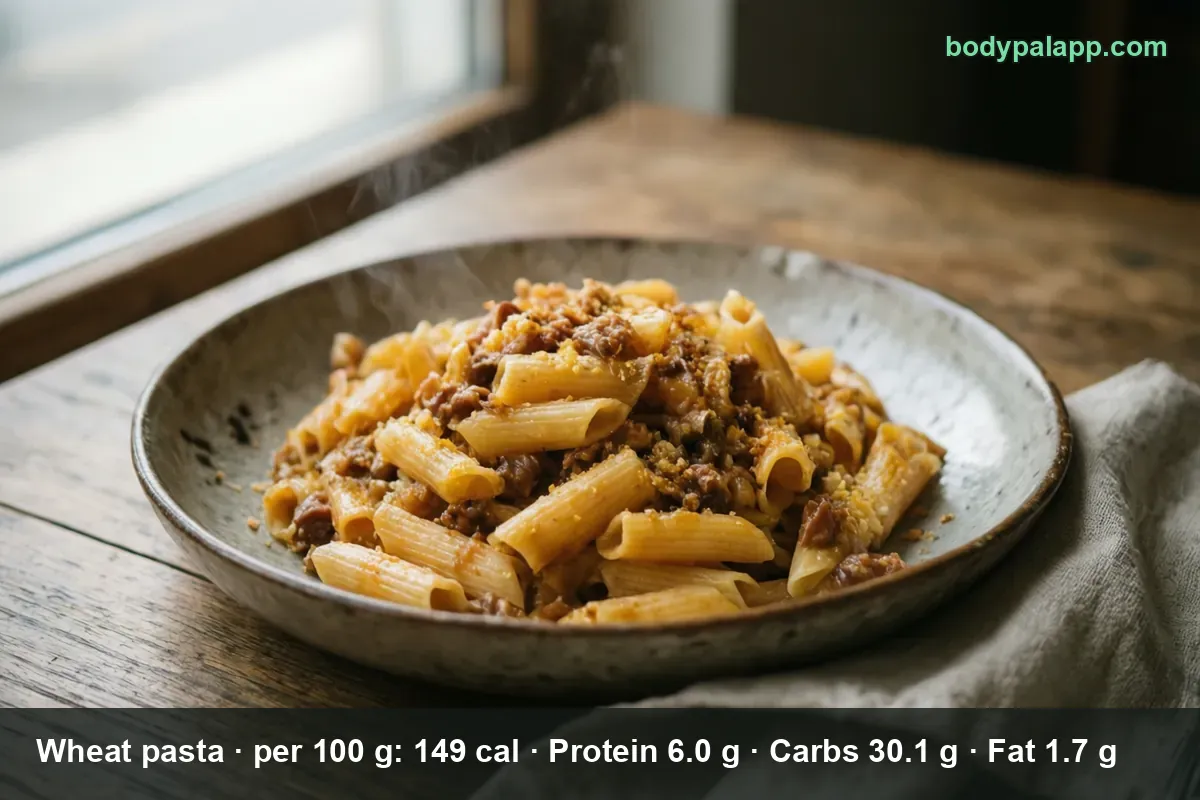
A 1-cup serving of cooked whole wheat penne weighs 97 g and carries 145 calories. Cooked, it runs 149 calories per 100 g, the lowest figure of any pasta row on this page. Dry, before it ever meets the water, that same pasta is 352 per 100 g.
On this page
- Wheat pasta quick facts
- US servings from one ounce to a packed cup
- Dry versus cooked and the 51 percent blends
- Fiber is the row that changes the meal
- How does wheat pasta compare?
- Most popular wheat pasta brands
- Wheat pasta FAQs
Wheat pasta quick facts
The number people actually want is for the pasta on the plate, not the pasta in the box. So the numbers here come from SR Legacy 168910, "Pasta, whole-wheat, cooked" — 100 percent whole wheat, boiled, no salt added. Two nearby USDA records (168916 and 172024) are labeled whole grain but are only 51 percent whole wheat with semolina making up the rest; they get their own section further down rather than being blended into the headline figure.
The serving is one cup of cooked penne, 97 g, which is what a normal restaurant side or a home portion of short pasta weighs. Long pasta measures heavier in the same cup, and that gap is worth more calories than the brand you buy.
| Nutrient | Per 100 g | Per 1 cup penne (97 g) | % Daily Value |
|---|---|---|---|
| Calories | 149 | 145 | — |
| Total fat | 1.71 g | 1.7 g | 2% |
| Saturated fat | 0.24 g | 0.2 g | 1% |
| Carbohydrate | 30.07 g | 29.2 g | 11% |
| Dietary fiber | 3.9 g | 3.8 g | 14% |
| Total sugars | 0.75 g | 0.7 g | — |
| Protein | 5.99 g | 5.8 g | 12% |
| Sodium | 4 mg | 4 mg | 0% |
% Daily Value is based on a 2,000-calorie diet.
Verified nutrition data
Numbers on this page come from USDA FoodData Central, the U.S. Department of Agriculture’s food composition database, and from manufacturer labels where a branded product is named. Last verified September 2026. How we verify our data →
There is no added sugars row above because the SR Legacy edition of this record does not carry that field at all — boiled pasta with nothing on it has none to declare. Cholesterol is 0 mg, as you would expect from a food made of flour and water. Potassium is 96 mg per 100 g, or 93 mg in the cup, which is 2% of the Daily Value. The Daily Values used for the percentages are the FDA's.
US servings from one ounce to a packed cup
| Serving | Weight | Calories |
|---|---|---|
| 1 oz cooked | 28 g | 42 kcal |
| 1 cup penne, cooked | 97 g | 145 kcal |
| 1 cup elbows, cooked | 117 g | 174 kcal |
| 1 cup spaghetti, not packed | 117 g | 174 kcal |
| 1 cup spaghetti, packed into the cup | 151 g | 225 kcal |
| Per 100 g | 100 g | 149 kcal |
Four of those are USDA household measures for this record: the penne cup, the elbow cup, and both spaghetti cups. The 1 oz line is our own arithmetic from the USDA 100 g figure, not a USDA serving, and it is there because ounces are how a lot of people weigh leftovers.
Look at the spread. The word "cup" covers everything from 97 g to 151 g here, a difference of 80 calories for the same word on the same page. Short shapes leave air between them, long strands packed down do not. If you log pasta by the cup and never by weight, that is where the drift comes from, and it compounds fast at five dinners a week.
Dry versus cooked and the 51 percent blends
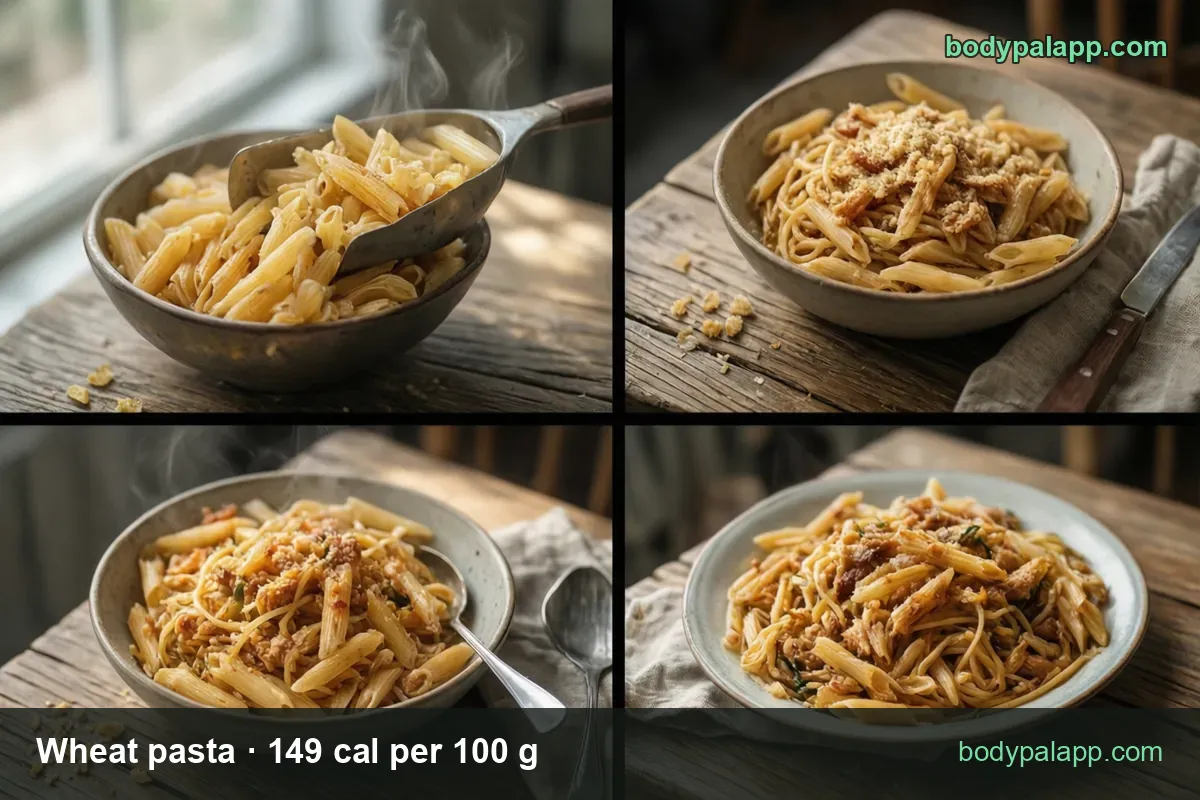
Dry pasta is the same food with the water removed, so per 100 g it is more than twice as dense: 352 calories dry against 149 cooked. The calories do not change in the pot. The weight does. Two ounces of dry whole wheat pasta, 56 g, is about 197 calories by our arithmetic from the USDA 100 g figure, and that becomes roughly 130 g of cooked pasta in the bowl. Same 197 calories, twice the number on the scale.
| Version | USDA record | Per 100 g | Typical serving | Calories |
|---|---|---|---|---|
| Whole-wheat, cooked | 168910 | 149 kcal | 1 cup penne, 97 g | 145 kcal |
| Whole-wheat, dry | 169738 | 352 kcal | 1 cup penne dry, 95 g | 334 kcal |
| 51% whole grain, unenriched semolina, cooked | 168916 | 159 kcal | 1 cup penne, 97 g | 154 kcal |
| 51% whole grain, enriched semolina, cooked | 172024 | 156 kcal | 1 cup penne, 97 g | 151 kcal |
| 51% whole grain, unenriched semolina, dry | 168915 | 362 kcal | 1 cup penne dry, 95 g | 344 kcal |
| 51% whole grain, enriched semolina, dry | 172025 | 361 kcal | 1 cup penne dry, 95 g | 343 kcal |
The blends are the surprise. A box marked whole grain that is 51 percent whole wheat and 49 percent semolina comes out at 159 calories per 100 g cooked for the unenriched version and 156 for the enriched one — both a little above the 100 percent whole wheat record, not below it. The blend absorbs less water, so a cooked cup of it is denser. Six to nine calories a cup is nothing to reorganize a diet around, but it does mean "whole grain" on the front of the box is not a calorie discount.
Brand boxes tell a third story. Barilla's whole wheat lines — elbows, penne, rotini, angel hair — all run 321 calories per 100 g dry and label a 2 oz (56 g) serving at 180 calories. Jovial's organic einkorn whole wheat fusilli and spaghetti are heavier at 351 per 100 g, 200 calories for their 2 oz (57 g) serving. The USDA generic dry record sits at 352, so a Barilla box and the USDA row disagree by about 17 calories on the same 2 oz of dry pasta. Log the box you own if you have it in front of you.
Fiber is the row that changes the meal
One cup of cooked whole wheat pasta gives 3.8 g of fiber, 14% of the Daily Value of 28 g. That is the single line that separates this food from white pasta, and it arrives at a cost of 4 mg of sodium, which rounds to 0% DV. Every milligram of sodium in a plate of pasta comes from the salt in the water and whatever goes on top; the noodles bring essentially none. If you are watching sodium, the sauce is the thing to read, not the box.
Protein is 5.8 g in the cup, 12% of the Daily Value. It is real but modest — a cup of pasta is not a protein source, and pairing it with beans, meat, or cheese is what makes it a meal rather than a side. On the grain side, MyPlate asks that at least half your grains be whole grains, and swapping a white box for a whole wheat one is one of the cheapest ways to move that number without touching your calorie total.
How does wheat pasta compare?
| Pasta, cooked | Per 100 g | 1 oz (28 g) | 1 cup penne (97 g) |
|---|---|---|---|
| Whole wheat | 149 kcal | 42 kcal | 145 kcal |
| Gluten-free, corn and quinoa flour | 152 kcal | 43 kcal | 147 kcal |
| Enriched white pasta, no added salt | 158 kcal | 44 kcal | 153 kcal |
| Protein-fortified spaghetti | 164 kcal | 46 kcal | 159 kcal |
The 1 oz column comes from USDA servings for the three comparison records; the whole wheat 1 oz figure is our own arithmetic from its 100 g number. The 1-cup column for the three comparison pastas is our own arithmetic from their 100 g figures, scaled to the 97 g penne cup, so the four rows can be read against each other.
Our take: whole wheat is the lightest of the four per 100 g, but by 8 calories a cup against ordinary white pasta — a rounding error next to what you put on top. Pick it for the 3.8 g of fiber and the fuller feeling, not as a calorie play. If protein matters more to you than fiber, the fortified spaghetti carries 8.86 g per 100 g against 5.99 g here, and pays 15 calories per 100 g for it. Gluten-free corn and quinoa pasta lands almost exactly where whole wheat does on calories but drops to 3.23 g of protein, the weakest row in the table.
Most popular wheat pasta brands in the United States
Ranked by how widely each product appears among foods sold in the United States, from the BodyPal food database of over 3.3 million products. Calories are the figures printed on each Nutrition Facts label, checked against USDA FoodData Central.
| Product | Calories (per 100 g) |
|---|---|
| Barilla Whole Grain Elbows Whole Wheat Pasta | 321 cal |
| Barilla Whole Grain Whole Wheat Angel Hair | 321 cal |
| Jovial Organic Einkorn Whole Wheat Fusilli | 351 cal |
| Jovial Organic Einkorn Whole Wheat Spaghetti | 351 cal |
| Barilla Rotini Whole Wheat Pasta | 321 cal |
| Barilla Whole Grain Penne Whole Wheat Pasta | 321 cal |
Brand popularity: BodyPal food database. Nutrition: manufacturer labels / USDA FoodData Central.
Wheat pasta FAQs
How many calories are in 1 cup of cooked whole wheat pasta?
145 calories for a 1-cup serving of cooked penne, which USDA weighs at 97 g. A cup of cooked elbows or loose spaghetti is heavier at 117 g and comes to 174 calories, and spaghetti packed down into the cup reaches 151 g and 225 calories.
How many calories in 2 oz of dry whole wheat pasta?
About 197 calories, our own arithmetic from the USDA dry figure of 352 per 100 g rather than a USDA serving. Barilla's whole wheat boxes label the same 2 oz at 180 calories because their product tests at 321 per 100 g. Use the box in your kitchen when you have it.
Is whole wheat pasta lower in calories than regular pasta?
Slightly — cooked whole wheat is 149 calories per 100 g against 158 for enriched white pasta with no added salt, a gap of 9 calories per 100 g, or about 8 per cup. The real difference is fiber, 3.9 g per 100 g here, not the calorie count.
How much fiber is in whole wheat pasta?
3.9 g per 100 g cooked, which is 3.8 g in a 1-cup serving and 14% of the 28 g Daily Value. One dinner portion covers roughly a seventh of the day. The 51 percent whole grain blends actually test higher, at 4.5 to 4.6 g per 100 g cooked.
How much protein is in a cup of whole wheat pasta?
5.8 g in a 1-cup serving of 97 g, which is 12% of the Daily Value of 50 g. Per 100 g it is 5.99 g. Protein-fortified spaghetti carries 8.86 g per 100 g if that matters more to you than the fiber whole wheat brings.
Does whole wheat pasta have sodium?
Almost none — boiled without salt it holds 4 mg per 100 g, and a 1-cup serving is also about 4 mg, which is 0% of the 2,300 mg Daily Value. Anything meaningful on your plate came from salted cooking water, jarred sauce, or cheese rather than the pasta.
How many calories in 100 g of cooked whole wheat pasta?
149 calories per 100 g cooked, with 30.07 g of carbohydrate, 5.99 g of protein, 1.71 g of fat and 3.9 g of fiber. That is the weight most kitchen scales show for a modest side portion, a little more than the 97 g USDA counts as one cup of penne.
Does cooking pasta change its calories?
No — cooking changes the weight, not the calories: dry whole wheat pasta is 352 calories per 100 g; the same pasta boiled is 149 per 100 g because it has taken on water. Two ounces dry, about 197 calories, becomes roughly 130 g on the plate carrying those same 197 calories.
Similar foods
- Pasta — 168 cal per cup penne
- Penne pasta — 169 cal per cup
- Rice — 205 cal per cup, cooked
- Quinoa — 222 cal per cup cooked
- Baba ganoush — 110 cal for 1/4 cup
- Prosciutto — 55 cal for 3 thin slices
Count it without the math
Point the camera at the bowl and BodyPal counts the pasta for you, cup, sauce and all.


How long does it take to burn off wheat pasta?
A 1-cup (97 g) serving of cooked penne is 145 kcal. Enter your weight and the amount you ate to see how long it takes you to burn that off:
lb
| Activity | Time to burn 145 kcal |
|---|---|
| Walking, brisk | 29 min |
| Cycling, moderate | 18 min |
| Swimming, moderate | 21 min |
| Jogging | 17 min |
| Weight training, moderate | 32 min |
Times are for a 155 lb adult at a steady pace; change the weight to see yours. The amount is set to the portion in the text (97 g); change it to what you actually ate. BodyPal works this out from your steps automatically.
One food is easy to picture; a whole day is harder. See how many calories you need a day and what a deficit actually looks like.