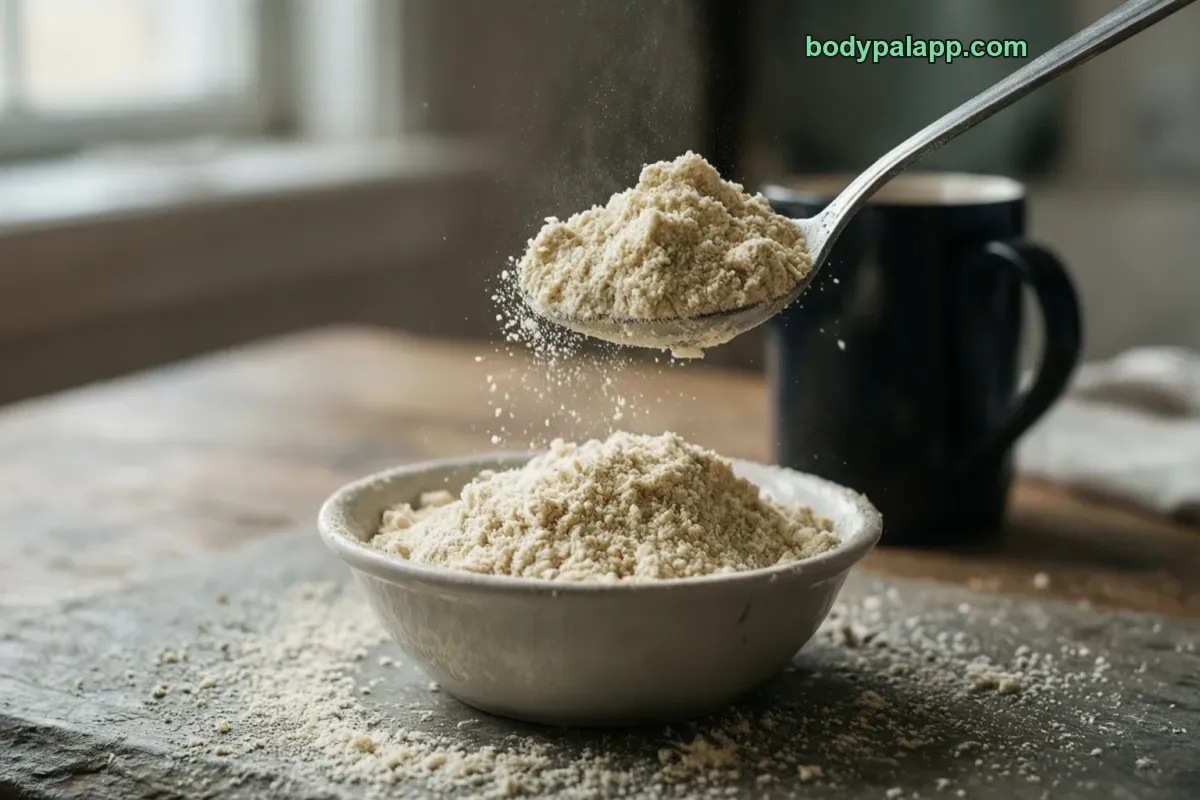
Coffee creamer powder calories come to 16 for one 3 g packet and 529 per 100 g. The packet looks harmless, but the powder itself is one of the densest things in the pantry: 55% of its calories come from fat, mostly saturated, and protein barely registers. What decides your total is how many packets or scoops go in.
16kcal
1 packet · 3 g, powder, non-dairy
2%protein
0.1 gProtein
2 gCarbs
1 gFat
How to burn off 16 kcal
—Walking, brisk
—Jogging
—Cycling, moderate
—Swimming
Skip the math. BodyPal counts these calories from your steps and workouts automatically.
Nutrition facts
Powder, non-dairy · per 3 g
Calories
16 kcal
Protein
0.1 g
Carbohydrate
1.8 g
Fat
1 g
Saturated fat
0.6 g
Cholesterol
0 mg
Sodium
4 mg
Potassium
20 mg
Iron
0 mg
Source: USDA FoodData Central
🛡️
Verified nutrition data
Numbers on this page come from USDA FoodData Central, the U.S. Department of Agriculture’s food composition database, and from manufacturer labels where a branded product is named. Last verified September 2026. How we verify our data →
Coffee creamer powder: calories, protein and sodium by serving
Percent of daily value uses the FDA reference of 2,000 kcal a day.
Serving
kcal
Protein
Carbs
Fat
Sodium
% DV kcal
1 packet (3 g)
16
0.1 g
1.8 g
1 g
4 mg
1%
Heaping spoonful (4 g)
21
0.1 g
2.4 g
1.3 g
5 mg
1%
1 cup (94 g)
497
2.3 g
55.7 g
30.9 g
117 mg
25%
100 g
529
2.5 g
59.3 g
32.9 g
124 mg
26%
3 × 1 packet (3 g)
48
0.2 g
11 mg
5 × 1 packet (3 g)
79
0.4 g
19 mg
Five packets turn 16 calories into 79
One 3 g packet holds 16 calories, 1 g of fat and 1.8 g of carbs. That is about 1% of a 2000-calorie daily value, small enough that most people never count it. A heaping spoonful from the canister is 4 g and 21 calories, so scooping instead of tearing a packet adds a little without you noticing.
The trouble is repetition. Two packets come to 32 calories, three reach 48, and five land at 79. If you drink several cups a day and lighten each one, the creamer can quietly become one of the larger line items in your coffee habit, ahead of the coffee itself.
At the far end, a full cup of powder weighs 94 g and carries 497 calories, about 25% of the daily value. Nobody stirs in a cup at once, but a canister emptied over a week tells the same story. Counting packets, or leveling the spoon, is the simplest way to keep the number honest.
Fat supplies more than half of every calorie
Per 100 g, coffee creamer powder has 32.9 g of fat, 59.3 g of carbohydrate and just 2.5 g of protein. Split by calories, that is 55% fat, 44% carbs and 2% protein. It is built to add body and a creamy mouthfeel, and fat is what delivers both.
The carbohydrate side is mostly not sugar. Only 7.8 g of the 59.3 g is listed as sugars per 100 g, which works out to 0.2 g in a single packet. The rest is starch-type carbohydrate that dissolves smoothly into hot coffee. Fiber is 0 g.
Protein is close to nothing at 0.1 g per packet, even though the product is meant to stand in for cream or milk. If you rely on a splash of dairy for a little protein in your morning cup, this swap removes it. Think of the powder as fat and carbs with a creamy texture, not as a milk product.
Saturated fat is the row to watch
Of the 32.9 g of fat in 100 g of powder, 19.1 g is saturated. The daily value used on this page for saturated fat is 20 g, so by weight the powder is very heavily skewed toward that one type of fat. In a single packet the absolute amount is small, but the proportion does not change as the packets pile up.
Sodium and cholesterol are not the concern here. A packet has 4 mg of sodium and 0% of the daily value, five packets reach just 19 mg, and cholesterol is 0 mg because this is a non-dairy product. Sugar is also modest at 0.2 g per packet.
So if you track one number beyond calories, make it saturated fat. Someone using one packet a day can mostly ignore it. Someone using three to five packets in several cups, on top of other foods rich in saturated fat, may want to look at the whole day rather than the coffee alone.
Treat it as a flavor, not a food
Coffee creamer powder adds calories without adding fullness. With 0 g of fiber and almost no protein, the 16 calories in a packet do nothing to carry you to the next meal. That is fine for a flavor accent, but it means breakfast still needs to come from somewhere else.
If your coffee comes with food, pair it with something that brings the protein and fiber the creamer lacks, such as eggs, yogurt, oats or fruit. If the coffee is the whole breakfast, the creamer is effectively empty energy, and a single packet makes more sense than three.
Shelf-stable options like Coffee Mate Original Powdered Coffee Creamer Packets are convenient at work or when traveling, which is also where the extra packets tend to sneak in. BodyPal can log your cup from a photo, which makes it easier to see how many creamers ended up in it.
How does coffee creamer powder compare?
Here is how coffee creamer powder stacks up against liquid creamers, per 100 g and per usual serving.
Verdict: Per 100 g the powder is far denser at 529 calories, against 251 for french vanilla liquid and 136 for a creamer pod, but a 3 g packet still comes in lower at 16 calories than a 15 g pod at 20 or a tablespoon of french vanilla at 38. For the fewest calories in a single cup pick one powder packet; if you tend to use several, a single pod is the easier portion to cap.
Most popular coffee creamer powder brands in the United States
Labels round tiny 2 to 3 g servings to whole calories, so their per 100 g values read a little lower than the 529 above. Source: manufacturer labels / USDA FoodData Central.
Coffee creamer powder FAQs
How many calories are in one packet of powdered coffee creamer?
A 3 g packet has about 16 calories, and a heaping 4 g spoonful has about 21.
Is powdered coffee creamer good for weight loss?
One packet adds only 16 calories and 1.0 g of fat, but 100 g of the powder holds 529 calories and 32.9 g of fat.
Powdered vs liquid flavored coffee creamer: which has fewer calories?
Per 100 g the powder has 529 calories versus 251 for flavored liquid creamer, yet a 3 g packet (16 calories) is lighter than a 15 g liquid container (38 calories).
How much fat and sugar is in powdered coffee creamer?
Per 100 g it has 32.9 g fat, 59.3 g carbs and 7.8 g sugar. One 3 g packet has 1.0 g fat and 1.8 g carbs.
How many calories are in a spoonful of powdered coffee creamer?
A heaping spoonful of about 4 g has 21 calories, with 1.3 g of fat and 2.4 g of carbs. A level spoon lands closer to the 16 calories of a 3 g packet.
How many calories are in a cup of powdered coffee creamer?
One cup of powder, about 94 g, contains 497 calories, which is roughly 25% of a 2000-calorie daily value. It also carries 30.9 g of fat and 55.7 g of carbs.
How much saturated fat is in powdered coffee creamer?
Coffee creamer powder has 19.1 g of saturated fat per 100 g, out of 32.9 g total fat. A single 3 g packet holds only a small share of that, but it adds up across packets.
Does powdered coffee creamer have cholesterol or much sodium?
It has 0 mg of cholesterol per 100 g and 124 mg of sodium. One packet contributes just 4 mg of sodium, which rounds to 0% of the daily value.
Does powdered coffee creamer have any protein?
Barely. A packet has 0.1 g of protein, and protein supplies only about 2% of the calories. Even 100 g of powder holds just 2.5 g.