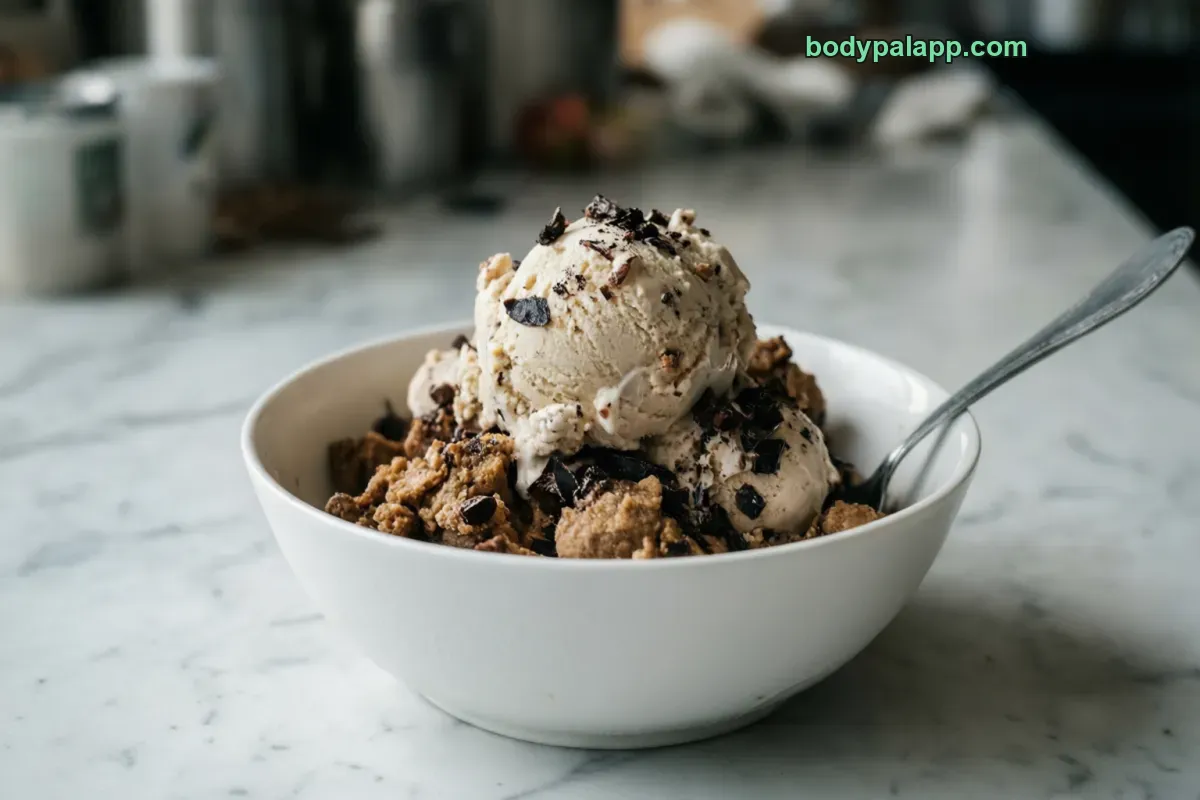
Ben & Jerry's cookie dough calories come to 280 for a ½ cup (106 g) scoop and 264 per 100 g. Fat supplies half of those calories, protein only 6%. The real story is portion size: the label's ½ cup is smaller than most bowls, and the total climbs fast once you go back for more.
280kcal
1 ½ cup · 106 g, packaged, per label
6%protein
4 gProtein
32 gCarbs
16 gFat
How to burn off 280 kcal
—Walking, brisk
—Jogging
—Cycling, moderate
—Swimming
Skip the math. BodyPal counts these calories from your steps and workouts automatically.
Nutrition facts
Packaged, per label · per 106 g
Calories
280 kcal
Protein
4 g
Carbohydrate
32 g
Fat
16 g
Saturated fat
9 g
Cholesterol
75 mg
Sodium
55 mg
Source: USDA FoodData Central
🛡️
Verified nutrition data
Numbers on this page come from USDA FoodData Central, the U.S. Department of Agriculture’s food composition database, and from manufacturer labels where a branded product is named. Last verified September 2026. How we verify our data →
Ben & Jerry's cookie dough ice cream: calories, protein and sodium by serving
Percent of daily value uses the FDA reference of 2,000 kcal a day.
Serving
kcal
Protein
Carbs
Fat
Sodium
% DV kcal
½ cup (106 g)
280
4 g
32 g
16 g
55 mg
14%
1 serving (138 g)
380
5 g
43 g
20 g
99 mg
19%
100 g
264
3.8 g
30.2 g
15.1 g
52 mg
13%
3 × ½ cup (106 g)
840
12 g
165 mg
5 × ½ cup (106 g)
1,399
20 g
276 mg
A ½ cup is 280 calories, and few bowls stop there
The label serving is ½ cup, or 106 g, and it carries 280 calories. That is 14% of a 2000-calorie daily value in a scoop that fits in a coffee mug. A larger 1 serving portion of 138 g reaches 380 calories, or 19% of the day.
Scooping straight from the pint is where totals get away from you. Two ½ cup portions, 212 g, come to 560 calories. Three portions, 318 g, land at 840. Five portions, 530 g, hit 1,399 calories, which is most of a full day for many people in a single sitting.
If you want the treat without the drift, weigh or measure once so you know what 106 g looks like in your own bowl. After that, eyeballing gets much more honest. BodyPal can also log the bowl from a photo if measuring feels like a chore.
Fat supplies half of every calorie
The calorie split is 50% fat, 44% carbs and 6% protein. Per 100 g that works out to 15.1 g of fat, 30.2 g of carbs and just 3.8 g of protein. This is a dessert built on cream, sugar and dough, and the numbers read that way.
Protein is the weak spot. A ½ cup gives 4 g, which is 8% of the daily value, and even the 138 g serving only reaches 5 g. Do not count on it to keep you full the way a dairy snack with more protein would.
Fiber is close to zero too, at 0.9 g per 100 g and about 1 g in either serving. With little protein and little fiber, most of what you get is quick energy from sugar and fat. That is fine for a treat, as long as you treat it as one.
Saturated fat is the row to watch
Per 100 g, this ice cream has 8.5 g of saturated fat, set against a daily value of 20 g. More than half of the total fat is saturated, which is typical for a cream-based pint loaded with dough chunks. Eat several portions and that number grows in step with the calories.
Cholesterol is also notable at 71 mg per 100 g, measured against a daily value of 300 mg. Sugar runs to 23.6 g per 100 g, so a ½ cup holds 25 g and the 138 g serving holds 34 g.
Sodium, on the other hand, is a non-issue. A ½ cup has 55 mg, just 2% of the daily value, and even five portions stay at 276 mg. If you watch salt, this is not where your problem lies; if you watch saturated fat or sugar, it is.
How to fit a scoop into a normal day
The simplest move is to decide the portion before the lid comes off. A single ½ cup at 280 calories fits into most days without much rearranging. Plan it the way you would plan any other meal, rather than as an extra that shows up after dinner.
Because protein and fiber are low, pair the scoop with something that brings them. A bowl of fresh berries on the side adds volume and fiber, and a protein-forward dinner earlier in the evening makes the dessert feel like a finish rather than a second meal.
If you keep a pint in the freezer, portioning it into small containers right after buying helps. You still get the cookie dough, just in amounts you chose on purpose.
How does Ben & Jerry's cookie dough ice cream compare?
Here is how Ben & Jerry's cookie dough stacks up against a generic cookie dough ice cream and two salty snacks, per 100 g and per usual serving.
Verdict: Per 100 g, generic cookie dough ice cream is almost the same at 254 calories, but its ½ cup (67 g) serving is only 170 calories, so it wins if you want a smaller default scoop. Crackers and peanut butter pack 494 calories per 100 g with 801 mg sodium, so for a lower-salt sweet bite Ben & Jerry's at 52 mg is the better pick.
Most popular Ben & Jerry's cookie dough ice cream brands in the United States
How many calories are in Ben & Jerry's Cookie Dough ice cream?
A ½ cup (106 g) has about 280 calories, and a 138 g label serving has about 380.
Is Ben & Jerry's Cookie Dough good for weight loss?
It is calorie dense at 264 calories per 100 g, with 25.0 g of sugar and 16.0 g of fat in a ½ cup.
Ben & Jerry's Cookie Dough vs regular cookie dough ice cream: which has more calories?
Ben & Jerry's Chocolate Chip Cookie Dough has 264 to 275 calories per 100 g depending on the label, which is 280 calories per ½ cup.
How much sugar is in Ben & Jerry's Cookie Dough ice cream?
A ½ cup has about 25.0 g of sugar and 32.0 g of carbs, while protein is only 4.0 g.
How many calories are in two scoops of Ben & Jerry's cookie dough?
Two ½ cup portions, 212 g in total, come to 560 calories. That doubles the label serving and brings 8 g of protein and 110 mg of sodium along with it.
How much fat is in Ben & Jerry's cookie dough ice cream?
A ½ cup has 16 g of fat, and 100 g has 15.1 g, of which 8.5 g is saturated. Fat accounts for 50% of the calories.
How much protein does Ben & Jerry's cookie dough have?
A ½ cup gives 4 g of protein, 8% of the daily value. The 138 g serving gives 5 g. Protein supplies only 6% of the calories, so it is not a filling snack.
Is Ben & Jerry's cookie dough high in sodium?
No. A ½ cup has 55 mg of sodium, only 2% of the daily value, and 100 g has 52 mg. Saturated fat and sugar are the bigger numbers to watch.