
How many calories are in a cucumber?
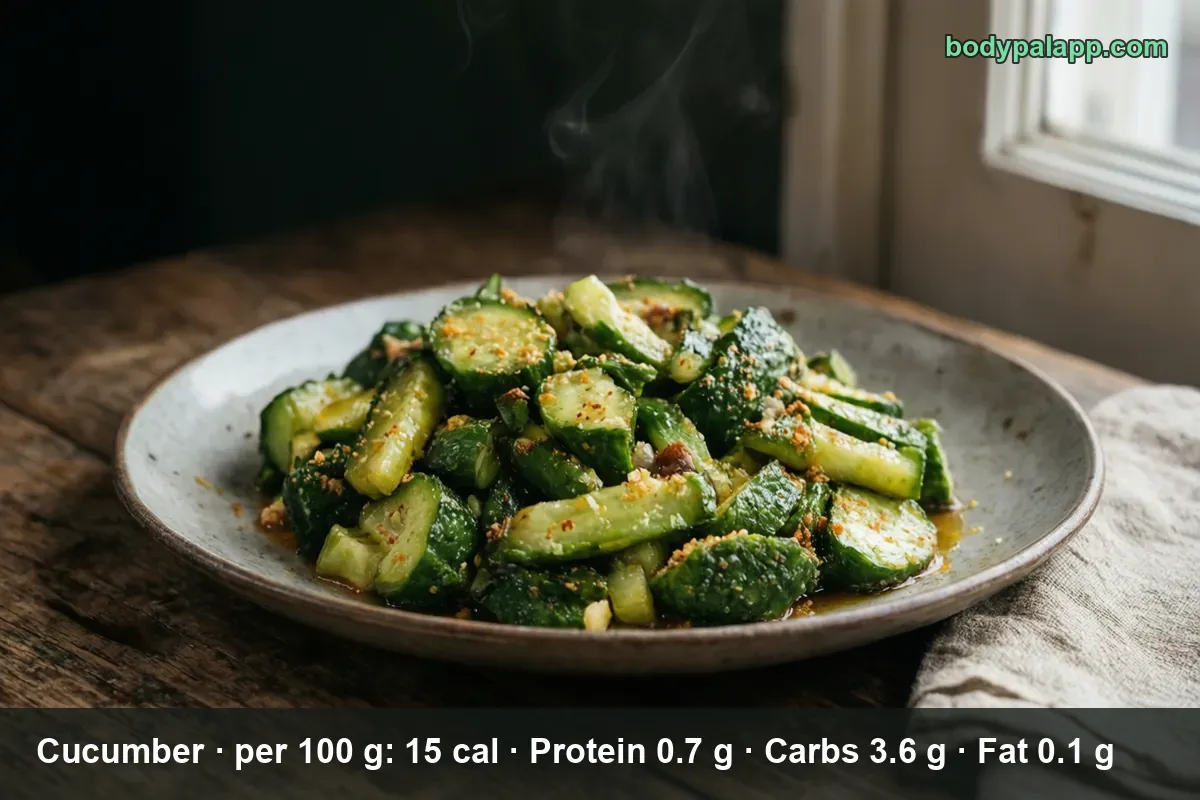
A whole medium cucumber — the 8¼-inch one USDA weighs at 301 g — is 45 calories. A cup of slices (104 g) is 16. One mini or Persian cucumber (65 g) is 10. Per 100 g, cucumber runs 15 calories. Which means the calories in a cucumber depend almost entirely on which cucumber you picked up.
On this page
- Cucumber quick facts
- US serving sizes, from one slice to a pound
- Mini, Persian and English cucumbers
- Peeling costs you vitamin K, not fiber
- Smashed cucumber salad and four other bowls
- Fresh cucumber vs. the pickle jar
- How does cucumber compare?
- Most popular cucumber brands
- FAQ
Cucumber quick facts
These are the numbers for raw cucumber with the skin on — SR Legacy 168409, the record that also carries USDA's official household measures. The serving column is one medium cucumber, 8¼ inches, 301 g.
| Nutrient | Per 100 g | Per 1 medium cucumber (301 g) | % Daily Value |
|---|---|---|---|
| Calories | 15 | 45 | — |
| Total fat | 0.1 g | 0.3 g | <1% |
| Saturated fat | 0.04 g | 0.1 g | <1% |
| Carbohydrate | 3.6 g | 10.9 g | 4% |
| Dietary fiber | 0.5 g | 1.5 g | 5% |
| Total sugars | 1.7 g | 5.0 g | — |
| Protein | 0.7 g | 2.0 g | 4% |
| Sodium | 2 mg | 6 mg | <1% |
| Potassium | 147 mg | 442 mg | 9% |
% Daily Value is based on a 2,000-calorie diet.
Verified nutrition data
Numbers on this page come from USDA FoodData Central, the U.S. Department of Agriculture’s food composition database, and from manufacturer labels where a branded product is named. Last verified September 2026. How we verify our data →
There is no added sugars row here because USDA's analysis of a raw cucumber does not carry one — a vegetable pulled out of the ground has no added sugar to declare. The 5.0 g of total sugars is what the plant made itself.
Three rows beat 5% of the day, which is not what most people expect from a food they treat as free. Potassium is 442 mg, or 9% of the FDA Daily Value of 4,700 mg. Vitamin C comes to 8.4 mg, another 9%. And vitamin K is the surprise: 16.4 µg per 100 g means a whole cucumber delivers 49 µg, about 41% of the 120 µg Daily Value the NIH Office of Dietary Supplements uses. Nearly half a day's vitamin K for 45 calories is a genuinely good trade.
Cucumber is 95.23 g of water per 100 g. For scale, watermelon — the food people name when they mean watery — is 91.45 g. The cucumber wins, and it wins without watermelon's 30 calories per 100 g.
US serving sizes, from one slice to a pound
| Serving | Weight | Calories |
|---|---|---|
| 1 oz | 28 g | 4 |
| ½ cup slices | 52 g | 8 |
| 1 cup sliced | 104 g | 16 |
| Half a cucumber | 150 g | 23 |
| 2 cups sliced | 208 g | 31 |
| 1 medium cucumber, 8¼ in. | 301 g | 45 |
| 1 pound | 454 g | 68 |
Two of those rows come straight from USDA's portion file for 168409: the half-cup of slices at 52 g and the whole 8¼-inch cucumber at 301 g. Everything else is arithmetic on top. A full cup of slices is USDA's half-cup doubled, which is why we print 104 g rather than borrowing a cup weight from a different record.
That distinction matters more than it sounds, because a "cup of cucumber" is not one thing in USDA's own data. A cup of slices off the whole vegetable is 104 g. A cup of sliced peeled cucumber is 119 g. A cup of peeled, chopped cucumber is 133 g. The survey database logs a generic cup at 120 g. Rounds of cucumber stack with air between them; chopped pieces pack down. Same word, 29 g of spread, close to a 30% difference in what actually lands in the bowl.
So the gram weight is printed next to every cup on this page. If you are logging by cup alone, you are logging a range, not a number.
Cucumber on a sandwich barely registers. USDA keeps a separate survey line for exactly that use (FNDDS 2710249, "Cucumber, for use on a sandwich") with a 10 g guideline amount for a regular sandwich and 20 g for a large one. That is 2 to 3 calories. The mayonnaise underneath will outweigh it forty times over.
Mini, Persian and English cucumbers
The mini cucumber is its own search, its own shelf item, and its own USDA line. The survey record FNDDS 2709784 runs 16 calories per 100 g and lists a portion called "1 miniature" at 65 g.
| Cucumber | Weight | Calories |
|---|---|---|
| 1 mini / Persian cucumber | 65 g | 10 |
| 1 regular cucumber (survey record) | 200 g | 32 |
| 1 cup, cut up | 120 g | 19 |
| 1 stick or spear | 10 g | ~2 |
One mini cucumber is 10 calories, 0.4 g of protein, 1.9 g of carbohydrate, 0.3 g of fiber, 1.1 g of sugars, 1 mg of sodium and 110 mg of potassium. Persian cucumbers land on the same line — they are the same short, thin-skinned, small-seeded fruit sold under a different name, and USDA does not separate them. Eat six of them out of the bag and you are at 60 calories, still under a slice of bread.
English cucumbers are the awkward one, and it is worth being straight about why: USDA has no English cucumber record. Not in the foundation set, not in SR Legacy, not in the survey files. Botanically it is the same species as every other cucumber here, grown long and thin-skinned under glass, so it takes the same 15 calories per 100 g and gets counted by weight. A shrink-wrapped English cucumber typically runs 300–400 g, which puts it at 45 to 60 calories. Weigh it once and you will know your own supermarket's number forever.
That gap between record and reality shows up on labels too. BJ's Wellsley Farms defines its serving as one third of a medium cucumber at 99 g, which back-calculates to a 297 g cucumber — within 1.3% of USDA's 301 g. The two sources agree almost exactly on weight. They disagree on calories: the label prints 10 per 100 g, USDA's laboratory analysis says 15. Nutrition labels on fresh produce are voluntary and generously rounded. Weigh the cucumber; don't take the sticker's word for it.
Peeling costs you vitamin K, not fiber
USDA runs two separate analyses of raw cucumber: 168409 with the peel and 169225 peeled. Line them up and the usual advice falls apart.
Fiber goes from 0.5 g with the peel to 0.7 g peeled. The peeled record is fractionally higher, which is the opposite of what you have been told about cucumber skin. Both figures are so small that neither is worth defending, and the honest reading is that peeling does not cost you meaningful fiber.
What it does cost is vitamin K: 16.4 µg per 100 g with the skin, 7.2 µg without — a 56% loss. A peeled medium cucumber drops from roughly 41% of the Daily Value to about 12%. Calories fall too, from 15 to 10 per 100 g, because the skin carries a chunk of the carbohydrate. On the peeled record, USDA's own portions are a 280 g large cucumber at 28 calories and a 201 g medium at 20.
Keep the skin. Not for the fiber, and not because the calorie difference matters — 45 versus about 30 is noise on a day. Keep it because it holds most of the one nutrient a cucumber is actually good at.
Smashed cucumber salad and four other bowls
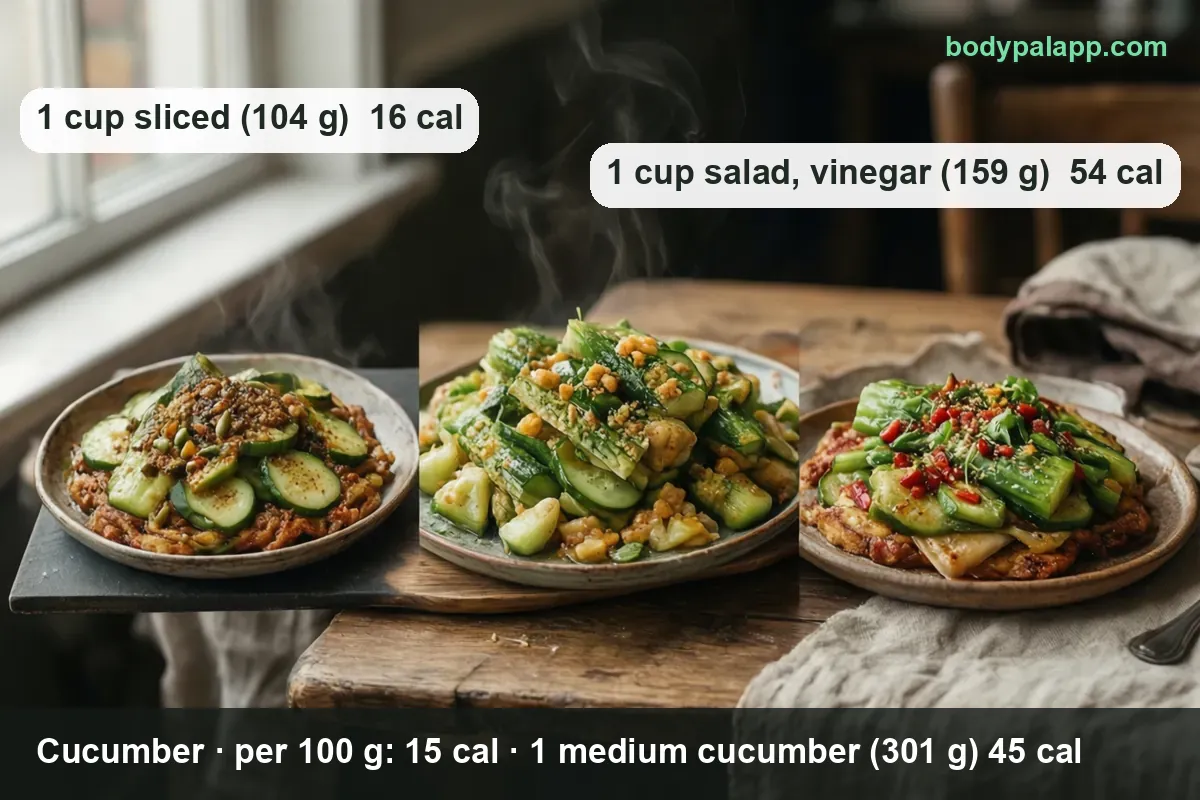
Smash a whole medium cucumber, dress it with a tablespoon of soy sauce, a teaspoon of sesame oil, a tablespoon of cider vinegar and two cloves of garlic, and the plate comes to 105 calories. Here is the part worth staring at: the cucumber is 45 of those calories for 301 g of food, and the single teaspoon of sesame oil is 40 for 4.5 g. Four and a half grams of oil nearly matches an entire vegetable. The soy sauce contributes 8 calories and 879 mg of sodium, taking the whole bowl to 887 mg, or 39% of the day's 2,300 mg.
The same pattern runs through every cucumber salad USDA has measured. Per cup:
| Cucumber salad (per 1 cup) | Weight | Calories | Fat | Sodium |
|---|---|---|---|---|
| With vinegar (FNDDS 2709821) | 159 g | 54 | 0.2 g | 375 mg (16% DV) |
| Cucumber and vegetable namasu (2709818) | 155 g | 87 | 0.3 g | 186 mg (8% DV) |
| With sour cream dressing (2709819) | 133 g | 88 | 6.9 g | 291 mg (13% DV) |
| With Italian dressing (2709820) | 159 g | 191 | 15.8 g | 329 mg (14% DV) |
| Tomato and cucumber, oil and vinegar (2709756) | 159 g | 194 | 16.2 g | 337 mg (15% DV) |
Fifty-four calories to 194 for one cup of the same vegetable — a 3.6× spread, and every calorie of the difference is dressing. The Italian-dressing bowl carries 15.8 g of fat; the vinegar bowl carries 0.2 g. Nothing about the cucumber changed.
Even USDA's cooked cucumber line reads that way. It comes in at 45 calories per 100 g against 15 raw, and the reason is not heat: that record contains 3.2 g of fat per 100 g, compared with 0.11 g in the raw vegetable. Cooking did not add calories. Oil did.
Practical version: build the bowl with vinegar, rice vinegar, lime, chili, herbs and a measured teaspoon of oil, and log the oil separately. It is the only ingredient in a cucumber salad that moves the total.
Fresh cucumber vs. the pickle jar
A whole fresh cucumber carries 6 mg of sodium. Under 1% of the day. Then you brine it.
| Pickle | Serving | Calories | Sodium |
|---|---|---|---|
| Dill or kosher dill | 1 small spear (35 g) | 4 | 283 mg (12% DV) |
| Dill or kosher dill | 1 large, 4 in. (135 g) | 16 | 1,092 mg (47% DV) |
| Dill or kosher dill | 1 cup slices (155 g) | 19 | 1,254 mg (55% DV) |
| Sweet, bread-and-butter | 1 chip (7.5 g) | 7 | 34 mg (1% DV) |
| Sweet, bread-and-butter | 1 cup sliced (153 g) | 139 | 699 mg (30% DV) |
One large dill pickle is still only 16 calories. It is also 1,092 mg of sodium — nearly half a day from a 16-calorie object. A cup of dill slices reaches 1,254 mg, 55% of the limit the CDC works from. Sour pickles go further still, at 1,208 mg per 100 g.
Sweet pickles flip the problem. Bread-and-butter chips are gentle on sodium at 34 mg a chip, but they carry 18.27 g of sugars per 100 g, and a cup of them is 139 calories — three times a whole fresh cucumber. One chip is 7 calories, which is fine. A cup is a dessert.
The rule is short. The cucumber is never the number on your log. The brine, the dressing and the oil are.
How does cucumber compare?
| Food | Per 100 g | US serving | Calories |
|---|---|---|---|
| Cucumber, with peel (this page) | 15 | 1 medium, 8¼ in. (301 g) | 45 |
| Zucchini, with skin, raw | 17 | 1 medium (196 g) | 33 |
| Green bell pepper, raw | 20 | 1 medium (119 g) | 24 |
| Celery, raw | 14 | 1 large stalk, 11–12 in. (64 g) | 9 |
| Dill pickle | 12 | 1 large, 4 in. (135 g) | 16 |
Per 100 g these five foods are indistinguishable: 12 to 20 calories, a range narrower than the rounding on most labels. Per serving they run from 9 to 45 — a fivefold spread. Nothing changed about the vegetables. The servings weigh between 64 g and 301 g.
Our take: stop ranking crisp vegetables by calorie density, because at 12–20 per 100 g the ranking is meaningless. Rank them by how much you will actually eat. Cucumber wins that contest — a 301 g medium is the largest single serving on the table and still the cheapest way to make a plate look full. Celery looks like the winner at 9 calories only because a stalk is a fifth the size. And the pickle is the one to watch, not for its 16 calories but for the 1,092 mg of sodium riding along.
Most popular cucumber brands in the United States
Ranked by how widely each product appears among foods sold in the United States, from the BodyPal food database of over 3.3 million products. Calories are the figures printed on each Nutrition Facts label, checked against USDA FoodData Central.
| Product | Calories (per 100 g) |
|---|---|
| Wellsley Farms Cucumbers (BJ’s) | 10 cal |
| Topline Farms Mini Cucumbers | 15 cal |
| Private Selection Mini Seedless Cucumbers (Kroger) | 15 cal |
| Ahold Mini Cucumbers (Stop & Shop / Giant) | 12 cal |
| Farm to Club Cucumbers | 15 cal |
| United With Earth Persian Cucumber | 15 cal |
Brand popularity: BodyPal food database. Nutrition: manufacturer labels / USDA FoodData Central.
Cucumber FAQs
How many calories are in a whole cucumber?
45 calories for a whole medium cucumber, which USDA measures at 8¼ inches and 301 g, eaten raw with the skin on. That works out to 15 calories per 100 g, with 10.9 g of carbohydrate, 1.5 g of fiber and 2 g of protein. It also carries 442 mg of potassium, 9% of the Daily Value.
How many calories are in a mini cucumber?
10 calories for one 65 g mini cucumber, using USDA's survey record for cucumber at 16 calories per 100 g. Each one brings 0.4 g of protein, 1.9 g of carbohydrate, 0.3 g of fiber and 110 mg of potassium. A six-pack snack bag of minis comes to roughly 60 calories in total.
How many calories are in Persian cucumbers?
10 calories each, at a typical 65 g. USDA does not keep a separate Persian cucumber record — they share the mini cucumber line, since they are the same short, thin-skinned, small-seeded type. Two Persian cucumbers sliced into a salad add about 20 calories and 2 mg of sodium.
How many calories are in an English cucumber?
Between 45 and 60 calories for a typical 300–400 g English cucumber. USDA has no separate record for the English or hothouse type, so it is counted by weight at the standard 15 calories per 100 g. Weigh yours once — supermarket English cucumbers vary by more than 100 g between stores.
How many calories are in half a cucumber?
23 calories for half a medium cucumber, about 150 g. That is 5.5 g of carbohydrate, 0.8 g of fiber and 3 mg of sodium. Sliced, half a cucumber fills roughly a cup and a half, so it is the amount most people actually put into a salad in one go.
How many calories are in a large cucumber?
45 to 60 calories, depending on weight. USDA's largest named portion is the 8¼-inch cucumber at 301 g and 45 calories; heavier field or English cucumbers reaching 400 g come to about 60. A full pound of cucumber, however it is cut, is 68 calories.
How many calories are in cucumber salad?
Between 54 and 194 calories per cup, and the dressing decides which. USDA's vinegar-dressed cucumber salad is 54 per cup, namasu 87, sour cream 88, and the Italian-dressing version 191. Fat runs from 0.2 g to 15.8 g across those same bowls, while the cucumber itself never changes.
Does peeling a cucumber cut the calories?
A little: peeled cucumber is 10 calories per 100 g against 15 with the skin, so a peeled medium runs about 20 rather than 45. Fiber barely moves, at 0.7 g peeled versus 0.5 g with the peel. Vitamin K is what you lose — 16.4 µg per 100 g drops to 7.2 µg, a 56% cut.
Similar foods
- English Cucumber — 45 cal per whole cucumber
- Lettuce Leaves — 5 cal per cup shredded
- Persian Cucumber — 13 cal per cucumber
- Celery — 6 cal per stalk, medium
- Celery Stick — 6 cal per stick
- Iceberg Lettuce — 10 cal per cup shredded
Log it without the math
Point the camera at the bowl and BodyPal reads the cucumber, the dressing and the sodium in one shot.


How long does it take to burn off a cucumber?
A whole medium cucumber (301 g) is 45 kcal. Enter your weight and the amount you ate to see how long it takes you to burn that off:
lb
| Activity | Time to burn 45 kcal |
|---|---|
| Walking, brisk | 9 min |
| Cycling, moderate | 6 min |
| Swimming, moderate | 6 min |
| Jogging | 5 min |
| Weight training, moderate | 10 min |
Times are for a 155 lb adult at a steady pace; change the weight to see yours. The amount is set to the portion in the text (301 g); change it to what you actually ate. BodyPal works this out from your steps automatically.
This table assumes you know your daily total. If you do not, the daily calorie calculator works it out from five numbers.