
How many calories are in an English cucumber?
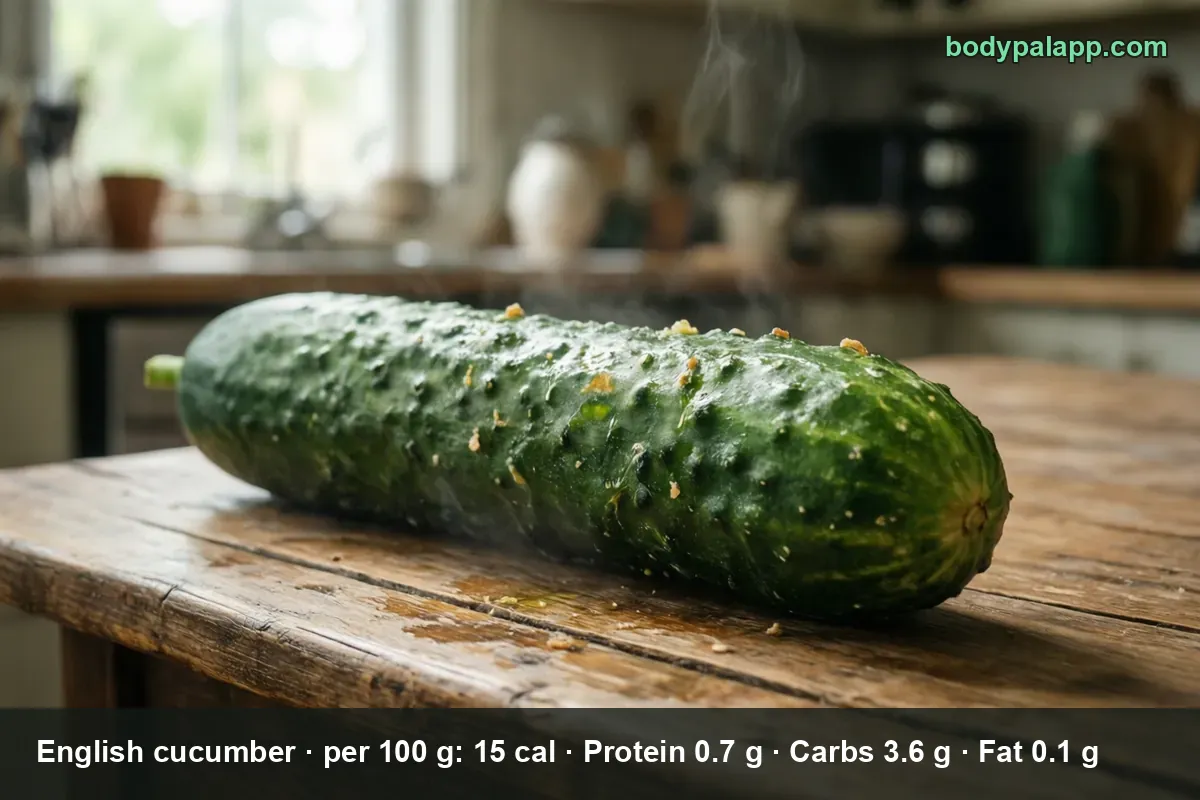
One 8-1/4-inch cucumber weighs 301 g and carries 45 calories. Per 100 g, cucumber with the peel on runs 15 calories — one of the lightest things you can put on a plate by weight. A cup of slices is 16. The peel matters more than the size does.
On this page
- English cucumber quick facts
- US servings from one ounce to a whole cucumber
- Peeled cooked and turned into salad
- Potassium is the biggest percentage on the label
- How does an English cucumber compare?
- Most popular english cucumber brands
- FAQ
English cucumber quick facts
USDA FoodData Central has no separate record for the English or seedless cucumber — the long shrink-wrapped one at the grocery store. What it does have is SR Legacy 168409, "Cucumber, with peel, raw", and that is the right match, because nobody peels an English cucumber. The skin is thin enough to eat, which is most of the point of buying one.
There is a newer Foundation measurement of the same food, but it reports energy by the Atwater factors and leaves fiber, sugars and saturated fat blank. The older SR Legacy row is complete, and its serving weights are real USDA household measures rather than something we invented. That is the row every number below comes from.
| Nutrient | Per 100 g | Per 1 cucumber 8-1/4 in (301 g) | % Daily Value |
|---|---|---|---|
| Calories | 15 | 45 | — |
| Total fat | 0.11 g | 0.3 g | 0% |
| Saturated fat | 0.04 g | 0.1 g | 1% |
| Carbohydrate | 3.63 g | 10.9 g | 4% |
| Dietary fiber | 0.5 g | 1.5 g | 5% |
| Total sugars | 1.67 g | 5.0 g | — |
| Protein | 0.65 g | 2.0 g | 4% |
| Sodium | 2 mg | 6 mg | 0% |
| Potassium | 147 mg | 442 mg | 9% |
% Daily Value is based on a 2,000-calorie diet.
Verified nutrition data
Numbers on this page come from USDA FoodData Central, the U.S. Department of Agriculture’s food composition database, and from manufacturer labels where a branded product is named. Last verified September 2026. How we verify our data →
There is no added sugars row here. The SR Legacy edition does not carry that nutrient for raw vegetables at all, and a cucumber straight off the vine has none, so the line would have been a zero pretending to be data. Cholesterol is a flat 0 mg, as it is in every plant food.
The sodium figure is worth a second look: 6 mg in an entire cucumber. One teaspoon of table salt holds roughly 2,300 mg of sodium, so you would need something like 380 whole cucumbers to match it. That changes completely the moment the cucumber goes into brine — see the pickle row further down.
US servings from one ounce to a whole cucumber
| Serving | Weight | Calories |
|---|---|---|
| 1 oz | 28.3 g | 4 kcal |
| 1/2 cup slices | 52 g | 8 kcal |
| 1 cup slices | 104 g | 16 kcal |
| One cucumber, 8-1/4 in | 301 g | 45 kcal |
| Per 100 g | 100 g | 15 kcal |
The 301 g whole cucumber and the 104 g cup of slices are both USDA household measures, so the weights are not guesses. The calorie figures for the cup, the half cup and the ounce are our own arithmetic from the USDA 100 g number, not USDA servings in their own right.
Two practical notes. First, an English cucumber is longer and narrower than the field cucumber USDA weighed, so a full one from the shrink wrap often lands between 250 g and 350 g — the 45-calorie figure moves by a few calories either way and never becomes a decision you have to think about. Second, the cup is the measure that trips people up: a cup of slices is only 104 g, about a third of a whole cucumber, so "a cup of cucumber" and "a cucumber" are not close to the same food.
Packaged brands agree with USDA. Topline Farms mini cucumbers are listed at 15 calories per 100 g, Double Diamond Farms minis at 12, and a Farm to Club whole cucumber at 237 g comes to 36 calories on its label. No brand of plain cucumber is meaningfully lighter or heavier than any other, which is rare on a nutrition page.
Peeled cooked and turned into salad
| Version | Per 100 g | Typical serving | Calories |
|---|---|---|---|
| Raw, with peel | 15 kcal | one cucumber, 301 g | 45 kcal |
| Peeled, raw | 10 kcal | 1 oz, 28.3 g | 3 kcal |
| Raw, FNDDS survey row | 16 kcal | 1 cup, 120 g | 19 kcal |
| Cooked | 45 kcal | 1 oz, 28.3 g | 13 kcal |
| Cucumber salad with vinegar | 34 kcal | 1 cup, 159 g | 54 kcal |
| Cucumber salad with Italian dressing | 120 kcal | 1 cup, 159 g | 191 kcal |
| Dill pickles | 12 kcal | 1 oz, 28.3 g | 3 kcal |
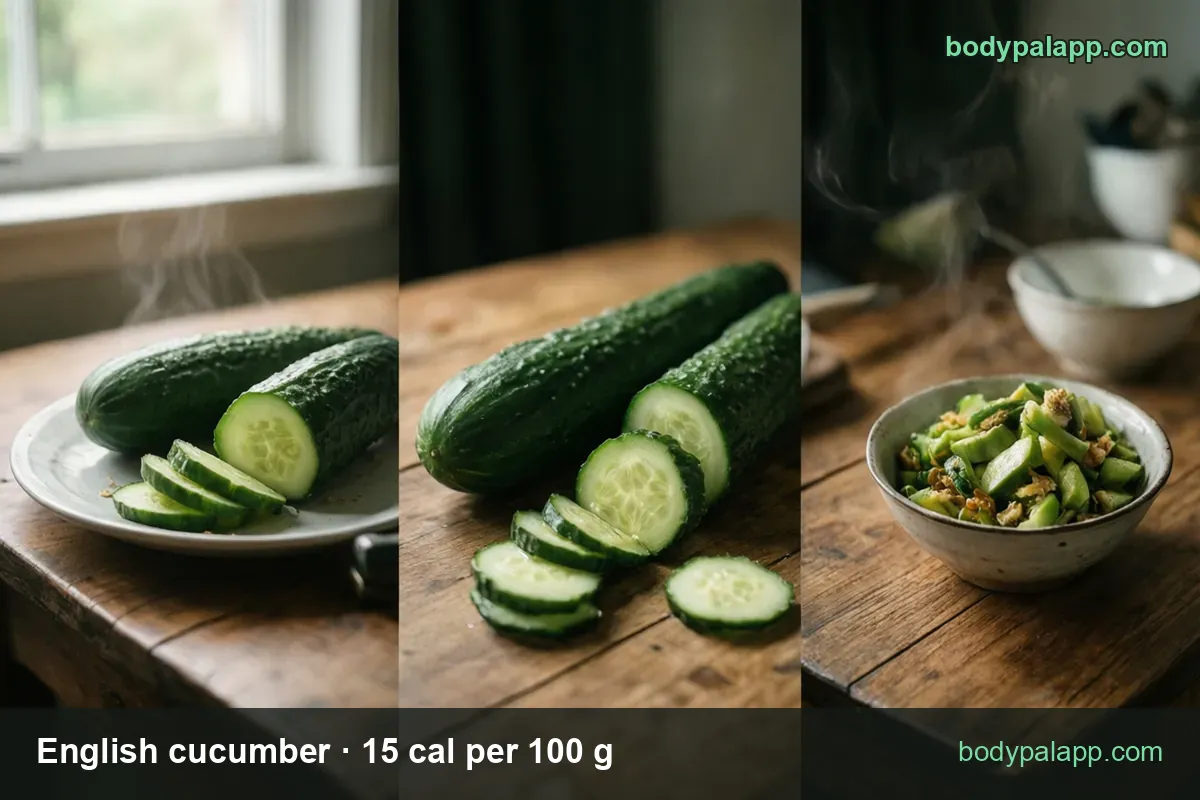
Peeling is the biggest single change, and it goes the direction most people do not expect: 15 calories per 100 g becomes 10. The skin holds sugars and dry matter, so taking it off removes about a third of the energy — and 11 mg of potassium per 100 g with it. If you are eating a cucumber to eat something, keep the peel. If you are eating one to fill a bowl, peel away.
Cooking is the sharpest jump on the table. The survey row for cooked cucumber lands at 45 calories per 100 g, three times the raw figure, and 3.2 g of fat where raw has 0.11 g. That fat is not from the vegetable; it is the butter or oil in the pan, and the 145 mg of sodium is the salt that went in with it.
Then there is salad. A cup of cucumber tossed with vinegar is 54 calories, most of it sugar in the marinade. The same cup with Italian dressing is 191 — three and a half times as much, from a bottle you poured in seconds. Plain slices at that same 159 g would be about 24 calories, our own scaling from the 100 g figure. The cucumber contributes almost nothing to any of those three numbers.
Dill pickles land close to raw cucumber on calories, 12 per 100 g against 15, and completely different on sodium: 809 mg per 100 g against 2 mg. An ounce of spears works out to roughly 229 mg of sodium, about 10% of the Daily Value, from a food that reads as a free snack.
Potassium is the biggest percentage on the label
Look down the %DV column and one number stands out. A whole cucumber gives 442 mg of potassium, 9% of the 4,700 mg Daily Value — higher than the fiber row, higher than the protein row, higher than anything else on the page. A vegetable with 45 calories in it is quietly doing a tenth of a day's potassium.
Fiber is the runner-up at 1.5 g, 5% of the Daily Value. That is real but modest; cucumber is not a fiber food, it is a water food. Roughly 95% of its weight is water, which is the whole reason 301 g of it costs 45 calories while 301 g of almost anything else costs several hundred.
Protein is 2.0 g in the whole cucumber, 4% of the Daily Value. Nobody eats cucumber for protein, and the number confirms it. What cucumber does well is volume: it fills a plate, adds crunch, and leaves the calorie budget essentially untouched. MyPlate counts one cup of raw cucumber slices toward the daily vegetable target, and at 16 calories that is one of the cheapest cups of vegetables in the produce aisle.
If you are watching sodium, the version you choose matters far more than the amount you eat. Raw is 2 mg per 100 g. Pickled is 809. That is a swing of about 400 times from one preparation decision.
How does an English cucumber compare?
| Vegetable | Per 100 g | US serving | Calories |
|---|---|---|---|
| Cucumber, with peel | 15 kcal | one cucumber, 301 g | 45 kcal |
| Lettuce, green leaf | 15 kcal | 1 oz, 28.3 g | 4 kcal |
| Tomatoes, yellow | 15 kcal | 1 oz, 28.3 g | 4 kcal |
| Cabbage, kimchi | 15 kcal | 1 oz, 28.3 g | 4 kcal |
Our take: at 15 calories per 100 g, cucumber ties every other row on this table exactly — nothing here is lighter per gram, and nothing is heavier. The difference is what a portion looks like. You eat an ounce of lettuce and a whole cucumber, so the cucumber is the one that shows up as 45 calories in a food log while the salad greens barely register. For protein per calorie, green leaf lettuce wins at 1.36 g per 100 g against cucumber's 0.65. For sheer bulk on the plate at almost no cost, cucumber is the pick, and it is the only one of the four you can eat by the fistful without a dressing.
Most popular english cucumber brands in the United States
Ranked by how widely each product appears among foods sold in the United States, from the BodyPal food database of over 3.3 million products. Calories are the figures printed on each Nutrition Facts label, checked against USDA FoodData Central.
| Product | Calories (per 100 g) |
|---|---|
| Topline Farms Mini Cucumbers | 15 cal |
| Double Diamond Farms Mini Cucumbers | 12 cal |
| Farm to Club Cucumbers | 15 cal |
Brand popularity: BodyPal food database. Nutrition: manufacturer labels / USDA FoodData Central.
English cucumber FAQs
How many calories are in a whole English cucumber?
A whole 8-1/4-inch cucumber weighing 301 g holds 45 calories, based on the USDA row for cucumber with the peel on. That is 15 calories per 100 g. Most of the weight is water, which is why a vegetable this large still lands under 50 calories.
How many calories in 1 cup of sliced cucumber?
One cup of slices weighs 104 g and works out to 16 calories, scaled from the USDA figure of 15 per 100 g. Half a cup is 52 g and 8 calories. The cup also carries 3.8 g of carbohydrate and 153 mg of potassium.
Are English cucumbers lower in calories than regular cucumbers?
No — both sit at 15 calories per 100 g with the peel on, because USDA FoodData Central does not publish a separate record for English or seedless cucumbers. The English variety is longer and thinner, so a whole one can weigh more and total more calories.
How many carbs are in an English cucumber?
A whole 301 g cucumber has 10.9 g of carbohydrate, 4% of the Daily Value, with 1.5 g of that as fiber and 5.0 g as naturally occurring sugars. Per 100 g the figure is 3.63 g. A cup of slices holds only 3.8 g.
Do you lose nutrients if you peel a cucumber?
Peeling drops the energy from 15 to 10 calories per 100 g and the potassium from 147 to 136 mg. Fiber per 100 g actually reads slightly higher without the peel, 0.7 g against 0.5 g, because removing the skin concentrates what is left. Leave the peel on for the potassium.
How much potassium is in a cucumber?
A whole 301 g cucumber supplies 442 mg of potassium, 9% of the 4,700 mg Daily Value and the highest percentage anywhere on this page. Per 100 g it is 147 mg. A cup of slices gives 153 mg, roughly 3% of the day's target.
How many calories in cucumber salad?
A cup of cucumber salad made with vinegar, 159 g, is 54 calories; the same cup made with Italian dressing is 191. Plain slices at that weight run about 24, so the dressing does almost all of the work. Vinegar salads stay cheap because the marinade adds sugar but no fat.
Are cucumbers keto friendly?
A cup of slices carries 3.8 g of carbohydrate and 0.5 g of fiber, so about 3.3 g of net carbs, low enough for most low-carb plans. A whole 301 g cucumber comes to 10.9 g of carbohydrate and 1.5 g of fiber. Pickles are lower still at 2.41 g per 100 g.
Similar foods
- Cucumber — 45 cal per whole cucumber
- Lettuce Leaves — 5 cal per cup shredded
- Persian Cucumber — 13 cal per cucumber
- Celery — 6 cal per stalk, medium
- Celery Stick — 6 cal per stick
- Iceberg Lettuce — 10 cal per cup shredded
Count it without the math
Point the camera at the plate and BodyPal counts the cucumber for you, peel, slices and dressing included.


How long does it take to burn off English cucumber?
One 8-1/4 inch cucumber (301 g) is 45 kcal. Enter your weight and the amount you ate to see how long it takes you to burn that off:
lb
| Activity | Time to burn 45 kcal |
|---|---|
| Walking, brisk | 9 min |
| Cycling, moderate | 6 min |
| Swimming, moderate | 6 min |
| Jogging | 5 min |
| Weight training, moderate | 10 min |
Times are for a 155 lb adult at a steady pace; change the weight to see yours. The amount is set to the portion in the text (301 g); change it to what you actually ate. BodyPal works this out from your steps automatically.
One food is easy to picture; a whole day is harder. See how many calories you need a day and what a deficit actually looks like.