Diet soda calories come to 0 for one 12 fl oz can (355 g) and 0 per 100 g. The more useful point: it has no sugar, no fat and no carbs, so the can size barely matters. The only rows that move as you drink more are a trace of protein and a small amount of sodium.
0kcal
1 12 fl oz can · 355 g, carbonated, low calorie
100%protein
0.4 gProtein
0 gCarbs
0 gFat
How to burn off 0 kcal
—Walking, brisk
—Jogging
—Cycling, moderate
—Swimming
Skip the math. BodyPal counts these calories from your steps and workouts automatically.
Nutrition facts
Carbonated, low calorie · per 355 g
Calories
0 kcal
Protein
0.4 g
Carbohydrate
0 g
Fat
0 g
Saturated fat
0 g
Cholesterol
0 mg
Sodium
21 mg
Potassium
7 mg
Iron
0.1 mg
Source: USDA FoodData Central
🛡️
Verified nutrition data
Numbers on this page come from USDA FoodData Central, the U.S. Department of Agriculture’s food composition database, and from manufacturer labels where a branded product is named. Last verified October 2026. How we verify our data →
Diet soda: calories, protein and sodium by serving
Percent of daily value uses the FDA reference of 2,000 kcal a day.
Serving
kcal
Protein
Carbs
Fat
Sodium
% DV kcal
1 can, 12 fl oz (355 g)
0
0.4 g
0 g
0 g
21 mg
0%
1 bottle, 16.9 fl oz (507 g)
0
0.5 g
0 g
0 g
30 mg
0%
100 g
0
0.1 g
0 g
0 g
6 mg
0%
3 × 1 can, 12 fl oz (355 g)
0
1.1 g
64 mg
5 × 1 can, 12 fl oz (355 g)
0
1.8 g
107 mg
Five cans still add up to 0 calories
Most foods punish a bigger portion. Diet soda does not. A 12 fl oz can (355 g) lists 0 calories, and a 16.9 fl oz bottle (507 g) lists 0 calories too. The label stays flat because there is no sugar, starch or fat in the drink to begin with.
Stack the cans and the total still does not budge. Two cans (710 g) come to 0 calories, three cans (1,065 g) come to 0, and five cans (1,775 g) still read 0. What does climb is sodium: 43 mg for two cans, 64 mg for three and 107 mg for five. Protein creeps up as well, from 0.7 g to 1.8 g across those same amounts, which is too little to count toward a meal.
So portion control here is not a calorie question. If you track your intake closely, logging each can is still worth doing for an honest record of fluids and sodium, but the calorie line on your log will not move.
The 100% protein split is a rounding quirk
The calorie split for diet soda reads 100% protein, 0% carbs and 0% fat. That looks strange for a fizzy drink, and it is worth reading correctly. The only macronutrient with a value above zero is protein, at 0.1 g per 100 g, so by default it takes the whole share.
In practice that share is tiny. A can holds 0.4 g of protein and a bottle holds 0.5 g, which is 1% of the daily value in either case. Carbs sit at 0 g, sugars at 0 g, fat at 0 g and fiber at 0 g per 100 g. The split tells you what little is there, not that diet soda is a protein drink.
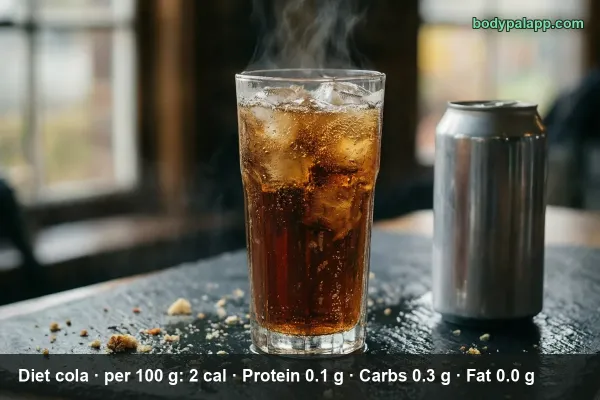
The values here come from the USDA row for a carbonated, low calorie beverage other than cola or pepper, without caffeine. Colas and caffeinated versions can differ slightly in the small rows, which is why a diet cola can show a couple of calories per 100 g while this row shows 0.
Sodium is the only row that moves
With calories, sugar and fat all at zero, sodium is the one line worth a glance. Diet soda carries 6 mg per 100 g. That works out to 21 mg in a 12 fl oz can and 30 mg in a 16.9 fl oz bottle, each about 1% of the daily value.
Even a heavy day stays modest. Five cans bring 107 mg of sodium, still a small slice of a 2300 mg daily value. If you watch sodium closely, the salty foods you eat alongside the drink will matter far more than the can itself.
Potassium is listed too, at just 2 mg per 100 g, and cholesterol is 0 mg. Neither row adds much to your day. Diet soda is close to a blank line on a nutrition log, with sodium as the only entry you might actually notice.
A zero-calorie swap, not a source of nutrients
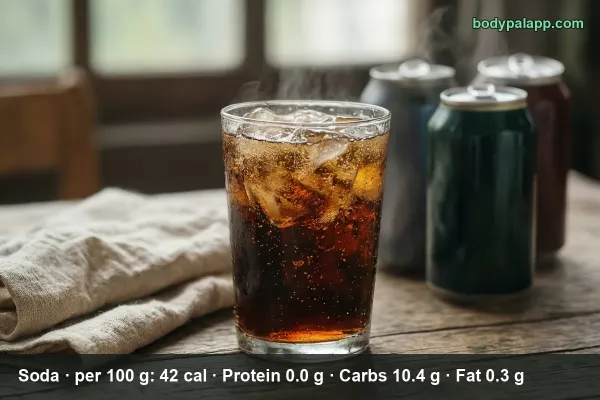
The clearest role for diet soda is as a replacement for sugared drinks. Regular soda runs 42 calories per 100 g with 10.4 g of carbs, while diet soda sits at 0 on both. If you usually drink regular soda with lunch, switching keeps the fizz and the flavor while taking the calories off the table.
What diet soda will not do is feed you. It brings almost no protein, no fiber and no potassium worth counting, so it cannot stand in for food. Pair it with a meal that carries the protein and fiber, and treat the can as a drink choice rather than part of the nutrition.
Brands on this page include Diet Pepsi, Diet Mtn Dew, Sam's Cola Diet Soda and Moxie Diet Soda. Their labels can differ a little from the USDA row above, so check the can if a small number matters to you. You can also log a can or bottle in BodyPal from a photo.
How does diet soda compare?
Here is how diet soda stacks up against diet coke and regular soda, per 100 g and per usual serving.
Verdict: For cutting calories, diet soda at 0 per 100 g edges out diet coke at 2, and both are far below regular soda at 42. If you count carbs, the gap is starker: regular soda carries 10.4 g per 100 g against 0 g for diet soda and 0.3 g for diet coke.
Most popular diet soda brands in the United States
A 12 fl oz can (355 g) of diet soda has 0 calories and 0 g sugar.
Is diet soda good for weight loss?
A 355 g can adds 0 calories, 0 g sugar and 0 g fat, so it does not add to a daily calorie total.
Diet soda vs regular soda: which has fewer calories?
Regular soda has 42 calories per 100 g, about 149 in a 355 g can, while diet soda has 0.
Does diet soda have sugar or carbs?
Diet soda has 0 g sugar and 0 g carbs per 100 g. A 355 g can has about 21 mg sodium.
Does diet soda have any calories at all?
Diet soda has 0 calories per 100 g, per 12 fl oz can and per 16.9 fl oz bottle. It contains a trace of protein, 0.4 g in a can, but not enough to register on the calorie line.
How many calories are in a 16.9 oz bottle of diet soda?
A 16.9 fl oz bottle (507 g) of diet soda has 0 calories. It also lists 0 g of sugar, 0 g of fat, 0.5 g of protein and 30 mg of sodium, about 1% of the daily value.
What are the nutrition facts for diet soda per 100 g?
Per 100 g, diet soda has 0 calories, 0.1 g protein, 0 g carbs, 0 g fat, 0 g sugars, 0 g fiber, 6 mg sodium, 2 mg potassium and 0 mg cholesterol.
How much sodium is in a can of diet soda?
A 12 fl oz can of diet soda has 21 mg of sodium, about 1% of the daily value. Even five cans add up to only 107 mg.
Do several cans of diet soda add calories?
No. Two cans come to 0 calories, three cans to 0 and five cans to 0. Only sodium rises, reaching 107 mg across five cans, along with 1.8 g of protein.