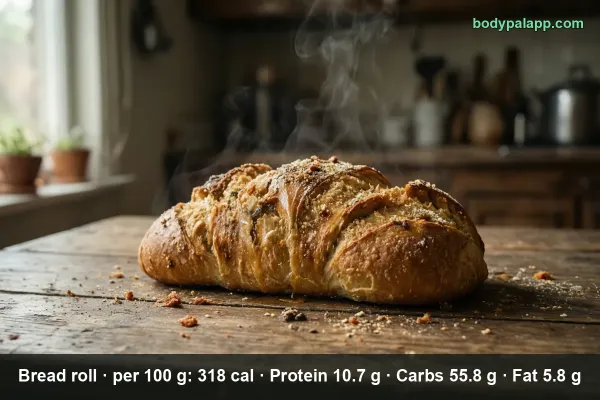
Dinner roll calories come to 76 for one 28 g roll and 273 per 100 g. On its own that is a light side. The number to watch is the count: carbs supply 67% of the calories, each roll adds 147 mg of sodium, and two rolls already make 153 calories while five reach 382.
76kcal
1 roll · 28 g, baked, wheat flour
13%protein
2.4 gProtein
13 gCarbs
1.8 gFat
How to burn off 76 kcal
—Walking, brisk
—Jogging
—Cycling, moderate
—Swimming
Skip the math. BodyPal counts these calories from your steps and workouts automatically.
Nutrition facts
Baked, wheat flour · per 28 g
Calories
76 kcal
Protein
2.4 g
Carbohydrate
12.9 g
Fat
1.8 g
Saturated fat
0.4 g
Cholesterol
0 mg
Sodium
147 mg
Potassium
32 mg
Iron
1 mg
Source: USDA FoodData Central
🛡️
Verified nutrition data
Numbers on this page come from USDA FoodData Central, the U.S. Department of Agriculture’s food composition database, and from manufacturer labels where a branded product is named. Last verified September 2026. How we verify our data →
Dinner roll: calories, protein and sodium by serving
Percent of daily value uses the FDA reference of 2,000 kcal a day.
Serving
kcal
Protein
Carbs
Fat
Sodium
% DV kcal
1 roll (28 g)
76
2.4 g
12.9 g
1.8 g
147 mg
4%
Sweet roll (30 g)
96
3 g
16.1 g
2.2 g
76 mg
5%
Whole wheat (28 g)
74
2.4 g
14.3 g
1.3 g
146 mg
4%
100 g
273
8.6 g
46 g
6.3 g
524 mg
14%
3 × 1 roll (28 g)
229
7.2 g
440 mg
5 × 1 roll (28 g)
382
12 g
734 mg
Two rolls make a 153-calorie side
A standard dinner roll weighs 28 g and holds 76 calories, which is 4% of the daily value. That is a small number by any measure. The catch is that rolls rarely arrive alone. The basket goes around, and a second or third disappears without much thought.
Two rolls bring 153 calories, 293 mg of sodium and 4.8 g of protein. Three reach 229 calories and 440 mg of sodium. Five, a plausible count over a long holiday dinner, add up to 382 calories and 734 mg of sodium from bread alone, before any butter goes on top. Treat each roll as a building block, not a free extra.
Size also varies more than the label suggests. A bakery roll can weigh well over 28 g, so if yours looks large, weigh it once and scale from 273 calories per 100 g. BodyPal can log a roll from a photo, which helps when the basket is shared and nobody is keeping count.
Two thirds of the calories come from carbs
The calorie split is 67% carbohydrate, 21% fat and 13% protein. Per 100 g that means 46 g of carbs, 6.3 g of fat and 8.6 g of protein. A single roll carries 12.9 g of carbs, 1.8 g of fat and 2.4 g of protein.
Sugar is low for bread: 0.5 g per roll and 1.6 g per 100 g. Saturated fat is 1.5 g per 100 g and cholesterol is 0, so the standard wheat roll is a plain, starchy food rather than a rich one. Butter-style and enriched rolls from brands such as Aunt Millie's or Heiner's can differ, so read the package if you buy those.
Protein is the weak spot. At 2.4 g per roll, or 5% of the daily value, a dinner roll does little to keep you full by itself. Fiber is modest too, at 1.1 g per roll. It works best as the starch beside a protein-rich main, not as the part of the meal that carries you to the next one.
Sodium is the row to watch
Bread is a quiet salt source, and dinner rolls are no exception. One roll has 147 mg of sodium, 6% of the 2300 mg daily value. Per 100 g the figure is 524 mg, or 23% of the daily value, which is a lot for something that does not taste salty.
Set that against the energy. Per 100 g, calories reach only 14% of the daily value while sodium reaches 23%, so the salt share outpaces the calorie share. The multiples show how fast it builds: three rolls carry 440 mg and five carry 734 mg. Gravy, ham or salted butter on the same plate push the total higher still.
If you watch sodium, the roll count matters more than the type of roll. A whole wheat roll has 146 mg, almost identical to the standard 147 mg. The sweet roll is the exception at 76 mg, or 3% of the daily value, though it trades salt for sugar.
Whole wheat beats the sweet roll on fiber
The card covers three USDA versions. The standard wheat roll is 76 calories for 28 g. A whole wheat roll of the same 28 g weight is 74 calories, and a sweet roll of 30 g is 96 calories. The calorie gap is small; the differences show up in the other rows.
Whole wheat is the better pick if you want more from the same calories. It has 2.1 g of fiber against 1.1 g in the standard roll, and its 1.3 g of fat is lower than 1.8 g. It does carry more sugar, 2.4 g against 0.5 g, but both amounts are small. Carbs run slightly higher at 14.3 g.
The sweet roll is closer to a pastry. It has 4.6 g of sugar, 2.2 g of fat and only 0.9 g of fiber. Its one advantage is the lower sodium. Soft, sweet styles like Sara Lee Hawaiian Dinner Rolls sit in this camp, so treat them as a treat at the table rather than the everyday default.
How does dinner roll compare?
Here is how the dinner roll stacks up against a bread roll, a Hawaiian roll and a kaiser roll, per 100 g and per usual serving.
Verdict: For the lightest serving, keep the dinner roll: a Hawaiian roll is 96 calories and a kaiser roll 167, both above it. If sodium is your concern, the Hawaiian roll is lowest at 253 mg per 100 g, while the kaiser roll is highest at 544 mg.
Most popular dinner roll brands in the United States
3Sunflour Bakery Soft Dinner Roll1.5 oz · 43 g279 kcal
4Heiner's Enriched Dinner Rolls1 roll · 38 g289 kcal
5Aunt Millie's Butter Dinner Rolls1 roll · 43 g282 kcal
6Heiner's Brown-N-Serve Enriched Dinner Rolls1 roll · 35 g286 kcal
7Sara Lee Hawaiian Dinner Rolls1 roll · 38 g289 kcal
8Sara Lee Classic Dinner Rolls1 roll · 40 g275 kcal
Packaged rolls weigh 35 to 43 g each, more than the 28 g roll used above, so one store roll adds up to more calories even at a similar density. Source: manufacturer labels / USDA FoodData Central.
Dinner roll FAQs
How many calories are in one dinner roll?
One dinner roll of 28 g has 76 calories. Per 100 g dinner rolls are 273 calories.
Are dinner rolls good for weight loss?
A 28 g roll is 76 calories with 12.9 g carbs, 2.4 g protein and 1.1 g fiber, so two rolls come to 152 calories.
Dinner roll or Hawaiian roll: which has more calories?
Hawaiian rolls are 321 calories per 100 g against 273 for a plain dinner roll, so gram for gram the Hawaiian roll is higher.
How much protein is in a dinner roll?
A 28 g dinner roll has 2.4 g protein, which is 8.6 g per 100 g. A whole wheat roll of the same size has 2.4 g protein and 2.1 g fiber.
How many carbs are in a dinner roll?
A 28 g dinner roll has 12.9 g of carbohydrates, and 100 g has 46 g. Carbs supply 67% of the roll's calories, while sugar is only 0.5 g per roll.
How many calories are in two dinner rolls?
Two standard dinner rolls (56 g) contain 153 calories. They also bring 293 mg of sodium and 4.8 g of protein, so the second roll doubles the salt along with the calories.
How many calories are in a small dinner roll?
A small standard dinner roll of 28 g has 76 calories. If your roll is bigger, use 273 calories per 100 g as the guide, since large bakery rolls can carry far more.
How many calories are in a whole wheat dinner roll?
A 28 g whole wheat dinner roll has 74 calories, close to the 76 in a standard roll. It offers 2.1 g of fiber, nearly double the 1.1 g in the regular version.
Does a bread roll have more calories than a dinner roll?
Yes. Our bread roll page lists 318 calories per 100 g, against 273 for a dinner roll, about 1.2 times as calorie-dense. The bread roll also has more protein, at 10.7 g per 100 g.