Donut holes calories come to 64 for one 15 g hole and 426 per 100 g. One hole is small. The count is what matters, because few people stop at one: five holes reach 320 calories. Fat and carbs split the energy almost evenly, and protein barely shows up.
64kcal
1 donut hole · 15 g, generic, not Dunkin-specific
5%protein
0.8 gProtein
7 gCarbs
3.4 gFat
How to burn off 64 kcal
—Walking, brisk
—Jogging
—Cycling, moderate
—Swimming
Skip the math. BodyPal counts these calories from your steps and workouts automatically.
Nutrition facts
Generic, not dunkin-specific · per 15 g
Calories
64 kcal
Protein
0.8 g
Carbohydrate
7.4 g
Fat
3.4 g
Saturated fat
1.5 g
Cholesterol
3 mg
Sodium
57 mg
Potassium
17 mg
Iron
0.4 mg
Source: USDA FoodData Central
🛡️
Verified nutrition data
Numbers on this page come from USDA FoodData Central, the U.S. Department of Agriculture’s food composition database, and from manufacturer labels where a branded product is named. Last verified September 2026. How we verify our data →
Donut hole: calories, protein and sodium by serving
Percent of daily value uses the FDA reference of 2,000 kcal a day.
Serving
kcal
Protein
Carbs
Fat
Sodium
% DV kcal
1 donut hole (15 g)
64
0.8 g
7.4 g
3.4 g
57 mg
3%
2 oz portion (57 g)
243
3.1 g
28.2 g
13 g
215 mg
12%
100 g
426
5.5 g
49.5 g
22.9 g
378 mg
21%
3 × 1 donut hole (15 g)
192
2.5 g
170 mg
5 × 1 donut hole (15 g)
320
4.1 g
284 mg
Five donut holes are a 320-calorie snack
A single 15 g donut hole has 64 calories, about 3 percent of the daily value. That looks harmless, and on its own it is. The problem is that donut holes come in boxes and bags, and the hand keeps going back.
The math climbs fast. Two holes are 30 g and 128 calories. Three holes are 45 g and 192 calories. Five holes weigh 75 g and land at 320 calories, which is more than a 2 oz portion of 57 g at 243 calories. By the time you reach a 100 g handful, you are at 426 calories and 21 percent of the daily value for energy.
If you want to keep the total in check, decide the number before you open the box. Put three on a plate and close the lid. Counting holes is easier than estimating grams, and each one is a clean 64-calorie step.
Fat and carbs split the calories almost evenly
Per 100 g, donut holes carry 22.9 g of fat, 49.5 g of carbs and 5.5 g of protein. Translated into calories, fat supplies 48 percent, carbs 47 percent and protein only 5 percent. That is the classic profile of fried dough: flour plus frying oil, with sugar on top.
Fat is the reason the number is so dense. Gram for gram, it carries more energy than carbs, so a fried cake ball ends up at 426 calories per 100 g, far above plain bread or fruit. One hole has 3.4 g of fat and 7.4 g of carbs.
Protein is close to irrelevant here. One hole gives 0.8 g, and even five holes only reach 4.1 g. Fiber is just as thin, at 0.3 g per hole and 1.8 g per 100 g. There is little in a donut hole that slows eating down or keeps you full, which is exactly why the second and third hole go down so easily.
Sugar and saturated fat are the rows to watch
Sugar makes up 23.5 g of every 100 g, so nearly half the carbs are sugar. One hole holds 3.5 g, and a 2 oz portion holds 13.4 g. Glazed or powdered versions are where most of that sugar sits, on the outside.
Saturated fat is the less obvious number. A 100 g serving has 9.9 g, which is about half of the 20 g daily value used on this page. That comes from the frying fat and the dough itself, and it adds up quickly if donut holes are a weekly habit rather than an occasional treat.
Sodium is moderate for a sweet food: 57 mg per hole, 215 mg in a 2 oz portion and 378 mg per 100 g, or 16 percent of the daily value. Cholesterol is low at 20 mg per 100 g. If you watch sodium, savory fried sides are a much bigger concern than these.
Treat them as dessert, not breakfast
The values on this page come from the USDA row for doughnut holes, a generic fast-food entry rather than a Dunkin-specific recipe. Chain and store versions vary with glaze and size, but the pattern holds: lots of energy, little protein, little fiber.
Because a donut hole offers almost nothing to keep you full, it works better as a planned treat after a meal than as breakfast on its own. Pair two or three with something that brings protein, such as eggs or Greek yogurt, and the snack stops being the whole meal. A sweetened coffee drink on the side will push the sugar total higher, so plain coffee or tea is the cleaner match.
Packaged options on the shelf include Entenmann's Glazed Donut Holes, Mel-O-Cream Original Glazed Donut Holes and Kroger Glazed Sour Cream Cake Donut Holes. If you lose count of how many you ate, BodyPal can log them from a photo of the plate.
How does donut hole compare?
Here is how donut holes stack up against other fast-food snacks and sweets, per 100 g and per usual serving.
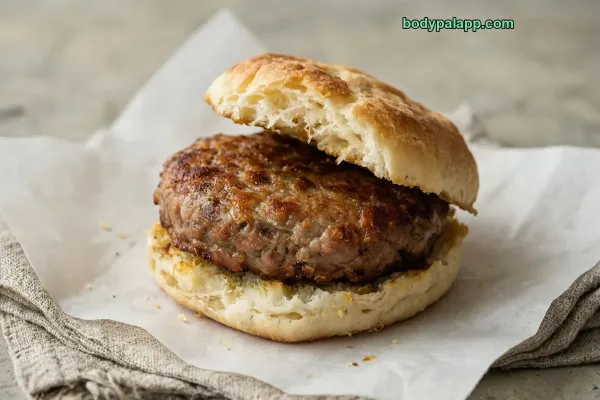
Verdict: Per serving, the donut hole is the easiest to control: 64 calories a hole against 210 for a Subway chocolate chip cookie, 440 for a McDonald's sausage biscuit and 488 for medium Burger King onion rings. If you want something that keeps you full, the sausage biscuit wins on protein at 9.6 g per 100 g, but it costs 875 mg of sodium per 100 g.
Most popular donut hole brands in the United States
Ranked by popularity in the BodyPal database
# Productkcal / 100 g
1Mel-O-Cream Original Glazed Donut Holes4 holes · 50 g420 kcal
About 64 calories in a 15 g donut hole, so 4 holes add up to 256 calories.
Are donut holes good for weight loss?
They are calorie dense at 426 calories per 100 g, with 22.9 g fat and 23.5 g sugar. A single hole is 64 calories.
How do packaged donut holes compare?
Packaged labels range from 375 calories per 100 g (Maple Donuts) to 464 (Kroger), against 426 for a generic donut hole.
How much sugar is in a donut hole?
About 3.5 g of sugar and 7.4 g of carbs per 15 g hole, or 14.1 g of sugar in 4 holes.
How many calories are in 5 donut holes?
Five donut holes have about 320 calories. They weigh 75 g together and bring 284 mg of sodium and 4.1 g of protein, so the calories add up much faster than anything filling.
How many calories are in 3 donut holes?
Three donut holes come to about 192 calories for 45 g. That is a reasonable portion for a treat, with 170 mg of sodium and 2.5 g of protein.
How much fat is in a donut hole?
One donut hole has 3.4 g of fat. Per 100 g that rises to 22.9 g, including 9.9 g of saturated fat, and fat supplies 48 percent of the calories.
Are donut holes high in sodium?
Not especially. One hole has 57 mg of sodium, about 2 percent of the daily value, and 100 g has 378 mg, or 16 percent. Burger King onion rings carry 776 mg per 100 g.