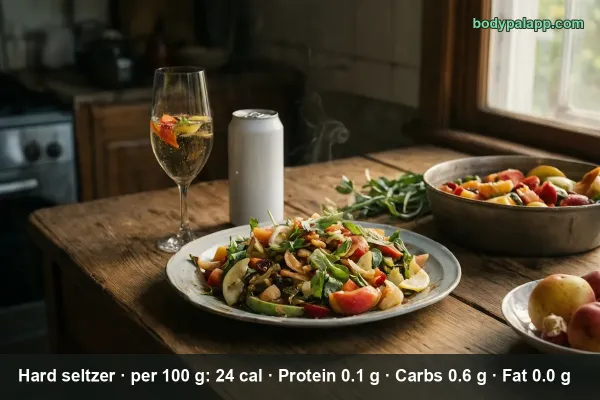
Hard seltzer calories come to 86 for a 12 fl oz can (360 g) and 24 per 100 g. The label rows barely explain that number: a can lists 0 g sugar, 0 g fat and about 2 g carbs. The total is set by how many cans you open, and it climbs quickly across an afternoon.
86kcal
1 12 fl oz can · 360 g, ready to drink
11%protein
0.3 gProtein
2 gCarbs
0 gFat
How to burn off 86 kcal
—Walking, brisk
—Jogging
—Cycling, moderate
—Swimming
Skip the math. BodyPal counts these calories from your steps and workouts automatically.
Nutrition facts
Ready to drink · per 360 g
Calories
86 kcal
Protein
0.3 g
Carbohydrate
2 g
Fat
0 g
Saturated fat
0 g
Cholesterol
0 mg
Sodium
61 mg
Potassium
22 mg
Iron
0 mg
Source: USDA FoodData Central
🛡️
Verified nutrition data
Numbers on this page come from USDA FoodData Central, the U.S. Department of Agriculture’s food composition database, and from manufacturer labels where a branded product is named. Last verified October 2026. How we verify our data →
Hard seltzer: calories, protein and sodium by serving
Percent of daily value uses the FDA reference of 2,000 kcal a day.
Serving
kcal
Protein
Carbs
Fat
Sodium
% DV kcal
12 fl oz can (360 g)
86
0.3 g
2 g
0 g
61 mg
4%
1 fl oz (30 g)
7
0 g
0.2 g
0 g
5 mg
0%
100 g
24
0.1 g
0.6 g
0 g
17 mg
1%
3 × 12 fl oz can (360 g)
259
0.8 g
184 mg
5 × 12 fl oz can (360 g)
432
1.3 g
306 mg
Three cans make a 259-calorie afternoon
One 12 fl oz can of hard seltzer is 86 calories, about 4% of a 2,000-calorie daily value. On its own that is a small number, smaller than many sodas or juices. The problem is that nobody at a pool party or a tailgate stops at one, and the can is the unit that repeats.
Two cans bring you to 173 calories. Three cans reach 259, and five cans, which is an easy count over a long day outside, add up to 432. That last figure is in the range of a full meal, delivered with almost no protein (1.3 g across all five) and nothing that keeps you full.
If you pour from a larger container or share a pitcher, think in fluid ounces: 1 fl oz is about 7 calories, so the math stays simple. Counting cans honestly does more for your daily total than switching between brands, because most hard seltzers sit close to each other per 100 g.
The calories hide outside the macro rows
Per 100 g, hard seltzer lists 0.1 g protein, 0.6 g carbs and 0 g fat. The calorie split on the label reads 89% carbs and 11% protein, but that split only shares out the tiny amounts of macronutrients the rows contain. Those grams cannot add up to 86 calories in a can.
The gap is alcohol. It carries calories of its own, and standard nutrition panels do not give it a row, which is why a drink with 0 g sugar and about 2 g carbs per can still lands near a hundred calories. Read the calorie line, not the carb line, if you are tracking intake.
This is also why "low carb" and "low calorie" are not the same claim for this drink. A hard seltzer can be very low in carbs and still deliver most of its energy from alcohol. If you log by carbs alone, you will undercount every can.
Zero sugar and almost no sodium
The generic hard seltzer row lists 0 g sugars per can and per 100 g. That is the main reason the category is marketed as a lighter choice than sweet mixed drinks or ciders. Flavored versions from names such as Vizzy, Corona or White Claw can vary, so check the can for any juice or added sugar.
Sodium is low too: 17 mg per 100 g and 61 mg per can, which is 3% of the 2,300 mg daily value. Even five cans come to 306 mg. If you watch sodium, the salty snacks on the table will matter far more than the drink in your hand.
Potassium is a token 6 mg per 100 g, and there is no fiber, cholesterol or saturated fat. Nutritionally, hard seltzer is close to empty apart from its calories, which makes the calorie count the only number really worth tracking.
The food next to the can decides the night
Because a can brings almost no protein, fat or fiber, it does nothing to blunt hunger. Drinks tend to come with chips, wings and dips, and those plates usually add more calories than the cans themselves. Planning the food side of a gathering is where most of the difference is made.
If you want to keep the total down, decide on a number of cans before you start and alternate with plain sparkling water. Pairing drinks with a protein-forward plate, such as grilled chicken or shrimp, gives the meal some staying power that the seltzer cannot offer.
Logging each can as you open it keeps the count from drifting. BodyPal can log a hard seltzer, or the plate next to it, from a photo, which is quicker than typing entries mid-conversation.
How does hard seltzer compare?
Here is how hard seltzer stacks up against High Noon, White Claw and Michelob Ultra, per 100 g and per usual serving.
Verdict: For the fewest calories, generic hard seltzer and High Noon tie at 24 per 100 g, a bit under White Claw at 28 and Michelob Ultra at 27. The gaps are small, so a can of any of them (86, 99 or 96 calories) costs about the same, and the number of cans matters far more than the label you choose.
Most popular hard seltzer brands in the United States
Ranked by popularity in the BodyPal database
# Productkcal / 100 g
1White Claw Mango Hard Seltzer12 fl oz · 355 ml28 kcal
2Vizzy Vitamin C Hard Seltzer360 ml28 kcal
3Fruit Smash Real Juice Hard Seltzer340 ml29 kcal
4Shiner Straight Shooter Lemonade Hard Seltzer360 ml28 kcal
A 12 fl oz can (360 g) has about 86 calories, which is 24 calories per 100 g.
Is hard seltzer good for weight loss?
A 12 fl oz can has 86 calories, 2.0 g carbs and 0 g sugar. The same size of hard cider has 202 calories.
Hard seltzer vs White Claw: which has fewer calories?
Generic hard seltzer has 24 calories per 100 g, while White Claw Mango lists 28 per 100 g on its label.
How many carbs are in hard seltzer?
A 12 fl oz can has 2.0 g carbs, 0 g sugar, 0.3 g protein and 0 g fat.
Does hard seltzer have fewer calories than beer?
Compared with a light beer, barely. A 12 fl oz can of hard seltzer has 86 calories, while Michelob Ultra has 96 per 12 fl oz. Per 100 g that is 24 versus 27, a small difference either way.
How many calories are in a White Claw hard seltzer?
A White Claw has 99 calories per can (355 g), or 28 per 100 g. That is slightly more than generic hard seltzer at 24 per 100 g, with 0.3 g carbs and 0 g fat per 100 g.
Which hard seltzers are lowest in sugar?
The standard hard seltzer row lists 0 g sugars per 12 fl oz can and 0 g per 100 g. Flavored or real-juice versions can differ, so check the label of the specific can you buy.
How many calories are in 3 hard seltzers?
Three 12 fl oz cans of hard seltzer add up to 259 calories. Two cans are 173 and five cans reach 432, with almost no protein in any of those totals.
How much sodium is in hard seltzer?
A 12 fl oz can has 61 mg of sodium, about 3% of the 2,300 mg daily value. Per 100 g it is 17 mg, so sodium is rarely a concern with this drink.