
How many calories are in a lemon cocktail?
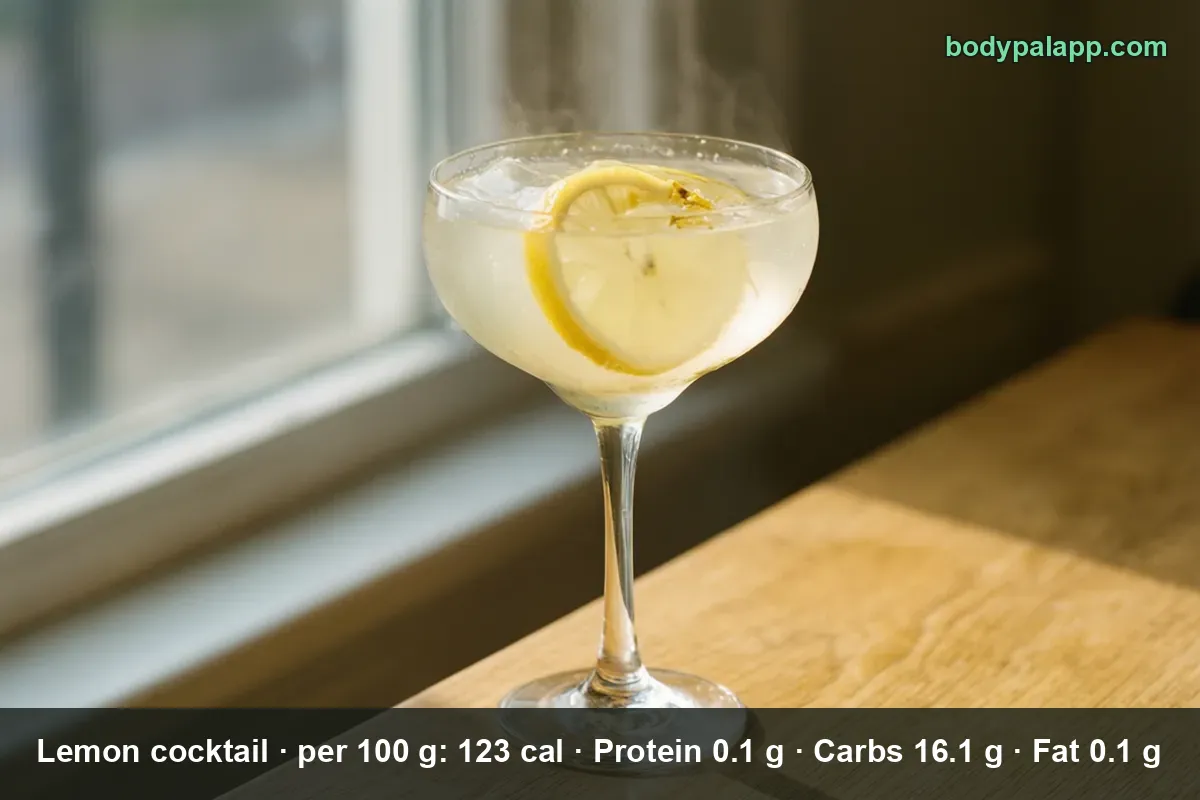
One drink of a lemon cocktail — the Tom Collins build of gin, lemon juice, sugar and soda water — carries 277 calories in a 225 g pour. Per 100 g it runs 123 calories. That sounds mild right up until you notice that a tall glass holds twice what a coupe does, and the recipe never changed.
On this page
- Lemon cocktail quick facts
- US servings from one ounce to a tall glass
- Whiskey sour canned and powder-mix versions
- Sugar and sodium are the rows to watch
- How does a lemon cocktail compare?
- Most popular lemon cocktail brands
- FAQ
Lemon cocktail quick facts
The number on this page comes from the USDA record for Tom Collins, FNDDS 2710653. That is the finished drink in the glass — gin, lemon juice, sugar syrup and soda water, already diluted — rather than a concentrate or a mixer bottle. It also carries a household serving, "1 drink" at 225 g, which is close to what a bartender actually hands you.
If your drink is a whiskey sour instead of a Tom Collins, the numbers below still hold. FNDDS lists whiskey sour, 2710654 at the same 123 calories per 100 g, because the sour build is the same lemon-and-sugar base with a different spirit at the same strength. That is not a database error; it is two drinks landing in the same place.
| Nutrient | Per 100 g | Per 1 drink (225 g) | % Daily Value |
|---|---|---|---|
| Calories | 123 | 277 | — |
| Total fat | 0.08 g | 0.2 g | 0% |
| Saturated fat | 0.01 g | 0.0 g | 0% |
| Carbohydrate | 16.11 g | 36.2 g | 13% |
| Dietary fiber | 0 g | 0 g | 0% |
| Total sugars | 16.11 g | 36.2 g | — |
| Protein | 0.08 g | 0.2 g | 0% |
| Sodium | 77 mg | 173 mg | 8% |
% Daily Value is based on a 2,000-calorie diet.
Verified nutrition data
Numbers on this page come from USDA FoodData Central, the U.S. Department of Agriculture’s food composition database, and from manufacturer labels where a branded product is named. Last verified September 2026. How we verify our data →
Two rows you would see on a bottle label are missing here on purpose. USDA does not publish added sugars or trans fat for these FNDDS cocktail records, so there is nothing to print and nothing to convert into a percentage. Cholesterol is 0 mg and potassium is 50 mg per drink, about 1% of the Daily Value, which is as close to nutritionally empty as a 277-calorie serving gets.
Total sugars have no Daily Value on the US label either, which is why that cell is a dash. The full list of reference amounts sits on the FDA's Daily Value page.
US servings from one ounce to a tall glass
| Serving | Weight | Calories |
|---|---|---|
| 1 fl oz | 30 g | 37 kcal |
| 1 oz by weight | 28.4 g | 35 kcal |
| One coupe glass, 4 fl oz | 120 g | 148 kcal |
| One drink, USDA household size | 225 g | 277 kcal |
| One tall glass, 8 fl oz | 240 g | 295 kcal |
| Per 100 g | 100 g | 123 kcal |
Only two of those lines come straight from USDA: the 225 g drink and the 1 fl oz measure at 37 calories. The coupe, the tall glass and the ounce by weight are our own arithmetic from the USDA 100 g figure, not USDA servings.
That gap between glasses is the single most useful thing on this page. The same drink, poured the same way, is 148 calories in a 4 fl oz coupe and 295 in an 8 fl oz tall glass — almost exactly double, with no change to the ratio of gin to lemon to sugar. People tinker with the recipe when they want to save calories. The glassware does far more of the work.
One more trap worth naming: fluid ounces and ounces by weight are not the same thing here. A fluid ounce of this drink weighs about 30 g, so the 1 oz weight line lands two calories lower. It is a rounding-level difference for one ounce and a real one by the time you are logging a 12 oz highball.
Whiskey sour canned and powder-mix versions
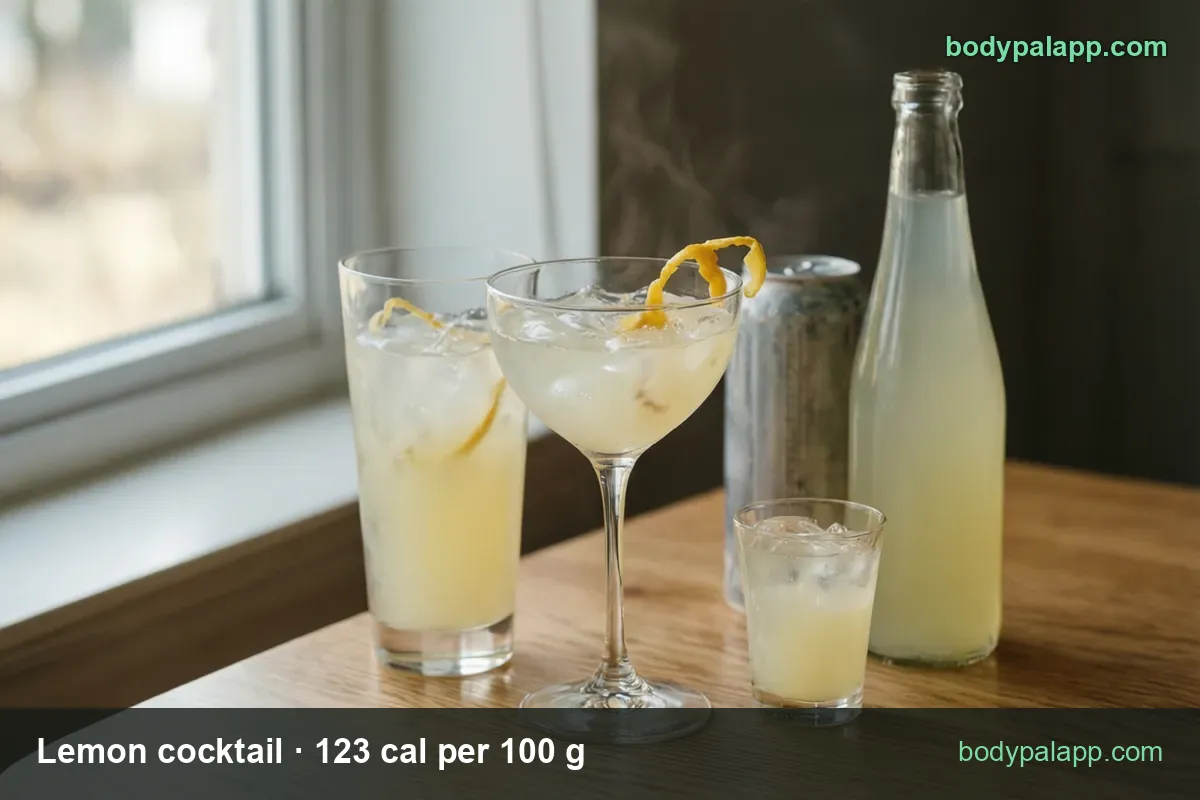
Lemon cocktails split less by flavor than by how they were built. Here is every USDA record for the family, each with its own serving.
| Version | Per 100 g | Typical serving | Calories |
|---|---|---|---|
| Tom Collins, the main record | 123 kcal | 1 drink, 225 g | 277 kcal |
| Whiskey sour, FNDDS | 123 kcal | 1 drink, 225 g | 277 kcal |
| Whiskey sour from bottled mix | 153 kcal | 1 drink, 225 g | 344 kcal |
| Whiskey sour, recipe with 2 oz mix and 1.5 oz whiskey | 149 kcal | 1 portion, 106 g | 158 kcal |
| Whiskey sour from powder mix | 164 kcal | 1 drink, 225 g | 369 kcal |
| Canned whiskey sour | 119 kcal | 1 can, 6.8 fl oz (209 g) | 249 kcal |
| Bottled sour mix, no alcohol | 87 kcal | 2 fl oz, 65 g | 57 kcal |
The powder-mix build is the heaviest poured version at 164 calories per 100 g, and at a matched 225 g that is 369 calories against 268 for the canned version scaled to the same size — our arithmetic, since the can's own serving is 209 g and 249 calories. The dry powder itself is 383 calories per 100 g, but nobody drinks it dry; it goes into water, which is what drops the finished drink back down.
The 106 g recipe line looks like a bargain at 158 calories and is not. It is a small, strong pour: 149 calories per 100 g, higher per gram than the Tom Collins, in a glass under half the size. Read the weight column before the calorie column.
Sour mix on its own is the cheapest way to see where the calories live. At 87 calories per 100 g and 57 for a 2 fl oz measure, the mix alone accounts for a solid share of the drink before any liquor is poured. Bottled US mixers run lighter still, since most are sweetened water: ShopRite Tom Collins Mixer is 42 calories per 100 g (151 for a 12 fl oz label serving), Polar Tom Collins 34 (122 per 12 fl oz), and Master of Mixes Whiskey Sour Lemon Juice Mixer 89, or 80 calories in a 3 fl oz pour. Those are mixers, not cocktails — the liquor is still to come.
Sugar and sodium are the rows to watch
Fat and protein are rounding errors in this drink: 0.2 g each per serving, 0% of the Daily Value. Everything that matters is in two rows.
Carbohydrate is 36.2 g in one drink, 13% of the 275 g Daily Value, and every gram of it is sugar. That is roughly nine teaspoons by weight, using 4.2 g to a teaspoon — our own arithmetic, not a USDA figure. There is no fiber to slow any of it down.
Sodium is the surprise. A cocktail reading 173 mg, or 8% of the Daily Value, is not something most people expect from a clear drink; it comes from the soda water and the mix. In salt terms that is less than a tenth of a teaspoon of table salt, so it is not a reason to change drinks. It is a reason not to assume a beverage contributes zero.
For context on how many drinks the federal advice actually covers, the Dietary Guidelines for Americans set moderate drinking at two drinks or less a day for men and one or less for women, and the CDC's alcohol facts page keeps the definitions in one place. Two of these cocktails is 554 calories and 72.4 g of sugars by our own arithmetic — the size of a full meal, with none of the food.
If you are counting and still want the drink, the coupe at 148 calories is the honest lever. Same recipe, half the glass.
How does a lemon cocktail compare?
| Drink | Per 100 g | USDA serving | Calories |
|---|---|---|---|
| Lemon cocktail (Tom Collins) | 123 kcal | 1 drink, 225 g | 277 kcal |
| Margarita | 122 kcal | 1 fl oz, 30 g | 37 kcal |
| Daiquiri | 119 kcal | 1 fl oz, 30 g | 36 kcal |
| Long Island iced tea | 107 kcal | 1 fl oz, 30 g | 32 kcal |
Those three carry only a 1 fl oz USDA measure, so the fair comparison is per gram. Matched at the same 225 g pour, our arithmetic puts the margarita at 275 calories, the daiquiri at 268 and the Long Island iced tea at 241, against 277 for the lemon cocktail.
Our take: the lemon cocktail is the heaviest of the four per gram, but only by one calorie per 100 g over a margarita — a difference nobody will taste or feel. Swapping among these drinks is not a calorie strategy. The Long Island iced tea is the lightest per gram at 107, which is counterintuitive given its reputation, and it is also the one people drink in the largest glasses. Pick the drink you want, then pick the smaller glass; that choice is worth 147 calories, and the swap is worth two.
Most popular lemon cocktail brands in the United States
Ranked by how widely each product appears among foods sold in the United States, from the BodyPal food database of over 3.3 million products. Calories are the figures printed on each Nutrition Facts label, checked against USDA FoodData Central.
| Product | Calories (per 100 g) |
|---|---|
| ShopRite Tom Collins Mixer | 42 cal |
| Polar Tom Collins | 34 cal |
| Master of Mixes Whiskey Sour Lemon Juice Mixer | 89 cal |
| Health-Ade Whiskey Sour Mixer | 34 cal |
| Cocktail Crate Maple Whiskey Sour Craft Mixer | 108 cal |
Brand popularity: BodyPal food database. Nutrition: manufacturer labels / USDA FoodData Central.
Lemon cocktail FAQs
How many calories are in a lemon cocktail?
277 calories for one 225 g drink, based on the USDA Tom Collins record at 123 calories per 100 g. That covers gin, lemon juice, sugar and soda water in a standard pour. Change the glass and the number moves: a 4 fl oz coupe is 148, a full 8 fl oz tall glass 295.
How many calories in a Tom Collins?
277 calories in the USDA 1-drink serving of 225 g. The Tom Collins is the reference build for this page: gin, lemon, sugar, soda water. Almost all of it is sugar and alcohol, since the record lists 36.2 g of carbohydrate and only 0.2 g of protein per drink.
Is a lemon cocktail high in sugar?
One 225 g drink carries 36.2 g of total sugars, and every gram of carbohydrate in the record is sugar. Total sugars have no Daily Value on the US label, so there is no percentage to quote. USDA does not publish added sugars for these FNDDS cocktail records.
How many carbs are in a whiskey sour?
36.2 g of carbohydrate in a 225 g whiskey sour, 13% of the 275 g Daily Value, and all of it counts as sugars. The bottled-mix version is stronger and drier: 153 calories per 100 g, so 344 calories and about 28.8 g of carbohydrate in the same pour by our own arithmetic.
Canned vs homemade lemon cocktail calories?
A 6.8 fl oz can of whiskey sour is 249 calories at 119 calories per 100 g, slightly lighter per gram than the 123 of a poured Tom Collins. The can wins on portion control more than on recipe: it is fixed at 209 g, while a home pour reaches 240 g and 295 calories.
How many calories in sour mix alone?
87 calories per 100 g for bottled sour mix, so a 2 fl oz (65 g) measure is 57 calories before any liquor goes in. Powdered sour mix is 383 calories per 100 g dry, but it gets mixed with water, which is why the finished drink lands near 164 per 100 g.
Which is lower in calories, a margarita or a lemon cocktail?
The margarita, by one calorie per 100 g: 122 against 123. Matched at a 225 g pour that is 275 against 277 by our own arithmetic, a difference nobody would notice. A daiquiri at 119 per 100 g and a Long Island iced tea at 107 are both lighter per gram than either.
Does a bigger glass change the calories?
Yes: 148 calories in a 4 fl oz coupe (120 g) against 295 in an 8 fl oz tall glass (240 g), almost exactly double for the same drink. The recipe never changed, and both numbers are scaled by our own arithmetic from the USDA figure of 123 calories per 100 g.
Similar foods
- Cayman Jack Margarita — 275 cal per glass
- Mango Margarita — 275 cal per drink
- Margarita — 275 cal per drink
- Margarita Cocktail — 275 cal per drink
- Margarita Cutwater — 275 cal per drink
- Skinny Margarita — 146 cal for 4 fl oz
Count it without the math
Point the camera at the glass and BodyPal counts the drink for you, mixer and all.


How long does it take to burn off 277 kcal of lemon cocktail?
One drink (225 g) is 277 kcal. Enter your weight and the amount you ate to see how long it takes you to burn that off:
lb
| Activity | Time to burn 277 kcal |
|---|---|
| Walking, brisk | 55 min |
| Cycling, moderate | 35 min |
| Swimming, moderate | 40 min |
| Jogging | 33 min |
| Weight training, moderate | 1 hr 2 min |
Times are for a 155 lb adult at a steady pace; change the weight to see yours. The amount is set to the portion in the text (225 g); change it to what you actually ate. BodyPal works this out from your steps automatically.
Burning it off is one side of it. The other is knowing your number: work out how many calories you need a day, with macros and a goal date.