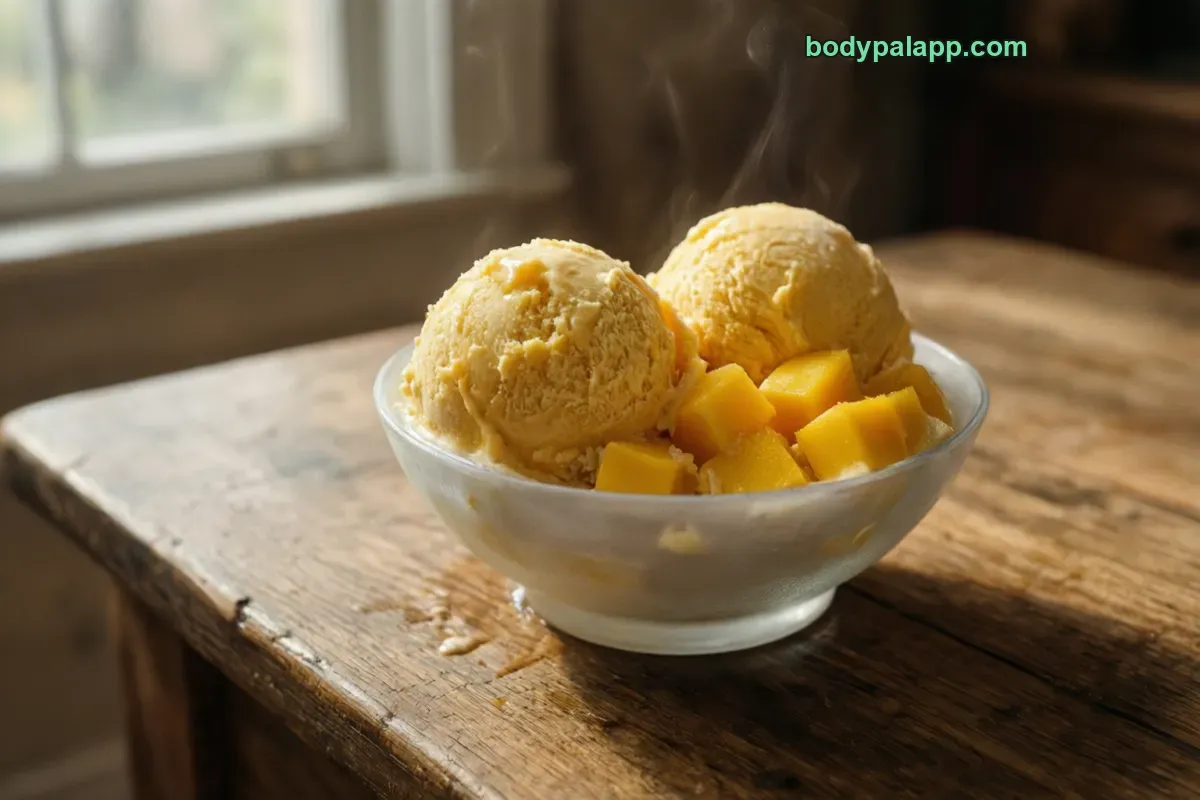
Mango ice cream calories come to 250 for a 1/2 cup (105 g) serving and 238 per 100 g. The number to notice is how the energy splits: fat supplies 47% and carbs 48%, while protein brings only 5%. A scoop tastes like fruit, but it eats like a rich cream dessert.
250kcal
1 half cup · 105 g, packaged, per label
5%protein
3 gProtein
30 gCarbs
13 gFat
How to burn off 250 kcal
—Walking, brisk
—Jogging
—Cycling, moderate
—Swimming
Skip the math. BodyPal counts these calories from your steps and workouts automatically.
Nutrition facts
Packaged, per label · per 105 g
Calories
250 kcal
Protein
3 g
Carbohydrate
30 g
Fat
13 g
Saturated fat
8 g
Cholesterol
55 mg
Sodium
50 mg
Source: USDA FoodData Central
🛡️
Verified nutrition data
Numbers on this page come from USDA FoodData Central, the U.S. Department of Agriculture’s food composition database, and from manufacturer labels where a branded product is named. Last verified September 2026. How we verify our data →
Mango ice cream: calories, protein and sodium by serving
Percent of daily value uses the FDA reference of 2,000 kcal a day.
Serving
kcal
Protein
Carbs
Fat
Sodium
% DV kcal
1/2 cup (105 g)
250
3 g
30 g
13 g
50 mg
12%
100 g
238
2.9 g
28.6 g
12.4 g
48 mg
12%
3 × 1/2 cup (105 g)
750
9 g
151 mg
5 × 1/2 cup (105 g)
1,250
15 g
252 mg
A half cup is 250 calories, and bowls rarely stop there
The label serving is 1/2 cup, or 105 g, and it carries 250 calories. That is 12% of the daily calorie value used on this page, which is reasonable for a dessert. The catch is that few people scoop a true half cup. A loose, heaped scoop into a cereal bowl lands well above it without looking like much.
The totals climb fast. Two half-cup servings, 210 g, reach 500 calories. Three servings, 315 g, reach 750. Finish 525 g straight from the container and you are at 1,250 calories, more than half of a full day's calorie value, in one sitting on the couch.
If you track your intake, weigh the first few bowls on a kitchen scale so you learn what 105 g actually looks like in your own dishes. After that, eyeballing gets far more honest. BodyPal can also log a bowl from a photo, which helps on nights when the scale stays in the drawer.
Fat and sugar carry almost every calorie
Per 100 g, mango ice cream has 12.4 g of fat, 28.6 g of carbohydrate and just 2.9 g of protein. In calorie terms that is 47% from fat, 48% from carbs and 5% from protein. Strip out the cream and the sugar and almost nothing is left to count.
Most of the carbohydrate is sugar: 26.7 g per 100 g, or 28 g in a 1/2 cup serving. Fiber is a token 1.1 g per serving, so the mango flavor does not bring the bulk of whole fruit with it. Protein per serving is 3 g, only 6% of the daily value.
That mix explains why a scoop rarely holds you for long. There is little protein or fiber to slow things down, and the fat makes the portion dense. Treat it as a planned dessert rather than a snack you expect to keep you full until dinner.
Saturated fat is the row to watch, not sodium
Of the 12.4 g of fat per 100 g, 7.6 g is saturated. Against the daily value of 20 g, that is more than a third of the day's allowance in a portion slightly smaller than one serving. Two or three servings take you most of the way to the full amount or past it.
Cholesterol sits at 52 mg per 100 g, compared with a daily value of 300 mg. That is a modest share for one serving, but it adds up alongside eggs, meat and cheese elsewhere in the day if you keep an eye on that row.
Sodium is the good news. A 1/2 cup serving has 50 mg, just 2% of the daily value, and even three servings come to 151 mg. If you are watching salt, ice cream is not where it hides. If you are watching saturated fat or sugar, this is the label line to read first.
Plan the scoop instead of fighting it
A single 1/2 cup serving at 250 calories fits into most eating days without drama. The problems start with second helpings and unmeasured bowls, not with the dessert itself. Deciding the portion before you open the freezer does more than any swap.
Because the scoop brings so little protein, it sits best after a meal that already had plenty of it. Serving it in a small cup rather than a large bowl makes 105 g look like a real portion. Adding fresh mango or berries on top stretches the bowl with fruit instead of more ice cream.
If you want the mango flavor for fewer calories, a fruit sorbet is the obvious trade, though you give up the creamy texture. If creaminess is the point, keep the ice cream and keep the serving honest.
How does mango ice cream compare?
Here is how mango ice cream stacks up against mango sorbet, butter pecan ice cream and chocolate soft serve, per 100 g and per usual serving.
Verdict: For fewer calories pick mango sorbet, at 110 per 100 g against 238 here, with almost no fat. If you want a creamy dessert, mango ice cream lands close to butter pecan at 243 and chocolate soft serve at 222 per 100 g, so choose by flavor and keep the portion small.
Mango ice cream FAQs
How many calories are in mango ice cream?
A 1/2 cup serving (105 g) of Haagen-Dazs mango ice cream has 250 calories, or 238 calories per 100 g.
Is mango ice cream good for weight loss?
A half cup has 250 calories, 13.0 g fat and 28.0 g sugar, so it is a calorie-dense dessert.
Mango ice cream vs mango sorbet: which has fewer calories?
Per 100 g, mango ice cream has 238 calories and mango sorbet 110, so the sorbet has less than half the calories.
How much sugar is in mango ice cream?
About 28.0 g of sugar per 1/2 cup (105 g), or 26.7 g per 100 g, with 3.0 g protein per serving.
How many calories are in two scoops of mango ice cream?
Two half-cup servings, 210 g in total, contain 500 calories. That also brings 6 g of protein and 101 mg of sodium. A heaped bowl can easily reach this amount without looking oversized.
How much fat is in mango ice cream?
A 1/2 cup serving has 13 g of fat, and 100 g has 12.4 g, of which 7.6 g is saturated. Fat supplies 47% of the calories, almost the same share as carbs.
Is mango ice cream high in protein?
No. A 1/2 cup serving has 3 g of protein, only 6% of the daily value, and protein supplies just 5% of the calories. It works as a dessert, not a protein snack.
Does mango ice cream have more calories than butter pecan ice cream?
Per 100 g they are almost equal: 238 calories for mango ice cream and 243 for butter pecan. Per usual serving mango is higher, 250 versus 170, because its listed serving weighs more.
How much sodium is in mango ice cream?
A 1/2 cup serving has 50 mg of sodium, just 2% of the daily value. Even three servings stay at 151 mg, so sodium is not the concern here.