Mango sorbet calories come to 220 for 1 cup (200 g) and 110 per 100 g. Nearly all of that energy is sugar. A cup carries 51.6 g of sugars against just 1.6 g of protein and 0.1 g of fat, so the size of your scoop is the only real lever you have.
220kcal
1 cup · 200 g, mango flavor, frozen
3%protein
1.6 gProtein
54 gCarbs
0.1 gFat
How to burn off 220 kcal
—Walking, brisk
—Jogging
—Cycling, moderate
—Swimming
Skip the math. BodyPal counts these calories from your steps and workouts automatically.
Nutrition facts
Mango flavor, frozen · per 200 g
Calories
220 kcal
Protein
1.6 g
Carbohydrate
54 g
Fat
0.1 g
Saturated fat
0 g
Cholesterol
0 mg
Sodium
26 mg
Potassium
56 mg
Iron
0.3 mg
Source: USDA FoodData Central
🛡️
Verified nutrition data
Numbers on this page come from USDA FoodData Central, the U.S. Department of Agriculture’s food composition database, and from manufacturer labels where a branded product is named. Last verified September 2026. How we verify our data →
Mango sorbet: calories, protein and sodium by serving
Percent of daily value uses the FDA reference of 2,000 kcal a day.
Serving
kcal
Protein
Carbs
Fat
Sodium
% DV kcal
1 cup (200 g)
220
1.6 g
54.2 g
0.1 g
26 mg
11%
100 g
110
0.8 g
27.1 g
0.1 g
13 mg
6%
1 bar (80 g)
88
0.6 g
21.7 g
0 g
10 mg
4%
3 × 1 cup (200 g)
660
4.7 g
78 mg
5 × 1 cup (200 g)
1,100
7.9 g
130 mg
A cup is 220 calories, a bar is 88
The default serving here is 1 cup (200 g), which lands at 220 calories, or 11% of the daily calorie value. A 100 g scoop, roughly half a cup, gives 110 calories and 6% of the daily value. A frozen bar of 80 g is the lightest option listed, at 88 calories and 4% of the daily value.
Sorbet goes down fast. It is cold, smooth and light on the tongue, so a second and third scoop rarely feel like much. Two cups (400 g) come to 440 calories, three cups (600 g) reach 660, and working through 1,000 g in one sitting adds up to 1,100 calories. That last number is a full tub eaten on the couch, and it happens more often than people admit.
If you want a hard stop, the bar format does the portioning for you. Scooping into a measured cup works too. Eating straight from the carton almost always means a bigger serving than the one you think you had.
Carbs supply 97% of the calories
The calorie split is blunt: 97% carbs, 3% protein, 0% fat. Per 100 g that works out to 27.1 g of carbs, of which 25.8 g are sugars, plus 0.8 g of protein and 0.1 g of fat. Nearly every calorie in the bowl is sugar.
Fiber barely registers at 0.5 g per 100 g, or 1 g in a cup, even though the flavor comes from mango. Potassium is low too, at 28 mg per 100 g. So sorbet behaves like a sweet, not a fruit serving, and it is best counted that way. A cup supplies 54.2 g of carbs, measured against a daily value of 275 g.
The upside of almost no fat is 0 g of saturated fat and 0 mg of cholesterol, which sets sorbet apart from cream-based desserts. The downside is that, with only 1.6 g of protein per cup, there is little in it to keep you full once the bowl is empty.
Sugar is the row to watch, sodium is not
A cup of mango sorbet carries 51.6 g of sugars, a 100 g scoop 25.8 g, and an 80 g bar 20.6 g. The figures here do not separate fruit sugar from added sugar, so if that distinction matters to you, read the label on the tub you buy. Recipes differ: brands such as Haagen-Dazs Mango Sorbet, Sharon's Mango Sorbet and Lidl Mango Sorbet use different fruit and sugar levels, and the brand table on this page shows how they line up.
Sodium is close to nothing. A cup has 26 mg, which is 1% of the daily value, and 100 g has 13 mg. If you track salt, sorbet is one of the easier desserts to fit in.
So the trade is clear. You give up nothing on fat, cholesterol or sodium, and you spend almost the entire calorie budget on sugar. Whether that is a good deal depends on how much room your day has left.
Treat it as the whole dessert, not a side
Sorbet works best as a planned, single-portion dessert rather than something stacked on top of cake or cookies. A bar at 88 calories or a 100 g scoop at 110 is a modest finish to a meal. A cup at 220 is more like a snack in its own right.
Because it offers 0.8 g of protein per 100 g, it pairs well with something that brings the protein and fiber it lacks. A scoop next to plain yogurt or fresh fruit makes a dessert that holds you longer than sorbet alone. Eating it after a balanced meal, not on an empty stomach, also makes a small portion feel like enough.
If you log what you eat, measure once so you know what your usual scoop weighs. BodyPal can also log mango sorbet from a photo of your bowl, which helps when you are scooping by eye.
How does mango sorbet compare?
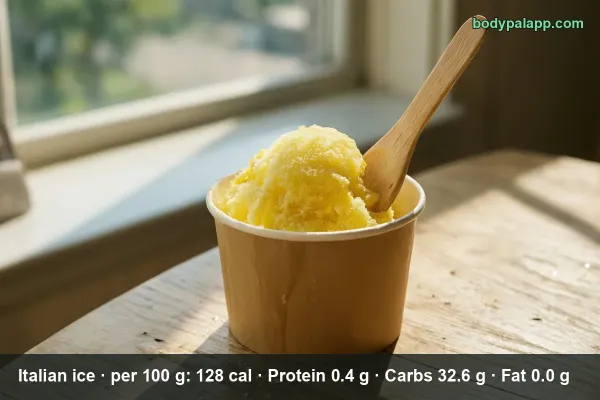
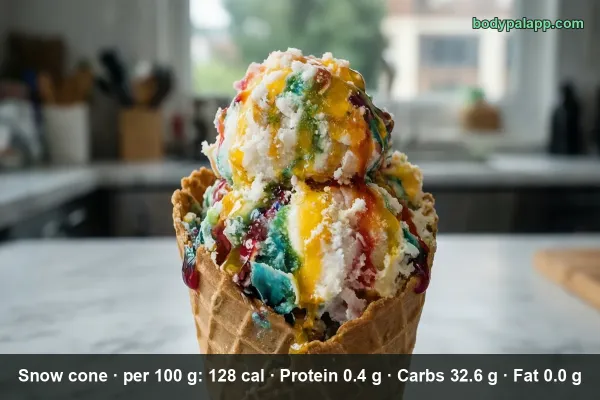
Here is mango sorbet next to italian ice, snowcone and Pinkberry frozen yogurt, per 100 g and per usual serving.
Verdict: For the fewest calories, mango sorbet wins at 110 per 100 g against 128 for italian ice or a snowcone and 159 for Pinkberry frozen yogurt. If you want something more filling, Pinkberry brings 4 g of protein per 100 g versus sorbet's 0.8 g, but its 175 g cup costs 278 calories.
Most popular mango sorbet brands in the United States
Ranked by popularity in the BodyPal database
# Productkcal / 100 g
1Sharon's Mango Sorbet2/3 cup · 129 g116 kcal
2Open Nature Mango Sorbet2/3 cup · 141 g113 kcal
3Lidl Mango Sorbet2/3 cup · 96 g115 kcal
4Absolute Fruit Mango Sorbet2/3 cup · 136 g132 kcal
5Haagen-Dazs Mango Sorbet2/3 cup · 151 g132 kcal
6Simply Balanced Mango Sorbet1/2 cup · 89 g124 kcal
7Private Selection Mango Sorbet2/3 cup · 141 g128 kcal
A one cup scoop is 220 calories and a half cup is 110 calories. Per 100 g mango sorbet has 110 calories.
Is mango sorbet good for weight loss?
It is nearly fat free at 0.05 g of fat per 100 g, so a half cup is 110 calories. The same 100 g still carries 25.8 g of sugar.
Mango sorbet vs Italian ice: which has fewer calories?
Mango sorbet has 110 calories per 100 g and Italian ice has 128. A full cup of sorbet comes to 220 calories.
How much sugar is in mango sorbet?
Per 100 g there are 25.8 g of sugar within 27.1 g of total carbs. A one cup serving works out to 51.6 g of sugar.
How many calories are in a mango sorbet bar?
An 80 g mango sorbet bar has 88 calories, 4% of the daily value. It carries 20.6 g of sugars, 0.6 g of protein and 0 g of fat, making it the smallest portion listed here.
How many calories are in two cups of mango sorbet?
Two cups (400 g) of mango sorbet come to 440 calories. That portion also has 3.2 g of protein and 52 mg of sodium, so nearly all of the energy is still sugar.
How much protein is in mango sorbet?
A cup of mango sorbet has 1.6 g of protein, 3% of the daily value. Per 100 g it is 0.8 g, so protein supplies just 3% of the calories.
Does mango sorbet have fat or cholesterol?
Mango sorbet has 0.1 g of fat per 100 g, 0 g of saturated fat and 0 mg of cholesterol. Fat contributes 0% of its calories; carbs supply 97%.
Is mango sorbet high in sodium?
No. A cup of mango sorbet has 26 mg of sodium, 1% of the daily value, and 100 g has 13 mg. It is one of the lowest-sodium desserts you can pick.
Does mango sorbet have fiber?
Very little. A cup of mango sorbet has 1 g of fiber and 100 g has 0.5 g, against a daily value of 28 g, so it does not count toward your fiber for the day.