
How many calories are in Italian ice?
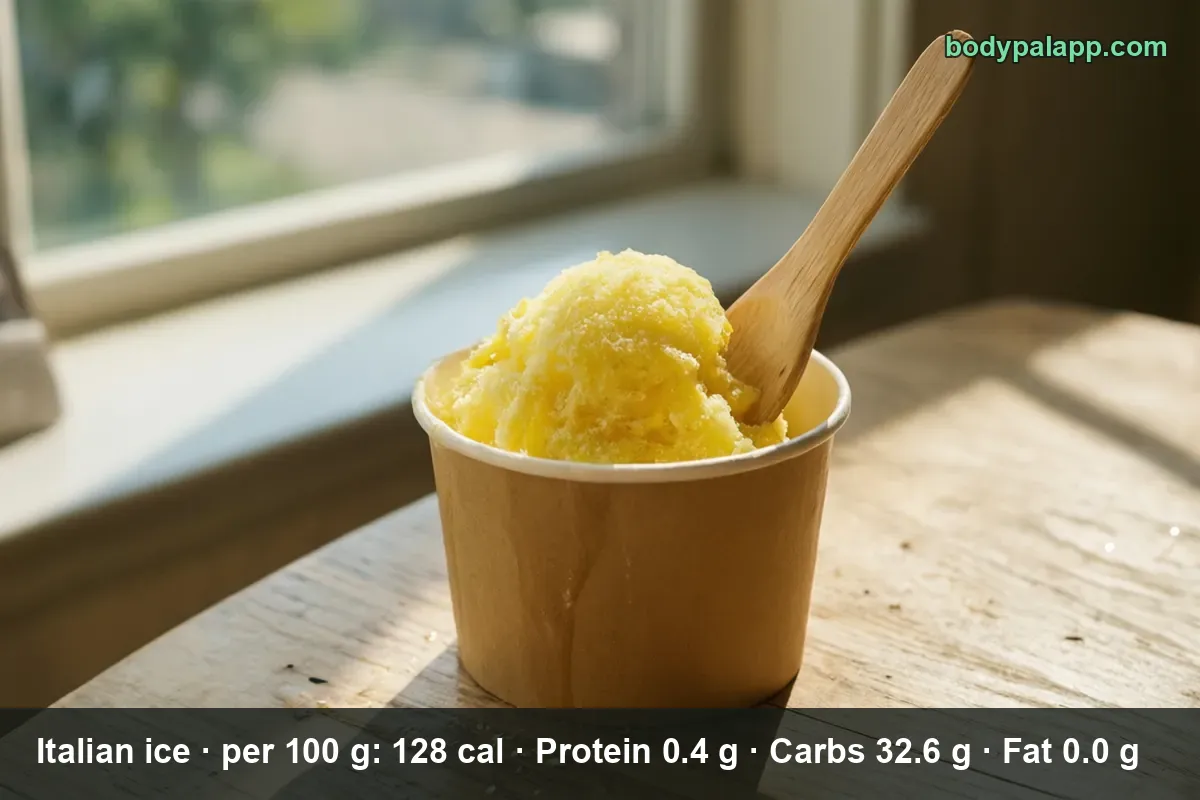
A 1-cup serving of Italian ice weighs 130 g and carries 166 calories. Per 100 g the USDA figure is 128 calories. There is no fat, no dairy and essentially no protein in it, which means the entire number is sugar syrup and water in a paper cup.
On this page
- Italian ice quick facts
- US servings, from one ounce to a full cup
- No sugar added, restaurant-made and the retail cup
- Carbs are the only row that moves
- How does Italian ice compare?
- Most popular italian ice brands
- FAQ
Italian ice quick facts
The row behind every number here is FNDDS 2710317, "Italian Ice", from the 2021-2023 survey release. It is the one that matches what a person is actually holding: a standard sweetened water ice, scooped or squeezed into a cup, sold at a stand or pulled from the freezer aisle. It also comes with household measures already attached, a cup and an individual container, so the serving math starts from a USDA portion rather than a guess.
Two other USDA rows exist for this food and neither one fits the search. The restaurant-prepared record is a thinner syrup with more water in it, and the no-sugar-added record is a different product entirely. Both get their own section further down instead of being blended into an average.
| Nutrient | Per 100 g | Per 1 cup (130 g) | % Daily Value |
|---|---|---|---|
| Calories | 128 | 166 | — |
| Total fat | 0 g | 0 g | 0% |
| Saturated fat | 0 g | 0 g | 0% |
| Carbohydrate | 32.6 g | 42.4 g | 15% |
| Dietary fiber | 0 g | 0 g | 0% |
| Total sugars | 32.6 g | 42.4 g | — |
| Protein | 0.4 g | 0.5 g | 1% |
| Sodium | 22 mg | 29 mg | 1% |
% Daily Value is based on a 2,000-calorie diet.
Verified nutrition data
Numbers on this page come from USDA FoodData Central, the U.S. Department of Agriculture’s food composition database, and from manufacturer labels where a branded product is named. Last verified September 2026. How we verify our data →
There is no added sugars row above, because this FNDDS edition does not publish added sugars for the record at all. Trans fat is missing for the same reason, though with 0 g of total fat the label figure would be zero anyway. Cholesterol is 0 mg per cup and potassium is 4 mg, which rounds to 0% of the Daily Value and is the reason neither earns a line in the table. Sodium at 29 mg per cup is roughly one-eightieth of a teaspoon of table salt.
US servings, from one ounce to a full cup
Italian ice is sold by the cup, and the cup is where people get tripped up. A stand's "small" is often closer to 6 ounces of volume than a measuring cup, and a retail container is a different weight again. Two of the servings below come straight from USDA household measures; the half cup and the ounce are ours.
| Serving | Weight | Calories |
|---|---|---|
| 1 oz | 28.4 g | 36 kcal |
| 1/2 cup | 65 g | 83 kcal |
| 1 cup | 130 g | 166 kcal |
| 1 individual container | 130 g | 166 kcal |
| Per 100 g | 100 g | 128 kcal |
The 1-cup and 1-container lines are USDA household measures for record 2710317, and they land on the same 130 g. The half cup and the ounce are our own arithmetic from the USDA 100 g figure, not USDA servings, scaled straight down at 128 calories per 100 g.
That ounce line is worth keeping in your head. A tasting spoonful of Italian ice is a rounding error, but the cup adds up quickly, and there is nothing in the food to slow you down between spoonfuls. No fat, no protein and no fiber means no brake.
No sugar added, restaurant-made and the retail cup
| Version | Per 100 g | Typical serving | Calories |
|---|---|---|---|
| Italian ice, standard | 128 kcal | 1 cup (130 g) | 166 kcal |
| No sugar added | 24 kcal | 1 cup (130 g) | 31 kcal |
| Restaurant-prepared | 53 kcal | 1/2 cup (116 g) | 62 kcal |
| Luigi's Real Italian Ice, Cherry | 74 kcal | 1 container (135 g) | 100 kcal |
No sugar added is the biggest single lever on this page. At 24 calories per 100 g it is a fifth of the standard version, and the same 130 g cup drops from 166 calories to 31. Carbohydrate falls to 5.92 g per 100 g and sugars to 1.52 g, because sweeteners are doing the work the syrup used to do. Texture suffers a little; the calorie difference is not subtle.
Restaurant-prepared Italian ice, the SR Legacy record, runs 53 calories per 100 g. That is a thinner syrup with more water frozen into it, and a half-cup scoop of it is 62 calories. Same food category, less than half the density of the survey record, which is exactly why averaging the two would produce a number that describes nothing you can buy.
The retail cup is not the cup in the table. A Luigi's Real Italian Ice cherry container weighs 135 g and is 100 calories, because the retail product is 74 calories per 100 g against 128 for the generic record. Across the six Luigi's flavors with gram weights on file, the density runs from 67 calories per 100 g for the lemon and cherry cup to 113 for chocolate, so the orange container is 141 calories and the chocolate one 150. Log the container in front of you, not the category.
Carbs are the only row that moves
Look at the Daily Value column and almost every line is a zero. Total fat 0%, saturated fat 0%, fiber 0%, sodium 1%, protein 1%, and cholesterol is a zero too. For a frozen dessert that is unusual, and it is the honest argument in Italian ice's favor: if you are watching saturated fat or sodium, this is the freezer-aisle pick that costs you nothing on either row. The FDA's Daily Value reference puts saturated fat at 20 g and sodium at 2,300 mg per day; a cup of Italian ice spends none of the first and about a hundredth of the second.
Carbohydrate is the one row doing anything. A cup is 42.4 g, or 15% of the Daily Value, and all 42.4 g of it are sugars, since the record contains no fiber and no starch worth counting. USDA does not publish added sugars for this record, so there is no way to line the cup up against the 50 g Daily Value for added sugars, and we are not going to substitute the total sugars figure for it. What can be said plainly: the Dietary Guidelines advise keeping added sugars under 10% of daily calories, and a sweetened water ice is close to pure sweetener by weight.
The practical read is that Italian ice behaves like a beverage, not like a dessert with structure. There is no protein and no fat to carry it, so it lands as sugar and then it is gone. Pairing it with something that has staying power, the way MyPlate frames a snack around protein and fiber, is more useful than trying to make the cup itself filling.
How does Italian ice compare?
| Frozen treat | Per 100 g | US serving | Calories |
|---|---|---|---|
| Italian ice | 128 kcal | 1 oz (28.4 g) | 36 kcal |
| Snow cone | 128 kcal | 1 oz (28.4 g) | 36 kcal |
| Sorbet | 110 kcal | 1 oz (28.4 g) | 31 kcal |
| Frozen fruit juice bar | 106 kcal | 1 oz (28.4 g) | 30 kcal |
Our take: Italian ice and the snow cone are the same food with different ice crystals, 128 calories per 100 g apiece, and USDA gives them identical macros down to the 22 mg of sodium. Sorbet and the juice bar are the two lighter options here, but only by about 20 calories per 100 g, and the gap between any of these four is smaller than the gap between a small cup and a large one. For weight control, pick by portion size, not by which sign is over the window. For anything resembling satiety, none of the four qualifies; the frozen fruit juice bar at least arrives pre-portioned on a stick at 106 calories per 100 g, which is the only built-in stopping point in the table.
Most popular italian ice brands in the United States
Ranked by how widely each product appears among foods sold in the United States, from the BodyPal food database of over 3.3 million products. Calories are the figures printed on each Nutrition Facts label, checked against USDA FoodData Central.
| Product | Calories (per 100 g) |
|---|---|
| Luigi's Real Italian Ice Cherry | 74 cal |
| Luigi's Real Italian Ice Lemon & Cherry | 67 cal |
| Luigi's Real Italian Ice Cherry & Lemon Blue Raspberry Swirl | 79 cal |
| Luigi's Real Italian Ice Orange | 97 cal |
| Luigi's Real Italian Ice Chocolate | 113 cal |
| Luigi's Real Italian Ice Mango | 73 cal |
Brand popularity: BodyPal food database. Nutrition: manufacturer labels / USDA FoodData Central.
Italian ice FAQs
How many calories are in Italian ice?
A 1-cup serving of Italian ice is 166 calories, and the USDA figure per 100 grams is 128 calories. That is a sweetened water ice with no fat, no dairy and almost no protein, so nearly every calorie in the cup arrives as sugar syrup.
How many calories in a cup of Italian ice?
One cup weighs 130 grams and carries 166 calories, along with 42.4 grams of carbohydrate. Half a cup, 65 grams, is 83 calories by our own arithmetic from the USDA 100-gram figure. Most shop cups sit between those two numbers, so weigh yours once and log it.
How many calories in a Luigi's Italian ice?
A Luigi's Real Italian Ice cherry cup, 135 grams, is 100 calories, or 74 calories per 100 grams, well under the 128 of the generic USDA record. The orange cup is 141 and the chocolate one 150, so the flavor you grab moves the total by 50 calories.
Italian ice vs sorbet: which has fewer calories?
Sorbet is lighter per gram: 110 calories per 100 grams against 128 for Italian ice. Over a 1-ounce spoonful that is 31 calories versus 36. Sorbet is fruit puree, Italian ice is flavored syrup and water, and sorbet also brings a little more protein at 0.79 grams.
How many carbs are in Italian ice?
A 1-cup serving holds 42.4 grams of carbohydrate, 15% of the Daily Value, and all 42.4 grams are sugars. Per 100 grams that is 32.6 grams. There is no fiber in the record at all, so the carbohydrate count and the sugar count are the same number.
Does Italian ice have fat or dairy?
Zero on both counts: 0 grams of total fat, 0 grams of saturated fat and 0 milligrams of cholesterol in a 1-cup serving. Italian ice is water, sugar and flavoring, which is why it reads 0% Daily Value on every fat row while dairy desserts do not.
How many calories in sugar free Italian ice?
The no-sugar-added USDA record runs 24 calories per 100 grams, so the same 130-gram cup is about 31 calories instead of 166. Carbohydrate falls to 5.92 grams per 100 grams and sugars to 1.52 grams, because sweeteners replace most of the syrup that carries the calories.
How much sugar is in Italian ice?
A 1-cup serving carries 42.4 grams of total sugars, and 100 grams carries 32.6 grams. USDA does not publish added sugars for this record, so we cannot line that figure up against the 50-gram Daily Value for added sugars; the total sugars number is what exists.
Similar foods
- Snow Cone — 256 cal per snow cone
- Frosty — 300 cal per small Frosty
- Chocolate Pudding — 153 cal per snack cup
- Orange Sherbet — 107 cal per half cup
- Mango Sorbet — 220 cal per cup
- Pudding Cup — 100 cal per cup
Count it without the math
Point the camera at the cup and BodyPal counts the Italian ice for you, scoop size and all.


How long does it take to burn off Italian ice?
A 1-cup (130 g) serving is 166 kcal. Enter your weight and the amount you ate to see how long it takes you to burn that off:
lb
| Activity | Time to burn 166 kcal |
|---|---|
| Walking, brisk | 33 min |
| Cycling, moderate | 21 min |
| Swimming, moderate | 24 min |
| Jogging | 20 min |
| Weight training, moderate | 37 min |
Times are for a 155 lb adult at a steady pace; change the weight to see yours. The amount is set to the portion in the text (130 g); change it to what you actually ate. BodyPal works this out from your steps automatically.
One food is easy to picture; a whole day is harder. See how many calories you need a day and what a deficit actually looks like.