
How many calories are in a snow cone?
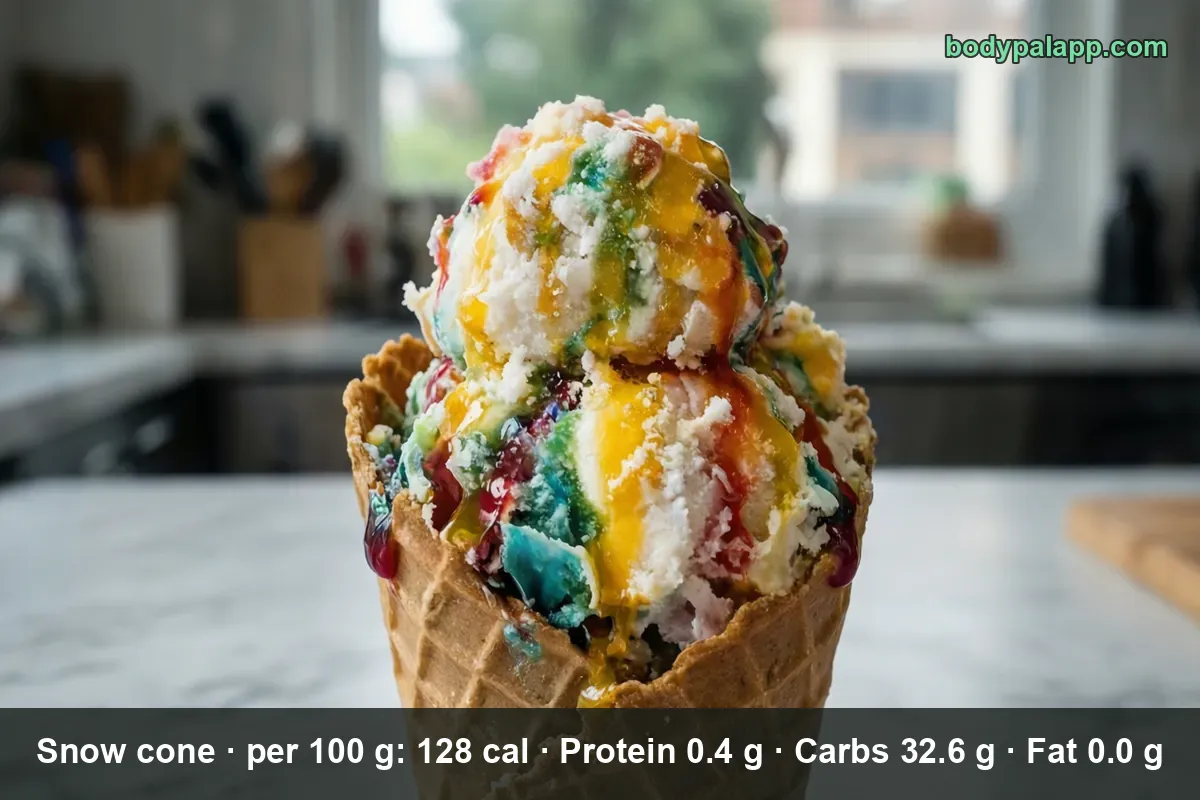
One snow cone, the 200 g cup a stand hands you, carries 256 calories. Per 100 g the syrup-soaked ice runs 128 calories, and all of it is sugar: 65.2 g in that cup. There is no fat, no fiber and almost no protein. Just shaved ice and flavored syrup.
On this page
- Snow cone quick facts
- US servings, from one ounce to a full cone
- Sugar-free snow cones cut it to 48 calories
- Italian ice, sorbet and popsicles
- The sugar row is the whole story
- How does a snow cone compare?
- Most popular snow cone brands
- Snow cone FAQs
Snow cone quick facts
The record used here is FNDDS 2710323, "Snow cone", from USDA's 2021-2023 survey release. It is the syrup-drenched shaved ice you actually hold, and it is the only USDA entry that comes with a ready-made "1 snow cone" portion at 200 g. Neither Foundation Foods nor SR Legacy carries an equivalent.
One thing the record does not cover: the container. USDA is weighing the ice and the syrup, so a paper cone or a foam cup changes nothing, while an edible waffle cone adds its own calories on top of the numbers below.
| Nutrient | Per 100 g | Per 1 snow cone (200 g) | % Daily Value |
|---|---|---|---|
| Calories | 128 | 256 | — |
| Total fat | 0 g | 0 g | 0% |
| Saturated fat | 0 g | 0 g | 0% |
| Carbohydrate | 32.6 g | 65.2 g | 24% |
| Dietary fiber | 0 g | 0 g | 0% |
| Total sugars | 32.6 g | 65.2 g | — |
| Protein | 0.4 g | 0.8 g | 2% |
| Sodium | 22 mg | 44 mg | 2% |
% Daily Value is based on a 2,000-calorie diet.
Verified nutrition data
Numbers on this page come from USDA FoodData Central, the U.S. Department of Agriculture’s food composition database, and from manufacturer labels where a branded product is named. Last verified September 2026. How we verify our data →
Two rows you will not find above. Added sugars is missing because this FNDDS edition does not publish an added-sugars value for the record, and trans fat is absent for the same reason. Cholesterol is 0 mg and potassium is 6 mg in the 200 g cone, both 0% of the Daily Value, so they stay in the prose rather than crowding the table.
US servings, from one ounce to a full cone
| Serving | Weight | Calories |
|---|---|---|
| 1 oz | 28.35 g | 36 kcal |
| 1 fl oz | 30 g | 38 kcal |
| 1 cup | 130 g | 166 kcal |
| One snow cone, stand size | 200 g | 256 kcal |
| Per 100 g | 100 g | 128 kcal |
The 1 cup, 1 fl oz and 1 snow cone lines are USDA household measures attached to the record. The 1 oz row is our own arithmetic from the USDA 100 g figure, not a USDA serving, because people weigh ice by the ounce on a kitchen scale far more often than they scoop it into a measuring cup.
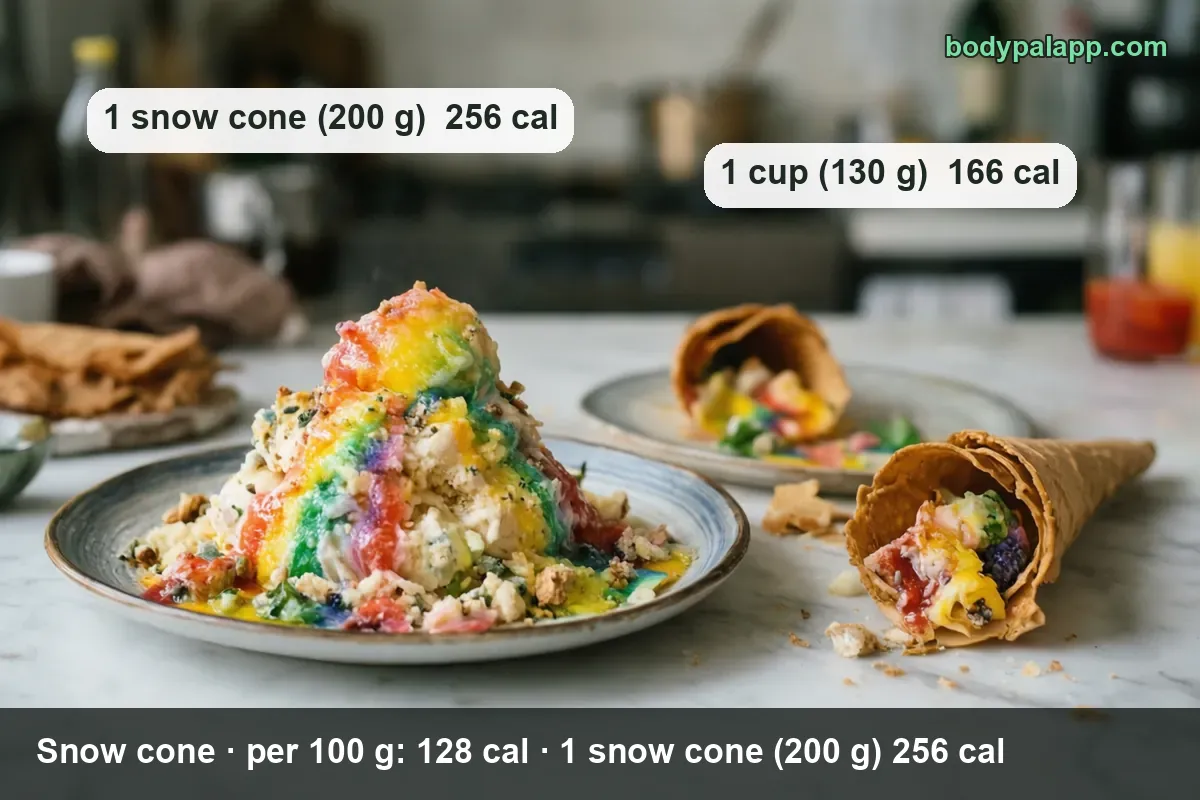
That distinction matters more here than in most foods. A cup of shaved ice is 130 g and 166 calories, but the cone a stand fills is 200 g and 256 calories. Log the cup when you ate the cone and you are 90 calories short, more than a third of the whole thing. Shaved ice packs loosely and unevenly, so the cup measure is a poor stand-in for anything served in a cone.
Sugar-free snow cones cut it to 48 calories
USDA keeps a separate entry for the version made with sweetener instead of sugar syrup: FNDDS 2710324, "Snow cone, no sugar added", at 24 calories per 100 g. The same 200 g cone comes to 48 calories, a drop of 208 from the regular one.
| Version | Per 100 g | Per 200 g cone | Carbohydrate | Total sugars |
|---|---|---|---|---|
| Snow cone, regular syrup | 128 kcal | 256 kcal | 65.2 g | 65.2 g |
| Snow cone, no sugar added | 24 kcal | 48 kcal | 11.8 g | 3.0 g |
Nothing else moves much. Fat stays at 0 g in both, protein is negligible in both, and sodium falls from 44 mg to 20 mg. The entire calorie gap is the syrup. If you are counting and the flavor matters more to you than the sugar, this is one of the rare swaps where the lighter version is not a compromise on volume: you still get the same 200 g of ice.
Packaged snow cone products sit between the two. USDA's Branded database lists AIRHEADS Watermelon White Mystery and Cherry & Blue Raspberry snowcone pouches at 93 calories per 100 g, or roughly 110 calories for the 4 fl oz pouch by our own arithmetic, and ICE BITES Snowcone On The Go at 41 and 47 calories per 100 g depending on flavor. None of them reach the 128 of a syrup-poured stand cone.
Italian ice, sorbet and popsicles
The frozen-treat aisle is where snow cone numbers get interesting, because its closest relative is not lighter at all.
| Frozen treat | Per 100 g | US serving | Calories |
|---|---|---|---|
| Snow cone | 128 kcal | one cone, 200 g | 256 kcal |
| Italian ice | 128 kcal | 1 oz, 28.35 g | 36 kcal |
| Sorbet | 110 kcal | 1 oz, 28.35 g | 31 kcal |
| Popsicle | 79 kcal | 1 oz, 28.35 g | 22 kcal |
Italian ice matches a snow cone exactly, 128 calories and 32.6 g of sugar per 100 g. The difference is how it is built, not what is in it: Italian ice is frozen with the syrup already mixed through, while a snow cone is shaved first and drenched after. The eating experience differs, the arithmetic does not.
Sorbet at 110 gets its sweetness partly from fruit puree rather than straight syrup. A popsicle is the lightest of the four per gram at 79 calories per 100 g, because the syrup is diluted further before it is frozen on the stick. Serving size is what usually settles the comparison in practice, though: a popsicle is a fixed small bar, and a snow cone is however much ice the stand can pile on.
The sugar row is the whole story
Look at the carbohydrate and total sugars rows in the quick facts table. They are the same number, 32.6 g per 100 g. That is unusual, and it tells you there is nothing in the cup but water, syrup and coloring. No starch, no fiber, no fruit solids.
The Daily Value for added sugars is 50 g, per the FDA's Daily Value reference. USDA does not publish an added-sugars figure for this record, so the 65.2 g on the label line is total sugars and cannot be scored against that Daily Value directly. What the numbers do support is simpler: the Dietary Guidelines for Americans advise keeping added sugars under 10% of daily calories, and a food whose carbohydrate and sugar figures are identical is not going to help with that.
The flip side is that the rest of the label is empty in a useful way. Zero fat, zero saturated fat, 0 mg cholesterol, and 44 mg of sodium in the whole cone, which is 2% of the Daily Value. If you are watching sodium or saturated fat rather than sugar, a snow cone costs you almost nothing on those rows. MyPlate files treats like this under the discretionary calories left after the food groups are covered, and 256 is a real bite out of that allowance for something that leaves you no fuller than a glass of water.
How does a snow cone compare?
| Frozen dessert | Per 100 g | US serving | Calories |
|---|---|---|---|
| Snow cone | 128 kcal | one cone, 200 g | 256 kcal |
| Sugar-free snow cone | 24 kcal | one cone, 200 g | 48 kcal |
| Italian ice | 128 kcal | 1 oz, 28.35 g | 36 kcal |
| Sorbet | 110 kcal | 1 oz, 28.35 g | 31 kcal |
Our take: if you are cutting calories, the sugar-free version is the only swap on this page that changes anything meaningfully, at 48 calories for the same volume of ice. Trading a snow cone for Italian ice buys you nothing per gram, and sorbet saves 18 calories per 100 g, which a bigger scoop erases immediately. For satisfaction per calorie, none of these compete with a food that has protein or fat in it. A snow cone is a hot-afternoon pleasure, and 256 calories is a fair price for one on a summer day. It is a poor way to spend 256 calories twice in the same day.
Most popular snow cone brands in the United States
Ranked by how widely each product appears among foods sold in the United States, from the BodyPal food database of over 3.3 million products. Calories are the figures printed on each Nutrition Facts label, checked against USDA FoodData Central.
| Product | Calories (per 100 g) |
|---|---|
| AIRHEADS Watermelon White Mystery Snowcone | 93 cal |
| AIRHEADS Cherry & Blue Raspberry Snowcone Pouches | 93 cal |
| ICE BITES Snowcone On The Go, Strawberry | 41 cal |
| ICE BITES Snowcone On The Go, Wedding Cake | 47 cal |
Brand popularity: BodyPal food database. Nutrition: manufacturer labels / USDA FoodData Central.
Snow cone FAQs
How many calories are in a snow cone?
256 calories for a standard 200 g snow cone, which works out to 128 calories per 100 g. All of it is carbohydrate from the syrup: 65.2 g of sugar per cone, with no fat and 0.8 g of protein. A smaller 1 cup portion, 130 g, is 166 calories.
How many calories in a large snow cone?
USDA does not publish a large size; its biggest listed serving is one snow cone at 200 g and 256 calories. A stand cup holding twice the 130 g cup measure, 260 g, comes to about 333 calories by our own arithmetic from the 128 per 100 g figure.
How much sugar is in a snow cone?
65.2 g of total sugars in a 200 g snow cone, or 32.6 g per 100 g. Sugars and carbohydrates are the same number in the USDA record, because syrup and water are the only things in the cup. The sugar-free version drops to 3.0 g of sugars per 200 g.
Are sugar-free snow cones lower in calories?
48 calories for a 200 g sugar-free snow cone against 256 for the regular one, a drop of 208. USDA lists it separately at 24 calories per 100 g, with 5.92 g of carbohydrate instead of 32.6 g. The sweetener carries almost nothing, so the cup is mostly frozen water.
Snow cone vs Italian ice: which has fewer calories?
Neither: both are 128 calories per 100 g in USDA's records, with the same 32.6 g of sugar. The difference is construction, not calories. Italian ice is frozen with the syrup already mixed in, while a snow cone is ice shaved first and drenched after, so the syrup pools at the bottom.
How many carbs are in a snow cone?
65.2 g of carbohydrate in a 200 g snow cone, 24% of the Daily Value, and every gram of it is sugar. Per 100 g the figure is 32.6 g. There is no fiber to subtract, so net carbs and total carbs are the same number here.
Does a snow cone have any fat or protein?
0 g of fat and 0.8 g of protein in a 200 g cone, which is 2% of the Daily Value for protein and 0% for fat. Cholesterol is 0 mg, sodium 44 mg, potassium 6 mg. The cup is sugar, water and coloring, and nothing else registers.
How many calories in a cup of shaved ice with syrup?
166 calories in a 1 cup serving, which USDA weighs at 130 g. That is 90 calories less than the 200 g cone most stands serve, so measuring by cup understates a real snow cone by more than a third. One fluid ounce, 30 g, is 38 calories.
Similar foods
- Italian Ice — 166 cal per cup
- Frosty — 300 cal per small Frosty
- Chocolate Pudding — 153 cal per snack cup
- Orange Sherbet — 107 cal per half cup
- Mango Sorbet — 220 cal per cup
- Pudding Cup — 100 cal per cup
Count it without the math
Point the camera at the cup and BodyPal counts the ice and the syrup for you.


How long does it take to burn off a snow cone?
One snow cone (200 g) is 256 kcal. Enter your weight and the amount you ate to see how long it takes you to burn that off:
lb
| Activity | Time to burn 256 kcal |
|---|---|
| Walking, brisk | 51 min |
| Cycling, moderate | 32 min |
| Swimming, moderate | 37 min |
| Jogging | 30 min |
| Weight training, moderate | 57 min |
Times are for a 155 lb adult at a steady pace; change the weight to see yours. The amount is set to the portion in the text (200 g); change it to what you actually ate. BodyPal works this out from your steps automatically.
This table assumes you know your daily total. If you do not, the daily calorie calculator works it out from five numbers.