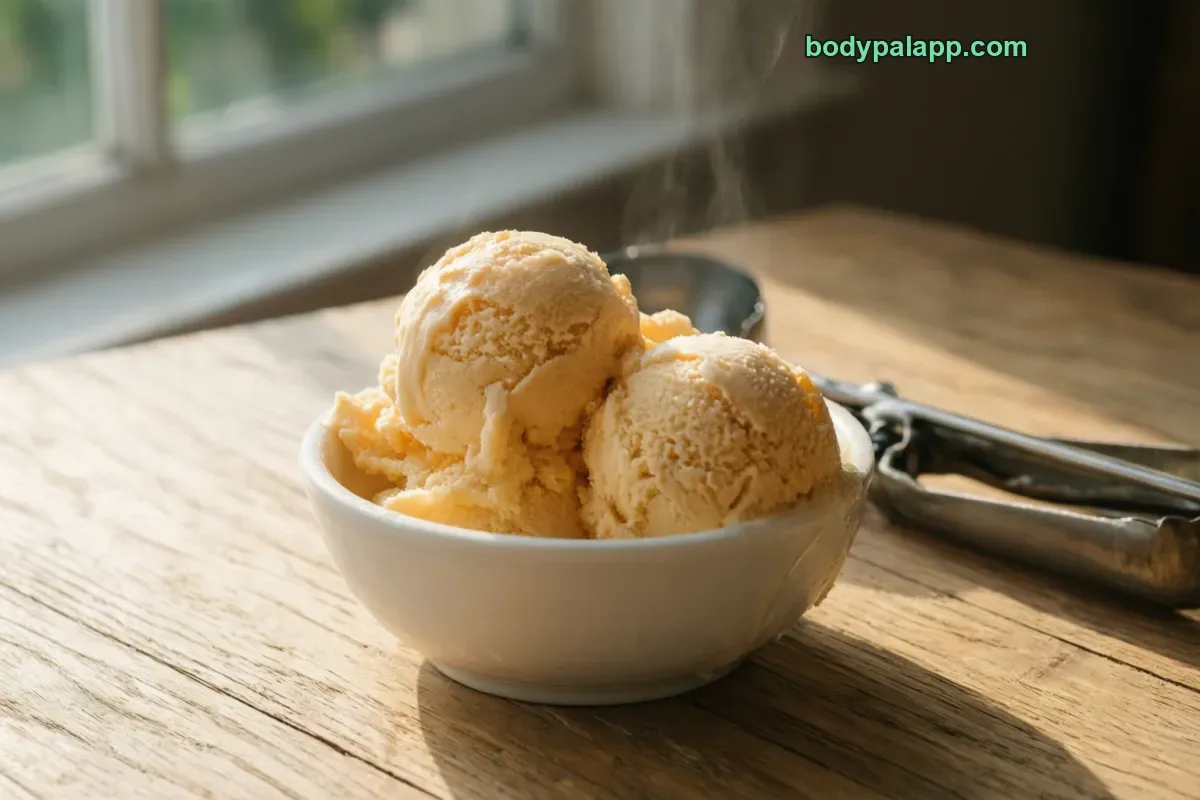
Orange sherbet calories come to 107 for a half cup (74 g) and 144 per 100 g. Almost all of that energy is carbohydrate: 84% of the calories come from carbs, and 18 g of the half cup's 22.5 g of carbs is sugar. Fat and protein barely show up, so the scoop size sets the total.
107kcal
1 half cup · 74 g, frozen dessert
3%protein
0.8 gProtein
22 gCarbs
1.5 gFat
How to burn off 107 kcal
—Walking, brisk
—Jogging
—Cycling, moderate
—Swimming
Skip the math. BodyPal counts these calories from your steps and workouts automatically.
Nutrition facts
Frozen dessert · per 74 g
Calories
107 kcal
Protein
0.8 g
Carbohydrate
22 g
Fat
1.5 g
Saturated fat
0.9 g
Cholesterol
1 mg
Sodium
34 mg
Potassium
71 mg
Iron
0.1 mg
Source: USDA FoodData Central
🛡️
Verified nutrition data
Numbers on this page come from USDA FoodData Central, the U.S. Department of Agriculture’s food composition database, and from manufacturer labels where a branded product is named. Last verified September 2026. How we verify our data →
Orange sherbet: calories, protein and sodium by serving
Percent of daily value uses the FDA reference of 2,000 kcal a day.
Serving
kcal
Protein
Carbs
Fat
Sodium
% DV kcal
1/2 cup (74 g)
107
0.8 g
22.5 g
1.5 g
34 mg
5%
1 bar (66 g)
95
0.7 g
20.1 g
1.3 g
30 mg
5%
100 g
144
1.1 g
30.4 g
2 g
46 mg
7%
3 × 1/2 cup (74 g)
320
2.4 g
102 mg
5 × 1/2 cup (74 g)
533
4.1 g
170 mg
A half cup is 107 calories; the bowl decides the rest
The standard serving is a half cup, or 74 g, and it lands at 107 calories. That is about 5% of the daily calorie value on a nutrition label. A single orange sherbet bar of 66 g comes in a little lower at 95 calories, which makes the bar the easier portion to keep in check because the wrapper ends the serving for you.
Scoops at home rarely stay at a half cup. Two half-cup servings (148 g) reach 213 calories, three (222 g) reach 320, and a generous bowl of five half cups, 370 g, climbs to 533 calories. Since sherbet is light and airy, a heaped bowl can look modest while carrying the calories of a small meal.
If you want a firm number, weigh the first few servings or use a measuring cup until a half cup looks familiar. BodyPal can also log the bowl from a photo, which helps on nights when the carton comes out more than once.
Carbs supply 84% of every spoonful
The calorie split is lopsided. Carbohydrates account for 84% of the energy, fat for 13% and protein for just 3%. Per 100 g that means 30.4 g of carbs against 2 g of fat and 1.1 g of protein.
That small fat number is what separates sherbet from richer frozen desserts. A half cup holds 1.5 g of fat, and saturated fat sits at 1.2 g per 100 g. Cholesterol is close to zero at 1 mg per 100 g. The trade-off is that very little of the dish works to keep you full: a half cup gives you 0.8 g of protein, about 2% of the daily value.
So orange sherbet behaves like a sweet, cold carbohydrate snack rather than a creamy one. It is light on fat, but it is not a source of protein, and you should not expect it to hold off hunger for long.
Sugar is the row to watch, not fat or sodium
Of the 30.4 g of carbs in 100 g, 24.3 g is sugar. In serving terms, a half cup carries 18 g of sugar and a 66 g bar carries 16.1 g. Most of what you taste as orange is sweetness, and that sugar is where nearly all the calories come from.
Fiber is minor at 1 g per half cup, or 1.3 g per 100 g, so it does little to slow things down. Potassium is modest too, at 96 mg per 100 g.
Sodium, on the other hand, is a non-issue. A half cup has 34 mg, about 1% of the daily value, and even the five-scoop bowl stays at 170 mg. If you track sodium, sherbet is an easy fit. If you track added sugar, it is the number to count before you go back for seconds.
Treat it as a measured dessert, not a filler
Because a half cup is only about 5% of daily calories, orange sherbet slots into most days without trouble when it stays a single serving. The catch is that it brings mostly sugar, so it works best after a meal that already covered protein and fiber.
A few practical moves keep it in line. Serve it in a small cup instead of a cereal bowl, or buy bars or cups when you know a carton tends to disappear. Brands such as North Star Orange Sherbet Cups and North Star Orange Sherbet Treats come pre-portioned, while tubs from Hiland, Oberweis or Crystal Creamery need a scoop and some restraint.
Pairing it with fresh fruit stretches the bowl and adds texture without much extra effort. If you are watching calories closely, log the actual grams, since the difference between one half cup at 107 and three at 320 is easy to miss.
How does orange sherbet compare?
Here is how orange sherbet stacks up against Orange Leaf frozen yogurt and orange peel, both per 100 g and per usual serving.
Verdict: For fewer calories per scoop pick orange sherbet: 144 per 100 g against 159 for Orange Leaf frozen yogurt, and a half cup at 107 is far below a 278-calorie cup of froyo. If you want some protein with dessert, the frozen yogurt gives 4 g per 100 g to sherbet's 1.1 g, though it also carries 5.6 g of fat.
Most popular orange sherbet brands in the United States
Ranked by popularity in the BodyPal database
# Productkcal / 100 g
1Lehigh Valley Farms Orange Sherbet4 oz · 85 g141 kcal
2Crystal Creamery Orange Sherbet2/3 cup · 115 g130 kcal
3North Star Orange Sherbet Cups85 g129 kcal
4North Star Orange Sherbet Treats1 tube · 65 g123 kcal
5Dollar Tree Orange Sherbet2/3 cup · 114 g132 kcal
6Umpqua Orange Sherbet2/3 cup · 112 g134 kcal
7Hiland Orange Sherbet2/3 cup · 118 g144 kcal
8Oberweis Orange Sherbet1 tube · 87 g184 kcal
Labels are measured in the same frozen, ready to eat state as the number above, so the spread from 123 to 184 calories per 100 g comes from recipe differences between dairies. Source: manufacturer labels / USDA FoodData Central.
Orange sherbet FAQs
How many calories are in orange sherbet?
A half cup (74 g) has 107 calories and 100 g has 144 calories. A 2.75 fl oz bar (66 g) is 95 calories.
Is orange sherbet good for weight loss?
A half cup stays at 107 calories, which is lighter than most scooped desserts, but sherbet carries 24.3 g of sugar per 100 g, so a 74 g scoop still has 18 g of sugar.
Orange sherbet vs orange frozen yogurt: which has fewer calories?
Sherbet has 144 calories per 100 g against 159 for Orange Leaf frozen yogurt, so a half cup of sherbet is 107 calories instead of 118.
How much sugar and fat are in orange sherbet?
Per 100 g there are 24.3 g of sugar, 2 g of fat and 1.1 g of protein. A half cup (74 g) has 18 g of sugar and 1.5 g of fat.
What are the nutrition facts for orange sherbet?
A half cup (74 g) of orange sherbet has 107 calories, 22.5 g of carbs, 18 g of sugar, 1.5 g of fat, 0.8 g of protein and 34 mg of sodium. Per 100 g it has 144 calories.
Is orange sherbet fattening?
A half cup has 107 calories and only 1.5 g of fat, so it is light per serving. The risk is portion size: five half cups reach 533 calories, mostly from sugar.
Is orange sherbet healthy?
It is low in fat at 2 g per 100 g and low in sodium at 46 mg, but 24.3 g of every 100 g is sugar and protein is just 1.1 g. Treat it as a dessert, not a nutritious snack.
How many calories are in an orange sherbet bar?
A 66 g orange sherbet bar has 95 calories, slightly fewer than the 107 in a half-cup scoop. It also carries 16.1 g of sugar and 1.3 g of fat.
What is the sugar content of sherbet per 100 g?
Orange sherbet has 24.3 g of sugar per 100 g, out of 30.4 g of total carbohydrates. That means sugar makes up most of the carbs, which supply 84% of the calories.