
How many calories are in old fashioned oats?
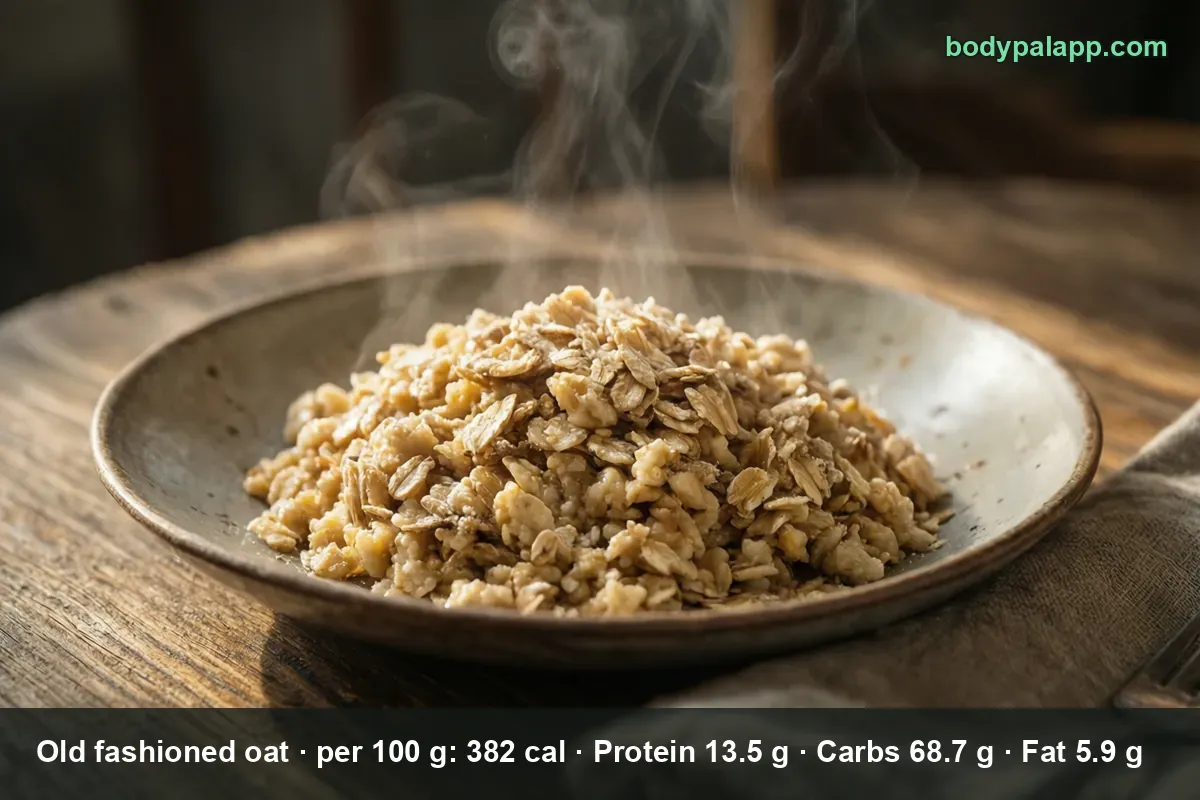
Half a cup of dry old fashioned oats weighs 40 g and carries 153 calories. Dry, per 100 g, the flakes run 382 calories, which reads heavy until you see what happens in the pot: those same 40 g swell into a full bowl of oatmeal and still cost 153, because water has no calories to give.
On this page
- Old fashioned oats quick facts
- US servings, from one ounce to a full cup dry
- Dry oats versus cooked oatmeal
- Which canister you bought barely moves the number
- Protein, potassium and a sodium row at zero
- How do old fashioned oats compare?
- Most popular old fashioned oats brands
- Old fashioned oats FAQs
Old fashioned oats quick facts
The numbers below come from the one Foundation record written for exactly this grain: USDA 2346396, "Oats, whole grain, rolled, old fashioned". That matters, because most oat entries in the database are either instant packets with sugar folded in or generic "oatmeal, cooked" rows that are mostly water. This record is the flake in the canister on your counter, measured dry.
The serving column is 40 g, half a cup dry. That is not an arbitrary choice: it is the label serving printed on every retail canister listed further down, so the arithmetic here lines up with the panel you can read in your own kitchen.
| Nutrient | Per 100 g | Per 1/2 cup dry (40 g) | % Daily Value |
|---|---|---|---|
| Calories | 382 | 153 | — |
| Total fat | 5.89 g | 2.4 g | 3% |
| Carbohydrate | 68.66 g | 27.5 g | 10% |
| Protein | 13.5 g | 5.4 g | 11% |
| Sodium | 0.67 mg | 0 mg | 0% |
| Potassium | 350.1 mg | 140 mg | 3% |
% Daily Value is based on a 2,000-calorie diet.
Verified nutrition data
Numbers on this page come from USDA FoodData Central, the U.S. Department of Agriculture’s food composition database, and from manufacturer labels where a branded product is named. Last verified September 2026. How we verify our data →
Four rows you would expect on a cereal box are missing here, and that is deliberate. USDA's Foundation edition of this record does not publish saturated fat, dietary fiber, total sugars or added sugars for old fashioned oats, so those lines are left out rather than borrowed from a different food. Percent Daily Values follow the FDA reference amounts for the Nutrition Facts label.
US servings, from one ounce to a full cup dry
Oats are the food where the measuring cup does the most damage. A half cup of dry flakes looks stingy in the bottom of a saucepan, so plenty of people pour a full cup, and the breakfast doubles before the water goes in.
| Serving | Weight | Calories |
|---|---|---|
| 1/4 cup dry | 20 g | 76 kcal |
| 1 oz dry | 28 g | 108 kcal |
| 1/2 cup dry, the label serving | 40 g | 153 kcal |
| 1 cup dry | 80 g | 305 kcal |
| Per 100 g dry | 100 g | 382 kcal |
Only the 40 g line is a USDA serving. The quarter cup, the ounce and the full cup are our own arithmetic from the USDA 100 g figure, scaled straight down or up, not separate USDA records. The ounce is worth memorizing if you weigh instead of scoop: 108 calories, and a kitchen scale removes the argument about how packed the cup was.
That full cup deserves a second look. At 305 calories dry, before any milk, it is already the calorie weight of a small meal, and it is the single most common way a "light breakfast" quietly stops being one.
Dry oats versus cooked oatmeal
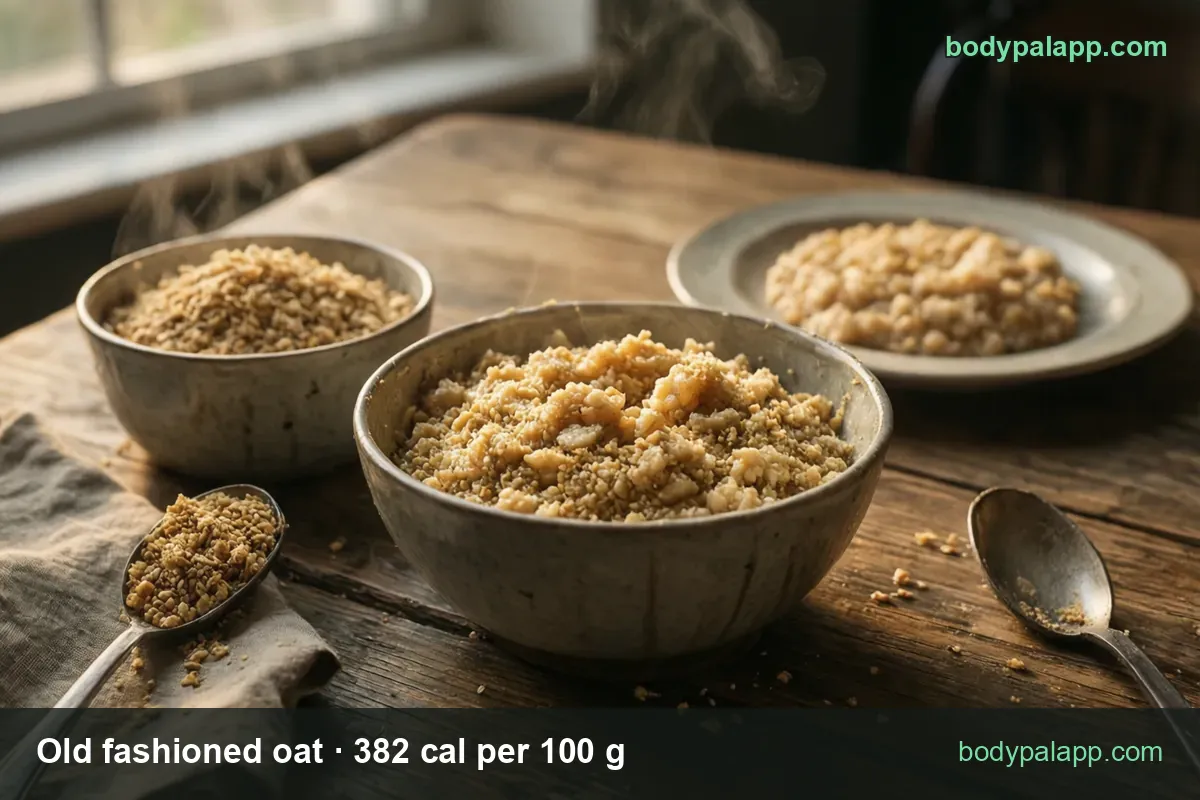
Cook 40 g of dry oats in water and you get roughly a cup of oatmeal that still costs 153 calories. The volume can triple. The calories do not move at all, because everything you added was water. This is the mirror image of the trap in the previous section, and it is why "one cup of oatmeal" and "one cup of oats" are two completely different numbers.
So the only question that matters is what you measured. If you scooped the dry flakes, use 153 for a half cup and 305 for a full cup. If you are looking at a finished bowl and want to reverse-engineer it, ask how much dry oat went in, not how full the bowl looks.
Then count what went on top. Oats themselves are one of the cheaper breakfast bases in calories; the milk, the peanut butter, the honey and the handful of granola are usually the larger half of the bowl. A cup of oatmeal made from half a cup of dry oats is 153 calories of a 350-to-450-calorie breakfast, which leaves real room for the toppings if you spend it on purpose.
Which canister you bought barely moves the number
Brand-to-brand differences in plain rolled oats are small, which is what you would hope for from a single-ingredient food. Quaker Old Fashioned Oats, Great Value, Rollin' Oats and the Publix store brand all file at 375 calories per 100 g on the same 1/2 cup dry (40 g) label serving, so each one lands on 150 calories, three under the 153 of the generic USDA record. Quaker Thick & Hearty Classic Oats reads 366 per 100 g in a 41 g package, which also works out to 150.
The organic canister is the one that reads differently, and only on paper: it lands at 120 calories because its label serving is a third of a cup, 34 g, rather than a half cup. Per 100 g it is 353, about 7.5% below the generic USDA figure of 382 and inside normal variation for a natural grain.
The practical read: swapping brands changes your breakfast by a couple of calories. Swapping scoop sizes changes it by 150.
Protein, potassium and a sodium row at zero
Two rows on the label are more interesting than the calorie line. The first is protein. A 40 g serving carries 5.4 g, which is 11% of the Daily Value, and per 100 g oats hold 13.5 g — more protein by weight than any of the neighboring grains in the table below. For a plant food eaten at breakfast, that is unusually good company, and it is the reason oats hold you longer than a same-calorie bowl of cornflakes.
The second is sodium, and it is essentially zero: 0.67 mg per 100 g, which rounds to 0 mg and 0% of the Daily Value in a 40 g serving. Nothing salty is in the canister. If your oatmeal ends up on the salty side, it came from the pinch you added, the flavored packet, or whatever went on top. If you are watching sodium, plain rolled oats are about as safe a base as a grain gets.
Potassium runs the other way at 140 mg per serving, 3% of the Daily Value. And because these are whole grain flakes, a half cup dry counts toward the whole grain target described at MyPlate; the Dietary Guidelines for Americans ask that at least half of daily grains be whole. Oats are one of the easiest ways to clear that bar before 9 a.m.
How do old fashioned oats compare?
All four of these are dry grains, so an ounce is the honest way to line them up.
| Grain, dry | Per 100 g | US serving | Calories |
|---|---|---|---|
| Old fashioned oats | 382 kcal | 1 oz (28 g) | 108 kcal |
| Bulgur, dry | 372 kcal | 1 oz (28 g) | 106 kcal |
| Quinoa flour | 385 kcal | 1 oz (28 g) | 109 kcal |
| Buckwheat flour | 358 kcal | 1 oz (28 g) | 101 kcal |
Our take: dry grains are dry grains, and the whole spread here is 8 calories per ounce. Choosing between them on calories is wasted effort. Choose on what the macros do instead — oats bring the most protein of the four at 13.5 g per 100 g and the least carbohydrate at 68.66 g, while buckwheat flour is the lightest per ounce but also the thinnest on protein at 8.88 g. If breakfast needs to hold until lunch, the oats are the better buy at nearly the same price.
Most popular old fashioned oats brands in the United States
Ranked by how widely each product appears among foods sold in the United States, from the BodyPal food database of over 3.3 million products. Calories are the figures printed on each Nutrition Facts label, checked against USDA FoodData Central.
| Product | Calories (per 100 g) |
|---|---|
| Quaker Old Fashioned Oats | 375 cal |
| Great Value Old Fashioned Oats | 375 cal |
| Quaker Organic Old Fashioned Oats | 353 cal |
| Quaker Thick & Hearty Classic Oats | 366 cal |
| Rollin' Oats Old Fashioned Oats | 375 cal |
| Publix Old Fashioned Oats | 375 cal |
Brand popularity: BodyPal food database. Nutrition: manufacturer labels / USDA FoodData Central.
Old fashioned oats FAQs
How many calories are in old fashioned oats?
153 calories in the standard half-cup dry serving of 40 g, and 382 calories per 100 g of dry flakes. That figure is for plain whole grain rolled oats with nothing added. Milk, sugar, fruit and nut butter all sit on top of it and are usually the larger part of the finished bowl.
How many calories in 1/2 cup of old fashioned oats?
153 calories for half a cup of dry oats, which weighs 40 g. This is the serving printed on the canister, so the number on the box and the number here describe the same scoop. It brings 27.5 g of carbohydrate, 5.4 g of protein and 2.4 g of fat.
How many calories in 1 cup of dry old fashioned oats?
305 calories for a full cup of dry oats, 80 g, which is exactly double the label serving. That is our own arithmetic from the USDA 100 g figure rather than a listed USDA serving. It is also the most common measuring mistake in oatmeal: a full dry cup is a meal on its own.
How many calories in a bowl of cooked old fashioned oatmeal?
153 calories if the bowl was made from half a cup of dry oats, 40 g, cooked in water. The oats absorb water and swell to about a cup, but water carries no calories, so nothing changes. Count the dry oats you poured, then add whatever you stirred in afterward.
Are old fashioned oats the same as rolled oats?
Yes, and USDA files them under one name: record 2346396 is titled "Oats, whole grain, rolled, old fashioned," at 382 calories per 100 g. Old fashioned is simply the American shelf label for whole oat groats steamed and rolled flat. Any canister marked rolled oats or old fashioned oats uses these numbers.
Old fashioned oats vs quick oats: is there a calorie difference?
Both are 40 g servings of the same rolled grain, so treat them as the same energy. USDA's Foundation data set publishes one rolled-oat record and no separate quick-oats row, so we will not invent a number for the gap. Quick oats are cut and rolled thinner, which changes cooking time and texture, not the grain.
How much protein is in old fashioned oats?
5.4 g of protein in a half-cup dry serving, 11% of the Daily Value, and 13.5 g per 100 g. That beats bulgur at 11.76 g, quinoa flour at 11.92 g and buckwheat flour at 8.88 g per 100 g. Milk or Greek yogurt in the bowl pushes a normal breakfast well past 15 g.
How many carbs are in old fashioned oats?
27.5 g of carbohydrate in a half cup dry, 10% of the Daily Value, and 68.66 g per 100 g. A full dry cup doubles that to 55 g. USDA's Foundation record for this oat does not publish a fiber or sugars breakdown, so we cannot split the carbohydrate line any further here.
Similar foods
- Coffee Liqueur — 175 cal per shot
- Kahlúa — 175 cal for 1.5 fl oz shot
- Cider Donut — 234 cal per medium doughnut
- Aperol — 190 cal per drink
- Cinnamon Whiskey — 126 cal per shot
- Shot Of Fireball — 126 cal per shot
Count it without the math
Point the camera at the bowl and BodyPal counts the oats for you, toppings included.


How long does it take to burn off 153 kcal of old fashioned oat?
Half a cup of dry oats (40 g) is 153 kcal. Enter your weight and the amount you ate to see how long it takes you to burn that off:
lb
| Activity | Time to burn 153 kcal |
|---|---|
| Walking, brisk | 31 min |
| Cycling, moderate | 19 min |
| Swimming, moderate | 22 min |
| Jogging | 18 min |
| Weight training, moderate | 34 min |
Times are for a 155 lb adult at a steady pace; change the weight to see yours. The amount is set to the portion in the text (40 g); change it to what you actually ate. BodyPal works this out from your steps automatically.
Want the bigger picture? Calculate your daily calorie needs — your maintenance figure, a target for losing or gaining, and the date you get there.