
How many calories are in Aperol?
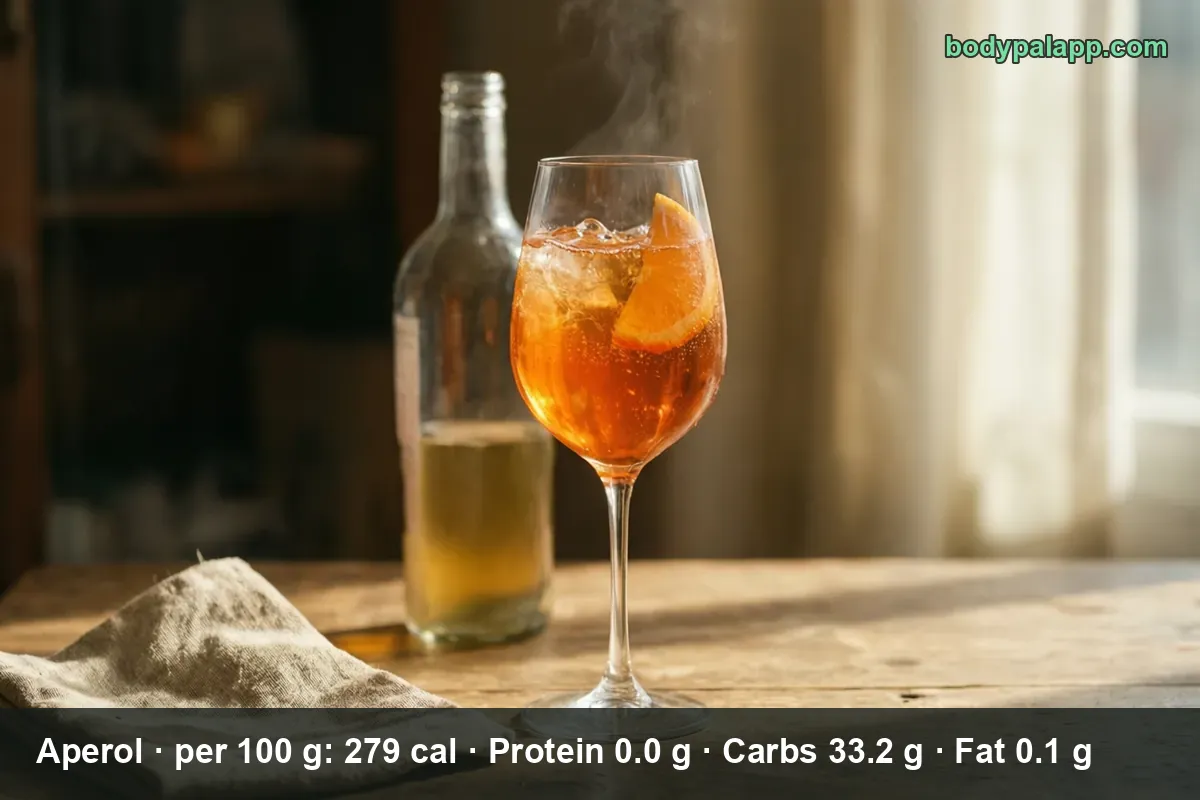
One drink of Aperol — 68 g in USDA's household measure — carries 190 calories, and the liqueur runs 279 calories per 100 g. That is dessert-level density in a glass you sip before dinner. Almost all of it is sugar and alcohol: 33.2 g of carbohydrate per 100 g, zero protein, zero fiber.
On this page
- Aperol quick facts
- US pours, from one ounce to a full drink
- What an Aperol Spritz actually costs
- Cream and coffee liqueurs on the same shelf
- Sugar is half the calories, alcohol is the rest
- How does Aperol compare?
- Aperol FAQs
Aperol quick facts
There is no Aperol row in USDA's database. Searching the index for the brand returns nothing at all, because spirits and aperitifs are labeled under TTB rules rather than FDA nutrition-label rules, so no US bottle of it carries a Nutrition Facts panel to be captured. The closest honest match is the generic FNDDS record Liqueur, fdc_id 2710623 — a sweet liqueur with real US household pours attached to it: a shot, a jigger, a drink. That is the liquid in the glass, described generically.
Treat the numbers below as the profile of a sweet liqueur, not as a transcription of the Aperol label. The one place it likely runs high is strength: Aperol is bottled at 11% ABV, which is gentle for the category, while the generic record covers stiffer bottles. Since alcohol carries calories of its own, the real figure for Aperol is probably a little under 279 per 100 g rather than over it.
| Nutrient | Per 100 g | Per 1 drink (68 g) | % Daily Value |
|---|---|---|---|
| Calories | 279 | 190 | — |
| Total fat | 0.11 g | 0.1 g | 0% |
| Saturated fat | 0 g | 0 g | 0% |
| Carbohydrate | 33.2 g | 22.6 g | 8% |
| Dietary fiber | 0 g | 0 g | 0% |
| Total sugars | 33.27 g | 22.6 g | — |
| Protein | 0 g | 0 g | 0% |
| Sodium | 1 mg | 1 mg | 0% |
% Daily Value is based on a 2,000-calorie diet.
Verified nutrition data
Numbers on this page come from USDA FoodData Central, the U.S. Department of Agriculture’s food composition database, and from manufacturer labels where a branded product is named. Last verified September 2026. How we verify our data →
Two rows you would expect on a US label are missing here. Added sugars and trans fat are not published in this FNDDS release for beverages, so there is nothing to report for either and both rows are left out rather than guessed at. Cholesterol is 0 mg. Potassium is 2 mg per 100 g, which works out to 1 mg in a drink and rounds to 0% of the Daily Value — this is not a mineral you drink Aperol for. The FDA Daily Value reference is what the percentage column is built on.
US pours, from one ounce to a full drink
| Serving | Weight | Calories |
|---|---|---|
| 1 oz | 28 g | 79 kcal |
| 1 fl oz, no ice | 30 g | 84 kcal |
| 1 shot or jigger | 45 g | 126 kcal |
| 2 fl oz pour for a spritz | 60 g | 167 kcal |
| 1 drink | 68 g | 190 kcal |
| Per 100 g | 100 g | 279 kcal |
Three of those come straight from USDA as household measures: the fluid ounce, the shot or jigger, and the drink. The 2 fl oz spritz pour and the 1 oz row are our own arithmetic from the USDA 100 g figure, not USDA servings — a fluid ounce of liqueur weighs a touch more than an ounce on the scale, which is why 30 g and 28 g sit next to each other with different calorie counts.
The gap that catches people is the one between a shot and a drink. Bartenders build a spritz on two ounces, home pours run heavier still, and the USDA "drink" at 68 g is already 64 calories past the 45 g shot. Free-pouring into a big stemmed wine glass is how a 126-calorie measure quietly becomes a 190-calorie one before any wine goes in.
What an Aperol Spritz actually costs
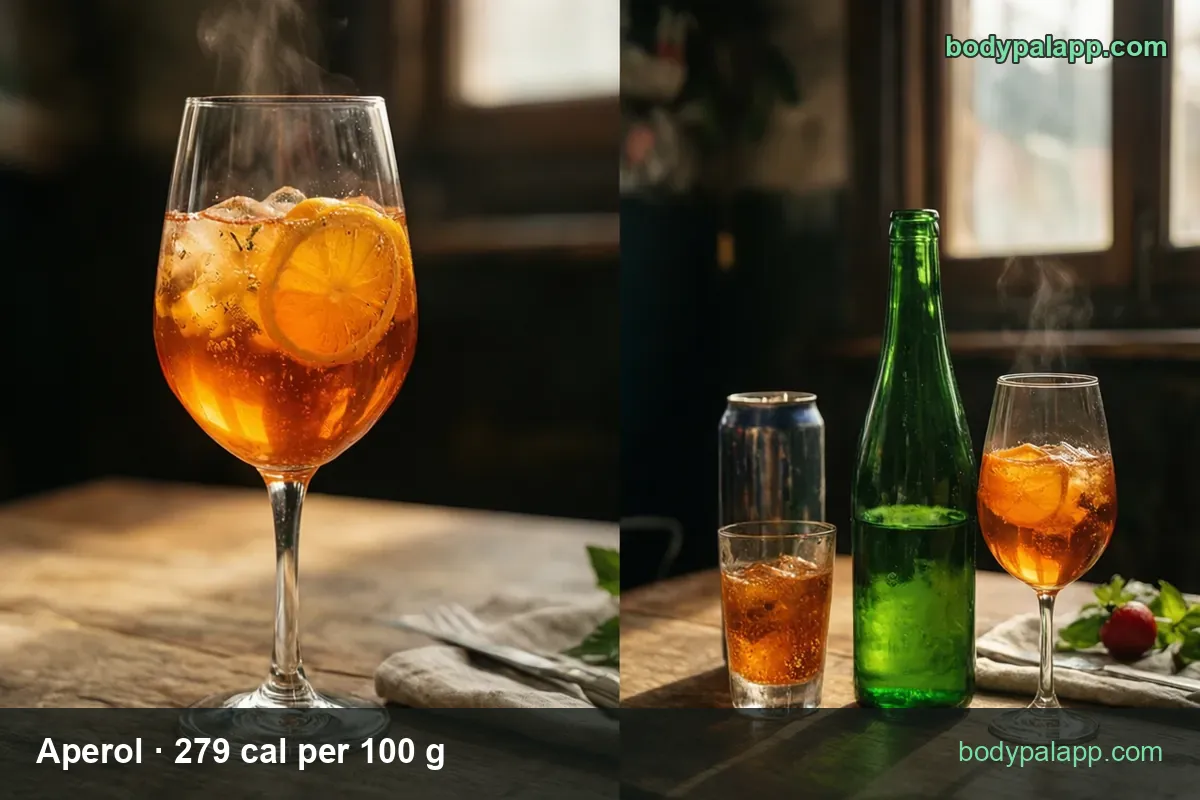
The classic build is three parts prosecco, two parts Aperol, one part soda water. Costed from two USDA records, a 3-2-1 spritz lands at roughly 235 calories: 2 fl oz of Aperol (60 g) is 167, and 3 fl oz of sparkling wine (90 g, at 75 calories per 100 g) adds only 68. The splash of soda is zero. That total is our own arithmetic across two records rather than a single USDA serving.
That ratio is the surprise. The bubbles are the bigger volume in the glass and the smaller number on the ledger — dry sparkling wine carries just 2.31 g of carbohydrate per 100 g, against 33.2 g for the liqueur. Trim the pour and you trim the drink. Going from a two-ounce measure to one ounce takes 83 calories off, more than swapping the wine for plain soda would.
| Component of a 3-2-1 spritz | Per 100 g | In the glass | Calories |
|---|---|---|---|
| Aperol, 2 fl oz | 279 kcal | 60 g | 167 kcal |
| Sparkling wine, 3 fl oz | 75 kcal | 90 g | 68 kcal |
| Soda water, 1 fl oz | 0 kcal | 30 g | 0 kcal |
Cream and coffee liqueurs on the same shelf
Aperol sits in the middle of the liqueur aisle, not at the light end of it. Every generic liqueur record USDA publishes clusters in the same band, and what moves them apart is fat and syrup rather than alcohol.
| Version | Per 100 g | Typical pour | Calories |
|---|---|---|---|
| Aperol, generic sweet liqueur | 279 kcal | 1 drink (68 g) | 190 kcal |
| Cream liqueur | 296 kcal | 1 shot (45 g) | 133 kcal |
| Coffee-flavored liqueur | 336 kcal | 1 shot (45 g) | 151 kcal |
| Coffee liqueur, 63 proof | 308 kcal | 1.5 fl oz (52 g) | 160 kcal |
| Coffee liqueur, 53 proof | 336 kcal | 1.5 fl oz (52 g) | 175 kcal |
The two coffee rows are the clearest lesson on the shelf. The 63-proof bottle is stronger and lands at 308 per 100 g; the 53-proof bottle is weaker and lands at 336. Less alcohol, more sugar to fill the gap, and the weaker bottle ends up the heavier one — 175 calories in a 1.5 fl oz pour against 160. Proof on the label tells you almost nothing about calories on its own.
Cream liqueur is the other instructive case: 296 calories per 100 g, but built differently, with 2.74 g of fat and 1.51 g of saturated fat where Aperol has essentially none. Aperol's 0.11 g of fat per 100 g is a rounding error. Its calories are pure sugar and pure ethanol.
Sugar is half the calories, alcohol is the rest
Run the arithmetic on the 100 g figure and the split falls out cleanly. Carbohydrate is 33.2 g, which at four calories a gram accounts for about 133 of the 279 — a little under half. The remaining 146 come from alcohol, which runs about seven calories per gram and has no Daily Value, no label row, and no percentage column to warn you about it. This is our own calculation from the USDA record, and it explains why a drink with no fat and no protein still reads like a slice of cake.
Per drink, that means roughly 90 of the 190 calories are sugar and about 100 are alcohol. The 22.6 g of carbohydrate is 8% of the Daily Value for carbohydrate, and none of it is offset by fiber, because there is none. A 45 g shot works out to about 15 g of carbohydrate by the same scaling.
Sodium is a non-issue at 1 mg per drink, well under a thousandth of the 2,300 mg Daily Value. Protein is 0 g, so nothing here counts toward the day's total. If you are watching intake generally, the useful framing is that a spritz is a beverage priced like a dessert. The Dietary Guidelines for Americans set out what moderate drinking means, and CDC keeps the current definitions in one place.
How does Aperol compare?
| Drink | Per 100 g | US serving | Calories |
|---|---|---|---|
| Aperol, generic sweet liqueur | 279 kcal | 1 drink (68 g) | 190 kcal |
| Sparkling wine | 75 kcal | 1 glass (180 g) | 135 kcal |
| Cream liqueur | 296 kcal | 1 shot (45 g) | 133 kcal |
| Coffee-flavored liqueur | 336 kcal | 1 shot (45 g) | 151 kcal |
Our take: sparkling wine is the only row here under 100 calories per 100 g, and it is still the drink that fills the biggest glass — a full 180 g pour at 135 calories undercuts a single 68 g measure of liqueur. Aperol is the heaviest serving in the table despite being neither the densest nor the strongest, purely because the pour is bigger than a shot. If you want the aperitif and a lighter evening, keep the liqueur to one ounce and let the wine and soda do the volume; the drink still tastes like a spritz and costs about 84 calories plus whatever you top it with.
Aperol FAQs
How many calories are in Aperol?
190 calories in one drink, the 68 g household serving USDA uses for liqueur, or 279 calories per 100 g. A 45 g shot is 126. USDA publishes no row for the Aperol label itself, so these come from the generic sweet liqueur record in FNDDS, not from the bottle.
How many calories are in an Aperol Spritz?
About 235 calories for a 3-2-1 spritz: 2 fl oz of Aperol (60 g) is 167 calories and 3 fl oz of prosecco (90 g) adds 68, with soda water contributing nothing. That total is our own arithmetic from two USDA records, not a single USDA serving. Ice changes nothing; a heavier pour does.
How many calories are in a 2 oz pour of Aperol?
167 calories for a 2 fl oz pour, which weighs about 60 g. That is the standard spritz measure, and the figure is our own scaling from the USDA 100 g value of 279 calories rather than a USDA serving. Halve it to 1 fl oz and you are at 84 calories.
How much sugar is in Aperol?
22.6 g of sugar in one 68 g drink, and 33.27 g per 100 g. Sugar is effectively the entire carbohydrate load, since the record lists 33.2 g of carbohydrate and 0 g of fiber. Total sugars carry no Daily Value on the US label, which is why that cell shows a dash.
How many carbs are in Aperol?
22.6 g of carbohydrate in a 68 g drink, which is 8% of the Daily Value, and 33.2 g per 100 g. None of it is fiber. A 45 g shot works out to about 15 g by our own scaling. There is no protein and only 0.11 g of fat per 100 g.
Is Aperol keto friendly?
22.6 g of carbohydrate per drink, none of it fiber, makes Aperol a carbohydrate-heavy choice by any low-carb standard. At 279 calories per 100 g the liqueur is dense, and USDA lists no reduced-sugar version of the record. Dry sparkling wine is far lighter at 2.31 g of carbohydrate per 100 g.
What is the ABV of Aperol?
Aperol is 11% ABV on the label, low for a liqueur. USDA does not publish an alcohol percentage for its generic liqueur record, and that record covers stronger bottles, so 279 calories per 100 g probably overstates Aperol slightly. Alcohol carries roughly seven calories per gram, with no Daily Value attached.
Aperol vs Campari: which has fewer calories?
At 279 calories per 100 g, the generic sweet liqueur record is the only honest figure available: USDA publishes no row for Aperol and none for Campari. Both are bittersweet aperitifs; Campari is bottled stronger and tastes less sweet, which shifts calories from sugar to alcohol rather than removing them.
Similar foods
- Cinnamon Whiskey — 126 cal per shot
- Shot Of Fireball — 126 cal per shot
- Malibu — 126 cal per shot
- Orange Liqueur — 126 cal per shot
- Whiskey Shot — 105 cal per shot
- Bourbon — 97 cal for 1.5 fl oz jigger
Count it without the math
Point the camera at the glass and BodyPal counts the pour for you, wine and all.


How long does it take to burn off Aperol?
One drink (68 g) is 190 kcal. Enter your weight and the amount you ate to see how long it takes you to burn that off:
lb
| Activity | Time to burn 190 kcal |
|---|---|
| Walking, brisk | 38 min |
| Cycling, moderate | 24 min |
| Swimming, moderate | 27 min |
| Jogging | 22 min |
| Weight training, moderate | 42 min |
Times are for a 155 lb adult at a steady pace; change the weight to see yours. The amount is set to the portion in the text (68 g); change it to what you actually ate. BodyPal works this out from your steps automatically.
Burning it off is one side of it. The other is knowing your number: work out how many calories you need a day, with macros and a goal date.