
How many calories are in bourbon?
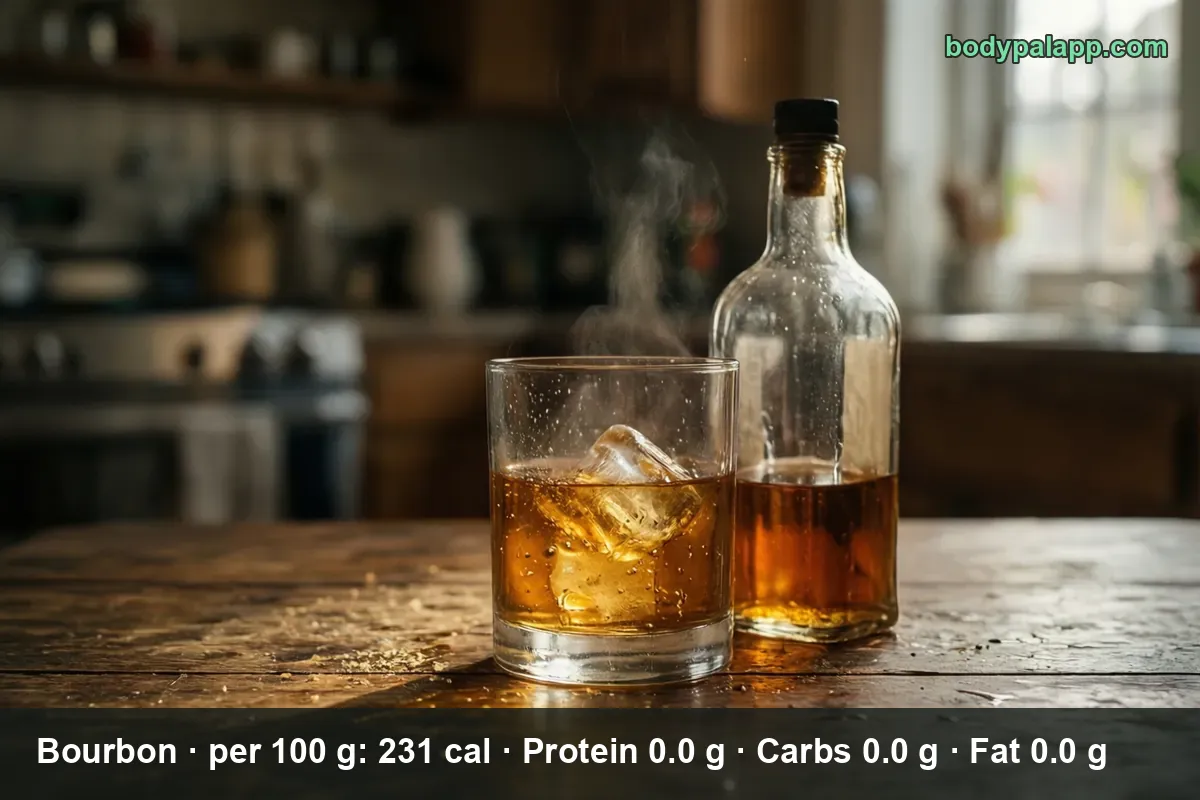
A 1.5 fl oz jigger of bourbon (42 g) carries 97 calories, and straight bourbon runs 231 calories per 100 g. All of it comes from the alcohol: zero fat, zero carbohydrate, zero sugar, zero protein. Pour a single fluid ounce instead and you are at 65. What lands beside it in the glass is what changes the total.
On this page
- Bourbon quick facts
- US pours from a splash to a full drink
- Proof is the calorie dial
- Mixers are where the calories come from
- Zero carbs but not zero calories
- How does bourbon compare
- FAQ
Bourbon quick facts
Bourbon does not have its own line in USDA FoodData Central. It sits inside FNDDS 2710700, "Whiskey", the record built around the standard American bottle at 80 proof, or 40% alcohol by volume. That is the row worth using, because it is also the one carrying real US household measures: a shot, a jigger, a drink. Its numbers match SR Legacy 174815, the pooled "distilled, all (gin, rum, vodka, whiskey) 80 proof" record, down to the calorie.
There is no branded bourbon in the USDA database at all, and that is not an oversight. Spirits above 7% ABV are labeled under TTB rules rather than FDA rules, so bottles never carry a Nutrition Facts panel to scrape. Searching the branded catalog for bourbon returns barbecue sauce, jerky and pecans, not liquor.
| Nutrient | Per 100 g | Per 1.5 fl oz jigger (42 g) | % Daily Value |
|---|---|---|---|
| Calories | 231 | 97 | — |
| Total fat | 0 g | 0 g | 0% |
| Saturated fat | 0 g | 0 g | 0% |
| Carbohydrate | 0 g | 0 g | 0% |
| Dietary fiber | 0 g | 0 g | 0% |
| Total sugars | 0 g | 0 g | — |
| Protein | 0 g | 0 g | 0% |
| Sodium | 1 mg | 0 mg | 0% |
% Daily Value is based on a 2,000-calorie diet.
Verified nutrition data
Numbers on this page come from USDA FoodData Central, the U.S. Department of Agriculture’s food composition database, and from manufacturer labels where a branded product is named. Last verified September 2026. How we verify our data →
Two rows you would expect on a label are missing here: added sugars and trans fat. USDA does not report either for an unsweetened distillate, so there is nothing to print. Cholesterol is 0 mg, and potassium is 2 mg per 100 g, which works out to 1 mg in a jigger. Every micronutrient row in the record behaves the same way. A neat bourbon is calories and water, and that is the whole ingredient list.
US pours from a splash to a full drink
| Serving | Weight | Calories |
|---|---|---|
| 1 fl oz pour, no ice | 28 g | 65 kcal |
| 1 oz by weight | 28.4 g | 66 kcal |
| 1 shot or 1.5 fl oz jigger | 42 g | 97 kcal |
| 1 drink, as USDA counts it | 63 g | 146 kcal |
| Per 100 g | 100 g | 231 kcal |
The pour, the jigger and the drink are USDA household measures; the 1 oz by weight line is our own arithmetic from the USDA 100 g figure, not a USDA serving, and it exists because people type "1 oz" when they mean a fluid ounce. Bourbon is lighter than water, so a fluid ounce weighs about 28 g and a weight ounce is 28.4 g. The gap is one calorie. Nobody needs to worry about it.
The gap that does matter is between "shot" and "ounce". A fluid ounce splashed over ice is 65 calories. A jigger, which is what a bartender actually measures, is 1.5 fl oz and 97 calories, half again as much. And USDA's "1 drink" for neat spirits is 63 g, or 146 calories, because a real pour at home tends to land above the jigger line. Three fingers in a rocks glass sits halfway between one shot and two.
The CDC defines a standard drink as 1.5 fl oz of 80-proof distilled spirits, which lines up exactly with the 42 g jigger. If you are counting drinks and counting calories at the same time, 97 is the number that keeps both ledgers honest.
Proof is the calorie dial
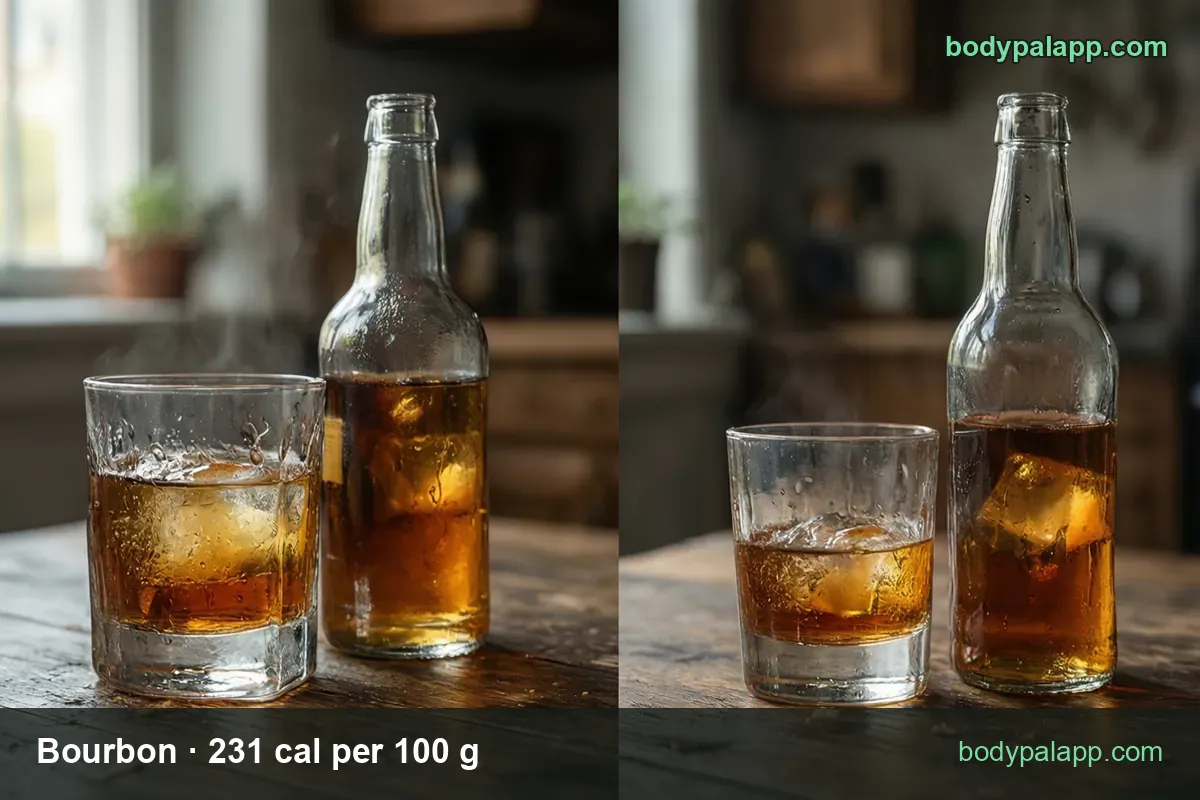
Bourbon is legally at least 80 proof, but plenty of bottles sit higher, and every extra point of proof is extra calories in the same glass. USDA publishes separate records by strength, and the jump from the standard bottle to a bottled-in-bond 100 proof is bigger than most people expect.
| Bottle | Per 100 g | 1.5 fl oz jigger (42 g) |
|---|---|---|
| 80 proof, the standard bottle | 231 kcal | 97 kcal |
| 86 proof | 250 kcal | 105 kcal |
| 90 proof | 263 kcal | 110 kcal |
| 94 proof | 275 kcal | 116 kcal |
| 100 proof, bottled in bond | 295 kcal | 124 kcal |
The per-100 g figures are USDA's; the jigger column is our own arithmetic from them, since these older records do not carry a jigger measure. Read across the bottom row: the same pour, the same glass, the same absence of sugar, and 124 calories instead of 97. That is 28% more for a bottle that most drinkers pick for flavor rather than strength. Barrel-proof bottles at 120 proof and up sit above everything in this table, and USDA does not publish a record that high, so there is no honest number to give you there.
Two neat jiggers of a 100 proof bourbon is 248 calories, roughly what the same person would spend on a snack they would actually notice eating.
Mixers are where the calories come from
Straight bourbon has no carbohydrate to add. Everything that arrives in a mixed drink comes from the other half of the glass, and USDA measures these as a full 225 g drink, mixer weight included.
| Drink | Per 100 g | Serving | Calories |
|---|---|---|---|
| Bourbon, neat | 231 kcal | 1 drink (63 g) | 146 kcal |
| Bourbon and Coke | 89 kcal | 1 drink (225 g) | 200 kcal |
| Bourbon and diet cola | 60 kcal | 1 drink (225 g) | 135 kcal |
| Bourbon and soda | 59 kcal | 1 drink (225 g) | 133 kcal |
| Bourbon and water | 59 kcal | 1 drink (225 g) | 133 kcal |
| Whiskey sour | 123 kcal | 1 drink (225 g) | 277 kcal |
| Manhattan | 222 kcal | 1 fl oz (30 g) | 67 kcal |
A bourbon and Coke is 200 calories and 17.6 g of carbohydrate, all of it sugar at 16.8 g. Swap to diet cola and the drink falls to 135, because the spirit is untouched and only the mixer changed. Soda water or plain water lands at 133, which is as close to neat bourbon as a tall drink gets.
The whiskey sour is the outlier at 277 calories a drink, 180 more than a neat jigger, and it carries 36.2 g of carbohydrate and 173 mg of sodium from the sweetened sour mix. It is a dessert with bourbon in it.
The Manhattan is the trap in the other direction. USDA lists it by the fluid ounce, so 67 calories looks gentle, but at 222 calories per 100 g it is nearly as dense as bourbon itself, because there is no soft drink diluting it. A 3 fl oz cocktail comes to about 200 calories by our own arithmetic from that 100 g figure. The small glass hides a full drink.
Zero carbs but not zero calories
The nutrition panel for neat bourbon is a column of zeroes, and that confuses people into treating it as free. Alcohol carries 7 calories per gram, more than carbohydrate or protein, and it does not appear as a macro on any label. A jigger of bourbon delivers 97 calories with 0% of the FDA Daily Values for fat, carbohydrate, protein, fiber and sodium. Nothing on the panel tells you the calories are there.
For low-carb and keto counting, that column of zeroes is genuinely useful: bourbon adds no carbohydrate to a daily total. For calorie counting it is the opposite of useful, because three drinks over an evening is 291 calories at 80 proof and 372 at 100 proof before anyone touches the bar snacks.
The Dietary Guidelines for Americans say adults who do not drink should not start, and those who do should limit intake to 2 drinks or less a day for men and 1 or less for women. If you are tracking a deficit, one neat pour at 97 calories is the version that fits with room to spare; a whiskey sour at 277 is nearly three of them.
How does bourbon compare
| Spirit | Per 100 g | US serving | Calories |
|---|---|---|---|
| Bourbon | 231 kcal | 1 fl oz (28 g) | 65 kcal |
| Scotch | 231 kcal | 1 fl oz (28 g) | 65 kcal |
| Vodka | 231 kcal | 1 fl oz (28 g) | 65 kcal |
| Rum | 231 kcal | 1 fl oz (28 g) | 65 kcal |
Our take: at the same proof, the grain in the bottle makes no difference at all. All four records are 231 calories per 100 g and 65 per fluid ounce, because what you are counting is ethanol and nothing else. Anyone switching from bourbon to vodka to save calories is switching for no reason. The two decisions that actually move the number are the proof on the label and what goes in the glass with it, in that order.
Bourbon FAQs
How many calories are in a shot of bourbon?
97 calories in a standard 1.5 fl oz shot, which weighs 42 g, at 231 calories per 100 g. That is for an 80-proof bottle poured neat. There is no fat, carbohydrate, sugar or protein in it, so all 97 calories come from the alcohol itself.
How many calories in 1 oz of bourbon?
65 calories in a 1 fl oz pour, which weighs 28 g. A weight ounce of 28.4 g works out to 66 calories, our own arithmetic from the USDA 100 g figure. The difference between the two is one calorie, so either number is close enough to log.
Does bourbon have carbs or sugar?
Neither: USDA lists straight bourbon at 0 g of carbohydrate and 0 g of total sugars per 100 g, along with 0 g of fat and 0 g of protein. Every one of its 231 calories per 100 g comes from alcohol. Sugar only appears once a mixer joins it.
Is bourbon keto friendly?
It adds 0 g of carbohydrate, so a 97-calorie jigger fits a keto carb budget without using any of it. The calories still count against your daily total, though. Mixers are the problem: bourbon and Coke brings 17.6 g of carbohydrate per drink, while diet cola or soda water brings none.
How many calories in bourbon and Coke?
200 calories for a 225 g drink, with 17.6 g of carbohydrate and 16.8 g of sugar, all from the cola. Made with diet cola the same drink is 135 calories and no sugar. With soda water or plain water it is 133, which is the closest a tall bourbon gets to neat.
Does 100 proof bourbon have more calories than 80 proof?
Yes, about 28% more. USDA puts 100-proof spirits at 295 calories per 100 g against 231 for 80 proof, so the same 1.5 fl oz jigger goes from 97 calories to 124. An 86-proof bottle sits between them at 105 per jigger. No sugar is involved; it is purely the extra alcohol.
Is there a calorie difference between bourbon, whiskey and Scotch?
No: USDA records Scotch, vodka and rum at the same 231 calories per 100 g as bourbon, or 65 calories per fluid ounce, because they are all 80-proof distillates. Bourbon shares its record with whiskey generally. Switching brown spirits for clear ones saves nothing at the same proof.
How many calories in a bourbon on the rocks?
97 calories for a jigger over ice, because ice contributes nothing. Melting ice dilutes the drink but does not change the calorie count of what you poured. If your rocks pour is heavier than a jigger, use the USDA drink measure instead: 63 g of bourbon is 146 calories.
Similar foods
- Cranberry Vodka — 97 cal per jigger
- Shot Of Crown Royal — 97 cal per shot
- Gin — 97 cal per shot
- Shot Of Gin — 97 cal per shot
- Jack Daniel's — 97 cal per shot
- Shot Of Rum — 97 cal per shot
Count it without the math
Point the camera at the glass and BodyPal counts the pour for you, mixer and all.


How long does it take to burn off bourbon?
A 1.5 fl oz jigger (42 g) is 97 kcal. Enter your weight and the amount you ate to see how long it takes you to burn that off:
lb
| Activity | Time to burn 97 kcal |
|---|---|
| Walking, brisk | 19 min |
| Cycling, moderate | 12 min |
| Swimming, moderate | 14 min |
| Jogging | 11 min |
| Weight training, moderate | 22 min |
Times are for a 155 lb adult at a steady pace; change the weight to see yours. The amount is set to the portion in the text (42 g); change it to what you actually ate. BodyPal works this out from your steps automatically.
One food is easy to picture; a whole day is harder. See how many calories you need a day and what a deficit actually looks like.