
How many calories are in a Miller Lite?
A 12 fl oz bottle or can of Miller Lite carries 103 calories, and light beer runs 29 calories per 100 g in the USDA database. That is the number for the whole bottle, not a pour. Fill a pint glass instead and the same beer becomes 137.
On this page
- Light beer quick facts
- US servings, from one ounce to a six-pack
- Pints, low-carb and regular beer
- Carbs are not where the calories are
- How does a light beer compare?
- FAQ
Light beer quick facts
Miller Lite does not have a record of its own in USDA FoodData Central. Alcoholic drinks are labeled under TTB rules rather than FDA rules, so brand-name beers almost never show up in the Branded Foods database. The row that fits is SR Legacy 168749, "Alcoholic beverage, beer, light", the generic entry for American light lager, and that is what the numbers below come from.
There is a near-identical FNDDS twin (record 2710617) with the same 29 calories per 100 g. The difference is the arithmetic behind the serving: SR Legacy weighs a fluid ounce of beer at 29.5 g, which is close to the real density, while FNDDS rounds it to 30 g. So one database calls a 12 fl oz bottle 354 g and the other calls it 360 g. Same beer, roughly one calorie apart.
| Nutrient | Per 100 g | Per 12 fl oz bottle (354 g) | % Daily Value |
|---|---|---|---|
| Calories | 29 | 103 | — |
| Total fat | 0 g | 0 g | 0% |
| Saturated fat | 0 g | 0 g | 0% |
| Carbohydrate | 1.64 g | 5.8 g | 2% |
| Dietary fiber | 0 g | 0 g | 0% |
| Total sugars | 0.09 g | 0.3 g | — |
| Protein | 0.24 g | 0.8 g | 2% |
| Sodium | 4 mg | 14 mg | 1% |
| Cholesterol | 0 mg | 0 mg | 0% |
| Potassium | 21 mg | 74 mg | 2% |
% Daily Value is based on a 2,000-calorie diet.
Verified nutrition data
Numbers on this page come from USDA FoodData Central, the U.S. Department of Agriculture’s food composition database, and from manufacturer labels where a branded product is named. Last verified September 2026. How we verify our data →
Two rows you would see on a packaged food label are missing here. This SR Legacy edition does not carry added sugars or trans fat, so they are left out rather than guessed. Neither is a real gap for beer: the sugar that started as malt is fermented away, which is why total sugars land at 0.09 g per 100 g, and there is no fat in the record to be trans fat.
US servings, from one ounce to a six-pack
| Serving | Weight | Calories |
|---|---|---|
| 1 fl oz | 29.5 g | 9 kcal |
| 1 oz by weight | 28.35 g | 8 kcal |
| One can or bottle, 12 fl oz | 354 g | 103 kcal |
| One pint, 16 fl oz | 472 g | 137 kcal |
| Six-pack, 6 x 12 fl oz | 2124 g | 616 kcal |
| Per 100 g | 100 g | 29 kcal |
The 12 fl oz can is the USDA household measure, and it is the only line in that table you can take straight off the record. The pint, the six-pack and the one-ounce line are our own arithmetic from the USDA 100 g figure, not USDA servings.
The fluid-ounce and weight-ounce rows are worth separating, because searches for "calories per oz" mean the first one and get answered with the second. A fluid ounce of light beer weighs 29.5 g and costs 9 calories. An ounce on a kitchen scale is 28.35 g and costs 8. It is a one-calorie gap at that size, and about four calories across a 12 fl oz pour.
Nobody drinks a hundred grams of beer, so treat the per-100-g column as a conversion tool rather than a portion. Multiply it by the volume in front of you and you have the answer: a 20 fl oz "imperial" pour at an English-style bar is 590 g and about 171 calories by the same math.
Pints, low-carb and regular beer
| Version | Per 100 g | Typical serving | Calories |
|---|---|---|---|
| Light beer, bottle or can | 29 kcal | 12 fl oz (354 g) | 103 kcal |
| Light beer, draft pint | 29 kcal | 16 fl oz (472 g) | 137 kcal |
| Bud Light | 29 kcal | 12 fl oz (354 g) | 103 kcal |
| Budweiser Select | 28 kcal | 12 fl oz (355 g) | 99 kcal |
| Low-carb light beer | 27 kcal | 12 fl oz (354 g) | 96 kcal |
| Regular (non-light) beer | 43 kcal | 12 fl oz (360 g) | 155 kcal |
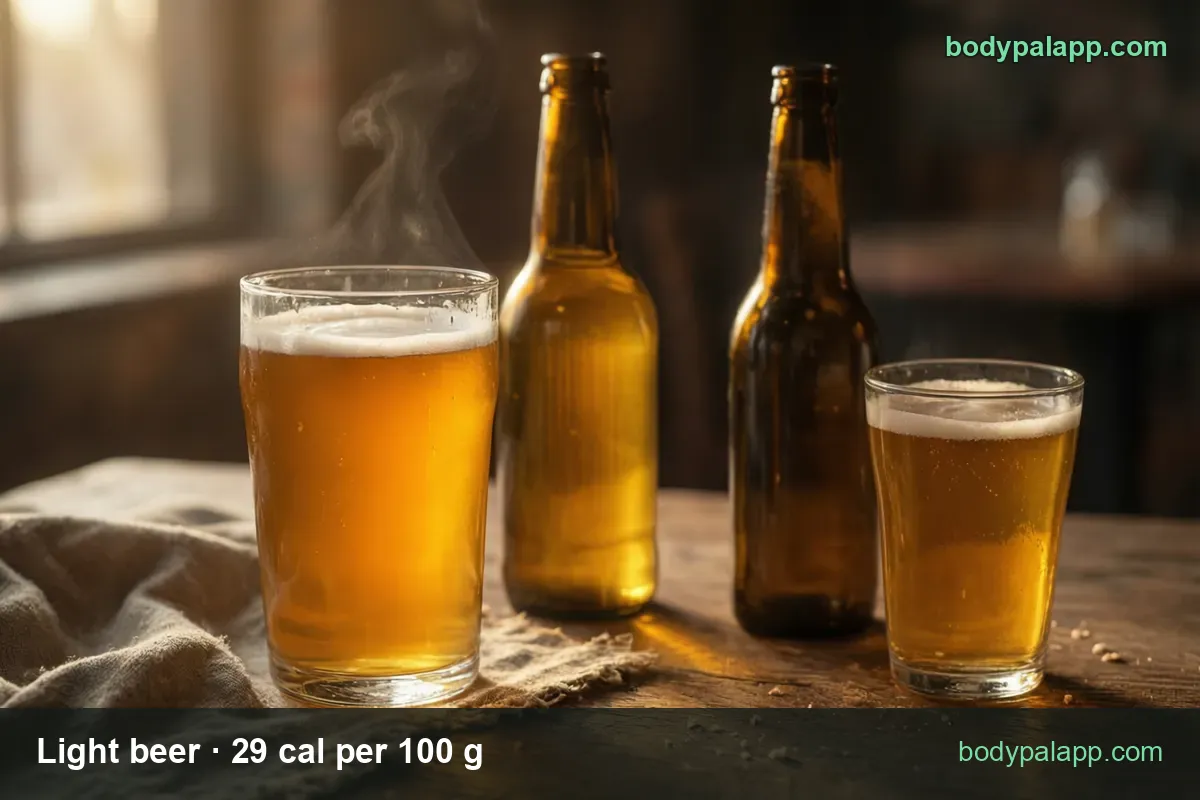
The pint is the line that catches people. Order a draft instead of grabbing a can and you have added 34 calories without changing a thing about the beer. Do that four times over an evening and the glass alone has cost you 136 calories, more than the 103 in a fifth bottle you never opened.
The brand-to-brand spread, meanwhile, is small. USDA keeps separate SR Legacy rows for Bud Light and Budweiser Select, and they land at 29 and 28 calories per 100 g against 29 for the generic light lager. Bud Light is the same 103 calories per bottle as the row on this page; Budweiser Select comes in at 99, and a low-carb light beer at 96. Seven calories separate the lightest of them from the standard, which is less than the difference between a full pour and one that stops an inch short of the rim.
Regular beer is the real jump. At 43 calories per 100 g it is roughly one and a half times the light version, and 155 calories for a 12 fl oz bottle against 103. That is where switching actually earns something. USDA also lists a higher-alcohol light beer at 46 calories per 100 g, more than the regular row, which is the cleanest proof that "light" describes the recipe, not a guaranteed calorie ceiling.
Carbs are not where the calories are
A 12 fl oz light beer holds 5.8 g of carbohydrate, 2% of the FDA Daily Value of 275 g. Protein is 0.8 g, also 2%. Fat is zero, cholesterol is zero, fiber is zero. Sodium is 14 mg, or 1% of the 2,300 mg Daily Value, so beer is irrelevant to a low-sodium day.
Add those macros up and they cannot reach 103 calories. Carbohydrate and protein together account for roughly 26 of them. The rest is alcohol, which carries energy but is not a macronutrient with a Daily Value, so it never appears as a row on any label or in any USDA table. That is the single most useful thing to understand about tracking beer: the number you log is mostly invisible in the nutrition panel.
It also explains why "low-carb" light beers save so little. Cutting carbohydrate from 1.64 g to 0.73 g per 100 g removes about three grams across a bottle, and three grams of carbohydrate is not many calories. The saving shows up as 96 instead of 103, and the alcohol is untouched.
If you are counting, the practical move is to decide on volume before you decide on brand, and to log the glass you actually used. For how many drinks fit a normal week, the Dietary Guidelines for Americans and CDC alcohol guidance are the places to look; they set limits in drinks, not in calories.
How does a light beer compare?
| Drink | Per 100 g | US serving | Calories |
|---|---|---|---|
| Light beer | 29 kcal | 12 fl oz (354 g) | 103 kcal |
| Regular beer | 43 kcal | 12 fl oz (360 g) | 155 kcal |
| Hard seltzer | 24 kcal | 12 fl oz (360 g) | 86 kcal |
| Higher-alcohol beer | 58 kcal | 12 fl oz (360 g) | 209 kcal |
Our take: hard seltzer is the only drink on this table that beats light beer, and it wins by 17 calories a can, which is a rounding error next to the 106-calorie gap between light beer and the higher-alcohol row. If you are trimming calories, the switch worth making is away from strong beer, not from light beer to seltzer. And if you are drinking light beer already, the container is the lever: two pints almost match three bottles, at 274 calories against 309, even though the two pints are four fluid ounces less beer.
Miller Lite FAQs
How many calories are in a 12 oz Miller Lite?
103 calories for a 12 fl oz can or bottle, which USDA weighs at 354 g. Light beer is 29 calories per 100 g, and the bottle also carries 5.8 g of carbohydrate, 0.8 g of protein, no fat and 14 mg of sodium. Most of the energy is alcohol.
How many calories are in one ounce of Miller Lite?
9 calories per fluid ounce, since a fluid ounce of beer weighs 29.5 g and light beer runs 29 calories per 100 g. An ounce measured by weight, 28.35 g, is 8 calories. Both are our own arithmetic from the USDA 100 g figure rather than a USDA serving.
How many calories in a 16 oz Miller Lite?
137 calories for a 16 fl oz pint, which weighs 472 g. That is 34 more than the 103 in a 12 fl oz bottle, from the extra four ounces alone. Draft pours are usually pints, so a bar round costs about a third more than the same beer from the fridge.
How many carbs does a light beer have?
5.8 g of carbohydrate in a 12 fl oz bottle, which is 2% of the FDA Daily Value of 275 g. Per 100 g that is 1.64 g. Total sugars are almost nothing, 0.3 g per bottle, because fermentation consumes the malt sugars before the beer is packaged.
Miller Lite vs Bud Light: which has fewer calories?
Neither. USDA lists Bud Light at 29 calories per 100 g, the same as the generic light lager this page uses, so both come to 103 calories per 12 fl oz. Bud Light shows slightly less carbohydrate, 1.3 g per 100 g against 1.64 g, but that gap is worth only a few calories.
How many calories in a six-pack of light beer?
616 calories for six 12 fl oz bottles, a total of 2,124 g of beer. That is our own arithmetic from the USDA 100 g figure, not a USDA serving. It is a full meal's worth of energy with zero fat, zero fiber and under 5 g of protein across the whole pack.
Does light beer have any fat or cholesterol?
None. The USDA record lists 0 g of total fat, 0 g of saturated fat and 0 mg of cholesterol, both per 100 g and per bottle. Beer is fermented grain and water, so there is nothing for fat to come from. The 103 calories are alcohol plus a little residual carbohydrate.
Is light beer lower in calories than hard seltzer?
No, seltzer is lighter by 17 calories a can: 86 for 12 fl oz against 103 for light beer, or 24 calories per 100 g against 29. The gap is small enough that it rarely decides an evening, and both are far below the 155 calories in a regular 12 fl oz beer.
Similar foods
- Miller Lite — 103 cal per can (12 fl oz)
- Natural Light — 103 cal per can (12 fl oz)
- Michelob Ultra Light Beer — 96 cal per bottle
- Ginger Ale — 124 cal per can (12 fl oz)
- High Noon — 86 cal per can (12 fl oz)
- Red Wine Vinegar — 3 cal per tbsp
Count it without the math
Point the camera at the glass and BodyPal logs the beer for you, pint or bottle.


How long does it take to burn off 103 kcal of Miller Lite?
A 12 fl oz bottle (354 g) is 103 kcal. Enter your weight and the amount you ate to see how long it takes you to burn that off:
lb
| Activity | Time to burn 103 kcal |
|---|---|
| Walking, brisk | 21 min |
| Cycling, moderate | 13 min |
| Swimming, moderate | 15 min |
| Jogging | 12 min |
| Weight training, moderate | 23 min |
Times are for a 155 lb adult at a steady pace; change the weight to see yours. The amount is set to the portion in the text (354 g); change it to what you actually ate. BodyPal works this out from your steps automatically.
Burning it off is one side of it. The other is knowing your number: work out how many calories you need a day, with macros and a goal date.