
How many calories are in red wine vinegar?
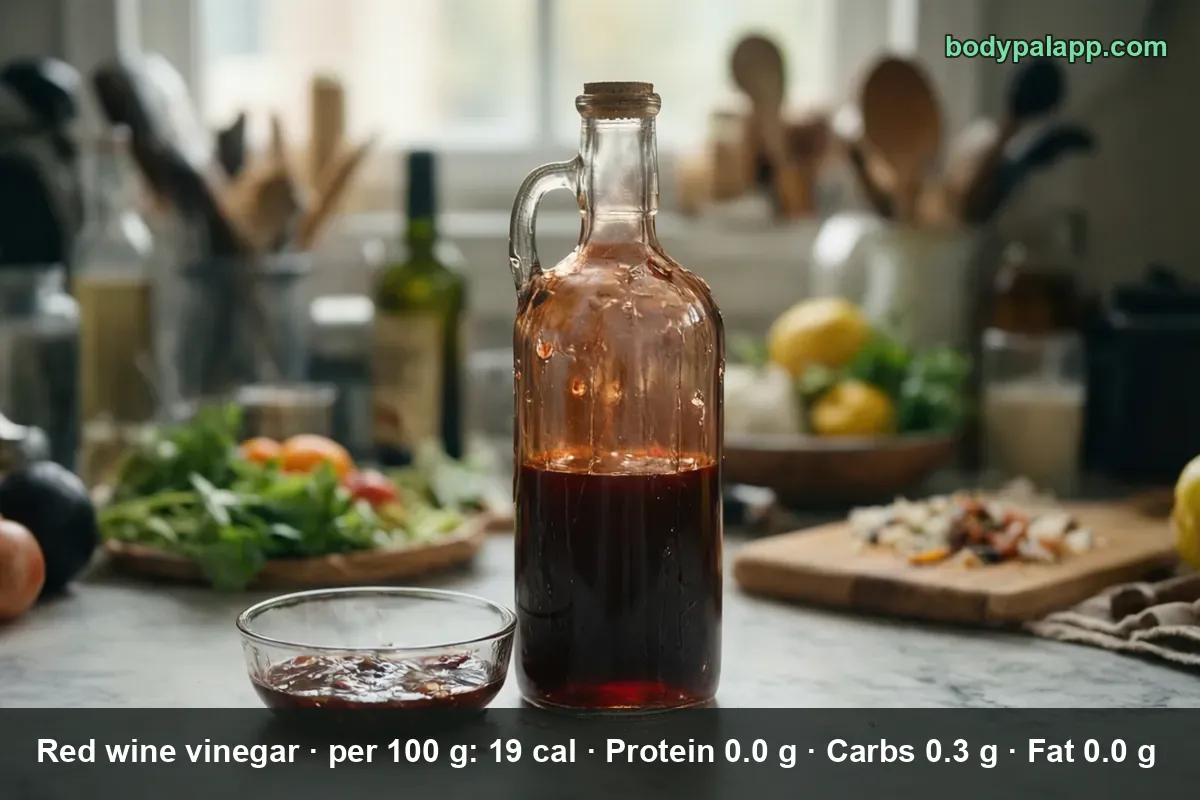
A tablespoon of red wine vinegar is 3 calories, and 100 g of it runs 19 calories. That is the whole story of the bottle: no fat, no fiber, 0.27 g of carbohydrate per 100 g and 8 mg of sodium. Pour a full cup, 239 g, and you are still only at 45.
On this page
- Red wine vinegar quick facts
- From a teaspoon to a full cup
- White vinegar, cider vinegar and the dressing that changes everything
- Sodium, sugar and the zero printed on the bottle
- How does red wine vinegar compare?
- Most popular red wine vinegar brands
- Red wine vinegar FAQs
Red wine vinegar quick facts
The row used here is SR Legacy 172240, "Vinegar, red wine". It is the only USDA record for the vinegar itself, and it matches what you are actually holding: a bottle of plain red wine vinegar, not a seasoning blend and not a bottled dressing. Anyone searching this term is looking at the vinegar aisle, so the vinegar aisle is what the numbers describe.
One tablespoon is 14.9 g, which is the USDA household measure for this record. Every serving column below is that record scaled by weight.
| Nutrient | Per 100 g | Per 1 tbsp (14.9 g) | % Daily Value |
|---|---|---|---|
| Calories | 19 | 3 | — |
| Total fat | 0 g | 0 g | 0% |
| Saturated fat | 0 g | 0 g | 0% |
| Carbohydrate | 0.27 g | 0 g | 0% |
| Dietary fiber | 0 g | 0 g | 0% |
| Total sugars | 0 g | 0 g | — |
| Protein | 0.04 g | 0 g | 0% |
| Sodium | 8 mg | 1 mg | 0% |
| Potassium | 39 mg | 6 mg | 0% |
% Daily Value is based on a 2,000-calorie diet.
Verified nutrition data
Numbers on this page come from USDA FoodData Central, the U.S. Department of Agriculture’s food composition database, and from manufacturer labels where a branded product is named. Last verified September 2026. How we verify our data →
Two rows you will not find above. USDA does not publish an added sugars figure for this SR Legacy record, so there is nothing honest to print there, and the same record carries no cholesterol value. Writing a zero in either row would be inventing data rather than reporting it.
There is one number worth staring at. Add up the macros on the record and they account for barely one of those 19 calories per 100 g: 0.27 g of carbohydrate and 0.04 g of protein, with no fat at all. The rest sits in the acetic acid and the traces left over from fermenting wine, which is why a food with almost no macros still shows a calorie figure above zero. It is small enough that it never matters in a day of eating, but it explains the arithmetic that confuses people who try to reverse-engineer the label.
From a teaspoon to a full cup
| Serving | Weight | Calories |
|---|---|---|
| 1 tsp | 5 g | 1 kcal |
| 1 tbsp | 14.9 g | 3 kcal |
| 2 tbsp | 29.8 g | 6 kcal |
| 1 oz | 28.4 g | 5 kcal |
| 1/4 cup | 59.8 g | 11 kcal |
| 1 cup | 239 g | 45 kcal |
| Per 100 g | 100 g | 19 kcal |
The teaspoon, the tablespoon and the cup are USDA household measures on the record itself. The 2 tbsp, 1 oz and 1/4 cup lines are our own arithmetic from the USDA 100 g figure rather than USDA servings, scaled by weight and rounded to whole calories.
What this table really shows is a food that refuses to scale into anything meaningful. A quarter cup, which is a serious splash in a marinade for a whole chicken, is 11 calories. The full cup a big batch of pickled onions might drink up is 45. There is no portion size of pure vinegar that turns into a decision you need to make.
That matters because the vinegar rarely arrives alone. Whisk that quarter cup with a half cup of olive oil and the bowl is suddenly running near a thousand calories, none of them from the vinegar. When people log a salad and the number surprises them, the fat is the reason, every time.
White vinegar, cider vinegar and the dressing that changes everything
| Version | Per 100 g | Typical serving | Calories |
|---|---|---|---|
| Red wine vinegar | 19 kcal | 1 tbsp (14.9 g) | 3 kcal |
| Distilled white vinegar | 18 kcal | 1 tbsp (14.9 g) | 3 kcal |
| Apple cider vinegar | 21 kcal | 1 tbsp (14.9 g) | 3 kcal |
| Red wine vinegar and olive oil dressing | 387 kcal | 2 Tbsp (31 g) | 120 kcal |
| Lite red wine vinegar and olive oil dressing | 161 kcal | 2 Tbsp (31 g) | 50 kcal |
Swapping one plain vinegar for another does nothing to your day. Distilled white is 18 calories per 100 g, red wine 19, cider 21, and all three land on 3 calories a tablespoon once you round. The gap between them is residual sugar from the source: cider vinegar keeps 0.93 g of carbohydrate per 100 g from the apples, red wine vinegar 0.27 g from the grapes, distilled white just 0.04 g because it has no fruit behind it.
The bottled dressing is a different food wearing a similar name. The full-fat version runs 387 calories per 100 g, so a standard 2 Tbsp pour is 120 calories, about 12 g of fat and 370 mg of sodium. Spoon for spoon that is roughly twenty times the calories of the vinegar the label is named after. The lite version cuts the fat to about 5 g per 2 Tbsp and lands at 50 calories with about 290 mg of sodium.
Store brands of the plain vinegar hold the line. Bellino, Kedem, Holland House, Cento and 365 Whole Foods Market all declare 0 calories per 1 Tbsp (15 mL) on the Nutrition Facts panel, while Fairway prints 20 calories per 100 g, which comes to 3 for the same spoonful. Both are describing the same liquid, which brings us to the zero.
Sodium, sugar and the zero printed on the bottle
Five of the six US labels in the USDA Branded set say 0 calories per tablespoon. That is not a different vinegar; it is FDA rounding doing its job, because a serving under 5 calories may be declared as zero. The USDA reference figure of 19 calories per 100 g is the more literal answer, and 3 calories a tablespoon is what we log. Neither number changes a diet, but knowing which one you are reading stops the confusion when an app and a bottle disagree.
Sodium is the other row people ask about, usually after a doctor's visit. A tablespoon carries 1 mg. Even a full cup is 19 mg, which is 1% of the 2,300 mg Daily Value, and the same cup delivers 93 mg of potassium, or 2%. Among things that season food, that combination is unusual: salt, soy sauce and most bottled dressings do the opposite.
Sugar is a flat zero on this record, so the acidity you taste is not hiding sweetness. That is the practical reason vinegar earns its place in a dressing for the vegetables MyPlate asks you to fill half the plate with: if you are watching sodium or added sugars, acid does the job that salt and sweeteners usually get hired for.
How does red wine vinegar compare?
| Food | Per 100 g | US serving | Calories |
|---|---|---|---|
| Red wine vinegar | 19 kcal | 1 tbsp (14.9 g) | 3 kcal |
| Distilled white vinegar | 18 kcal | 1 tbsp (14.9 g) | 3 kcal |
| Apple cider vinegar | 21 kcal | 1 tbsp (14.9 g) | 3 kcal |
| Capers, canned | 23 kcal | 1 oz (28.4 g) | 7 kcal |
Our take: of the four, only distilled white vinegar is lighter per 100 g, and by a single calorie, so choose your vinegar on flavor and nothing else. Red wine vinegar is the one to reach for in a vinaigrette or on roasted vegetables because it is sharp enough to let you cut the oil back, and the oil is where the calories in a dressing live. Capers, at 23 calories per 100 g, are the other cheap way to make a plate taste finished, though they bring real sodium with them while the vinegar brings almost none. If a bottled dressing is the alternative, making your own with this vinegar is the single easiest 100 calories to skip at lunch.
Most popular red wine vinegar brands in the United States
Ranked by how widely each product appears among foods sold in the United States, from the BodyPal food database of over 3.3 million products. Calories are the figures printed on each Nutrition Facts label, checked against USDA FoodData Central.
| Product | Calories (per 100 g) |
|---|---|
| Bellino Red Wine Vinegar | 0 cal |
| Kedem Red Wine Vinegar | 0 cal |
| Holland House Red Wine Vinegar | 0 cal |
| Cento Red Wine Vinegar | 0 cal |
| 365 Whole Foods Market Red Wine Vinegar | 0 cal |
| Fairway Red Wine Vinegar | 20 cal |
Brand popularity: BodyPal food database. Nutrition: manufacturer labels / USDA FoodData Central.
Red wine vinegar FAQs
How many calories are in 1 tablespoon of red wine vinegar?
3 calories in one tablespoon, which USDA weighs at 14.9 g, working out to 19 calories per 100 g. A teaspoon is 1 calorie and a full cup, 239 g, is 45. Most US bottles print 0 calories per tablespoon because servings under 5 calories may legally be rounded down.
Does red wine vinegar have carbs?
0.27 g of carbohydrate per 100 g, which rounds to 0 g on a tablespoon. That is the residual sugar left from the grapes after fermentation. Cider vinegar keeps more at 0.93 g per 100 g, distilled white almost none at 0.04 g. There is no fiber in any of them.
Is red wine vinegar keto friendly?
With 0.27 g of carbohydrate per 100 g and 3 calories a tablespoon, it fits any low-carb approach without meaningful arithmetic. A quarter cup used in a marinade is 11 calories. The thing to check is the dressing bottle beside it, not the vinegar, since sweetened versions are a separate product entirely.
How much sodium is in red wine vinegar?
1 mg per tablespoon and 8 mg per 100 g, so even a full cup is only 19 mg, about 1% of the 2,300 mg Daily Value. That same cup carries 93 mg of potassium. Among pantry seasonings that is close to the low end, which is why acid is a useful substitute for salt.
Does red wine vinegar have sugar?
Total sugars are 0 g on the USDA record, with 0.27 g of total carbohydrate per 100 g. USDA does not publish an added sugars figure for this record, so we will not print one. Sweetened vinegar glazes and dressings are different products and their labels carry their own sugar rows.
Does red wine vinegar contain alcohol?
The USDA record behind the 19 calories per 100 g publishes no alcohol value, so we cannot put a number on it. Fermentation converts the wine's alcohol into acetic acid, and that acid is what carries most of those calories, since 0.27 g of carbohydrate explains barely one of them.
How many calories are in red wine vinegar and olive oil dressing?
120 calories in a 2 Tbsp (31 g) pour of the full-fat bottled version, at 387 calories per 100 g, with about 12 g of fat and 370 mg of sodium. The lite version is 50 calories and roughly 290 mg of sodium. The vinegar in the name contributes almost none of that.
Is red wine vinegar good for weight loss?
At 3 calories a tablespoon it is effectively free in a food diary, and that is its real use: it makes vegetables and lean protein taste finished without oil. Cutting one 2 Tbsp pour of bottled dressing, 120 calories, and replacing it with vinegar and a smaller amount of oil is where the saving comes from.
Similar foods
- High Noon — 86 cal per can (12 fl oz)
- Michelob Ultra Light Beer — 96 cal per bottle
- Miller Lite — 103 cal per can (12 fl oz)
- Natural Light — 103 cal per can (12 fl oz)
- Miller Lite — 137 cal per pint
- Ginger Ale — 124 cal per can (12 fl oz)
Count it without the math
Point the camera at the plate and BodyPal counts the salad, dressing and all.


Burning it off is one side of it. The other is knowing your number: work out how many calories you need a day, with macros and a goal date.