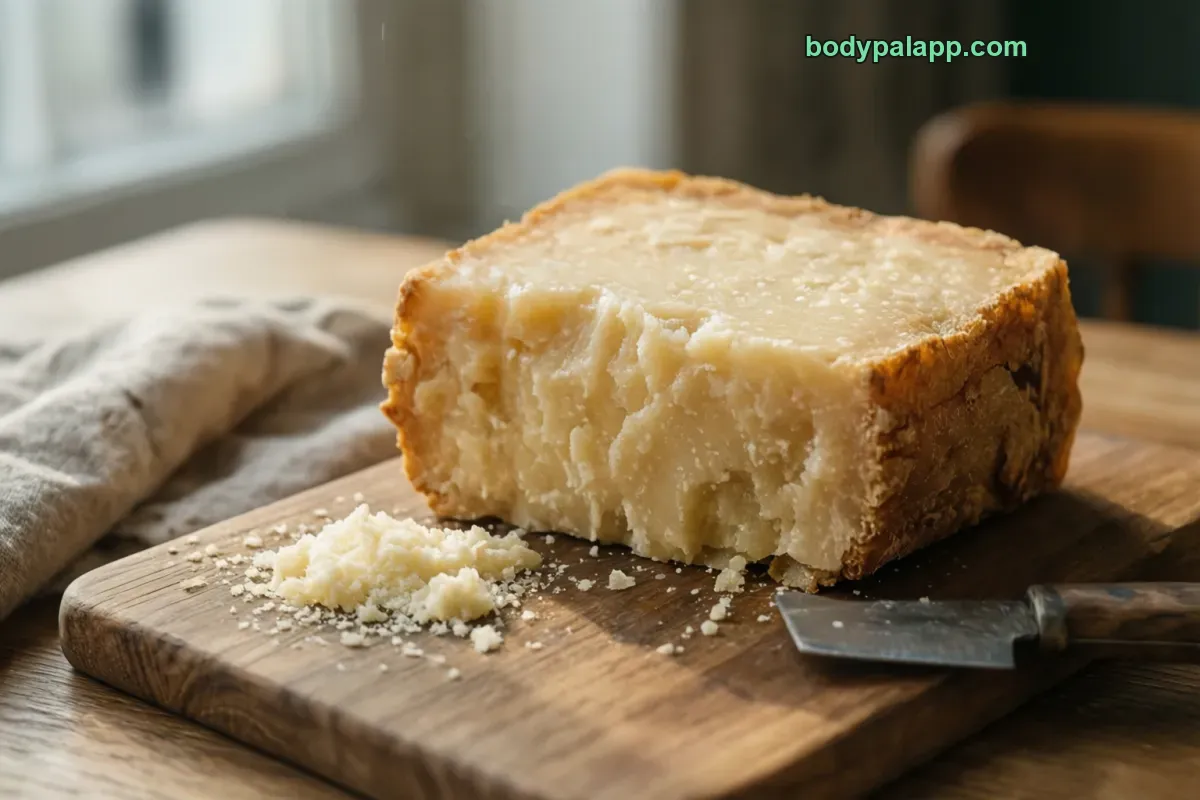
Parmesan cheese calories come to 118 for a 1 oz portion (28 g) of grated parmesan and 420 per 100 g. Fat supplies 60% of those calories, but sodium is the number that stands out: one ounce carries 505 mg, 22% of the daily value. A tablespoon, at 21 calories, is a far lighter sprinkle.
118kcal
1 ounce · 28 g, grated
27%protein
8 gProtein
4 gCarbs
7.8 gFat
How to burn off 118 kcal
—Walking, brisk
—Jogging
—Cycling, moderate
—Swimming
Skip the math. BodyPal counts these calories from your steps and workouts automatically.
Nutrition facts
Grated · per 28 g
Calories
118 kcal
Protein
8 g
Carbohydrate
3.9 g
Fat
7.8 g
Saturated fat
4.3 g
Cholesterol
24 mg
Sodium
505 mg
Potassium
50 mg
Iron
0.1 mg
Source: USDA FoodData Central
🛡️
Verified nutrition data
Numbers on this page come from USDA FoodData Central, the U.S. Department of Agriculture’s food composition database, and from manufacturer labels where a branded product is named. Last verified September 2026. How we verify our data →
Parmesan cheese: calories, protein and sodium by serving
Percent of daily value uses the FDA reference of 2,000 kcal a day.
Serving
kcal
Protein
Carbs
Fat
Sodium
% DV kcal
1 oz portion (28 g)
118
8 g
3.9 g
7.8 g
505 mg
6%
1 tablespoon (5 g)
21
1.4 g
0.7 g
1.4 g
90 mg
1%
100 g
420
28.4 g
13.9 g
27.8 g
1,804 mg
21%
Hard block, 1 oz (28 g)
110
10 g
0.9 g
7 g
329 mg
5%
3 × 1 oz portion (28 g)
353
23.9 g
1,515 mg
5 × 1 oz portion (28 g)
588
39.8 g
2,526 mg
A tablespoon is 21 calories, a heavy hand is not
Grated parmesan rarely gets weighed. It gets shaken, spooned or piled on until the plate looks right. A 1 tablespoon sprinkle (5 g) is 21 calories and 90 mg of sodium, small enough that it barely moves a day's total.
The ounce is where it starts to count. A 1 oz portion (28 g) is 118 calories, which is roughly what a generous mound over a bowl of pasta adds up to. Two ounces (56 g) reach 235 calories, and 3 ounces (84 g) reach 353 calories with 23.9 g of protein. That is the territory of a small meal, not a garnish.
Five ounces, or 140 g, comes to 588 calories and 2,526 mg of sodium, more sodium than a full day's value in one go. Few people eat that much at a sitting, but an open tub on the dinner table can get there across a couple of meals without anyone noticing. If you track, weigh your usual shake once so you know what a normal serving looks like.
Fat carries 60% of the calories
Per 100 g, grated parmesan has 28.4 g of protein, 27.8 g of fat and 13.9 g of carbs. Protein and fat weigh in almost evenly, yet fat supplies 60% of the energy, with protein at 27% and carbs at 13%. On the calorie side, this is a fat-led food.
Of that fat, 15.4 g per 100 g is saturated, more than half of the total. A 1 oz portion holds 7.8 g of fat, so if saturated fat is a row you follow, a heavy grating is worth counting rather than guessing. Cholesterol sits at 86 mg per 100 g.
The protein is real, though. One ounce gives 8 g, 16% of the daily value, for 118 calories, and 100 g covers 57% of the protein value. Sugar is close to nothing at 0.1 g per 100 g, and fiber is 0. For a cheese, that is a solid protein return, as long as the portion stays modest.
Sodium is the row to watch
Grated parmesan carries 1,804 mg of sodium per 100 g, which is 78% of the daily value. Per ounce that is 505 mg, or 22%, in a portion that uses only 6% of daily calories. The salt arrives much faster than the energy does.
That gap matters most when parmesan lands on dishes that are already salty. Cured meats, jarred sauces, salted pasta water and canned soups all bring their own sodium, and a thick layer of cheese stacks on top. If you watch sodium, go lighter on salt elsewhere in the dish and let the cheese do the seasoning.
Portion size is the easiest lever. Three ounces (84 g) pass 1,515 mg, while the tablespoon is 90 mg, just 4% of the daily value. A finely grated tablespoon spreads farther than a coarse shred, so you keep most of the flavor and lose most of the sodium load.
A block ounce is leaner and less salty than grated
The USDA lists grated parmesan and the hard block as separate rows, and the numbers do not match. An ounce of hard block is 110 calories with 10 g of protein, 7 g of fat and 0.9 g of carbs. The grated ounce is 118 calories with 8 g of protein, 7.8 g of fat and 3.9 g of carbs.
The bigger gap is sodium: 329 mg for the block ounce, 14% of the daily value, against 505 mg for grated. If you buy shelf-stable shaker products such as Kraft Grated Parmesan Cheese, the grated row is the closer match. Grating your own from a wedge lines up better with the block row, and shredded tubs from brands like Bella Rosa or Polly-O sit somewhere you should check on the label.
Either way, parmesan earns its place as a finishing cheese. A spoonful over roasted vegetables, soup, eggs or beans adds sharp flavor and a little protein for 21 calories. BodyPal can log it from a photo of the plate.
How does parmesan cheese compare?
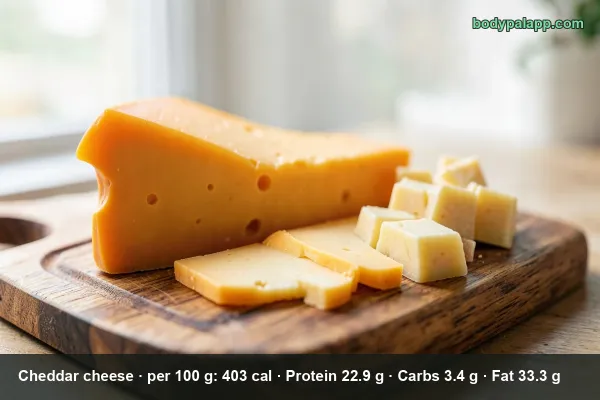
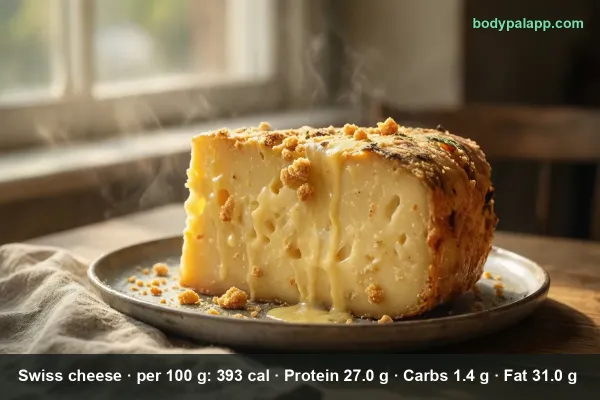
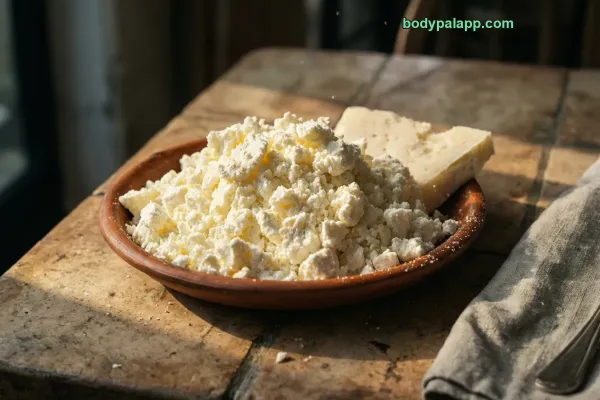
Here is how grated parmesan stacks up against everyday cheese, Swiss and cotija, per 100 g and per usual serving.
Verdict: Parmesan is the most calorie-dense of the four at 420 per 100 g, and its 1,804 mg of sodium tops cotija's 1,400 mg and dwarfs Swiss at 185 mg. For the fewest calories pick cotija at 366 per 100 g, for the least sodium pick Swiss, and keep parmesan for small, flavorful sprinkles.
Most popular parmesan cheese brands in the United States
A 1 oz portion of grated parmesan is 118 calories and a tablespoon is 21 calories. Per 100 g it comes to 420 calories.
Is parmesan cheese good for weight loss?
A tablespoon adds 21 calories, 1.4 g protein and 1.4 g fat, while 100 g is 420 calories and 27.8 g fat. Because the flavour is strong, most of the taste comes from a small sprinkle.
Parmesan or Swiss cheese: which has fewer calories?
Swiss cheese is 393 calories per 100 g against 420 for grated parmesan, a difference of 27 calories per 100 g.
How much protein is in parmesan cheese?
Grated parmesan has 28.4 g protein per 100 g, which is about 8 g in a 1 oz portion and 1.4 g in a tablespoon.
How many calories are in an ounce of parmesan cheese?
An ounce (28 g) of grated parmesan has 118 calories, 6% of the daily value. A 1 oz piece cut from a hard block comes to 110 calories, with 10 g of protein and less sodium.
How many calories are in 1 tablespoon of parmesan cheese?
One tablespoon (5 g) of grated parmesan has 21 calories, with 1.4 g of protein, 1.4 g of fat and 90 mg of sodium. That makes it one of the lightest ways to add strong cheese flavor.
What are the macros of parmesan cheese per 100 g?
Per 100 g, grated parmesan has 420 calories, 28.4 g of protein, 27.8 g of fat and 13.9 g of carbs. Fat supplies 60% of the calories, protein 27% and carbs 13%.
How much fat is in parmesan cheese?
A 1 oz portion of grated parmesan has 7.8 g of fat, and 100 g has 27.8 g, of which 15.4 g is saturated. A tablespoon carries only 1.4 g of fat.
How much is 100 g of parmesan cheese?
100 g of grated parmesan is a bit more than three 1 oz portions (28 g each). It holds 420 calories, 28.4 g of protein, 1,804 mg of sodium and 86 mg of cholesterol.