
How Many Calories in Peanuts?
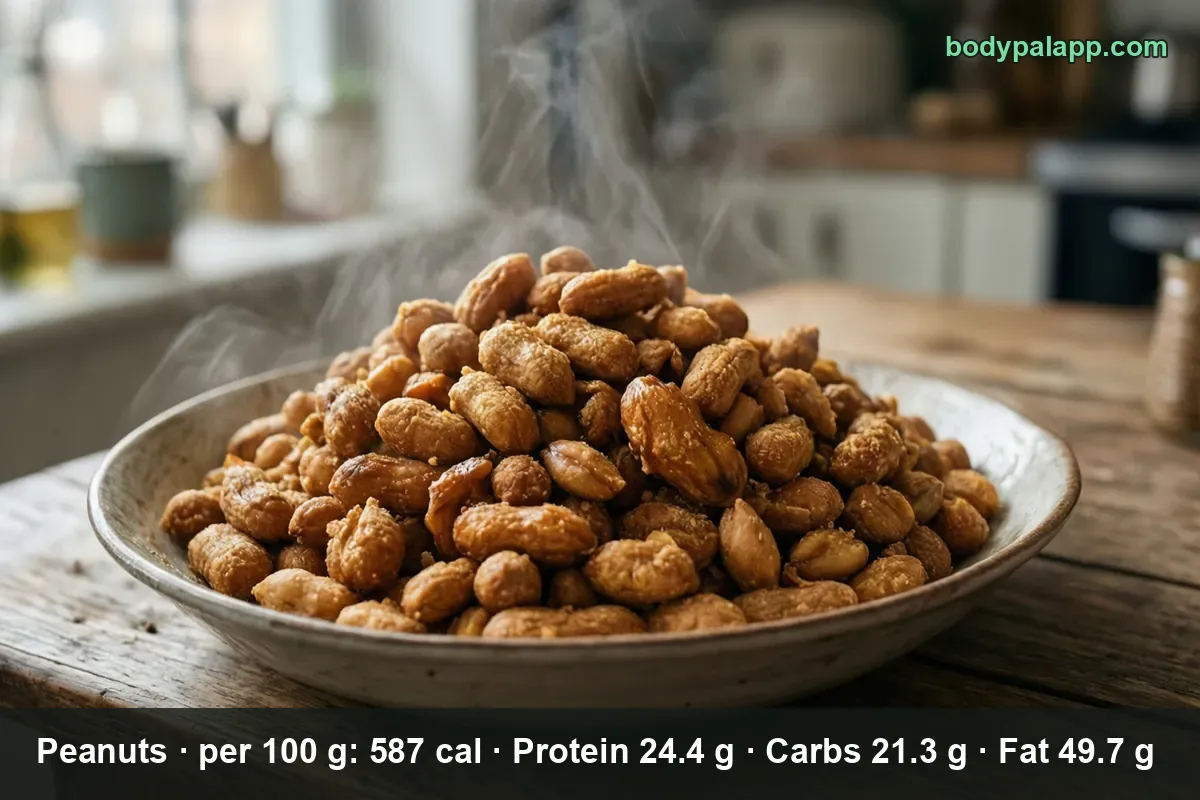
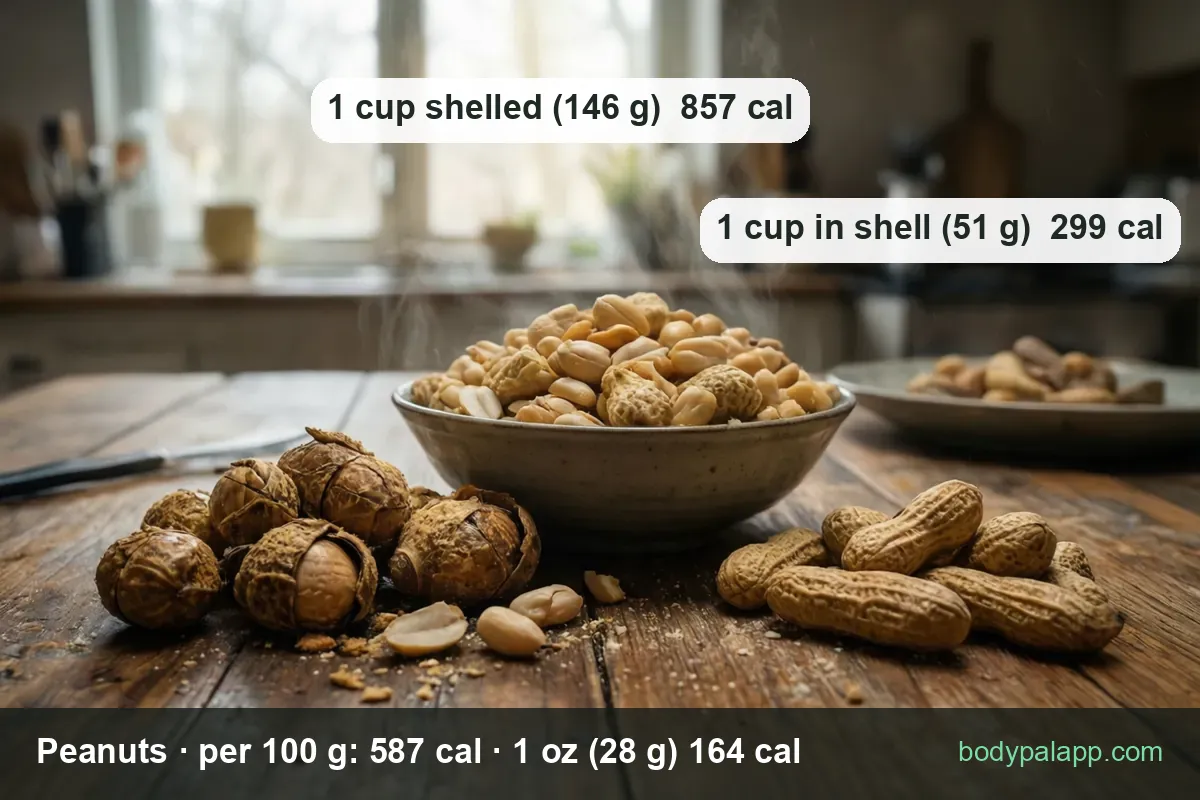
A 1-ounce serving of peanuts, about 28 kernels or one small handful, is 164 calories. Per 100 g that works out to 587 calories. A full cup of shelled peanuts weighs 146 g and lands at 857 calories, which is where most snacking actually happens. Boiled peanuts break the pattern at 89 calories an ounce.
On this page
- Peanut quick facts
- Why 164 calories is the honest default
- Peanut serving sizes, ounce by ounce
- What the shells hide
- Boiled peanuts: 89 calories an ounce
- Dry roasted, oil roasted, raw
- Label calories vs the USDA number
- Peanuts against the tree nuts
- Most popular peanut brands
- FAQ
Peanut quick facts
The reference below is the peanut most Americans are holding: dry roasted and salted, straight from a jar or a vending-machine packet (USDA SR Legacy 174262).
| Nutrient | Per 100 g | Per 1 oz (28 g) | % Daily Value |
|---|---|---|---|
| Calories | 587 | 164 | — |
| Total fat | 49.7 g | 13.9 g | 18% |
| Saturated fat | 7.7 g | 2.2 g | 11% |
| Carbohydrate | 21.3 g | 6.0 g | 2% |
| Dietary fiber | 8.4 g | 2.4 g | 8% |
| Total sugars | 4.9 g | 1.4 g | — |
| Protein | 24.4 g | 6.8 g | 14% |
| Sodium | 410 mg | 115 mg | 5% |
| Potassium | 634 mg | 178 mg | 4% |
% Daily Value is based on a 2,000-calorie diet.
Verified nutrition data
Numbers on this page come from USDA FoodData Central, the U.S. Department of Agriculture’s food composition database, and from manufacturer labels where a branded product is named. Last verified September 2026. How we verify our data →
Two rows carry the story. Fat is the calorie engine here: nearly half the weight of a peanut is oil, and 18% of a day's Daily Value comes in a single ounce. Protein is the payoff at 6.8 g, which is why the USDA files peanuts under protein foods rather than with the fruit and vegetables.
There is no added sugar row on this page, and that is deliberate. The USDA does not publish an added-sugars figure for any plain roasted peanut record, because plain peanuts do not have any. The honey roasted version does, and it gets its own line further down.
Why 164 calories is the honest default
Search for calories in peanuts and you get three different numbers thrown at you: 567, 587, 599. They are all real, and they describe raw, dry roasted and oil roasted peanuts in that order. The question is which one belongs at the top of the page.
The USDA answers it directly, and almost nobody quotes the answer. In the national dietary surveys, when someone says only "peanuts" without specifying anything, the coders assign the food code Peanuts, NFS (FNDDS 2707512). That record is numerically identical to dry roasted, salted peanuts: 587 calories, 24.35 g protein, 49.66 g fat, 410 mg sodium per 100 g, matching to three decimal places.
So the government's own default for an unspecified peanut is the salted dry roasted one. That makes 164 calories per ounce the honest headline, not 159 (raw) and not 168 (oil roasted).
One record we left out on purpose: the newer Foundation Foods entry for raw peanuts has no energy value at all, no saturated fat and no sugars, only two Atwater estimates that disagree with each other by 38 calories. An incomplete row does not belong in a nutrition table, so every raw figure here comes from SR Legacy 172430 instead.
Peanut serving sizes, ounce by ounce
| Serving | Weight | Calories | Protein | Sodium |
|---|---|---|---|---|
| 1 peanut (kernel) | 1 g | 6 | 0.2 g | 4 mg |
| 1 peanut in the shell (2 kernels) | 2 g | 12 | 0.5 g | 8 mg |
| 1 oz in shell, edible yield | 21 g | 123 | 5.1 g | 86 mg |
| 1 oz, about 28 kernels | 28 g | 164 | 6.8 g | 115 mg |
| ¼ cup | 36.5 g | 214 | 8.9 g | 150 mg |
| 1 single-serve packet | 50 g | 294 | 12.2 g | 205 mg |
| 1 cup in shell, edible yield | 51 g | 299 | 12.4 g | 209 mg |
| 1 cup, shelled | 146 g | 857 | 35.6 g | 599 mg |
The gap between the top and the bottom of that table is the whole problem with peanuts. The label serving is an ounce. The bowl in the photo above is roughly a cup and a half.
One cup of shelled peanuts is 5.2 label servings. It carries 857 calories, 72.5 g of fat and 599 mg of sodium, which is 93% of the day's fat Daily Value and 26% of the sodium, from something eaten with one hand while doing something else. Nobody weighs peanuts. That is exactly why the per-ounce number misleads more than any other figure on this page.
A useful anchor: a quarter cup is 214 calories, and four of those rebuild the cup almost exactly (856 against 857). If you want a portion you can see rather than weigh, a quarter cup is the one to learn.
What the shells hide
In-shell peanuts play a trick on the eye, and it works in your favor.
USDA measured it. One cup of peanuts in the shell yields only 51 g of edible kernels, against 146 g for a cup of shelled ones. So a cup of peanuts in shells is 299 calories, roughly a third of the 857 in the same cup shelled. A single peanut in its shell usually holds two kernels: 2 g, 12 calories.
That is why a ballpark bag looks enormous and does less damage than it appears to. The pile of shells on the plate is volume you never ate. Working the shells also slows you down, and speed is most of what makes 857 calories possible in the first place.
Turn it around and the proportion holds: an ounce of shelled peanuts, 28 g, is about half a cup once you put the shells back on.
Boiled peanuts: 89 calories an ounce
Boiled peanuts are the one preparation that genuinely changes the calorie math, and searches for them run as high as the searches for plain peanuts. Green peanuts simmered in brine come in at 318 calories per 100 g (USDA SR Legacy 174260), against 587 for roasted. That is 46% fewer calories per gram.
The reason is water. Boiling floods the kernel, so fat drops from 49.66 g per 100 g to 22.01 g and the whole food dilutes. Fiber stays put at 8.8 g.
| Boiled serving | Weight | Calories | Sodium | %DV sodium |
|---|---|---|---|---|
| 1 oz, about 33 boiled peanuts | 28 g | 89 | 210 mg | 9% |
| 1 cup in shell, edible yield | 63 g | 200 | 473 mg | 21% |
| 1 cup, shelled | 180 g | 572 | 1,352 mg | 59% |
Now read the last column again. A cup of shelled boiled peanuts carries 1,352 mg of sodium, 59% of the Daily Value, because they sit in brine for hours and take it in. The same cup of roasted peanuts carries 599 mg. A roadside cup of boiled peanuts is a sodium event, not a calorie one, which is the reverse of what most people expect from the "healthier" option.
Dry roasted, oil roasted, raw
The standard advice is to pick dry roasted over oil roasted to save calories. The USDA numbers say that advice is close to pointless.
| Version | Per 100 g | Per 1 oz (28 g) | Sodium per 100 g |
|---|---|---|---|
| Raw | 567 | 159 | 18 mg |
| Dry roasted, salted | 587 | 164 | 410 mg |
| Dry roasted, unsalted | 587 | 164 | 6 mg |
| Oil roasted, salted | 599 | 168 | 320 mg |
| Honey roasted | 574 | 161 | 349 mg |
| Boiled, salted | 318 | 89 | 751 mg |
Nine calories separate raw peanuts from oil roasted ones per ounce. A peanut is already 49% fat by weight; there is no room left to absorb much frying oil, and roasting raises the number mostly by driving off water rather than by adding anything.
What the roast really decides is sodium. Dry roasted salted peanuts carry 410 mg per 100 g, the identical unsalted record carries 6 mg. Choosing dry roasted is a choice about salt, not calories, and unsalted is where the actual saving sits.
Honey roasted is the surprise. At 574 calories per 100 g it is lower than plain roasted, because the sugar coating displaces some fat. The cost shows up elsewhere: 16.14 g of total sugars per 100 g against 4.9 g for plain.
Label calories vs the USDA number
Pull three jars off an American shelf and the ounce serving reads 160, 170 and 180 calories for what is essentially the same food. Planters Dry Roasted lists 160 per 28 g, its oil-roasted Cocktail Peanuts list 170, and Great Value Dry Roasted lists 180.
Great Value against Planters is worth a moment, because both jars contain peanuts and salt and nothing else. The 20-calorie gap is label rounding, not product. Manufacturers round to the serving, so working backward to 100 g turns 160 into 571 and 180 into 643, a spread no peanut actually has.
Treat brand labels as what they are: rounded numbers for the jar in your hand. The USDA reference figure of 587 per 100 g is the more accurate one, and the two should never be averaged together.
Peanut butter belongs in the same conversation. Two tablespoons of smooth salted peanut butter (32 g) is 191 calories with 136 mg of sodium, so a spoonful spread on toast outweighs a handful of the whole nuts it was made from. Defatted peanut flour, sold as peanut butter powder, runs 327 calories per 100 g with 0.55 g of fat and 52.2 g of protein: the fat has been pressed out, which is the entire trick.
Peanuts against the tree nuts
| Nut (dry roasted, salted) | Per 100 g | Per 1 oz (28 g) | Protein per oz |
|---|---|---|---|
| Peanuts | 587 | 164 | 6.8 g |
| Almonds | 598 | 167 | 5.9 g |
| Cashews | 574 | 161 | 4.3 g |
| Pistachios | 569 | 159 | 5.9 g |
| Walnuts | 654 | 183 | 4.3 g |
Per ounce, five of the most common nuts in an American pantry sit between 159 and 183 calories. Swapping one for another to save calories moves almost nothing; only walnuts stand meaningfully apart, and they stand apart on the high side.
Our take: peanuts win on protein and lose nothing on price. At 6.8 g per ounce they beat every tree nut in the table, and cashews deliver barely two thirds as much. That is not a coincidence of processing. A peanut is a legume that grows underground, closer to a bean than to an almond, and the protein comes with the family. If you are picking for calories, pistachios at 159 are the marginal winner and the shells slow you down. If you are picking for a snack that holds until dinner, peanuts do it.
Most popular peanut brands in the United States
Ranked by how widely each product appears among foods sold in the United States, from the BodyPal food database of over 3.3 million products. Calories are the figures printed on each Nutrition Facts label, checked against USDA FoodData Central.
| Product | Calories (per 100 g) |
|---|---|
| Planters Cocktail Peanuts | 607 cal |
| Planters Dry Roasted Peanuts | 571 cal |
| Planters Honey Roasted Peanuts | 571 cal |
| Great Value Dry Roasted Peanuts | 643 cal |
| Good & Gather Cocktail Peanuts (Target) | 571 cal |
| Kroger Salted Peanuts | 571 cal |
Brand popularity: BodyPal food database. Nutrition: manufacturer labels / USDA FoodData Central.
Peanut FAQs
How many calories are in 1 oz of peanuts?
164 calories in a 1 oz serving, about 28 kernels, based on USDA dry roasted salted peanuts at 587 calories per 100 g. That ounce brings 6.8 g of protein, 13.9 g of fat, 2.4 g of fiber and 115 mg of sodium.
How many calories are in a handful of peanuts?
About 164 calories. When survey respondents give no amount, the USDA assigns 28 g to a serving of peanuts, which matches a small handful and the standard 1 oz label serving. A generous two-handed scoop closer to a quarter cup is 214 calories.
How many calories are in a cup of peanuts?
857 calories in one cup of shelled peanuts, 146 g. That is 5.2 label servings, with 72.5 g of fat, 35.6 g of protein and 599 mg of sodium. A cup of peanuts still in the shell yields only 51 g of kernels, so it comes to 299 calories.
How many calories are in boiled peanuts?
89 calories per ounce, 318 per 100 g, which is 46% below roasted peanuts because boiling replaces fat with water. A cup in the shell is 200 calories; a cup of shelled boiled peanuts is 572. The catch is sodium: that shelled cup carries 1,352 mg, 59% of the Daily Value.
Dry roasted or oil roasted peanuts - which has fewer calories?
Dry roasted, by 4 calories an ounce: 164 against 168. Raw peanuts sit just below at 159. The difference nobody mentions is sodium, where salted dry roasted peanuts carry 410 mg per 100 g and the unsalted version of the same record carries 6 mg.
How much protein is in peanuts?
6.8 g per ounce, or 14% of the Daily Value, and 24.4 g per 100 g. That is more protein per ounce than almonds (5.9 g), pistachios (5.9 g) or cashews (4.3 g), because a peanut is a legume rather than a tree nut.
How many peanuts should I eat in a day?
A 1 oz serving is the practical unit: 164 calories, 18% of the day's fat Daily Value and 8% of its fiber. The USDA counts peanuts in the protein foods group. The number that runs away is the cup, at 857 calories and 93% of the fat Daily Value, so portion out the ounce rather than eating from the jar.
Peanuts or peanut butter - which is lighter?
Peanuts, per typical serving. An ounce of peanuts is 164 calories against 191 for 2 tablespoons of smooth salted peanut butter (32 g). Per 100 g they are close, 587 against 598, so the gap is the serving you actually take, not the food.
Similar foods
- Ferrero Rocher — 220 cal for 3 pieces
- Lay'S Potato Chips — 160 cal per oz
- Movie Popcorn — 1128 cal per large order
- Movie Theater Popcorn — 862 cal per medium order
- Cheese Puffs — 159 cal per serving
- Cheetos Style Cheese Puffs — 159 cal per 1 oz bag
Count it without the math
Point the camera at the bowl and BodyPal works out the calories, the protein and the sodium before you reach for the second handful.


How long does it take to burn off peanuts?
1 oz, about 28 kernels is 164 kcal. Enter your weight and the amount you ate to see how long it takes you to burn that off:
lb
| Activity | Time to burn 164 kcal |
|---|---|
| Walking, brisk | 33 min |
| Cycling, moderate | 20 min |
| Swimming, moderate | 23 min |
| Jogging | 19 min |
| Weight training, moderate | 36 min |
Times are for a 155 lb adult at a steady pace; change the weight to see yours. The amount is set to the portion in the text (1 oz); change it to what you actually ate. BodyPal works this out from your steps automatically.
Burning it off is one side of it. The other is knowing your number: work out how many calories you need a day, with macros and a goal date.