
How Many Calories in a Slice of Pizza?
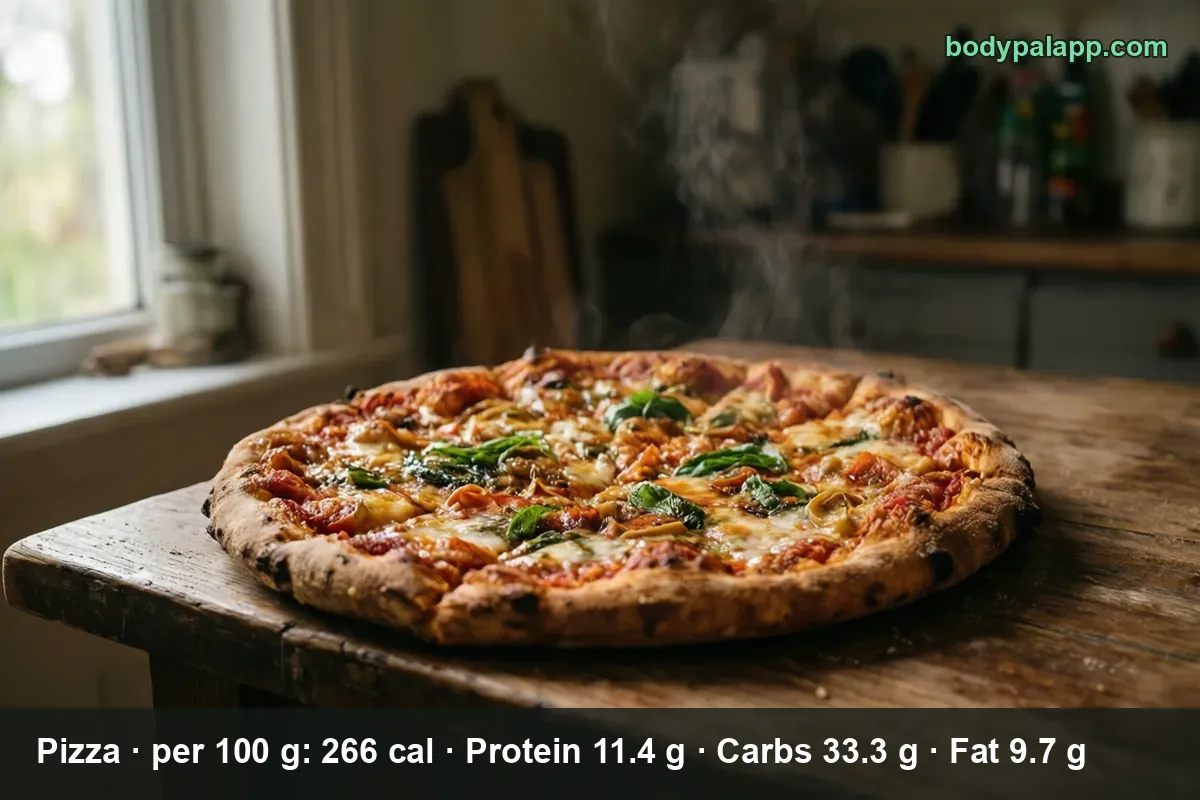
A slice of cheese pizza is 317 calories. That is one eighth of a 14-inch pie, 119 g on the plate, at 266 calories per 100 g. Cut the same pizza at 12 inches and the slice falls to 229. The width of the pizza moves the number far more than anything sprinkled on top of it.
On this page
- What a slice actually carries
- Pizza is priced by the square inch
- Every slice size, from personal to extra-large
- Crust and topping, slice by slice
- Thin crust is denser, not lighter
- What USDA measured at the chains
- Costco, MOD and any pizza you can measure
- Sodium breaks before calories do
- Pizza against the rest of the takeout menu
- Most popular frozen pizza brands
- Pizza FAQs
What a slice actually carries
The reference food is restaurant cheese pizza on a medium crust, the record behind almost every pizza a delivery driver hands over.
| Nutrient | Per 100 g | Per 1 slice (119 g) | % Daily Value |
|---|---|---|---|
| Calories | 266 | 317 | — |
| Total fat | 9.7 g | 11.5 g | 15% |
| Saturated fat | 4.5 g | 5.3 g | 27% |
| Carbohydrate | 33.3 g | 39.7 g | 14% |
| Dietary fiber | 2.3 g | 2.7 g | 10% |
| Total sugars | 3.6 g | 4.3 g | — |
| Protein | 11.4 g | 13.6 g | 27% |
| Sodium | 540 mg | 643 mg | 28% |
% Daily Value is based on a 2,000-calorie diet.
Verified nutrition data
Numbers on this page come from USDA FoodData Central, the U.S. Department of Agriculture’s food composition database, and from manufacturer labels where a branded product is named. Last verified September 2026. How we verify our data →
Two rows deserve a second look. Protein is genuinely good: 13.6 g in a slice, 27% of the day, which is why two slices hold you the way a bagel never does. Sodium is the outlier — 28% of the daily limit for 16% of the day's calories.
There is no added-sugars line here on purpose. No USDA record for pizza carries one, and a pizzeria has no Nutrition Facts panel to read, so the honest figure is total sugars: 4.3 g, most of it tomato and dough. Total sugars have no Daily Value under FDA labeling rules, which is why that cell is blank rather than guessed.
Pizza is priced by the square inch
Here is the thing nobody else publishes: USDA does not only weigh slices, it weighs one square inch of pizza. For a medium crust that unit is 6.2 g, or 16 calories. Thin crust is 4.5 g a square inch (12 calories), thick crust 6.9 g (19 calories).
Run the circle math and the official weights fall straight out of it. A 14-inch pizza covers 153.9 square inches; at 6.2 g each that is 954 g, which is exactly the weight USDA lists for one large (13–15 inch) pizza. Divide by eight: 119 g, the slice at the top of this page. A 10-inch pizza comes to 487 g, and cut into six it gives 81 g against USDA's listed small slice of 80 g.
So the slice counts baked into the data are six on a 10-inch, eight on a 12- or 14-inch, and ten on a 16- to 18-inch. That is testable, and it holds.
The consequence is the single most useful fact about pizza calories. Area scales with the square of the diameter. An 18-inch pizza is only 1.5 times wider than a 12-inch, but it carries 2.25 times the food. Going one size down on the same order saves about 88 calories per slice; switching pepperoni for plain cheese saves 33. Ask how wide the pizza was before you ask what was on it.
Every slice size, from personal to extra-large
| Portion | Weight | Calories | Sodium |
|---|---|---|---|
| 1 oz | 28 g | 75 | 153 mg |
| 1 slice, small 8–10 inch | 80 g | 213 | 432 mg |
| 1 slice, medium 11–12 inch | 86 g | 229 | 464 mg |
| 1 slice, large 13–15 inch | 119 g | 317 | 643 mg |
| 1 slice, extra-large 16–18 inch | 128 g | 340 | 691 mg |
| 2 slices, large | 238 g | 633 | 1,285 mg |
| 3 slices, large | 357 g | 950 | 1,928 mg |
| 1 personal pizza, 5–7 inch | 175 g | 466 | 945 mg |
| 1 whole 11–12 inch pizza | 691 g | 1,838 | 3,731 mg |
| 1 whole 13–15 inch pizza | 954 g | 2,538 | 5,152 mg |
Every weight in that table is USDA's own portion figure for the same food, not a guess scaled from one slice.
A personal pizza is the row people misjudge most. It looks like a snack because it is small enough to hold in one hand, and it is 466 calories — more than a slice and a half of the large pie you were trying to avoid. The pan version sold as a lunch deal has no separate USDA record, so 175 g and 466 calories is the closest measured stand-in.
Two slices, at 633 calories, is an ordinary dinner. Three, at 950, is half a day.
Crust and topping, slice by slice
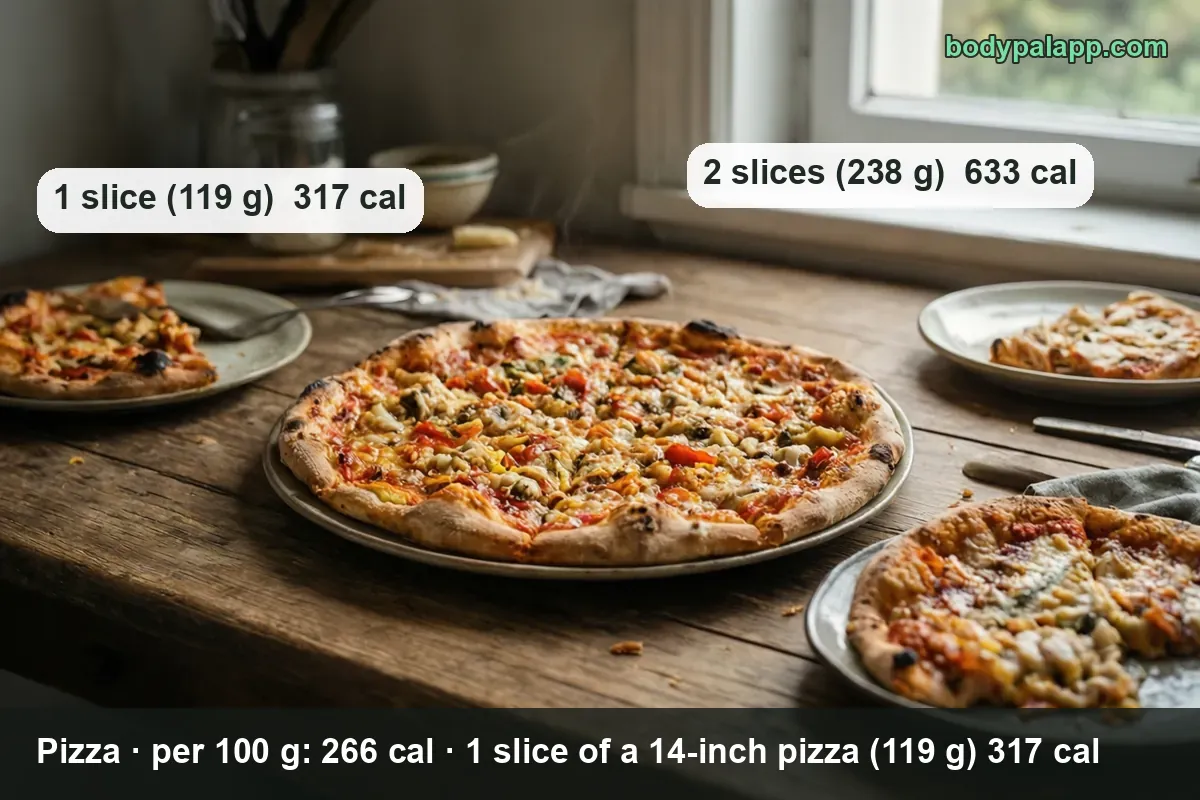
Each row below uses its own slice weight from a 14-inch pizza, so the comparison is one pizza size with the crust and topping changed underneath it.
| USDA record | Per 100 g | Slice | Calories | Sodium |
|---|---|---|---|---|
| Cheese, thin crust | 266 | 86 g | 229 | 464 mg |
| Cheese, medium crust | 266 | 119 g | 317 | 643 mg |
| Cheese, thick crust | 271 | 132 g | 358 | 713 mg |
| Cheese with vegetables | 242 | 133 g | 322 | 644 mg |
| Cheese, whole wheat thin crust | 267 | 119 g | 318 | 646 mg |
| Cheese, gluten-free thin crust | 264 | 119 g | 314 | 577 mg |
| No cheese, thin crust | 276 | 75 g | 207 | 413 mg |
| Pepperoni, medium crust | 282 | 124 g | 350 | 769 mg |
| Pepperoni, thick crust | 287 | 139 g | 399 | 862 mg |
| Cheese, stuffed crust | 274 | 148 g | 406 | 910 mg |
| Pepperoni, stuffed crust | 296 | 164 g | 485 | 1,163 mg |
Pepperoni costs 16 calories per 100 g over plain cheese, about 6%. Stuffed crust costs a third of a slice in weight before anything goes on top, which is why one stuffed-crust pepperoni slice reaches 485 calories and half a day's sodium.
The whole wheat row is the quiet surprise. It is 318 calories against 317 for the ordinary slice — identical energy — but 4.2 g of fiber instead of 2.7 g. It buys fiber, not calories. Gluten-free thin crust behaves the same way at 314 calories; neither is a lighter pizza, they are differently built ones.
Out of the freezer the picture shifts again, because a boxed pizza is cut by the manufacturer:
| From frozen | Per 100 g | Piece | Calories | Sodium |
|---|---|---|---|---|
| Cheese, thin crust | 263 | 97 g | 255 | 457 mg |
| Cheese, thick crust | 268 | 133 g | 356 | 595 mg |
| Pepperoni, medium crust | 275 | 102 g | 280 | 514 mg |
USDA's branded-label records show frozen pizza "servings" defined as anything from half the pizza to a sixth of it, all printed as one serving. Two boxes with nearly the same density can differ by 27% on the panel, purely because of where the maker drew the line. Read the fraction, not the word.
Cauliflower crust is worth a sentence for the same reason. Across the branded records the cauliflower-crust shelf runs 165 to 270 calories per 100 g, sitting squarely inside the normal band, and a typical box calls half the pizza one serving at around 350 calories. The saving comes from a smaller pizza, not from the cauliflower.
Thin crust is denser, not lighter
The received wisdom says thin crust is the diet order. Measured as one pizza, it is the opposite.
USDA's earlier lab analysis put three crusts of the same 14-inch cheese pizza side by side: thin 302 calories per 100 g, regular 266, thick 271. Take away bread and what remains is a higher share of cheese and oil, so the density climbs. The thin slice is lighter only because it weighs 76 g instead of 107 g.
Which makes the advantage entirely a portion effect, and portion effects evaporate. Four thin slices weigh 304 g; three regular slices weigh 321 g. If the thinner crust talks you into one more piece, you have eaten the same pizza and paid a slightly worse rate per gram.
Order thin crust because you like the crunch. As a calorie strategy it works only if the slice count stays fixed.
What USDA measured at the chains
These are lab analyses of chain pizzas with their own USDA record numbers, not menu claims. All are 14-inch pies, and each slice weight is USDA's own for that specific pizza.
| USDA's own analysis | Per 100 g | Slice | Calories | Sodium |
|---|---|---|---|---|
| Domino's cheese, classic hand-tossed | 257 | 108 g | 278 | 565 mg |
| Domino's cheese, crunchy thin | 298 | 70 g | 209 | 440 mg |
| Domino's pepperoni, hand-tossed | 273 | 113 g | 308 | 690 mg |
| Pizza Hut cheese, hand-tossed | 275 | 105 g | 289 | 708 mg |
| Pizza Hut cheese, Thin 'N Crispy | 306 | 79 g | 242 | 677 mg |
| Pizza Hut pepperoni, hand-tossed | 291 | 110 g | 320 | 835 mg |
| Little Caesars cheese, regular crust | 265 | 89 g | 236 | 404 mg |
| Papa John's cheese, original crust | 260 | 117 g | 304 | 676 mg |
At one identical 14-inch size, the slices land between 236 and 338 calories. Almost none of that hundred-calorie spread is density: the pizzas run 257 to 306 per 100 g, a narrow band. It is the knife. Little Caesars cuts the lightest slice in the set at 89 g, Papa John's the heaviest pepperoni at 123 g, and a Domino's crunchy thin slice is 70 g — half the weight of a stuffed-crust wedge.
Two caveats worth stating plainly. These samples were collected for a USDA fast-food survey and the chains have reformulated since, so treat them as measured anchors rather than today's menu. And a chain's own calculator will disagree, because it counts a different slice.
Costco, MOD and any pizza you can measure
Some of the most-searched pizzas have no measured record at all. The food-court slice has never been analyzed by USDA and is not a packaged product, so there is no label behind it either. Rather than repeat an unsourced number, here is the arithmetic, using the per-square-inch figure from the section above.
An 18-inch pizza covers 254.5 square inches. Cut into six, one slice is 42.4 square inches. At 6.2 g per square inch that slice weighs 263 g, and at 2.66 calories per gram it works out to about 700 calories, with roughly 1,420 mg of sodium — 62% of the day. That is a derived figure, shown so you can check it, not a company's claim.
The same three lines work for any pizza you can eyeball. Square the radius, multiply by 3.14, divide by the number of slices, then multiply by 16 calories per square inch for a medium crust, 12 for thin, 19 for thick. The fast-casual personal pie built to order at a counter has no USDA record and no verified panel either, so it gets no number from us — but its diameter gives you one in about ten seconds.
Sodium breaks before calories do
Calories are why people search for pizza. Sodium is the number that runs out first.
One slice is 643 mg, or 28% of the 2,300 mg daily limit, for 16% of a 2,000-calorie day. The ratio stays lopsided all the way up:
- Two slices: 633 calories and 1,285 mg — 56% of the day's sodium
- Three slices: 950 calories and 1,928 mg — 84%
- A whole 14-inch cheese pizza: 2,538 calories and 5,152 mg, or 224%
A single stuffed-crust pepperoni slice carries 1,163 mg on its own, 51% of the limit in one piece. Most sodium in the American diet arrives in restaurant and packaged food rather than from the shaker, and pizza is one of the clearest examples: nothing about a cheese slice tastes salty enough to warn you.
Practical version: if pizza is a weekly fixture, the slice count is a sodium decision as much as a calorie one. The CDC's guidance on sodium puts the target below 2,300 mg a day for adults, and three slices spend nearly all of it before anything else on the table is counted.
Pizza against the rest of the takeout menu
| Food | Per 100 g | US portion | Calories |
|---|---|---|---|
| Cheese pizza, restaurant | 266 | 1 slice, large 14 inch (119 g) | 317 |
| Cheeseburger, fast food | 296 | 1 burger (165 g) | 488 |
| Garlic bread, from frozen | 350 | 1 large slice (111 g) | 389 |
| Fried chicken wing, coated | 323 | 1 wing (55 g) | 178 |
| Cheese quesadilla | 316 | 1 full circle (120 g) | 379 |
Our take: pizza is the cheapest calorie on this table, 266 per 100 g against 296 to 350 for everything else, and it returns 13.6 g of protein a slice. The slice is not the problem. Its companions are — one slice of garlic bread costs more than a slice of pizza, and six wings come to 1,068 calories, about three and a half slices. If you want the lowest-calorie item on the menu, order wings and stop at three. If you want the meal that actually ends hunger, two slices at 633 calories with 27 g of protein does it, and it does it with a fraction of the decision-making. Just skip the bread that arrives alongside.
Most popular frozen pizza brands in the United States
Ranked by how widely each product appears among foods sold in the United States, from the BodyPal food database of over 3.3 million products. Calories are the figures printed on each Nutrition Facts label, checked against USDA FoodData Central.
| Product | Calories (per 100 g) |
|---|---|
| DiGiorno Pepperoni Original Rising Crust | 231 cal |
| DiGiorno Four Cheese Original Rising Crust | 218 cal |
| Red Baron Pepperoni Classic Crust | 260 cal |
| Red Baron Classic Crust Cheese | 255 cal |
| Tombstone Pepperoni Original | 260 cal |
| Totino’s Party Pizza, Pepperoni | 241 cal |
Brand popularity: BodyPal food database. Nutrition: manufacturer labels / USDA FoodData Central.
Pizza FAQs
How many calories in a slice of pizza?
317 calories for a slice of cheese pizza cut from a 14-inch pie, which USDA weighs at 119 g. That is 266 calories per 100 g. A slice off a 12-inch pizza is 229 calories and a slice off an 18-inch is 340, so the diameter decides the number.
How many calories in 2 slices of pizza?
633 calories for two slices of a large cheese pizza, 238 g together. They also bring 27 g of protein and 1,285 mg of sodium, which is 56% of the daily limit. Three slices reach 950 calories and 84% of the day's sodium.
How many calories in a Costco pizza slice?
About 700 calories, derived rather than measured. A food-court slice is a sixth of an 18-inch pizza, which is 42.4 square inches; at USDA's 6.2 g per square inch that is 263 g, and at 2.66 calories per gram it comes to roughly 700, with about 1,420 mg of sodium. No lab analysis of it exists.
How many calories in a Domino's slice?
278 calories for a slice of 14-inch cheese pizza on classic hand-tossed crust, from USDA's own analysis of a 108 g slice. Crunchy thin drops to 209 for a 70 g slice, and hand-tossed pepperoni is 308. Chains reformulate, so treat these as measured anchors.
How many calories in thin crust pizza?
229 calories for a thin-crust slice from a 14-inch cheese pizza, because that slice weighs 86 g instead of 119 g. Per 100 g thin crust is not lighter: measured as one pizza, thin ran 302 calories per 100 g against 266 for regular. Less bread means a higher share of cheese.
How many calories in pepperoni pizza?
350 calories for a pepperoni slice from a 14-inch pizza, at 282 calories per 100 g and a 124 g slice. That is 33 more than the cheese slice. Pepperoni on a thick crust reaches 399 calories, and on a stuffed crust 485.
How many calories in a whole pizza?
1,838 calories for a whole 12-inch cheese pizza (691 g) and 2,538 for a 14-inch (954 g). A small 10-inch is 1,277. Sodium tracks with it: the 14-inch pie holds 5,152 mg, or 224% of the daily limit.
How many calories in a pizza roll?
48 calories per roll, at 345 calories per 100 g for a 14 g piece. Nobody eats one: six rolls, the usual serving, come to 293 calories and 536 mg of sodium. A full bowl of them costs about as much as a slice of pizza.
Similar foods
- NY Pizza — 229 cal per slice, large pizza
- Thin Crust Pizza — 229 cal per slice
- Cheese Pizza — 309 cal per slice
- Mexican Pizza — 249 cal per pizza
- Chicken Pizza — 150 cal per slice
- Pepperoni Pizza — 320 cal per slice
Skip the slice math
Point the camera at the open box and BodyPal logs the slice, the protein and the sodium riding along with it.


How long does it take to burn off a slice of pizza?
A slice of a 14-inch cheese pizza is 317 kcal. Enter your weight to see how long it takes you to burn that off:
lb
| Activity | Time to burn 317 kcal |
|---|---|
| Walking, brisk | 1 hr 3 min |
| Cycling, moderate | 40 min |
| Swimming, moderate | 45 min |
| Jogging | 37 min |
| Weight training, moderate | 1 hr 10 min |
Times are for a 155 lb adult at a steady pace; change the weight to see yours. BodyPal works this out from your steps automatically.
Burning it off is one side of it. The other is knowing your number: work out how many calories you need a day, with macros and a goal date.