
How many calories are in pom juice?
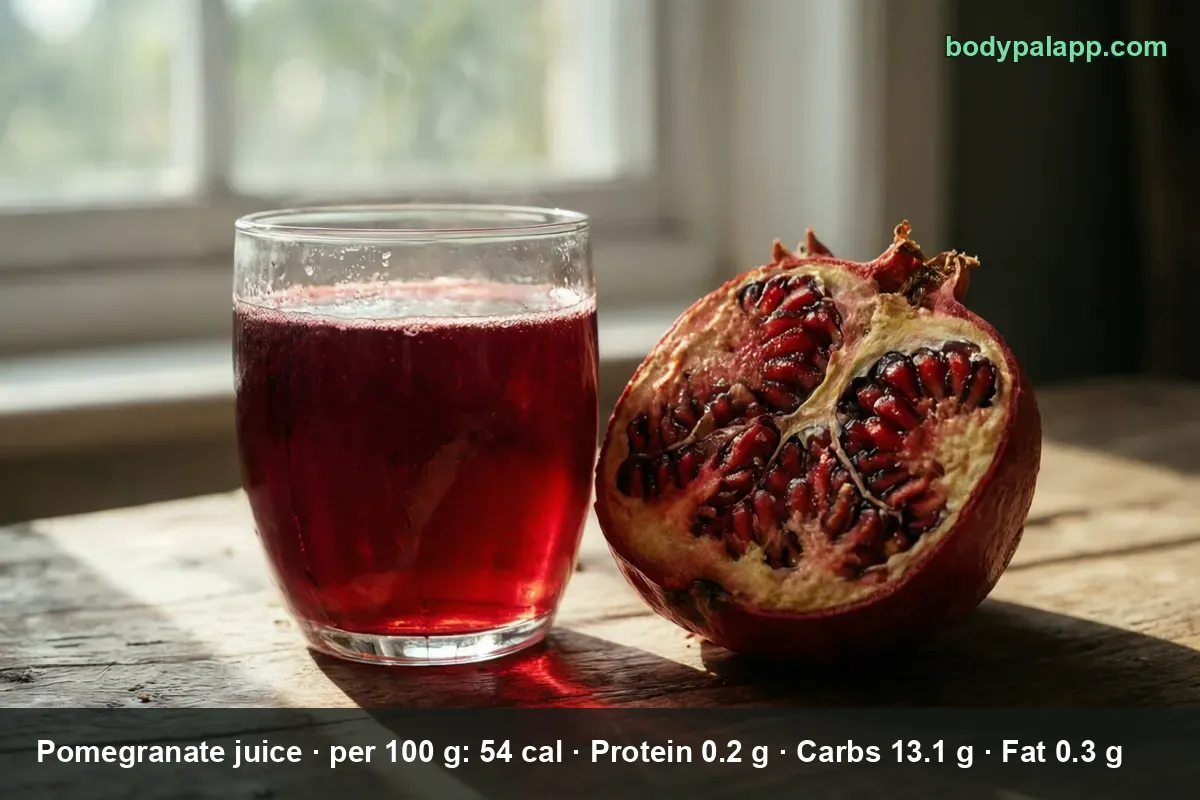
A 1-cup glass of bottled pomegranate juice, 249 g, is 134 calories, and the juice itself runs 54 calories per 100 g. That puts it in the same bracket as most 100% fruit juices: light per sip, deceptive by the bottle, and almost all of the calories arrive as sugar.
On this page
- Pom juice quick facts
- US servings, from one ounce to a 16 oz bottle
- Light juice blends and other pomegranate rows
- Sugar, potassium and what the label leaves out
- How does pom juice compare?
- Most popular pomegranate juice brands
- FAQ
Pom juice quick facts
When Americans say pom juice, they mean bottled 100% pomegranate juice, the dark red kind sold cold in the refrigerated case. The record that matches it is SR Legacy 167787, "Pomegranate juice, bottled", and it is the only entry that carries a cup as a household measure, which is how anyone actually pours it.
There is a second entry for the same product in the survey database, FNDDS 2709330. The nutrients are identical down to the decimal; only the serving sizes differ, since that one is listed in fluid ounces. Same juice, different measuring cup.
| Nutrient | Per 100 g | Per 1 cup (249 g) | % Daily Value |
|---|---|---|---|
| Calories | 54 | 134 | — |
| Total fat | 0.29 g | 0.7 g | 1% |
| Saturated fat | 0.08 g | 0.2 g | 1% |
| Carbohydrate | 13.13 g | 32.7 g | 12% |
| Dietary fiber | 0.1 g | 0.2 g | 1% |
| Total sugars | 12.65 g | 31.5 g | — |
| Protein | 0.15 g | 0.4 g | 1% |
| Sodium | 9 mg | 22 mg | 1% |
| Cholesterol | 0 mg | 0 mg | 0% |
| Potassium | 214 mg | 533 mg | 11% |
% Daily Value is based on a 2,000-calorie diet.
Verified nutrition data
Numbers on this page come from USDA FoodData Central, the U.S. Department of Agriculture’s food composition database, and from manufacturer labels where a branded product is named. Last verified September 2026. How we verify our data →
There is no added sugars row here because USDA does not publish added sugars for this record. The 12.65 g per 100 g are the fruit's own sugars, pressed out of the arils. Total sugars carry no Daily Value on the US label either, which is why that cell shows a dash while carbohydrate right above it shows 12%.
US servings, from one ounce to a 16 oz bottle
| Serving | Weight | Calories |
|---|---|---|
| 1 fl oz | 31.4 g | 17 kcal |
| 1 oz | 28.4 g | 15 kcal |
| Half a cup | 124.5 g | 67 kcal |
| 1 cup | 249 g | 134 kcal |
| 8 fl oz glass | 251.2 g | 136 kcal |
| 16 fl oz bottle | 502.4 g | 271 kcal |
| Per 100 g | 100 g | 54 kcal |
Only the 1-cup line and the 100 g line come from USDA. Everything else — the half cup, the 8 fl oz pour, the 16 fl oz bottle, the fluid ounce and the ounce — is our own arithmetic scaled from the USDA 100 g figure, not a USDA serving.
The sip is what fools people. One fluid ounce is 17 calories, the sort of number that makes juice feel free. Drink the whole 16 fl oz bottle in an afternoon and it is 271 calories, a hair over double what a single cup costs and roughly what a bagel would run you. Nothing about the juice changed; only the container did.
Note how close the 1-cup row and the 8 fl oz row sit: 134 against 136. Pomegranate juice is a touch denser than water, so a cup measured by volume and a cup measured on a scale land two calories apart. For counting purposes they are the same pour.
Light juice blends and other pomegranate rows
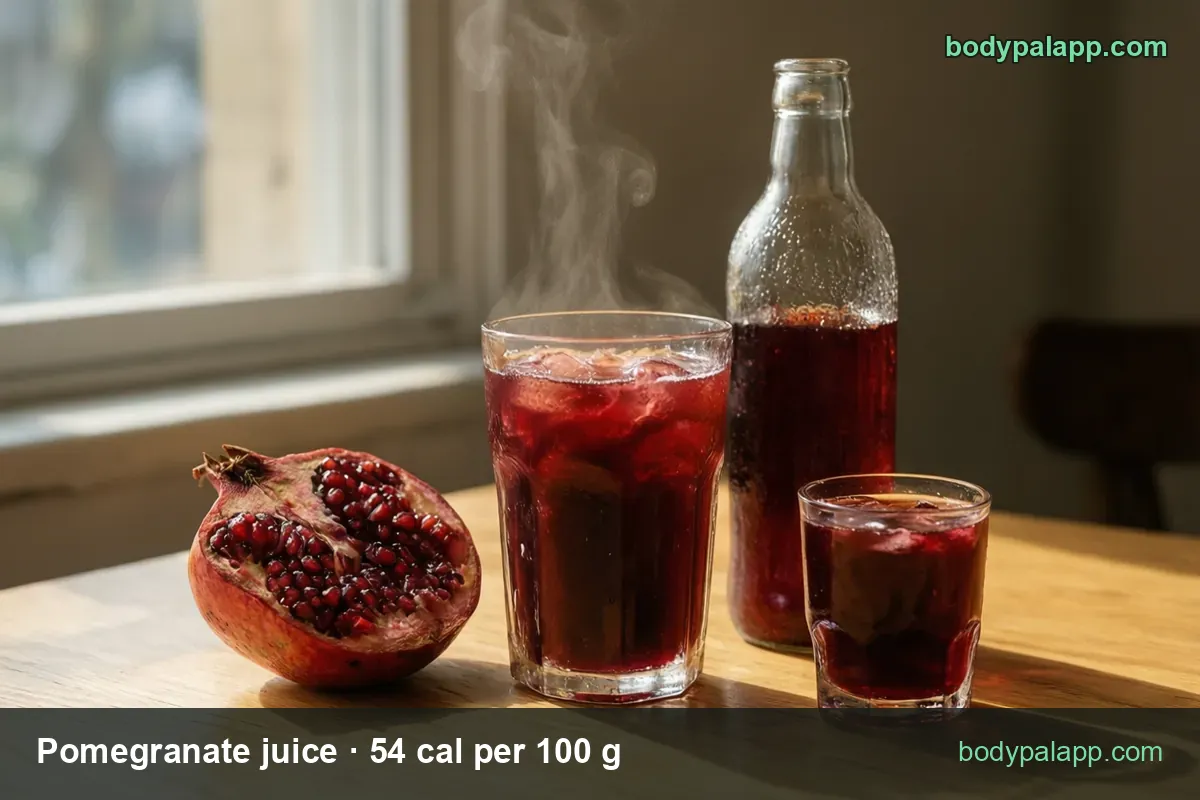
The bottled shelf holds two different drinks that both look like pomegranate juice. One is the real thing at 100% juice. The other is a light beverage cut to 40-50% juice, and the calorie gap between them is exactly half.
| Version | Per 100 g | Typical pour | Calories |
|---|---|---|---|
| Bottled 100% pomegranate juice | 54 kcal | 1 cup, 249 g | 134 kcal |
| Pomegranate juice, 100%, survey record | 54 kcal | 1 glass, 248 g | 134 kcal |
| Light pomegranate beverage, 40-50% juice | 27 kcal | 1 glass, 240 g | 65 kcal |
The light version is 27 calories per 100 g against 54, and the sugars fall with it: 6.32 g per 100 g instead of 12.65 g. A tall glass of it is 65 calories. If juice is a daily habit rather than an occasional glass, that swap is the single largest lever on this page, and it costs you nothing but some of the flavor intensity.
Home-squeezed juice is the one version this page cannot price. USDA publishes no separate record for it, so any number would be a guess. The bottled figure is the closest stand-in, and fresh juice will usually sit near it since nothing is added or removed except the seeds.
Sugar, potassium and what the label leaves out
Potassium is the row worth reading. One cup delivers 533 mg, which is 11% of the 4,700 mg Daily Value the FDA sets. That is the highest percentage on the whole panel apart from carbohydrate at 12%, and potassium is a nutrient most Americans fall short on. A glass of pom juice is a genuinely efficient way to move that number, at 134 calories.
Fiber is the trade. The juice keeps 0.1 g per 100 g, so a full cup carries 0.2 g and 1% of the 28 g Daily Value. Juicing leaves the seeds and the white membrane behind, and the fiber leaves with them. That is the practical argument for eating the fruit rather than drinking it: MyPlate counts 100% juice toward the fruit group but recommends most of your fruit come whole, and the fiber row here shows exactly why.
Protein and fat barely register — 0.4 g and 0.7 g in a cup, 1% DV each. Cholesterol is zero. Sodium is 22 mg per cup, about 1% DV, which is just under a hundredth of a teaspoon of table salt. Whatever you are watching on a label, with this drink it comes down to two numbers: the calories and the sugar.
If you are cutting calories, treat juice as a food, not a drink. It has no fiber and almost no protein, so it does very little for fullness at 134 calories a cup. For satiety per calorie, whole fruit wins outright. For potassium per calorie, and for anyone who struggles to eat enough produce, the glass earns its place.
How does pom juice compare?
| Juice | Per 100 g | US serving | Calories |
|---|---|---|---|
| Pomegranate juice, bottled | 54 kcal | 1 cup, 249 g | 134 kcal |
| Pineapple juice, 100% | 53 kcal | 1 cup, 249 g | 132 kcal |
| Grape juice, 100%, calcium added | 62 kcal | 1 cup, 249 g | 154 kcal |
| Cranberry juice blend, 100% juice | 46 kcal | 1 cup, 249 g | 115 kcal |
The 1-cup figures for the other three juices are our own arithmetic from their USDA 100 g rows. Our take: pomegranate sits in the middle of the pack and closer to the light end than most people assume. Only two of these are lighter — cranberry blend at 115 calories a cup and pineapple at 132, and pineapple is within two calories, which is noise. Grape is the one to watch at 154 a cup, 20 calories more than pomegranate for the same pour. If you are choosing purely on calories, the juice you pick matters less than the size of the glass you pour it into; the 1-cup rows here span 39 calories, while going from a cup to a 16 fl oz bottle of pom alone adds 137.
Most popular pomegranate juice brands in the United States
Ranked by how widely each product appears among foods sold in the United States, from the BodyPal food database of over 3.3 million products. Calories are the figures printed on each Nutrition Facts label, checked against USDA FoodData Central.
| Product | Calories (per 100 g) |
|---|---|
| POM Wonderful 100% Pomegranate Juice | 65 cal |
| Kral Pomegranate Juice | 48 cal |
| Langers Fresh Pressed All Pomegranate Juice | 68 cal |
| Open Nature Pomegranate Juice | 67 cal |
| Bolthouse Farms 100% Pomegranate Juice | 62 cal |
Brand popularity: BodyPal food database. Nutrition: manufacturer labels / USDA FoodData Central.
Pom juice FAQs
How many calories are in a glass of pomegranate juice?
A 1-cup glass of bottled pomegranate juice, 249 g, is 134 calories, from the USDA figure of 54 calories per 100 g. Most drinking glasses hold a little more than that. Pour a full 8 fluid ounces, about 251 g by our own arithmetic from the same 100 g row, and you are at 136.
How many calories in 8 oz of pom juice?
Eight fluid ounces works out to roughly 251 g and 136 calories. That is our own arithmetic from the USDA 100 g value of 54 calories, not a USDA serving. It lands two calories above the listed 1-cup serving of 249 g, which USDA puts at 134 calories.
How much sugar is in pomegranate juice?
One cup carries 31.5 g of total sugars, or 12.65 g per 100 g. That is nearly all of the carbohydrate in the glass, since the cup holds 32.7 g of carbohydrate in total. Total sugars have no Daily Value on the US label, so that row shows a dash rather than a percentage.
Does pomegranate juice have added sugar?
The 12.65 g per 100 g in the SR Legacy entry are the sugars of the fruit itself, pressed from pomegranates. USDA does not publish an added sugars figure for this record, so this page cannot put a number on it. A sweetened juice cocktail or a light juice beverage is a different product with a different record.
Is pomegranate juice high in potassium?
A 1-cup serving supplies 533 mg of potassium, 11% of the 4,700 mg Daily Value, from 214 mg per 100 g. That is the highest percentage on the panel apart from carbohydrate at 12%, and it arrives for 134 calories, which makes the glass an efficient source rather than a token one.
Pomegranate juice vs grape juice: which has more calories?
Grape juice is heavier: 62 calories per 100 g against 54 for pomegranate, so a 1-cup pour comes to 154 calories versus 134. Grape also carries more carbohydrate, 14.77 g per 100 g against 13.13 g. Both are sold as 100% juice, so the gap is the fruit, not the processing.
How many carbs are in pomegranate juice?
One cup holds 32.7 g of carbohydrate, 12% of the Daily Value, from 13.13 g per 100 g. Almost all of it is sugar, 31.5 g, because the juice keeps only 0.2 g of fiber per cup. A half-cup pour, our own arithmetic at 124.5 g, halves it for 67 calories.
Does pomegranate juice have any fiber?
Barely: 0.1 g per 100 g, which is 0.2 g in a full cup and 1% of the 28 g Daily Value. Juicing leaves the seeds and membranes behind and the fiber goes with them. Whole fruit is the version that counts toward your fiber for the day, not the glass.
Similar foods
- Cranberry Juice — 137 cal per cup (8 fl oz)
- Orange Julius Blended Orange Drink — 134 cal per cup
- Sunny D — 134 cal per cup
- Boba Drink — 239 cal per item, any size
- Boba Tea — 239 cal per boba tea
- Bubble Tea — 239 cal per drink
Count it without the math
Point the camera at the glass and BodyPal counts the juice for you, bottle size and all.


How long does it take to burn off pom juice?
A 1-cup (249 g) glass is 134 kcal. Enter your weight and the amount you ate to see how long it takes you to burn that off:
lb
| Activity | Time to burn 134 kcal |
|---|---|
| Walking, brisk | 27 min |
| Cycling, moderate | 17 min |
| Swimming, moderate | 19 min |
| Jogging | 16 min |
| Weight training, moderate | 30 min |
Times are for a 155 lb adult at a steady pace; change the weight to see yours. The amount is set to the portion in the text (249 g); change it to what you actually ate. BodyPal works this out from your steps automatically.
Want the bigger picture? Calculate your daily calorie needs — your maintenance figure, a target for losing or gaining, and the date you get there.