Pop tart calories come to 193 for one 52 g tart and 372 per 100 g. The figure to notice is the split: carbs supply 81% of those calories and protein only 4%. That makes a tart quick, easy energy with very little to keep you full, and a second tart pushes the total to 387.
193kcal
1 tart · 52 g, breakfast tart, low fat
4%protein
2.1 gProtein
40 gCarbs
3.1 gFat
How to burn off 193 kcal
—Walking, brisk
—Jogging
—Cycling, moderate
—Swimming
Skip the math. BodyPal counts these calories from your steps and workouts automatically.
Nutrition facts
Breakfast tart, low fat · per 52 g
Calories
193 kcal
Protein
2.1 g
Carbohydrate
40 g
Fat
3.1 g
Saturated fat
0.7 g
Cholesterol
0 mg
Sodium
188 mg
Potassium
34 mg
Iron
1.8 mg
Source: USDA FoodData Central
🛡️
Verified nutrition data
Numbers on this page come from USDA FoodData Central, the U.S. Department of Agriculture’s food composition database, and from manufacturer labels where a branded product is named. Last verified September 2026. How we verify our data →
Pop tart: calories, protein and sodium by serving
Percent of daily value uses the FDA reference of 2,000 kcal a day.
Serving
kcal
Protein
Carbs
Fat
Sodium
% DV kcal
1 tart (52 g)
193
2.1 g
39.9 g
3.1 g
188 mg
10%
100 g
372
4 g
76.8 g
6 g
361 mg
19%
3 × 1 tart (52 g)
580
6.2 g
563 mg
5 × 1 tart (52 g)
967
10.4 g
939 mg
One tart is 193 calories, two are 387
The numbers here come from the USDA row for a low fat breakfast tart, which weighs 52 g per piece. One tart delivers 193 calories, about 10% of a 2000-calorie daily value. That is a modest snack on its own. The trouble is that a single tart rarely feels like a full breakfast.
Eat two and you land at 387 calories, 104 g of food, and just 4.1 g of protein. Three tarts reach 580 calories, and a run of five adds up to 967 calories, close to half of a standard daily value. The total climbs in clean steps because each tart is the same size, so counting them is easy. Stopping is the hard part.
If you track your intake, log tarts by the piece rather than by the package. A pouch, a box and a family pack all share the same per-tart math, so the honest question is simply how many you ate. Branded versions such as Kellogg's Pop-Tarts Frosted Strawberry or Blueberry can differ from this USDA row, so check the brand table on this page if you buy a specific flavor.
Carbs supply 81% of every calorie
Per 100 g, a breakfast tart holds 76.8 g of carbs, 6 g of fat and 4 g of protein. Turned into calories, that is 81% carbs, 14% fat and 4% protein. In practice nearly every bite is refined starch and filling. The low fat label is accurate, but it does not make the tart light: 372 calories per 100 g is a dense food.
Protein is the weak spot. One tart gives 2.1 g, about 4% of the daily value, and even five tarts only reach 10.4 g. Fiber is thin too, at 0.8 g per tart. With so little protein and fiber to slow things down, most people find a tart wears off fast.
Fat stays moderate at 3.1 g per tart, with 1.4 g of saturated fat per 100 g and no cholesterol at all. So the case against eating several is not fat. It is the volume of calories you can take in without much to show for it in protein or fiber.
Sodium is the quiet row on the label
A sweet pastry does not look salty, yet one tart carries 188 mg of sodium, or 8% of the daily value. Per 100 g that is 361 mg, about 16% of the daily value. On a single tart that is unremarkable. Stack several and it adds up: two tarts bring 375 mg, three reach 563 mg and five hit 939 mg.
Sugar in this USDA row is lower than many people expect, at 2.5 g per tart and 4.9 g per 100 g. Keep in mind this row describes a low fat breakfast tart, not a frosted one. Frosted flavors from Kellogg's Pop-Tarts may sit differently, so if sugar is your concern, read the label of the exact box you bought.
If you watch sodium, a tart is a small entry by itself, but it counts on days when the rest of your meals lean on packaged foods. Potassium is low at 66 mg per 100 g, so a tart does nothing to balance that sodium.
A tart works best as part of a meal, not the whole meal
Because a tart is almost all carbs, the simplest fix is to pair it with something that brings protein. Eggs, yogurt or a glass of milk round out the 2.1 g a tart offers and make the meal last longer. Fruit adds volume and a little fiber without many calories.
Treat a tart as a fixed, known block of 193 calories. That predictability is useful: you know exactly what one costs, and you can decide whether it fits around your other meals. The risk is grabbing a second one out of habit, which doubles the cost while adding only another 2 g or so of protein.
If you want to keep a record without weighing anything, BodyPal can log a tart from a photo. One tart, counted honestly, is easy to fit into most days.
How does pop tart compare?
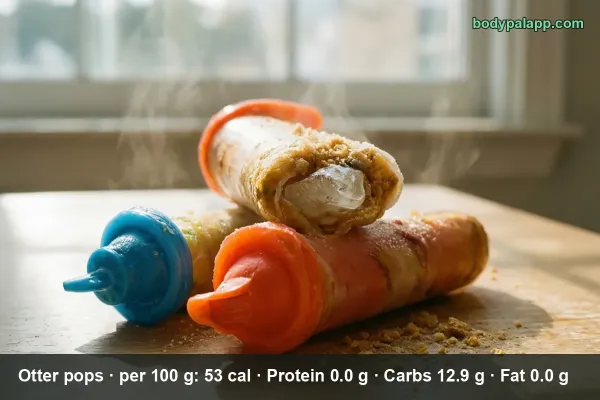
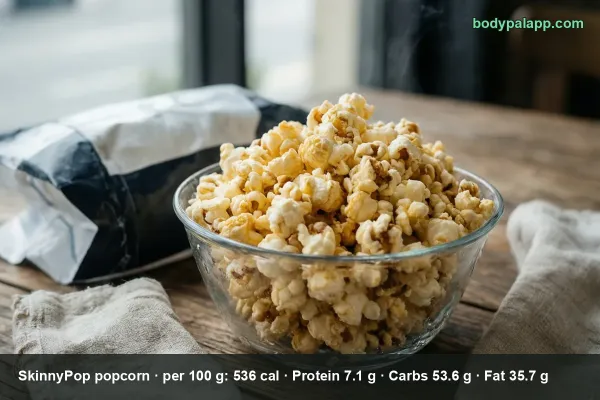
Here is how a pop tart stacks up against a hot pocket, otter pops and skinny pop popcorn, per 100 g and per usual serving.
Verdict: If you want the lightest sweet snack, otter pops win at 53 calories per 100 g, while skinny pop popcorn is the densest at 536. If you want something closer to a meal, a hot pocket costs 338 calories per pocket but gives 10.3 g of protein per 100 g against 4 g in a pop tart.
The number above is the low fat breakfast tart, so frosted retail pastries read higher, around 391 calories per 100 g. Source: manufacturer labels / USDA FoodData Central.
Pop tart FAQs
How many calories are in one pop tart?
One 52 g breakfast tart is about 193 calories. A two pastry pouch of 104 g comes to about 387 calories.
Are pop tarts good for weight loss?
One tart is 193 calories with 39.9 g of carbs and only 2.1 g of protein, and the usual two pastry pouch doubles that to about 387 calories.
Do frosted pop tarts have more calories than the plain breakfast tart?
Yes. The low fat breakfast tart is 372 calories per 100 g, while frosted strawberry pastries are 391 calories per 100 g, about 203 calories for a 52 g pastry.
How many carbs are in a pop tart?
A 52 g tart has 39.9 g of carbs, of which 2.5 g is sugar, plus 0.8 g of fiber. Per 100 g that is 76.8 g of carbs.
How many calories are in two pop tarts?
Two tarts contain 387 calories in 104 g. You also get 375 mg of sodium and only 4.1 g of protein, so the calories climb much faster than anything that keeps you full.
How much protein is in a pop tart?
One tart has 2.1 g of protein, about 4% of the daily value. Protein makes up only 4% of its calories, so pair a tart with eggs, yogurt or milk if you want a more filling breakfast.
How much sodium is in a pop tart?
A single tart carries 188 mg of sodium, 8% of the daily value. Per 100 g it is 361 mg, so eating three tarts brings you to 563 mg.
How much sugar is in a pop tart?
The USDA low fat breakfast tart lists 2.5 g of sugars per tart and 4.9 g per 100 g. Frosted branded versions can differ, so check the label of the flavor you buy.
How much fat is in a pop tart?
One tart has 3.1 g of fat, and fat supplies 14% of its calories. Per 100 g there are 6 g of fat, 1.4 g of it saturated, and no cholesterol.