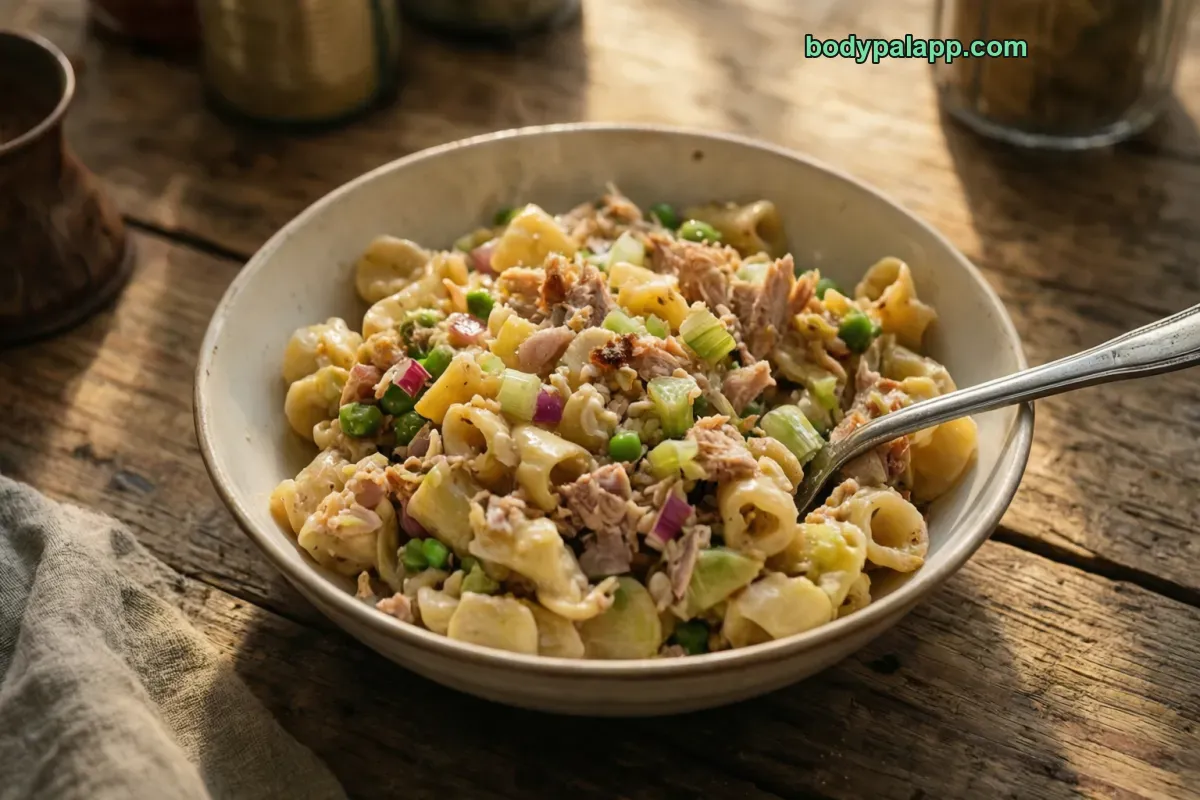
Tuna pasta salad calories come to 408 for 1 cup (204 g) and 200 per 100 g. The surprise is where they come from: fat supplies 45% of the calories, pasta carbs 42% and tuna protein just 13%. The dressing and the size of your scoop decide the total far more than the tuna does.
408kcal
1 cup · 204 g, macaroni or pasta, with dressing
13%protein
13.6 gProtein
43 gCarbs
20 gFat
How to burn off 408 kcal
—Walking, brisk
—Jogging
—Cycling, moderate
—Swimming
Skip the math. BodyPal counts these calories from your steps and workouts automatically.
Nutrition facts
Macaroni or pasta, with dressing · per 204 g
Calories
408 kcal
Protein
13.6 g
Carbohydrate
43 g
Fat
20 g
Saturated fat
3.2 g
Cholesterol
22 mg
Sodium
420 mg
Potassium
141 mg
Iron
2.3 mg
Source: USDA FoodData Central
🛡️
Verified nutrition data
Numbers on this page come from USDA FoodData Central, the U.S. Department of Agriculture’s food composition database, and from manufacturer labels where a branded product is named. Last verified September 2026. How we verify our data →
Tuna pasta salad: calories, protein and sodium by serving
Percent of daily value uses the FDA reference of 2,000 kcal a day.
Serving
kcal
Protein
Carbs
Fat
Sodium
% DV kcal
1 cup (204 g)
408
13.6 g
42.6 g
20.2 g
420 mg
20%
Small serving (136 g)
272
9.1 g
28.4 g
13.5 g
280 mg
14%
With egg, 1 cup (204 g)
402
14.6 g
39.5 g
20.3 g
408 mg
20%
100 g
200
6.7 g
20.9 g
9.9 g
206 mg
10%
3 × 1 cup (204 g)
1,224
40.9 g
1,261 mg
5 × 1 cup (204 g)
2,040
68.2 g
2,101 mg
A cup of tuna pasta salad is a 408-calorie scoop
A level cup of tuna pasta salad weighs 204 g and carries 408 calories, which is 20% of the daily value. That is a full lunch's worth of energy from something many people treat as a side dish. It also brings 13.6 g of protein, or 27% of the daily value, so the cup does more than fill space on the plate.
A small serving of 136 g drops the total to 272 calories and 9.1 g of protein. That is the scoop to take when the salad sits next to a sandwich or grilled meat. Going back for seconds is where the math changes fast: 2 cups reach 816 calories, and 3 cups hit 1,224.
A potluck bowl of 5 cups comes to 2,040 calories and 2,101 mg of sodium. Nobody eats that alone. It is still a useful number when you portion a homemade batch into containers for the week, because every container you fill heavier than a cup quietly adds to the count.
Fat supplies more calories than the pasta
The calorie split is 45% fat, 42% carbs and 13% protein. Per 100 g that works out to 9.9 g of fat, 20.9 g of carbs and 6.7 g of protein. Pasta contributes more grams, yet fat wins on calories because each gram of fat carries more than twice the energy of a gram of carbs.
The dressing is the likely fat source, which is why the amount of mayonnaise or oil in a recipe moves the total more than the noodles do. Saturated fat stays modest at 1.6 g per 100 g, and cholesterol is just 11 mg. A cup holds 20.2 g of fat in total.
Fiber and sugar are both low. A cup has 2.4 g of fiber and 3.2 g of sugars, so the 42.6 g of carbs in that cup are mostly starch from the pasta. If you want the bowl to keep you full longer, the fiber has to come from what you mix in or serve alongside it.
Adding egg barely moves the numbers
The USDA also lists a version made with egg. At 1 cup (204 g) it comes to 402 calories against 408 for the standard recipe. Protein edges up to 14.6 g, which is 29% of the daily value, while carbs dip to 39.5 g. Fat is essentially identical at 20.3 g.
Sodium is a touch lower too, 408 mg versus 420 mg per cup. Fiber and sugars barely shift, at 2.2 g and 3.1 g. In practice the two salads are interchangeable for logging, and chopped egg adds texture and a little protein rather than a calorie penalty.
What does change the numbers is how much dressing goes in and how many cups end up on the plate. A wetter, creamier batch will run higher than the USDA row, and a lightly dressed one will run lower. If you make your own recipe, weigh a serving the first time so you know which side of 408 your version lands on.
Sodium stays moderate until the second cup
One cup brings 420 mg of sodium, 18% of the daily value, and the small serving has 280 mg, or 12%. That is moderate for a prepared deli-style salad. Per 100 g the figure is 206 mg, about half of the 418 mg in tuna mayo salad.
Portions are what push it up. Two cups carry 840 mg and three cups 1,261 mg, which starts to crowd a day if your other meals lean on deli meat, cheese or canned soup. If you watch sodium, keep the salad to a single cup and build the rest of the plate from fresh food.
Good partners are high in volume and low in calories: a green salad, sliced tomatoes, cucumbers or a piece of fruit. They add the fiber the pasta lacks without adding much to the 408 calories already on the plate. BodyPal can log the salad from a photo, which helps when the scoop size is a guess.
How does tuna pasta salad compare?
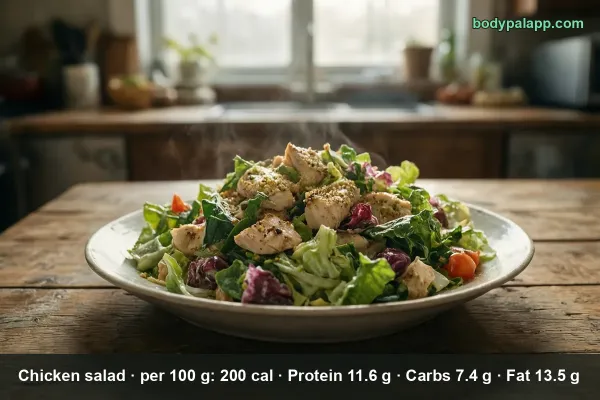
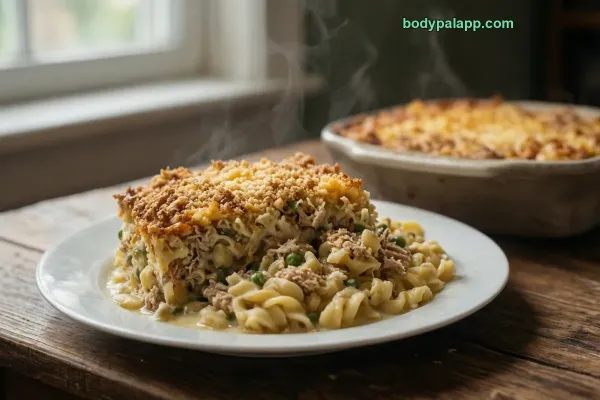
Here is how tuna pasta salad stacks up against other creamy salads and a tuna casserole, per 100 g and per usual serving.
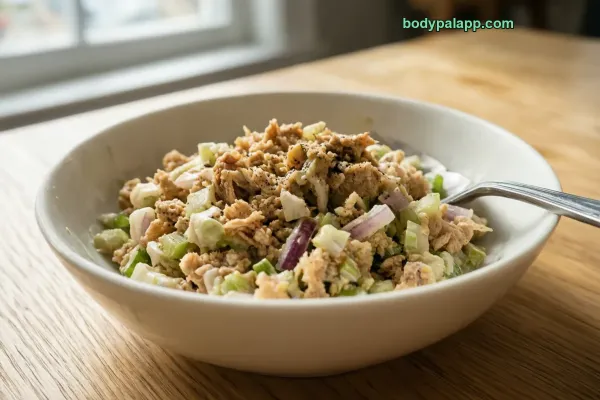
Verdict: For the fewest calories pick tuna noodle casserole at 311 per cup and 139 per 100 g; for more protein per bite pick chicken salad at 11.6 g or tuna mayo salad at 10.1 g per 100 g. Tuna pasta salad sits in between at 408 per cup, and its 206 mg of sodium per 100 g is the lowest of the group.
Tuna pasta salad FAQs
How many calories are in a cup of tuna pasta salad?
About 408 calories per cup (204 g), or 272 in a smaller 136 g serving.
Is tuna pasta salad good for weight loss?
A cup has 408 calories, 13.6 g protein and 20.2 g fat. At 200 calories per 100 g it is denser than most leafy salads.
Tuna pasta salad vs chicken salad: which has fewer calories?
They are about even at 200 calories per 100 g each. Tuna pasta salad gets more of its calories from the pasta, with 20.9 g carbs per 100 g.
How many carbs are in tuna pasta salad?
A cup has 42.6 g carbs, including 2.4 g fiber and 3.2 g sugars.
How much protein is in tuna pasta salad?
A cup of tuna pasta salad has 13.6 g of protein, which is 27% of the daily value. Per 100 g it is 6.7 g, so protein supplies only 13% of the calories while fat and carbs make up the rest.
How much sodium does tuna pasta salad have?
One cup has 420 mg of sodium, or 18% of the daily value. Per 100 g it is 206 mg, lower than tuna mayo salad at 418 mg and chicken salad at 653 mg.
Does adding egg change the calories in tuna pasta salad?
Only slightly: the egg version has 402 calories per cup (204 g) versus 408 for the standard salad. It also has a bit more protein at 14.6 g and a little less sodium at 408 mg.
How many calories are in a small serving of tuna pasta salad?
A small serving of 136 g has 272 calories, 14% of the daily value. It also gives 9.1 g of protein and 280 mg of sodium, a sensible side portion next to a main dish.
How much fat is in tuna pasta salad?
A cup holds 20.2 g of fat, and fat supplies 45% of the calories. Per 100 g there are 9.9 g of fat, of which 1.6 g is saturated. The amount of dressing decides most of that number.