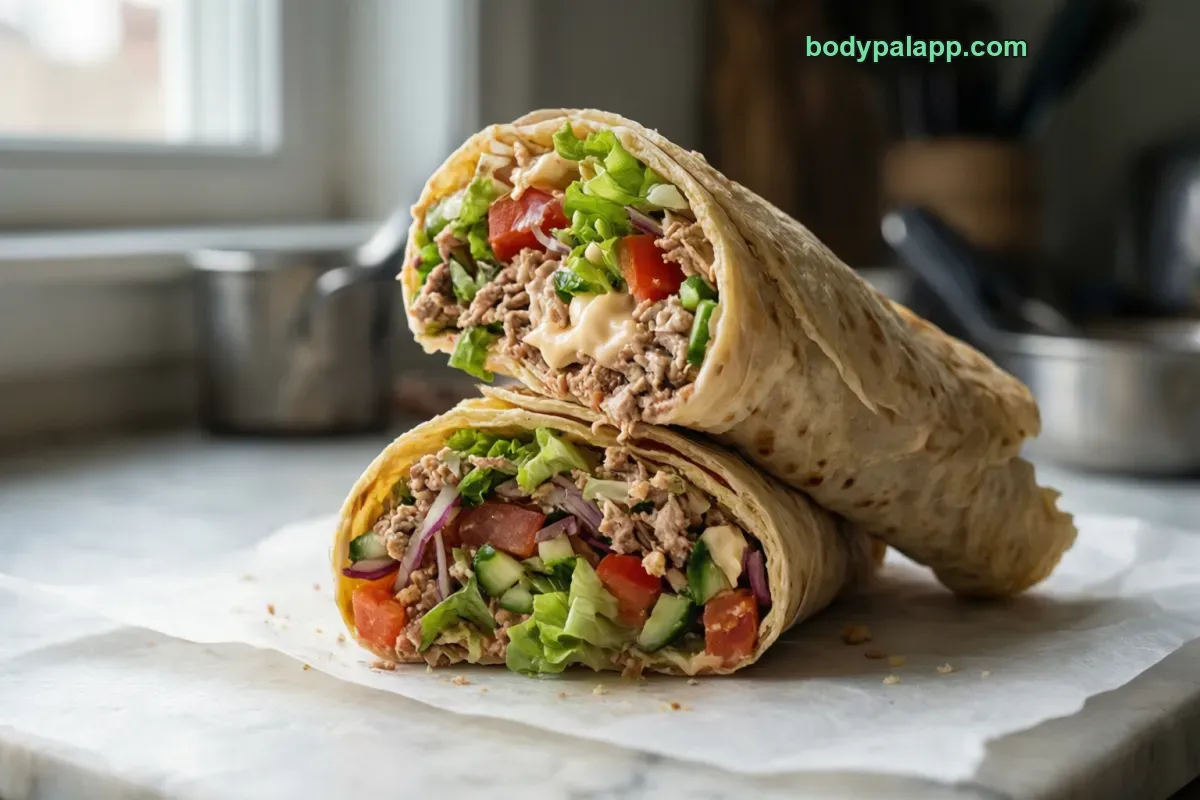
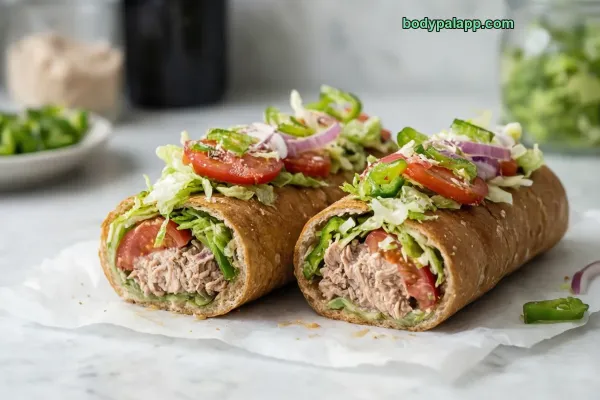
Subway tuna wrap calories come to 900 for one wrap (330 g), or 273 per 100 g, based on Subway's official nutrition information. Notice the scale first: that single wrap covers 45% of a day's calorie value and 57% of the sodium value. Most of its energy comes from fat, not tuna.
900kcal
1 wrap · 330 g, as served
18%protein
41 gProtein
52 gCarbs
59 gFat
How to burn off 900 kcal
—Walking, brisk
—Jogging
—Cycling, moderate
—Swimming
Skip the math. BodyPal counts these calories from your steps and workouts automatically.
Subway tuna wrap: calories, protein and sodium by serving
Percent of daily value uses the FDA reference of 2,000 kcal a day.
Serving
kcal
Protein
Carbs
Fat
Sodium
% DV kcal
1 wrap (330 g)
900
41 g
52 g
59 g
1,310 mg
45%
100 g
273
12.4 g
15.8 g
17.9 g
397 mg
14%
3 × 1 wrap (330 g)
2,700
123 g
3,930 mg
5 × 1 wrap (330 g)
4,500
204.9 g
6,550 mg
One wrap is 900 calories, close to half a day
A wrap looks lighter than a sub, but this one weighs 330 g and lands at 900 calories. That is 45% of the daily value for calories in a single item, before chips, cookies or a soda. It also brings 41 g of protein, 52 g of carbs and 59 g of fat.
The total climbs fast if you order for a long day or share nothing. Two wraps reach 1,800 calories and 2,620 mg of sodium. Three wraps hit 2,700 calories with 3,930 mg of sodium, which is more salt than most people see across an entire day.
There is no smaller wrap size in the data, so portion control means splitting it. Eat half now and half later, or share it, and the numbers drop with it. The per 100 g figure of 273 calories is the easiest way to estimate a partial wrap if you weigh what you actually ate.
Fat supplies 59% of the calories
Tuna has a lean reputation, but the calorie split tells a different story. Fat provides 59% of the calories, carbs 23% and protein only 18%. Per 100 g, that works out to 17.9 g of fat, 15.8 g of carbs and 12.4 g of protein.
The fat comes mainly from the mayonnaise-dressed tuna filling and the large flatbread wrap, not from the fish itself. Saturated fat sits at 3.9 g per 100 g, and cholesterol at 30 mg per 100 g, both moderate for a fast-food item. Sugar stays low at 1.5 g per 100 g.
Protein is still a real strength. The 41 g in one wrap equals 82% of the daily value, more than many chicken options deliver. The catch is that you pay for it with a lot of fat calories. Fiber is thin, with 3 g per wrap and 0.9 g per 100 g.
Sodium is the row to watch
One wrap carries 1,310 mg of sodium, which is 57% of the daily value. Per 100 g it is 397 mg, so even a half wrap still delivers a meaningful share of a day's salt.
Salt comes from every layer: the wrap, the dressed tuna, cheese if you add it, and pickles or olives from the vegetable bar. Sauces push it higher. If you watch sodium, skip the extra cheese and salty toppings and load up on lettuce, tomato, cucumber and spinach instead.
It helps to plan the rest of the day around it. A salty lunch like this one leaves less room for chips, deli meat or canned soup later. Water and fresh produce at other meals make the day balance out better than trying to fix it inside the wrap.
Treat it as a full meal, not a snack
At 900 calories, this wrap is a complete meal on its own. Adding a side of chips or a cookie turns lunch into most of a day's energy. If you want something extra, pick a side that adds volume rather than fat, such as apple slices or a side salad without heavy dressing.
The protein makes it filling, so it suits a day with a lighter breakfast and dinner. Pair the evening meal with vegetables and a lean protein to keep fat and sodium in check. Drink water or unsweetened tea alongside it rather than soda.
If you track intake, log the whole wrap rather than guessing. BodyPal can log it from a photo, which makes it easier to see how one lunch stacks up against the rest of your day.
How does subway tuna wrap compare?
Here is how the Subway tuna wrap compares with other Subway items, per 100 g and per usual serving.
Verdict: For weight loss the 6-inch tuna sandwich is the better tuna pick at 524 calories versus 900 for the wrap, and the broccoli cheddar soup is lighter still at 200 per bowl. Choose the wrap only if you want the bigger protein hit and can budget for its 273 calories per 100 g.
Subway tuna wrap FAQs
How many calories are in a Subway tuna wrap?
One Subway tuna wrap (330 g) has 900 calories, which is 273 calories per 100 g.
Is the Subway tuna wrap good for weight loss?
One wrap is 900 calories with 59.0 g of fat and 1310 mg of sodium, so it takes up a large share of a daily calorie budget.
Subway tuna wrap vs tuna sub: which has fewer calories?
The tuna sub has 221 calories per 100 g against 273 for the tuna wrap. A 6-inch tuna sub (237 g) comes to 524 calories, compared with 900 for the whole wrap.
How much protein is in a Subway tuna wrap?
One wrap has 41.0 g of protein, 52.0 g of carbs and 59.0 g of fat.
What are the full nutrition facts for a Subway tuna wrap?
One Subway tuna wrap (330 g) has 900 calories, 41 g protein, 52 g carbs, 59 g fat, 3 g fiber, 5 g sugars and 1,310 mg sodium, according to Subway's official nutrition information.
How many calories are in 100 grams of tuna wrap?
A Subway tuna wrap has 273 calories per 100 g. That same 100 g holds 12.4 g protein, 15.8 g carbs, 17.9 g fat and 397 mg sodium, so fat drives most of the energy.
How many calories are in a Subway tuna sandwich?
A 6-inch Subway tuna sandwich (237 g) has 524 calories, or 221 per 100 g. The tuna sub entry lists 570 calories for a 6-inch sub (236 g). Both are well below the 900-calorie wrap.
What is the nutrition of a Subway tuna sandwich per 100 g?
Per 100 g, the Subway tuna sandwich has 221 calories, 12.3 g protein, 16 g carbs, 12 g fat and 329 mg sodium. It carries less fat per 100 g than the wrap's 17.9 g.
How much sodium is in a Subway tuna wrap?
One Subway tuna wrap has 1,310 mg of sodium, which is 57% of the daily value. Two wraps would reach 2,620 mg.