
How many calories are in turkey chili?
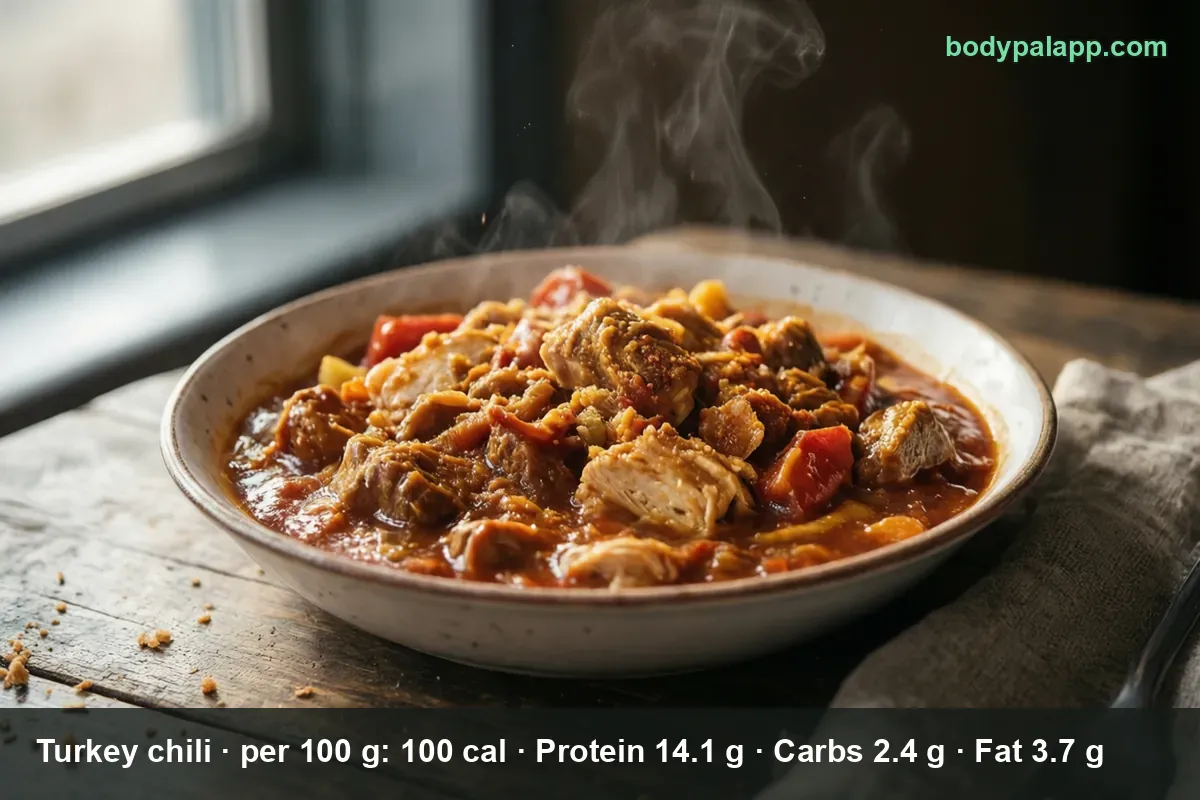
A 1-cup (255 g) serving of turkey chili without beans is 255 calories, and the pot itself runs 100 calories per 100 g — about as close to a one-to-one gram-to-calorie ratio as a hot dinner ever gets. That same cup hands you 36 g of protein and 915 mg of sodium.
On this page
- Turkey chili quick facts
- From one ounce to a two-cup bowl
- How beans and canned versions change the count
- Sodium is the row to watch
- How does turkey chili compare?
- Most popular turkey chili brands
- FAQ
Turkey chili quick facts
There is no line in the USDA database called "turkey chili." Poultry chili is coded inside the mixed-dishes group, and the row that matches a pot of ground or diced turkey simmered with tomatoes and peppers is FNDDS 2706426, "Chili with chicken" — chili built on poultry, with no beans in it. That is the version most people mean when they type the question: meat, tomato, chili powder, maybe a diced red pepper, nothing starchy stirred through.
Every branded row in the database is a can, and almost all of them come with beans, so a can is a different food with a different calorie count. Those get their own section further down rather than standing in for the pot on your stove.
| Nutrient | Per 100 g | Per 1 cup (255 g) | % Daily Value |
|---|---|---|---|
| Calories | 100 | 255 | — |
| Total fat | 3.71 g | 9.5 g | 12% |
| Saturated fat | 1.057 g | 2.7 g | 13% |
| Carbohydrate | 2.41 g | 6.1 g | 2% |
| Dietary fiber | 0.5 g | 1.3 g | 5% |
| Total sugars | 1.37 g | 3.5 g | — |
| Protein | 14.11 g | 36.0 g | 72% |
| Sodium | 359 mg | 915 mg | 40% |
% Daily Value is based on a 2,000-calorie diet.
Verified nutrition data
Numbers on this page come from USDA FoodData Central, the U.S. Department of Agriculture’s food composition database, and from manufacturer labels where a branded product is named. Last verified September 2026. How we verify our data →
Two rows you would see on a can are missing here on purpose: added sugars and trans fat. The USDA does not publish either field for mixed dishes in this dataset, so putting a number in those rows would mean inventing one. Cholesterol and potassium do exist for this record: a cup carries 156 mg of cholesterol (52% DV) and 556 mg of potassium (12% DV). The cholesterol figure is the one that surprises people — poultry chili is lean, but it is still a cup packed with meat.
The percentages come from the FDA's Daily Values for the Nutrition Facts label, the same reference numbers printed on packaged food.
From one ounce to a two-cup bowl
Chili is a ladle food, and ladles lie. A standard measuring cup holds 255 g of it, but the soup bowls in most American kitchens hold closer to two cups once you fill them to a comfortable level. That is the single biggest error in logging chili — not the recipe, the bowl.
| Serving | Weight | Calories |
|---|---|---|
| 1 oz | 28 g | 28 kcal |
| Half a cup | 128 g | 128 kcal |
| 1 cup, the USDA measure | 255 g | 255 kcal |
| 2 cups, a filled dinner bowl | 510 g | 510 kcal |
| Per 100 g | 100 g | 100 kcal |
Only the 1-cup line is a USDA household measure. The ounce, the half cup and the two-cup bowl are our own arithmetic from the USDA 100 g figure, not USDA servings — which is easy arithmetic here, because 100 g of this chili is 100 calories almost exactly. Weigh the bowl on a kitchen scale and the gram number is the calorie number.
Toppings sit outside all of this. A handful of shredded cheddar, a spoon of sour cream and a few crushed crackers can add as much as the chili underneath them, and none of it is in the row above.
How beans and canned versions change the count
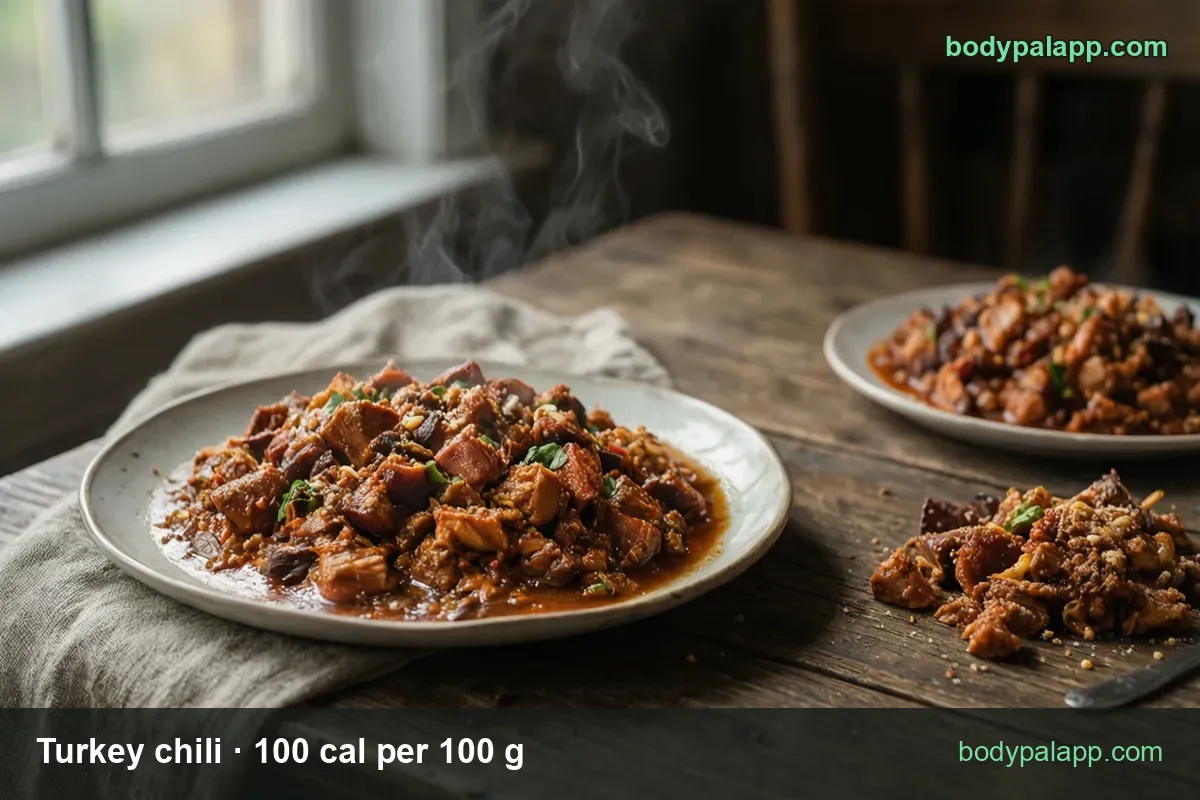
Here is the finding that runs against intuition: beans barely move the calories. They move the macros.
| Version | Per 100 g | Typical serving | Calories |
|---|---|---|---|
| Turkey chili, no beans | 100 kcal | 1 cup (255 g) | 255 kcal |
| Turkey chili with beans | 99 kcal | 1 cup (255 g) | 252 kcal |
| White turkey chili | 95 kcal | 1 cup (255 g) | 242 kcal |
| Canned chili, no beans | 118 kcal | 1 cup (240 g) | 283 kcal |
| Vegetarian chili | 119 kcal | 1 cup (255 g) | 303 kcal |
| Chili, NFS | 118 kcal | 1 cup (255 g) | 301 kcal |
| Beef chili, no beans | 139 kcal | 1 cup (255 g) | 354 kcal |
With beans. A cup lands at 252 calories against 255 without — a three-calorie difference nobody needs to think about. What changes is what those calories are made of. Protein falls from 14.11 g per 100 g to 10.2 g, because beans displace meat by volume. Fiber goes the other way, from 0.5 g to 3.0 g per 100 g, which is six times as much. If you want the protein, cook it without beans. If you want the fiber, add them, and stop worrying about the calorie cost.
White turkey chili. The lightest version on the table at 95 calories per 100 g, or 242 a cup — white beans and broth instead of tomatoes and chili powder. It is lower than the tomato version, but by 13 calories a cup, which is inside the noise of how heavily you ladle. Choose it for taste, not for the count.
Out of a can. Canned chili without beans is denser than the homemade pot at 118 calories per 100 g, and a 240 g can serving is 283 calories — 28 more than the same cup made at home. Canned turkey chili brands read lower on the label because beans and liquid dilute them: Hormel Turkey Chili with Beans lists 220 calories per 247 g cup, Wolf Turkey Chili No Beans 230 per 250 g cup, and Nalley 260 per 260 g cup. Read the can, not the category.
Beef, for reference. Chili with meat is 139 calories per 100 g and 354 a cup. Same pot, same ladle, 99 calories more.
Sodium is the row to watch
Calories are not the interesting number in a bowl of chili. Sodium is.
One cup carries 915 mg — 40% of the 2,300 mg Daily Value, from a single ladle of a food most people eat two ladles of. Fill a dinner bowl with two cups and you are at 1,830 mg before the crackers, which is close to eighty percent of the day. Canned versions run higher still: a cup of Hormel turkey chili with beans is about 1,200 mg, 52% of the day, and two cups of that clears the limit outright.
If sodium is something you track, this is where the lever is, and it is entirely under your control at home. Chili powder, canned tomatoes and broth carry most of it; the turkey carries very little. Low-sodium canned tomatoes and unsalted broth cut it hard without touching the calorie count at all.
The upside on the same plate is protein. A cup delivers 36.0 g, 72% of the Daily Value in one bowl, which is more than most people get at lunch and dinner combined. MyPlate counts a cup of chili like this as a solid protein serving, and the Dietary Guidelines for Americans put lean poultry near the front of the protein group. At 100 calories per 100 g, this is one of the cheapest ways to buy protein with calories that exists in a saucepan.
How does turkey chili compare?
| Chili | Per 100 g | Protein per 100 g | Fat per 100 g | US serving | Calories |
|---|---|---|---|---|---|
| Turkey chili, no beans | 100 kcal | 14.11 g | 3.71 g | 1 cup (255 g) | 255 kcal |
| Turkey chili with beans | 99 kcal | 10.2 g | 2.08 g | 1 cup (255 g) | 252 kcal |
| Beef chili, no beans | 139 kcal | 13.32 g | 8.22 g | 1 cup (255 g) | 354 kcal |
| Vegetarian chili | 119 kcal | 6.28 g | 2.42 g | 1 cup (255 g) | 303 kcal |
Our take: turkey chili without beans is the pick, and it is not close. It is the only one of the four above 14 g of protein per 100 g, and it is the lightest per cup except for its own bean version, which is three calories away. The switch from beef to turkey saves 99 calories a cup and more than halves the fat per 100 g, 3.71 g against 8.22 g, while protein barely moves — 14.11 g against 13.32 g. The vegetarian bowl is the one people assume is lightest and is not: 303 calories a cup, more than either turkey version, with less than half the protein.
For a cut, cook turkey with no beans and keep the bowl to one cup. For staying full through an afternoon, use beans and take the fiber — the calorie cost is a rounding error.
Most popular turkey chili brands in the United States
Ranked by how widely each product appears among foods sold in the United States, from the BodyPal food database of over 3.3 million products. Calories are the figures printed on each Nutrition Facts label, checked against USDA FoodData Central.
| Product | Calories (per 100 g) |
|---|---|
| Hormel Turkey Chili with Beans | 89 cal |
| Ahold Turkey Chili with Beans | 110 cal |
| Wolf Turkey Chili No Beans | 92 cal |
| Wolf Turkey Chili with Beans | 102 cal |
| Western Family Premium Mild Turkey Chili with Beans | 85 cal |
| Nalley Turkey Chili with Beans | 100 cal |
Brand popularity: BodyPal food database. Nutrition: manufacturer labels / USDA FoodData Central.
Turkey chili FAQs
How many calories are in a bowl of turkey chili?
A 1-cup bowl of turkey chili without beans is 255 calories, since the USDA record runs 100 calories per 100 g. A filled dinner bowl closer to two cups doubles that to 510 calories. The two-cup figure is our own arithmetic from the USDA 100 g number, not a USDA serving.
How much protein is in turkey chili?
One cup carries 36.0 g of protein, which is 72% of the Daily Value on a 2,000-calorie diet. That comes from 14.11 g per 100 g in the USDA record for poultry chili with no beans. Stirring beans in drops it to 10.2 g per 100 g, because beans displace meat.
Turkey chili vs beef chili: which has fewer calories?
Turkey wins by 99 calories a cup: 255 against 354 for the USDA record for chili with meat. The gap is fat, 3.71 g per 100 g against 8.22 g. Protein is close to a tie, 14.11 g against 13.32 g per 100 g, so you give up almost nothing by switching.
How many calories in turkey chili without beans?
255 calories a cup, from a USDA record of 100 calories per 100 g for poultry chili with no beans. Half a cup is 128 calories and one ounce is 28. The half-cup and ounce figures are our own arithmetic from the 100 g number, not USDA servings.
How many calories in a cup of canned turkey chili?
Canned chili without beans is 283 calories per 240 g cup, at 118 calories per 100 g — 28 more than the same cup made at home. Canned turkey chili with beans reads lower because beans and liquid dilute it: Hormel lists 220 calories a cup, Wolf 230 without beans.
Is turkey chili high in sodium?
Yes. One cup is 915 mg of sodium, 40% of the 2,300 mg Daily Value, and that is the homemade-style record. Canned versions run higher — a cup of Hormel turkey chili with beans is about 1,200 mg, 52% of the day, so two cups of it clear the whole limit.
Is turkey chili good for weight loss?
At 100 calories per 100 g with 14.11 g of protein, turkey chili is one of the best protein-per-calorie hot meals you can make in a pot. A 255-calorie cup fits inside a 350–450-calorie lunch with room to spare. If you are watching sodium, the 915 mg a cup is the number to plan around.
How many carbs are in turkey chili?
6.1 g of carbohydrate in a cup, only 2% of the Daily Value, because there are no beans in the record. Add beans and carbs climb to 10.25 g per 100 g, or 26.1 g a cup, while fiber rises from 0.5 g to 3.0 g per 100 g — six times as much.
Similar foods
- Skyline Chili — 244 cal per cup
- Beef Stew — 194 cal per cup
- Chicken Chili — 252 cal per cup
- Cocktail Shrimp — 84 cal per 3 oz portion
- Corn Chowder — 238 cal per cup
- Turkey Chili With Beans — 252 cal per cup
Count it without the math
Point the camera at the bowl and BodyPal counts the chili for you, ladle size and all.


How long does it take to burn off turkey chili?
A 1-cup (255 g) serving is 255 kcal. Enter your weight and the amount you ate to see how long it takes you to burn that off:
lb
| Activity | Time to burn 255 kcal |
|---|---|
| Walking, brisk | 51 min |
| Cycling, moderate | 32 min |
| Swimming, moderate | 36 min |
| Jogging | 30 min |
| Weight training, moderate | 57 min |
Times are for a 155 lb adult at a steady pace; change the weight to see yours. The amount is set to the portion in the text (255 g); change it to what you actually ate. BodyPal works this out from your steps automatically.
One food is easy to picture; a whole day is harder. See how many calories you need a day and what a deficit actually looks like.