
Calories in Cucumber: 14 kcal per 100 g
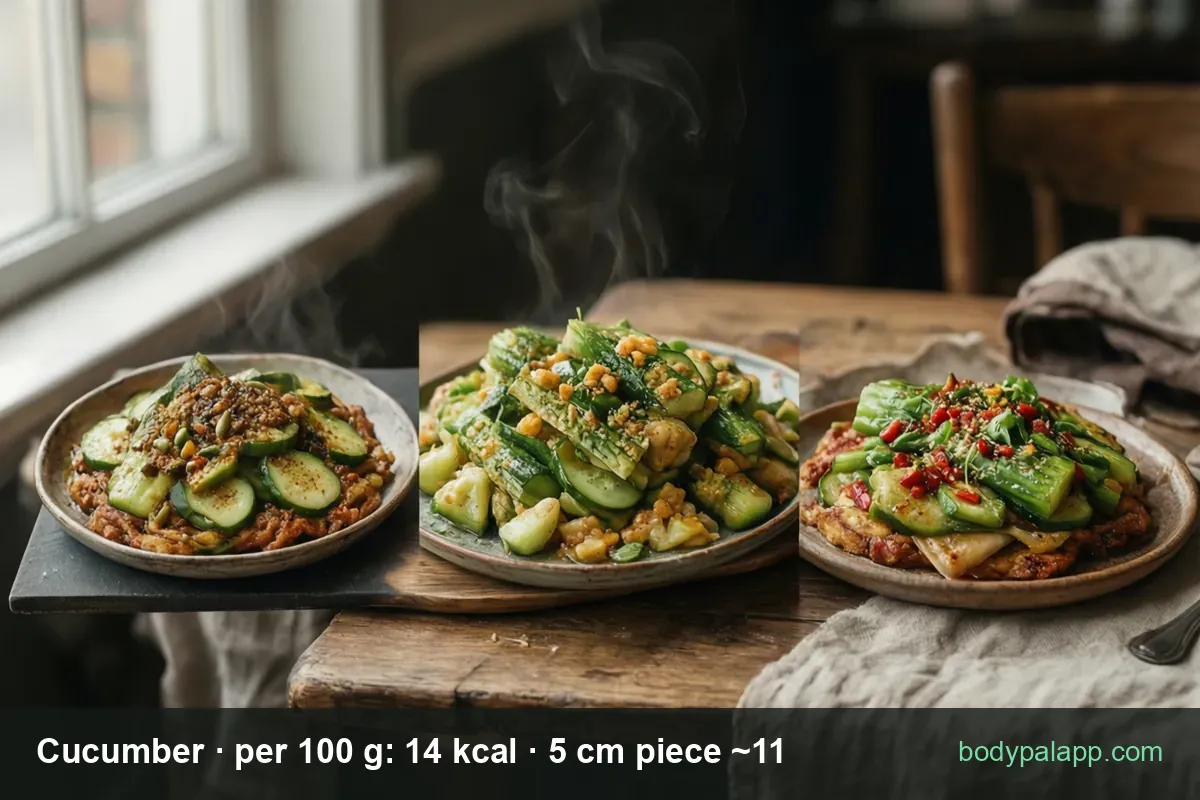
There is almost nothing to count: calories in cucumber run to 14 kcal per 100 g, meaning a 5 cm piece (about 80 g) costs 11 kcal and half a whole cucumber just 25 kcal. It is one of the lowest-calorie foods in any UK supermarket, salad aisle included.
On this page
- Quick facts
- Portion sizes
- The negative-calorie myth
- How does it compare?
- Most popular cucumber brands
- FAQ
Quick facts (per 100 g and per 5 cm piece)
| Nutrient | Per 100 g | Per 5 cm piece (~80 g) | % RI (portion) |
|---|---|---|---|
| Energy | 14 kcal / 59 kJ | 11 kcal / 46 kJ | 1% |
| Protein | 1.0 g | 0.8 g | 2% |
| Carbohydrates | 1.2 g | 1.0 g | <1% |
| Fat | 0.6 g | 0.5 g | 1% |
| Fibre | 0.7 g | 0.6 g | — |
| Sugar | 1.2 g | 1.0 g | 1% |
| Salt | 0.01 g | 0.008 g | 0% |
These figures are for raw cucumber with the skin on, which is how CoFID measures it — and how you should eat it, since peeling throws away most of the modest 0.7 g of fibre. Every single row here rounds to 2% of your reference intake or less. Cucumber is, for tracking purposes, nutritional white space.
Verified nutrition data
Numbers on this page come from CoFID, the UK government’s Composition of Foods Integrated Dataset, and from manufacturer labels where a branded product is named. Last verified August 2026. How we verify our data →
That emptiness is mostly water — which is the whole point. Water adds weight and crunch without energy, so cucumber drags the calorie density of any dish it joins downwards: add 100 g to a salad and you've grown the meal substantially for 14 kcal. It also makes cucumber one of the more hydrating things you can eat, though it won't replace a glass of water.
Portion sizes in UK terms
Nobody weighs cucumber, and with these numbers nobody needs to — but here's what the usual amounts come to, so your log matches reality:
| Portion | Weight | Calories |
|---|---|---|
| Handful of slices | ~30 g | 4 kcal |
| 5 cm piece | ~80 g | 11 kcal |
| Half a cucumber | ~180 g | 25 kcal |
The 80 g piece matters for one reason: that's the NHS 5-a-day portion size for salad veg, so a decent chunk of cucumber ticks a box for 11 kcal. Crunch through half a cucumber and you're still at 25 kcal — and since half is 25, a whole one lands around 50 kcal, roughly one custard cream's worth of energy for a foot of vegetable.
The sandwich-filler maths is even friendlier. A handful of slices adds 4 kcal to your lunch; the butter you spread underneath will beat that twentyfold. When a cucumber dish gets expensive, the cucumber is never the culprit — creamy dressings, oil and feta are.
Pickles are the one detour worth flagging. Gherkins and brined cucumbers start from the same 14 kcal vegetable, but the brine loads them with salt far beyond fresh cucumber's 0.01 g per 100 g — worth knowing if you're tracking against the 6 g daily reference. Sweet pickles add sugar on top. Fresh and raw is the version these numbers describe.
Tzatziki and cucumber raita sit somewhere in between: the cucumber remains a rounding error while the yoghurt and oil supply the actual calories. Log the dip by its own ingredients and let the cucumber ride along free.
The negative-calorie myth
You may have read that chewing and digesting cucumber burns more energy than the 14 kcal it delivers, making it a "negative-calorie food". Nice story; no evidence. Digestion does use energy, but only a small fraction of a food's calories — cucumber's 14 kcal per 100 g stay comfortably positive.
The truth needs no embellishment anyway. Cucumber is water with a snap: 1.2 g of carbs, 0.6 g of fat and 0.01 g of salt per 100 g. That's exactly the high-volume, low-energy profile the NHS Eatwell Guide wants filling half your plate — no metabolic magic required.
If the negative-calorie idea has a kernel of use, it's this: foods this light are effectively free, so eat them without arithmetic. The difference between "free" and "burns calories" matters only to the myth, not to your food diary — either way, cucumber is the last place to economise.
How does it compare?
| Food (per 100 g) | Calories | Fibre |
|---|---|---|
| Carrot | 34 kcal | 3.9 g |
| Cucumber (this page) | 14 kcal | 0.7 g |
| Tomato | 14 kcal | 1.0 g |
| Lettuce | 11 kcal | 1.5 g |
Verdict: cucumber ties with tomato at 14 kcal and the whole salad drawer is a rounding error — but if you're choosing on nutrition rather than crunch, carrot earns its 34 kcal with over five times the fibre. Use cucumber for bulk and freshness; it isn't there to feed you.
Every figure above comes from the UK Government's CoFID food composition dataset, and cucumber's near-zero salt makes it a safe pick if you're watching your salt intake — provided it doesn't arrive pickled in brine.
A practical way to use this table: pair rather than choose. Cucumber and tomato for volume, carrot for fibre and bite, lettuce as the base — the whole bowl, before dressing, still costs less than a couple of squares of chocolate. Salad only gets expensive after the bottle comes out.
Most popular cucumber brands in the United Kingdom
Ranked by how widely each product appears among foods sold in the United Kingdom, from the BodyPal food database of over 3.3 million products. Calories are the figures printed on each label.
| Product | Calories (per 100 g) |
|---|---|
| Tesco Cucumber | 11 kcal |
| Sunset Mini Cucumbers | 12 kcal |
Brand popularity: BodyPal food database. Nutrition: manufacturer labels.
FAQ
How many calories are in cucumber?
Cucumber has 14 kcal per 100 g, eaten raw with the skin on. A 5 cm piece is about 11 kcal, a handful of slices around 4 kcal, and half a cucumber roughly 25 kcal. It's about 2% of a banana's calorie density, which is why it barely dents a food diary.
How many calories are in 100g of cucumber?
Per 100 g: 14 kcal (59 kJ), 1.0 g protein, 1.2 g carbohydrate, 0.6 g fat, 0.7 g fibre, 1.2 g sugar and 0.01 g salt. Those are CoFID figures for raw cucumber, flesh and skin together — peeling it discards fibre without saving anything worth counting.
How many calories are in cucumber slices?
A handful of cucumber slices (about 30 g) is 4 kcal. Layer them into a sandwich or scatter them over a salad and the calorie impact is essentially nil — the bread, butter or dressing will out-calorie the cucumber many times over. Slice freely.
How many calories are in a whole cucumber?
Around 50 kcal — half a cucumber (~180 g) is 25 kcal, so a full one comes to roughly double that. For an entire vegetable, that's less energy than a plain digestive biscuit, which makes whole-cucumber snacking about as safe as snacking gets.
How many calories are in cucumber salad?
The cucumber contributes 14 kcal per 100 g; the dressing decides the rest. A vinegar-based salad stays close to the vegetable's own numbers, while creamy or oil-heavy versions can multiply the total several times. Log the dressing as its own ingredient and the maths stays honest.
Is cucumber a fruit or vegetable?
Botanically it's a fruit — the 14-kcal-per-100 g cucumber grows from a flower and carries its seeds inside, like a melon. In the kitchen, in the shop and on your 5-a-day tally, it's treated as a salad vegetable. Both labels are correct; only the context differs.
Is cucumber good for you?
An 80 g piece is 11 kcal and counts as one of your NHS 5-a-day, with virtually no fat, sugar or salt. Cucumber's value is volume and hydration rather than nutrients — it fills the plate for almost nothing, leaving your calorie budget for foods that feed you more.
Is cucumber safe for dogs?
Plain cucumber, at about 4 kcal per handful of slices, is generally considered a safe, low-calorie treat for dogs. Offer small pieces to avoid choking and skip pickled versions, which carry far more salt than the fresh vegetable's 0.01 g per 100 g. Check with your vet if unsure.
Similar foods
- Tomato — 12 kcal per medium tomato
- Aubergine — 38 kcal per medium aubergine
- Salad — 13 kcal per 100 g green salad
- Lettuce — 3 kcal per side salad
- Mushrooms — 7 kcal per 100 g raw
- Cabbage — 14 kcal per boiled portion
Count it without the maths
Point your camera at the salad and BodyPal logs the cucumber — calories and macros in seconds.


Want the bigger picture? Calculate your daily calorie needs — your maintenance figure, a target for losing or gaining, and the date you get there.