
Calories in Lettuce: 11 per 100 g (3 per Salad Bowl)
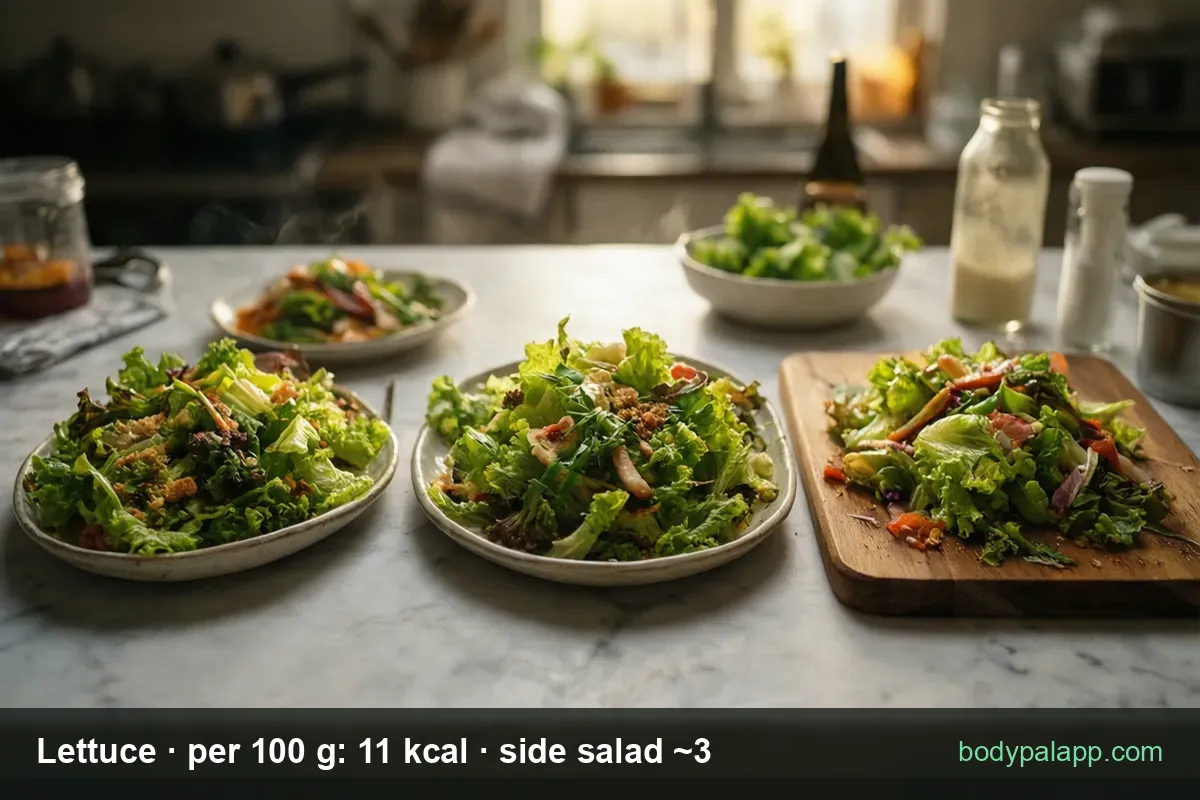
Lettuce has 11 calories per 100 g (46 kJ), so an 80 g portion — enough to count towards your 5-a-day — costs just 9 calories. A side-salad bowl of about 30 g barely registers at 3. Tracking the calories in lettuce is close to a formality; the real numbers live in whatever you pour on top.
On this page
- Quick facts
- Portions: bowls and leaves
- Salad maths: lettuce, cucumber, tomato
- How does it compare?
- Most popular lettuce brands
- FAQ
Quick facts
| Nutrient | Per 100 g | Per 80 g portion | % RI (80 g)* |
|---|---|---|---|
| Energy | 11 kcal (46 kJ) | 9 kcal (38 kJ) | <1% |
| Protein | 1.2 g | 1.0 g | 2% |
| Carbohydrates | 1.4 g | 1.1 g | <1% |
| Fat | 0.1 g | 0.1 g | <1% |
| Fibre | 1.5 g | 1.2 g | — |
| Sugar | 1.4 g | 1.1 g | 1% |
| Salt | 0.022 g | 0.02 g | <1% |
*Reference intake for an average adult, calculated for the 80 g portion.
Verified nutrition data
Numbers on this page come from CoFID, the UK government’s Composition of Foods Integrated Dataset, and from manufacturer labels where a branded product is named. Last verified August 2026. How we verify our data →
Every row in the reference-intake column rounds to almost nothing, and that is the entire point of lettuce in a tracked diet. It adds volume, crunch and freshness at a cost your daily budget cannot feel.
There is more going on than water, though. At 1.5 g of fibre and 1.2 g of protein per 100 g, lettuce quietly beats its reputation as "crunchy nothing" — modest amounts, but from a food that is essentially calorie-free.
A note on what "lettuce" covers here: the figure is for average raw lettuce, which is the sensible way to log it. Round, romaine, iceberg and the mixed-leaf bags all sit so close together that splitting hairs between varieties changes your day by a calorie or two at most. Pick whichever you like eating; the tracker won't notice.
Portions: bowls and leaves
| Portion | Weight | Calories |
|---|---|---|
| Side-salad bowl of shredded leaves | ~30 g | 3 kcal |
| One 5-a-day portion | 80 g | 9 kcal |
Thirty grams of shredded lettuce is a bigger pile than it sounds — a proper side-salad bowl — and it costs 3 calories. To reach a mere 100 kcal from plain lettuce you would need to get through roughly a kilogram of leaves, which nobody outside a rabbit hutch is attempting.
The 80 g row matters for a different reason: that is the size the NHS counts as one of your 5-a-day. A genuinely large salad base ticks that box for 9 calories, which makes lettuce one of the cheapest 5-a-day entries available in any supermarket.
Honestly, this is one food where obsessive weighing buys you nothing. Whether your handful of leaves is 25 g or 40 g, the answer stays in single digits. Put the kitchen scale away, log a sensible estimate, and spend the precision where it actually pays — on the dressing bottle and the cheese.
Salad maths: lettuce, cucumber, tomato
Here is the arithmetic behind the classic British side salad, using per-100 g figures: lettuce 11 kcal, cucumber 14 kcal, tomato 14 kcal. Build an enormous bowl with 100 g of each — 300 g of vegetables, easily two people's worth — and the total is 39 calories.
Now the caveat that makes or breaks salad as a "light" option. Dressings, croutons, cheese and oils are dense in a way the vegetables are not, and a couple of tablespoons of a creamy dressing can outweigh the entire 300 g of vegetables several times over. When a salad surprises someone on the scales, the leaves were never the culprit; the fat poured over them was.
Want more substance in the bowl? Swap the tomato for 100 g of grated carrot and the total moves from 39 to 59 calories — still nothing, but with carrot's 3.9 g of fibre per 100 g joining the mix. At these prices you can build the salad entirely around texture and taste.
The practical rule: count the vegetables in one line (they will total a few dozen calories at most) and give the dressing its own honest entry. A salad logged that way stays the bargain it appears to be.
This is also the logic behind eating for volume. The Eatwell Guide asks vegetables to cover over a third of the plate, and lettuce covers that third for single-digit calories. A meal that starts on a bed of leaves looks bigger, takes longer to eat, and finishes more satisfying than the same food served on an empty plate — for a rounding-error cost.
How does it compare?
The verdict: lettuce is the lightest thing in the salad drawer, undercutting even cucumber and tomato, and a third of carrot's figure. Choose between them on nutrition rather than calories — carrot brings 3.9 g of fibre per 100 g to lettuce's 1.5 g — because at these numbers the energy difference is irrelevant.
Most popular lettuce brands in the United Kingdom
Ranked by how widely each product appears among foods sold in the United Kingdom, from the BodyPal food database of over 3.3 million products. Calories are the figures printed on each label.
| Product | Calories (per 100 g) |
|---|---|
| Tesco Iceberg Lettuce | 16 kcal |
| Tesco Little Gem Lettuce | 14 kcal |
Brand popularity: BodyPal food database. Nutrition: manufacturer labels.
Lettuce questions, answered
How many calories are in lettuce?
Lettuce contains 11 calories per 100 g of raw leaves. An 80 g portion — the amount that counts as one of your 5-a-day — is 9 kcal, and a 30 g side-salad bowl is just 3. In a tracked day, plain lettuce is as close to free as food gets.
How many calories in a lettuce leaf?
Given 11 calories per 100 g, a single lettuce leaf carries next to nothing — a whole 30 g bowl of shredded leaves is only 3 kcal, and one leaf weighs a fraction of that. Individual leaves are the one food you can reasonably skip logging altogether.
How many calories in 100g of lettuce?
100 g of raw lettuce provides 11 calories (46 kJ), with 1.2 g protein, 1.4 g carbohydrate, 0.1 g fat and 1.5 g fibre. Salt is negligible at 0.022 g. Those figures are for average raw lettuce, which covers the everyday round, romaine and mixed-leaf bags alike.
How many calories in a lettuce salad?
The lettuce base contributes 11 kcal per 100 g, so even a huge bowl of leaves stays under a few dozen calories. The dressing decides the rest: creamy dressings, croutons and cheese can add several hundred. Log the leaves and the extras separately and the salad stays honest.
How many calories in lettuce wraps?
The lettuce part of a wrap is trivial — at 11 kcal per 100 g, a few large leaves used as a shell contribute almost nothing. That is why lettuce wraps are such an effective swap: virtually the whole calorie count comes from the filling, which you control.
How many calories in a lettuce, cucumber and tomato salad?
Around 39 calories for a very large bowl: 100 g each of lettuce (11 kcal), cucumber (14 kcal) and tomato (14 kcal). A more typical single-serve mix of half those amounts lands near 20 kcal. Whatever dressing you add will dwarf the vegetables, so count it separately.
Is lettuce good for you?
At 9 calories per 80 g portion, lettuce counts towards your NHS 5-a-day while contributing 1.2 g of fibre and a little protein. It will not carry a diet nutritionally, but as a near-free vehicle for volume and crunch it makes lighter meals feel substantially bigger.
Is lettuce a vegetable?
Yes — lettuce is a leaf vegetable, and with 1.4 g of carbohydrate and 11 kcal per 100 g it behaves exactly as you would expect one to. An 80 g serving qualifies as one of your 5-a-day, the same as any other portion of salad or veg.
Similar foods
- Salad — 13 kcal per 100 g green salad
- Cucumber — 11 kcal per 5 cm piece
- Tomato — 12 kcal per medium tomato
- Aubergine — 38 kcal per medium aubergine
- Mushrooms — 7 kcal per 100 g raw
- Cabbage — 14 kcal per boiled portion
Count it without the maths
BodyPal can tell your lettuce from your dressing in one photo — and it is almost never the lettuce doing the damage.


Burning it off is one side of it. The other is knowing your number: work out how many calories you need a day, with macros and a goal date.