
How Many Calories in Aubergine?
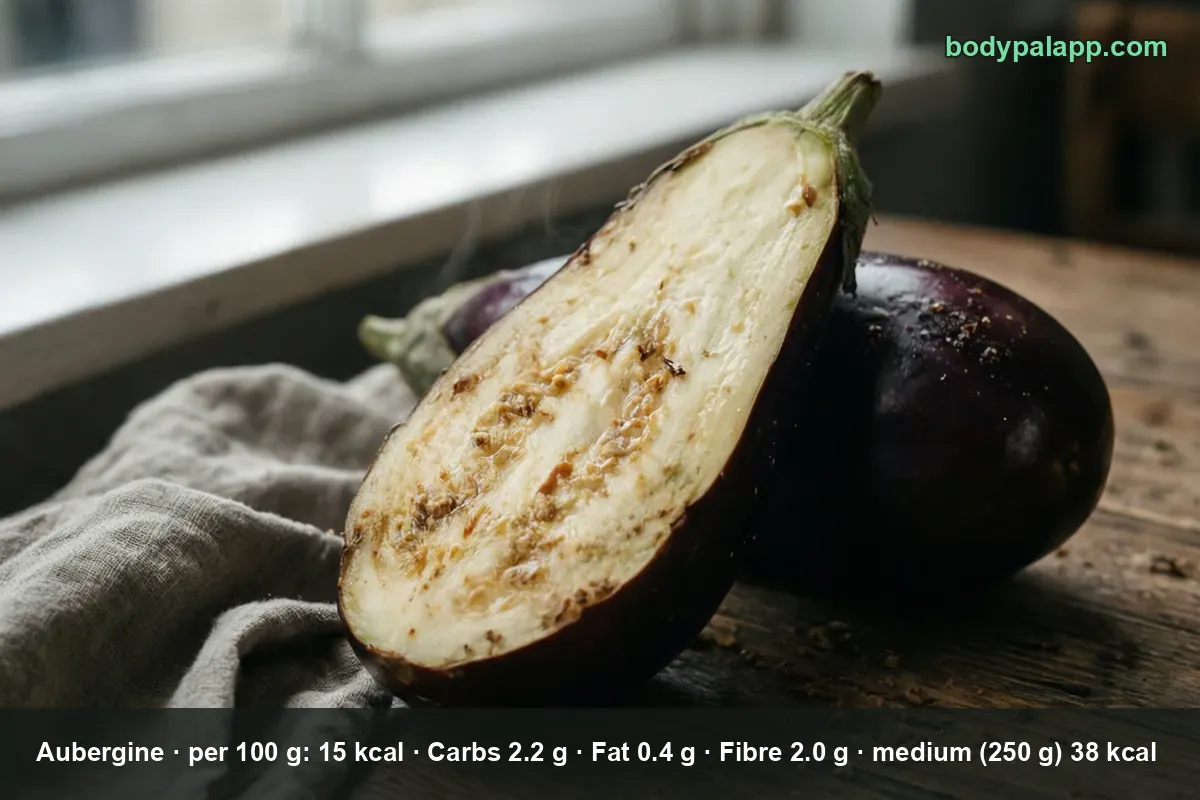
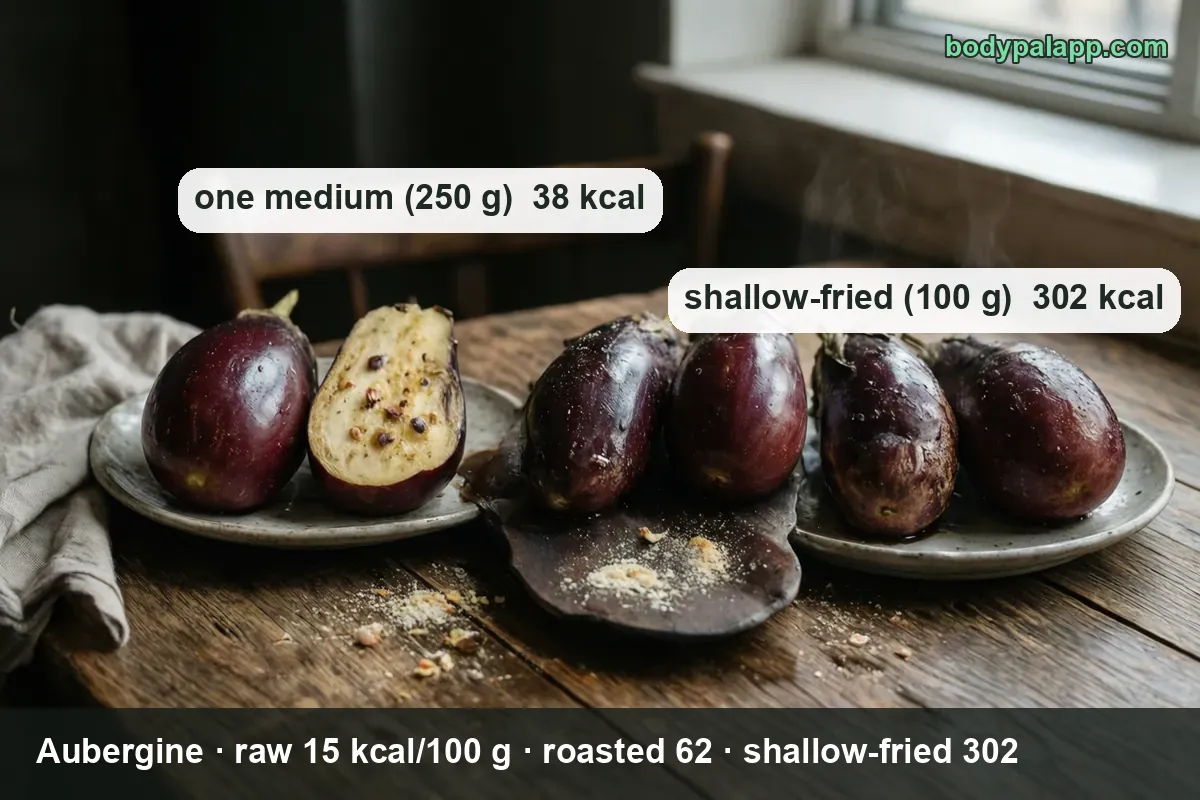
Raw aubergine is 15 calories per 100 g, which makes a whole medium one — 250 g of it — just 38 kcal. Roast it in a little oil and 100 g becomes 62 kcal. Fry it and the same 100 g becomes 302. Nothing else in the vegetable aisle moves like that.
On this page
- Aubergine quick facts
- The 20x problem
- Why aubergine drinks oil and courgette does not
- Roasting is the answer, not boiling
- UK portions and what a whole one costs
- Aubergine in the dishes people actually eat
- Aubergine against the other light vegetables
- Popular aubergine products
- FAQ
Aubergine quick facts
Numbers below are for raw aubergine with the ends trimmed, which is how you buy it and how you weigh it before cooking. The M&S label agrees to the decimal: 15 kcal, 0.4 g fat, 2.2 g carbohydrate, 0.9 g protein per 100 g. Other supermarkets print between 15 and 25.
| Nutrient | Per 100 g | Medium aubergine (250 g) | RI%* |
|---|---|---|---|
| Energy | 15 kcal / 64 kJ | 38 kcal / 159 kJ | 2% |
| Protein | 0.9 g | 2.3 g | 5% |
| Carbohydrates | 2.2 g | 5.5 g | 2% |
| – of which sugars | 2.0 g | 5.0 g | 6% |
| Fat | 0.4 g | 1.0 g | 1% |
| – of which saturates | 0.10 g | 0.25 g | 1% |
| Fibre (NSP) | 2.0 g | 5.0 g | 17% |
| Salt | 0.005 g | 0.01 g | 0% |
Verified nutrition data
Numbers on this page come from CoFID, the UK government’s Composition of Foods Integrated Dataset, and from manufacturer labels where a branded product is named. Last verified September 2026. How we verify our data →
*RI% = one medium aubergine's share of an adult's daily reference intake, based on 2,000 kcal.
One note on the fibre row. The raw entry has never been run through the AOAC method that modern labels use, so the figure given is NSP, an older and more conservative measure of the same thing. The cooked entries do have AOAC values, and they are quoted as such further down. Treating 2.0 g as a floor rather than a ceiling is the safe reading.
Everything else is close to nothing. A whole aubergine gives you 2% of a day's energy, 5% of the protein reference and, at 0.01 g, an amount of salt that rounds to zero.
The 20x problem
The calorie question for aubergine has almost nothing to do with the aubergine. Look at the same vegetable prepared four ways:
| Preparation | Per 100 g | Fat | Against raw |
|---|---|---|---|
| Boiled in unsalted water | 14 kcal | 0.5 g | ×0.9 |
| Raw | 15 kcal | 0.4 g | ×1 |
| Roasted in a little rapeseed oil | 62 kcal | 3.8 g | ×4.1 |
| Shallow-fried | 302 kcal | 31.9 g | ×20.1 |
Twenty times. That is +287 kcal and +31.5 g of fat per 100 g, and none of it came from the plant.
Break the fried row apart and it is stark: of 302 kcal, roughly 287 come from the 31.9 g of fat. About 11 come from carbohydrate and 5 from protein. Ninety-five per cent of a fried aubergine's calories are oil. By that point it is no longer a vegetable you are eating; it is a delivery mechanism for the frying pan.
For scale, 100 g of fried aubergine outweighs 100 g of fish and chips at 224 kcal and 100 g of burger at 288.
Why aubergine drinks oil and courgette does not
Run the same test on a courgette, the closest vegetable in shape and water content, and the multiplier collapses. Raw courgette is 16 kcal per 100 g. Fried in corn oil it is 63. That is ×3.9, against aubergine's ×20.1.
The difference is structure. Aubergine flesh is a foam — an open network of air pockets held in a soft matrix. Heat collapses those pockets, and whatever is in the pan rushes in to fill them. Courgette is dense and wet, with far less air to give up, so there is nowhere for the oil to go.
Which is why every recipe that tells you to keep adding oil "because the pan looks dry" is describing a vegetable that will absorb every drop you give it. The pan is not dry. The aubergine has swallowed the last lot.
One useful consequence: the choice of oil does not change the energy at all. Fried in corn oil, in rapeseed oil or in butter, the entry is 302 kcal every time. What changes is the saturated fat — 4.10 g, 2.18 g and 21.10 g per 100 g respectively. If you are going to fry, the oil you pick is a saturated fat decision, not a calorie one.
Roasting is the answer, not boiling
Boiled aubergine is the lowest-calorie version at 14 kcal per 100 g. It is also the worst of the three ideas, and the fibre column shows why.
| Cooked how | Per 100 g | Fibre | Potassium |
|---|---|---|---|
| Boiled | 14 kcal | 1.8 g (AOAC) | 136 mg |
| Roasted in a little rapeseed oil | 62 kcal | 5.1 g (AOAC) | 300 mg |
| Fried | 302 kcal | 2.3 g (NSP) | — |
Roasting drives water out and leaves everything else behind, so per 100 g of finished food the fibre goes up two and a half times over the boiled version. Boiling does the opposite: the vegetable takes water on and leaches potassium into the pan. Roasted aubergine costs 48 kcal more per 100 g and gives back 3.3 g of fibre, which is 11% of the 30 g a day most adults fall short of.
The trick with roasting is the same one that ruins it: measure the oil. Half a medium aubergine roasted with oil brushed on is a different meal from the same half roasted with oil poured on.
UK portions and what a whole one costs
| Portion | Weight | Calories | Fibre |
|---|---|---|---|
| One thick slice, about 1 cm | 30 g | 5 kcal | 0.6 g |
| One "5 a day" portion | 80 g | 12 kcal | 1.6 g |
| Half an aubergine | 125 g | 19 kcal | 2.5 g |
| One medium aubergine | 250 g | 38 kcal | 5.0 g |
| One large aubergine | 300 g | 45 kcal | 6.0 g |
An 80 g serving counts as one of your 5 a day and costs 12 calories, which is about as cheap as a vegetable portion gets.
Now the number that actually decides your dinner. A whole medium aubergine is 38 kcal. One tablespoon of olive oil is 124 kcal. Grill the whole thing with a single measured tablespoon and the plate is 162 kcal — of which the aubergine is 23%.
The gap between 38 and 162 is not in the vegetable. It is in the spoon. Anyone counting calories on aubergine dishes is really counting the oil, and the aubergine is a rounding error attached to it.
Aubergine in the dishes people actually eat
| Dish | Per 100 g | Fat | Salt |
|---|---|---|---|
| Ratatouille, homemade | 82 kcal | 7.0 g | 0.01 g |
| Stuffed with rice | 86 kcal | 2.1 g | 0.02 g |
| Stuffed with vegetables and cheese | 119 kcal | 9.7 g | 0.27 g |
| Moussaka, homemade | 128 kcal | 8.0 g | 0.18 g |
| Aubergine and potato bhaji | 135 kcal | 8.8 g | 0.02 g |
| Moussaka, shop-bought and reheated | 140 kcal | 8.3 g | 0.70 g |
| Pakora, aubergine, homemade | 294 kcal | 22.5 g | 0.05 g |
British ready meals built on aubergine run from around 80 kcal per 100 g for a supermarket parmigiana up to 200 for a jarred imam bayildi. Every one of those figures is oil, cheese and sauce sitting on a 15 kcal vegetable.
The salt column deserves a look on its own. Homemade moussaka carries 0.18 g of salt per 100 g; the reheated shop version carries 0.70 g, nearly four times as much, which on a 350 g tray is 2.45 g — 41% of the 6 g daily limit. And one product outdoes everything else on this page: a jar of aubergine pickle sits at 381 kcal and 4 g of salt per 100 g, so a 50 g dollop on the side of a curry carries 2 g of salt, a third of the day.
Aubergine against the other light vegetables
| Vegetable | Per 100 g | Typical portion | Calories |
|---|---|---|---|
| Mushroom | 7 kcal | — | — |
| Lettuce | 11 kcal | side salad | 3 kcal |
| Cucumber | 14 kcal | 5 cm piece | 11 kcal |
| Tomato | 14 kcal | one medium | 12 kcal |
| Aubergine | 15 kcal | one medium, 250 g | 38 kcal |
| Pepper | 26 kcal | one red | 42 kcal |
| Broccoli | 28 kcal | 80 g portion | 22 kcal |
| Carrot | 34 kcal | one medium | 27 kcal |
Our take: raw, aubergine belongs at the very bottom of the vegetable table, level with cucumber and tomato and beaten only by mushrooms and leaves. It is the biggest object on this list for the fewest calories, which makes it genuinely useful for bulking out a meal. Cooked, it is the most dangerous vegetable on the list, because it is the only one that can multiply its own calories by twenty while you watch. Use it for volume, roast it rather than fry it, and measure the oil with a spoon instead of a bottle.
Popular aubergine products in the BodyPal food database
Ranked by how widely each product appears among foods sold in the United Kingdom, from the BodyPal food database of over 3.3 million products. Calories are the figures printed on each label.
| Product | Calories (per 100 g) |
|---|---|
| Aubergine (Tesco) | 15 kcal |
| Aubergines (Tesco) | 20 kcal |
| Baby Aubergine (Sainsbury's) | 20 kcal |
Brand popularity: BodyPal food database. Nutrition: manufacturer labels.
Aubergine FAQs
How many calories in an aubergine?
15 kcal per 100 g raw, so a whole medium aubergine of about 250 g is 38 kcal and a large 300 g one is 45 kcal. Half an aubergine is 19 kcal and a single 1 cm slice is 5. Cooking changes this far more than size does.
How many calories in fried aubergine?
302 kcal per 100 g, which is twenty times the raw figure of 15. The jump comes entirely from oil: fried aubergine carries 31.9 g of fat per 100 g, and about 287 of its 302 calories come from that fat rather than from the vegetable.
How many calories in roasted aubergine?
62 kcal per 100 g when roasted in a small amount of rapeseed oil, four times the raw figure but a fifth of the fried one. Roasting also concentrates the fibre to 5.1 g per 100 g, the highest of any aubergine preparation.
Does aubergine absorb a lot of oil?
More than any other common vegetable. Frying takes it from 15 to 302 kcal per 100 g, a multiplier of 20.1, while the same treatment takes courgette from 16 to only 63, a multiplier of 3.9. Aubergine flesh is full of air pockets that collapse and fill with oil.
Is aubergine good for weight loss?
Raw or roasted it is one of the lowest-energy foods you can put on a plate: a whole medium one is 38 kcal with 5.0 g of fibre. The catch is the pan. The same aubergine fried reaches 302 kcal per 100 g, so how you cook it matters more than how much you use.
How much fibre is in aubergine?
2.0 g per 100 g raw, measured as NSP, which gives 5.0 g in a whole medium aubergine — 17% of the 30 g daily reference. Roasting concentrates it to 5.1 g per 100 g of finished food, while boiling brings it down to 1.8 g.
Does the type of oil change the calories?
No. Aubergine fried in corn oil, in rapeseed oil or in butter comes to 302 kcal per 100 g in every case. What changes is the saturated fat: 4.10 g, 2.18 g and 21.10 g per 100 g respectively, a fivefold spread from the same energy figure.
How many calories in aubergine parmigiana or moussaka?
British supermarket aubergine parmigiana runs from about 80 to 111 kcal per 100 g, and moussaka is 128 kcal per 100 g homemade or 140 reheated from a tray. The aubergine in them is a 15 kcal vegetable; the rest is oil, cheese and sauce.
Similar foods
- Cucumber — 11 kcal per 5 cm piece
- Tomato — 12 kcal per medium tomato
- Salad — 13 kcal per 100 g green salad
- Lettuce — 3 kcal per side salad
- Mushrooms — 7 kcal per 100 g raw
- Cabbage — 14 kcal per boiled portion
Count it without the maths
Point the camera at the pan and BodyPal counts the oil the aubergine soaked up, not just the vegetable.


How long does it take to burn off aubergine?
A whole medium aubergine (250 g) is 38 kcal. Enter your weight and the amount you ate to see how long it takes you to burn that off:
lb
| Activity | Time to burn 38 kcal |
|---|---|
| Walking, brisk | 8 min |
| Cycling, moderate | 5 min |
| Swimming, moderate | 5 min |
| Jogging | 4 min |
| Weight training, moderate | 8 min |
Times are for a 154 lb (11 st) adult at a steady pace; change the weight to see yours. The amount is set to the portion in the text (250 g); change it to what you actually ate. BodyPal works this out from your steps automatically.
Burning it off is one side of it. The other is knowing your number: work out how many calories you need a day, with macros and a goal date.