
Calories in Broccoli: 22 kcal [28 Per 100 g]
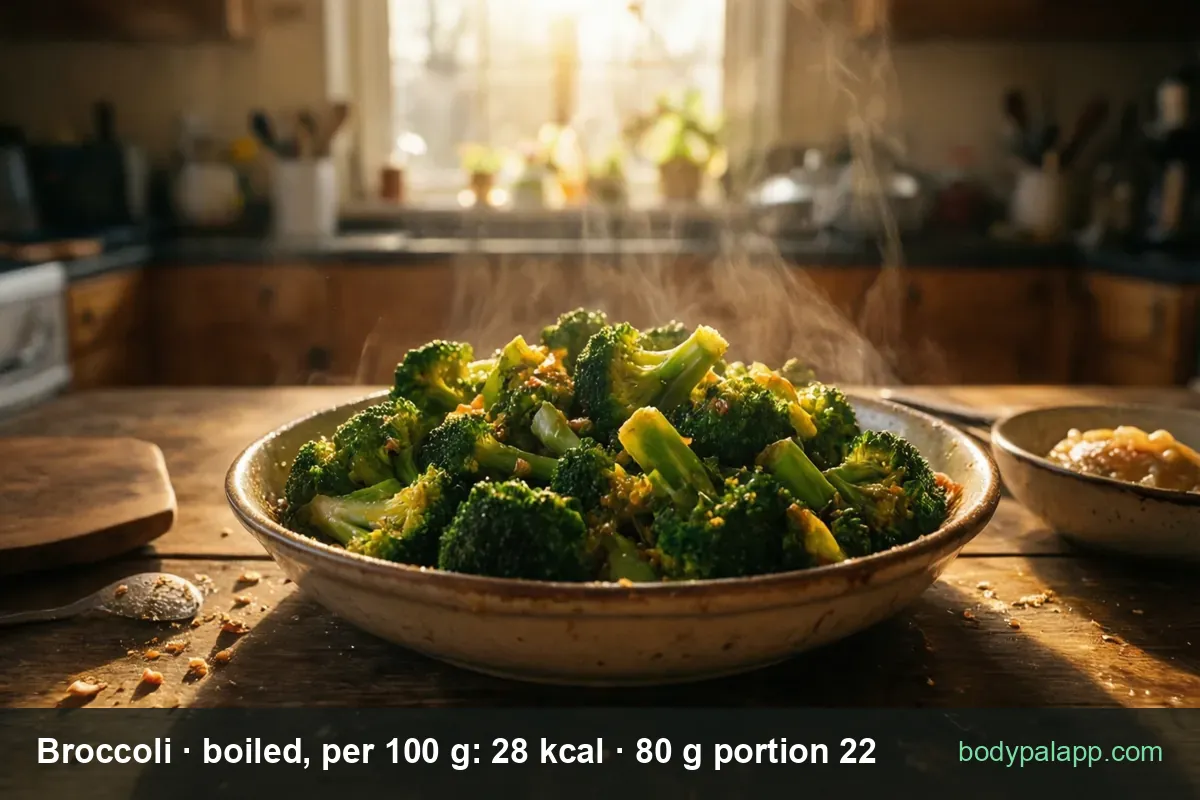
An 80 g serving of boiled broccoli — exactly one of your NHS 5-a-day — has 22 calories, with the full figure at 28 kcal per 100 g (117 kJ). Rarer still for a vegetable, it carries more protein (3.3 g per 100 g) than sugar (1.6 g). The calories in broccoli are about as cheap as nutrition gets.
On this page
- Quick facts
- Portions in real plates
- More protein than sugar
- How does it compare?
- Is broccoli man-made?
- Most popular broccoli brands
- FAQ
Quick facts
All figures are for green broccoli boiled in unsalted water — the way most UK households actually serve it.
| Nutrient | Per 100 g | Per 80 g serving | % RI (80 g)* |
|---|---|---|---|
| Energy | 28 kcal (117 kJ) | 22 kcal (92 kJ) | 1% |
| Protein | 3.3 g | 2.6 g | 5% |
| Carbohydrates | 2.8 g | 2.2 g | 1% |
| Fat | 0.5 g | 0.4 g | 1% |
| Fibre | 2.8 g | 2.2 g | — |
| Sugar | 1.6 g | 1.3 g | 1% |
| Salt | 0.015 g | 0.01 g | <1% |
*Reference intake for an average adult, calculated for the 80 g serving.
Verified nutrition data
Numbers on this page come from CoFID, the UK government’s Composition of Foods Integrated Dataset, and from manufacturer labels where a branded product is named. Last verified August 2026. How we verify our data →
Read the right-hand column again. A full serving of broccoli spends 1% of a day's energy budget while delivering 5% of the day's protein reference intake. Almost nothing else on a dinner plate offers that trade.
Salt is effectively absent at 0.015 g per 100 g, so the sodium story of a broccoli side dish is written entirely by what you cook it in or pour over it, not by the vegetable itself.
Portions in real plates
Two portions cover nearly every real-world situation:
| Portion | Weight | Calories |
|---|---|---|
| Boiled serving — one 5-a-day portion | 80 g | 22 kcal |
| Large helping | 160 g | 45 kcal |
The 80 g serving is the one that matters administratively: it is what the NHS counts as one of your 5-a-day. It looks like two to three good-sized florets on the plate.
The 160 g row is the more interesting one for anyone managing hunger. Doubling your broccoli costs 23 extra calories, which rounds to nothing in a day's ledger. When a meal feels small, broccoli is the ingredient you scale up without doing any arithmetic afterwards.
One practical note on the figures: they describe plain boiled or steamed broccoli. Roast it in oil, stir-fry it, or bury it under cheese sauce and the vegetable stays at 28 kcal per 100 g while the dish becomes something else entirely. Log the fats and sauces as their own items and the broccoli maths stays trustworthy.
More protein than sugar
Vegetables usually tilt sweet: more sugar than protein, sometimes several times more. Broccoli inverts that. Per 100 g boiled, it holds 3.3 g of protein against 1.6 g of sugar, which is why it has become the default green on training plates. No one is suggesting it replaces the protein portion of a meal, but as the vegetable alongside it, it quietly tops up the day's total.
Then there is fibre: 2.8 g per 100 g, so a large 160 g helping delivers a meaningful chunk of the roughage most UK diets fall short on. Fibre plus water plus chewing is also the practical reason a broccoli-heavy plate keeps you full far beyond what 22 calories should buy.
If you are building meals along Eatwell Guide lines, where vegetables should cover over a third of the plate, broccoli is one of the cheapest ways to fill that third — in calories, and usually in pounds too.
How does it compare?
The verdict: none of these will trouble a calorie budget, so pick by what the calories are buying, and on that measure broccoli wins — 3.3 g of protein and 2.8 g of fibre per 100 g outwork everything else in the table. Carrot edges it on fibre at 3.9 g but carries over four times the sugar (7.2 g against 1.6 g).
Is broccoli man-made?
Strictly, yes — and it is nothing to worry about. Broccoli does not exist in the wild; it was bred over centuries from wild cabbage (Brassica oleracea), the same species that farmers steered into cauliflower, kale and Brussels sprouts. That is ordinary selective breeding, the process behind almost everything in the fruit and veg aisle.
"Man-made" in this sense has nothing to do with genetic modification or laboratories. The plant on your plate is the result of growers repeatedly choosing the biggest, tastiest flower heads to replant, and its 28 kcal per 100 g comes with the nutritional record you saw above.
If anything, the claim is a compliment. Centuries of selection produced a vegetable that packs 3.3 g of protein and 2.8 g of fibre into 28 calories — a spec sheet no wild cabbage ever managed. The 5-a-day system happily counts it either way, and your dinner plate should too.
Most popular broccoli brands in the United Kingdom
Ranked by how widely each product appears among foods sold in the United Kingdom, from the BodyPal food database of over 3.3 million products. Calories are the figures printed on each label.
| Product | Calories (per 100 g) |
|---|---|
| Sainsbury’s Tenderstem Broccoli | 26 kcal |
| Asda Extra Special Tenderstem | 35 kcal |
| Deluxe Tenderstem Broccoli (Lidl) | 35 kcal |
| Co-op Tenderstem Broccoli | 40 kcal |
Brand popularity: BodyPal food database. Nutrition: manufacturer labels.
Broccoli questions, answered
How many calories are in broccoli?
Boiled broccoli has 28 calories per 100 g, which makes an 80 g serving 22 kcal and a large 160 g helping 45 kcal. It is one of the lowest-calorie foods that still contributes meaningful protein and fibre to a meal, at 3.3 g and 2.8 g per 100 g respectively.
How many calories in cooked broccoli?
Cooked (boiled in unsalted water), broccoli comes in at 28 kcal per 100 g. That is the figure to log for plain steamed or boiled florets. Anything added in the pan — oil, butter, cheese sauce — changes the number far more than the cooking method itself does.
How many calories in 100g of broccoli?
100 g of boiled broccoli contains 28 calories (117 kJ), alongside 3.3 g of protein, 2.8 g of carbohydrate, 2.8 g of fibre and only 1.6 g of sugar. Salt is negligible at 0.015 g. Those numbers make it one of the best value-per-calorie vegetables you can plate up.
How many calories in broccoli florets?
Florets are what the standard figures describe: 28 kcal per 100 g once boiled. A typical 80 g serving of florets — two to three good-sized pieces — is 22 calories. Weigh them once if you are unsure; after that, eyeballing a portion of florets is accurate enough for everyday logging.
Is broccoli man-made?
Yes, in the harmless sense: today's 28-kcal-per-100 g broccoli was selectively bred from wild cabbage over many centuries, the same way cauliflower and kale were developed. It is not genetically modified and never came out of a lab; it came out of farmers picking their best plants.
Is broccoli good for you?
At 22 calories per 80 g serving, broccoli counts towards your NHS 5-a-day while adding 2.6 g of protein and 2.2 g of fibre per portion. Very few foods deliver that much for that little energy, which is why it earns a default spot on so many plates.
Is broccoli good for dogs?
At 28 kcal per 100 g, plain boiled broccoli is generally fine for dogs as an occasional treat in small amounts, with no seasoning, oil or sauce. Large quantities can upset a dog's stomach, so keep it to a floret or two and ask your vet about anything regular.
Is broccoli high in fibre?
With 2.8 g of fibre per 100 g, broccoli is a genuinely useful fibre source for so few calories — a large 160 g helping provides 4.5 g for just 45 kcal. Most UK adults eat less fibre than recommended, and low-calorie contributors like this are the easiest way to close the gap.
Similar foods
- Cabbage — 14 kcal per boiled portion
- Cauliflower — 23 kcal per 80 g portion
- Pepper — 42 kcal per red pepper
- Carrot — 27 kcal per medium carrot
- Onions — 53 kcal per medium onion
- Aubergine — 38 kcal per medium aubergine
Count it without the maths
Steam it, plate it, photograph it — BodyPal logs your broccoli serving with calories, protein and fibre already split out.


Want the bigger picture? Calculate your daily calorie needs — your maintenance figure, a target for losing or gaining, and the date you get there.