
How Many Calories Are in Pepper?
A red pepper carries 42 calories whole, or 26 per 100 g. A green one is lighter still at 15 per 100 g. If you're wondering how many calories are in pepper, the honest answer is barely any — and the colour on the shelf tells you which end of "barely" you're getting.
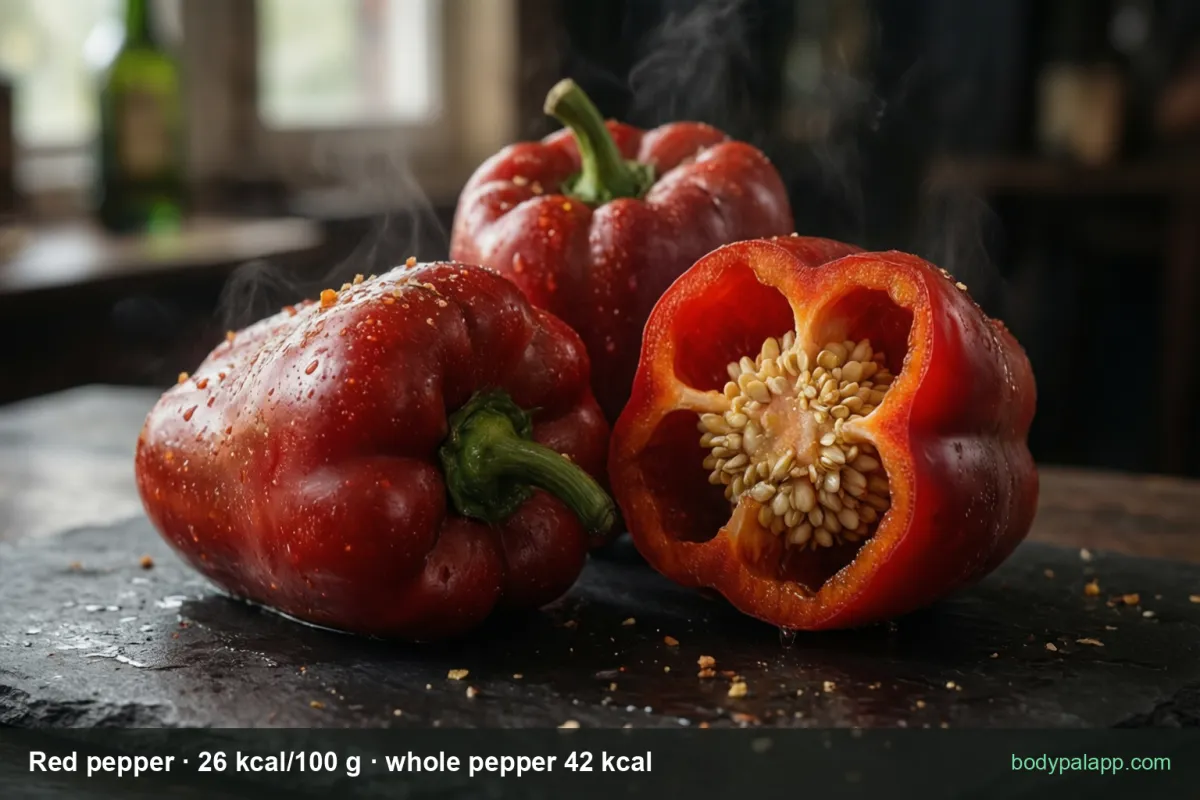 (alt: "Red pepper - 42 calories in a whole pepper")
On this page
- Pepper quick facts
- Whole, half and 5 A Day portions
- Red vs green: one plant, two numbers
- How does a pepper compare?
- Bell pepper, capsicum, sweet pepper
- Most popular pepper brands
- FAQ
Pepper quick facts
Figures are for raw red pepper. CoFID's 2021 tables carry no row for raw red, so these are the consensus of label and food-database records; the green figures further down are CoFID's own.
| Nutrient | Whole pepper (~160 g) | Per 100 g | RI%* |
|---|---|---|---|
| Energy | 42 kcal / 176 kJ | 26 kcal / 109 kJ | 2% |
| Protein | 1.6 g | 1.0 g | 3% |
| Carbohydrates | 6.7 g | 4.2 g | 3% |
| – of which sugars | 6.7 g | 4.2 g | 7% |
| Fat | 0.5 g | 0.3 g | 1% |
| Fibre | 2.6 g | 1.6 g | – |
| Salt | 0.02 g | 0.01 g | under 1% |
*RI% = a whole pepper's share of an adult's daily reference intake, based on 2,000 kcal.
Verified nutrition data
Numbers on this page come from CoFID, the UK government’s Composition of Foods Integrated Dataset, and from manufacturer labels where a branded product is named. Last verified August 2026. How we verify our data →
Notice that carbs and sugars are the same number. Essentially all of a red pepper's carbohydrate is natural sugar, which is why it eats like something faintly sweet and why it out-scores the green one. Even so, the totals are tiny.
Whole, half and 5 A Day portions
- Whole red pepper (~160 g): 42 kcal.
- Half a pepper (~80 g): 21 kcal — and 80 g is exactly one adult portion for 5 A Day purposes.
That second line is the practical one. Half a pepper in a lunchbox or sliced through a stir-fry ticks a full vegetable portion for the price of a fifth of an apple. Eat the whole thing and it's still cheaper, calorie-wise, than a digestive's worth of anything.
(alt: "BodyPal app scanning a red pepper showing calories and macros")
Red vs green: one plant, two numbers
 (alt: "Red and green pepper variants calories comparison")
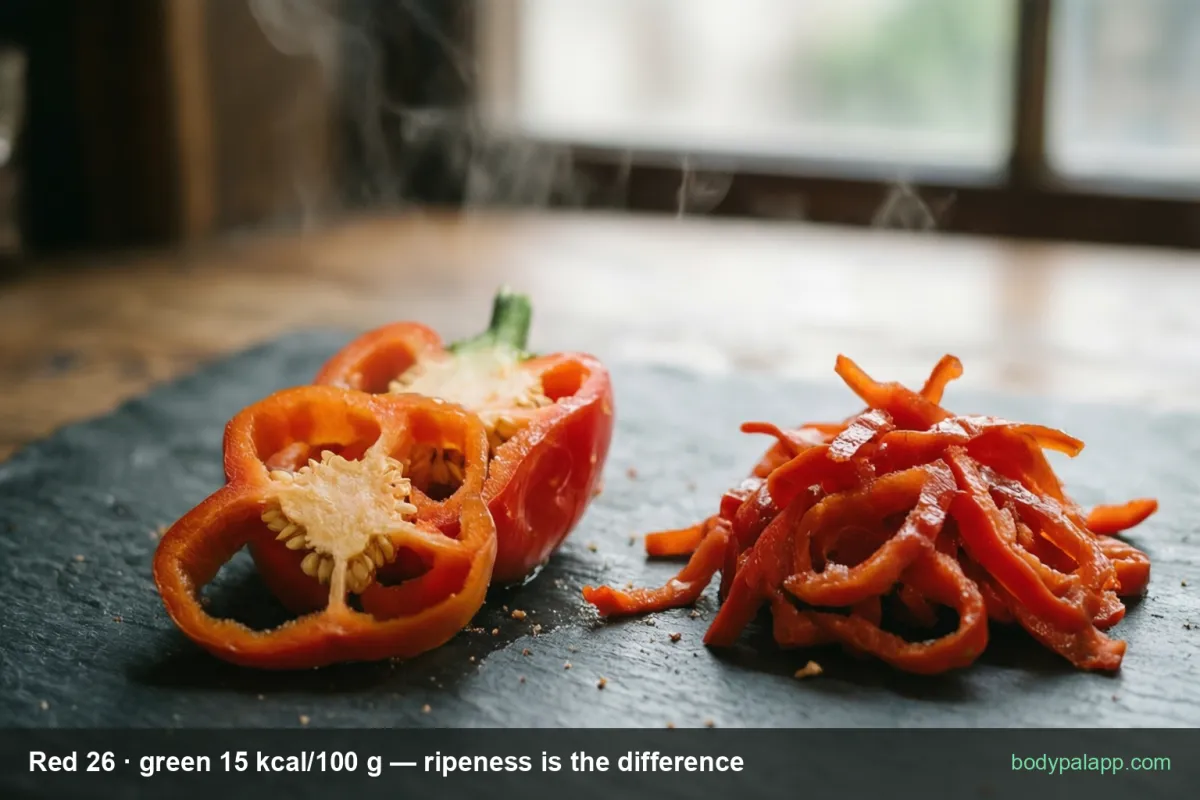
Red and green peppers aren't different vegetables. A red pepper is a green pepper that stayed on the plant and ripened, and ripening means sugar:
- Green, raw (CoFID): 15 kcal per 100 g — protein 0.8 g, carbs 2.6 g, fat 0.3 g, sugars 2.4 g.
- Green, boiled: 18 kcal per 100 g.
- Red, raw: 26 kcal per 100 g, sugars 4.2 g — nearly double the green's sugar, which is the entire difference in taste and in calories. These are intrinsic sugars in a whole vegetable, not the free sugars the NHS asks you to cap.
So the "which pepper is healthiest" question mostly answers itself: they're the same plant at different ages, all of them trivial in calories. Pick red for sweetness, green for sharpness, and don't lose a minute over 11 kcal per 100 g. Roasting doesn't change the pepper much either — it's the oil it sits in that adds anything worth counting.
How does a pepper compare?
(alt: "Pepper vs tomato, cucumber, onion and carrot calories comparison")
| Food | Typical amount |
|---|---|
| Cucumber | 11 kcal per piece |
| Tomato | 12 kcal per medium tomato |
| Carrot | 27 kcal per carrot |
| Red pepper | 42 kcal whole |
| Onion | 53 kcal per medium onion |
On paper the pepper looks like the heavy one here. It isn't — a whole 160 g pepper is simply more food than a slice of cucumber. Gram for gram they're all in the same feather-weight class, broccoli included. The verdict: build the plate on whichever you'll actually eat — the Eatwell Guide wants over a third of it to be fruit and veg, and the calorie differences between salad vegetables are rounding errors.
Bell pepper, capsicum, sweet pepper
Three names, one vegetable. "Bell pepper" is the American term, "capsicum" the botanical and Australian one, and UK shelves mostly just say "pepper" or "sweet pepper". Every number on this page applies to all of them.
The one real distinction worth keeping: none of this covers chilli peppers, which are a different use case entirely — nobody eats 160 g of chillies in a sitting.
Most popular pepper brands in the United Kingdom
Ranked by how widely each product appears among foods sold in the United Kingdom, from the BodyPal food database of over 3.3 million products. Calories are the figures printed on each label. Fresh peppers mostly sell loose and unbranded.
| Product | Calories (per 100 g) |
|---|---|
| Lidl Pointed Red Pepper | 35 kcal |
Brand popularity: BodyPal food database. Nutrition: manufacturer labels.
Pepper FAQ
How many calories in a red pepper?
42 kcal for a whole ~160 g red pepper, or 26 per 100 g. Nearly all of that comes from natural sugars — 4.2 g per 100 g — with almost no fat. It's one of the most filling things you can add to a plate for under 50 kcal.
How many calories in a green pepper?
15 kcal per 100 g raw, per CoFID, rising to 18 when boiled. A whole green pepper therefore comes in around the mid-20s — roughly half the calories of a red one, because it's picked before ripening builds up the sugar.
How many calories in half a pepper?
21 kcal for half a red pepper (~80 g). Conveniently, 80 g is also one full adult 5 A Day portion, so half a pepper in a salad or stir-fry earns a vegetable tick for about the calories of two grapes' worth of anything.
How many carbs are in a bell pepper?
4.2 g of carbohydrate per 100 g in a red pepper — effectively all of it natural sugar. A green pepper holds 2.6 g per 100 g. Even a whole red pepper carries under 7 g of carbs, which keeps peppers popular in low-carb cooking.
Why are red peppers sweeter than green?
Because red is riper, not a different sort. Sugars build as the fruit matures on the plant: 2.4 g per 100 g in green against 4.2 g in red. That ripening is also the whole calorie gap — 15 versus 26 kcal per 100 g.
How many calories in roasted peppers?
The pepper itself barely changes — boiling only nudges green peppers from 15 to 18 kcal per 100 g, and roasting is similar territory. What changes the number is oil: peppers roasted or preserved in it soak up fat, so an oily antipasti pepper can multiply the plain figure several times.
How many calories in a yellow pepper?
Between the green and red figures — yellow and orange are intermediate ripening stages of the same fruit, and CoFID doesn't list them separately. Expect a per-100 g value in the 15–26 kcal window, with pack labels the best source for an exact number.
Are peppers good for you?
At 26 kcal per 100 g with 1.6 g of fibre and almost no fat or salt, a red pepper is about as easy a vegetable win as exists — and 80 g counts towards your 5 A Day under the NHS Eatwell approach. There's no calorie-based reason to limit them.
Similar foods
- Cabbage — 14 kcal per boiled portion
- Broccoli — 22 kcal per 80 g portion
- Cauliflower — 23 kcal per 80 g portion
- Carrot — 27 kcal per medium carrot
- Onions — 53 kcal per medium onion
- Aubergine — 38 kcal per medium aubergine
Count the stir-fry, not just the pepper
Snap the whole pan with BodyPal and the pepper, the oil and everything else lands in your log in one go.


How long does it take to burn off pepper?
A whole red pepper (~160 g) is 42 kcal. Enter your weight and the amount you ate to see how long it takes you to burn that off:
lb
| Activity | Time to burn 42 kcal |
|---|---|
| Walking, brisk | 8 min |
| Cycling, moderate | 5 min |
| Swimming, moderate | 6 min |
| Jogging | 5 min |
| Weight training, moderate | 9 min |
Times are for a 154 lb (11 st) adult at a steady pace; change the weight to see yours. The amount is set to the portion in the text (160 g); change it to what you actually ate. BodyPal works this out from your steps automatically.
One food is easy to picture; a whole day is harder. See how many calories you need a day and what a deficit actually looks like.