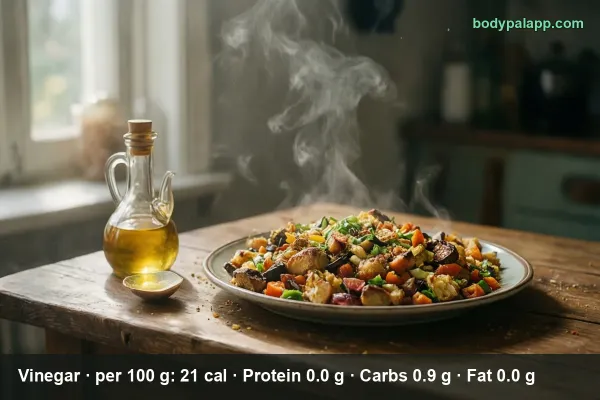
Apple cider vinegar calories come to 3 for 1 tablespoon (14.9 g) and 21 per 100 g, based on the USDA row for bottled, undiluted cider vinegar. Every one of those calories comes from carbohydrate, and there is so little of it that portion size barely matters until you pour a full cup, which reaches 50.
3kcal
1 tablespoon · 14 g, bottled, undiluted
0%protein
0 gProtein
0 gCarbs
0 gFat
How to burn off 3 kcal
—Walking, brisk
—Jogging
—Cycling, moderate
—Swimming
Skip the math. BodyPal counts these calories from your steps and workouts automatically.
Nutrition facts
Bottled, undiluted · per 14 g
Calories
3 kcal
Protein
0 g
Carbohydrate
0.1 g
Fat
0 g
Saturated fat
0 g
Cholesterol
0 mg
Sodium
1 mg
Potassium
11 mg
Iron
0 mg
Source: USDA FoodData Central
🛡️
Verified nutrition data
Numbers on this page come from USDA FoodData Central, the U.S. Department of Agriculture’s food composition database, and from manufacturer labels where a branded product is named. Last verified October 2026. How we verify our data →
Apple cider vinegar: calories, protein and sodium by serving
Percent of daily value uses the FDA reference of 2,000 kcal a day.
Serving
kcal
Protein
Carbs
Fat
Sodium
% DV kcal
1 tablespoon (14.9 g)
3
0 g
0.1 g
0 g
1 mg
0%
1 teaspoon (5 g)
1
0 g
0 g
0 g
0 mg
0%
1 cup (239 g)
50
0 g
2.2 g
0 g
12 mg
3%
100 g
21
0 g
0.9 g
0 g
5 mg
1%
3 × 1 tablespoon (14.9 g)
9
0 g
2 mg
5 × 1 tablespoon (14.9 g)
16
0 g
4 mg
Even five tablespoons stay in the teens
A teaspoon (5 g) of apple cider vinegar logs as 1 calorie. A tablespoon (14.9 g) logs as 3. Those are the amounts most people actually use in a dressing, a marinade or a glass of water, and they will not move a day's total in any way you could notice.
Doubling up changes little. Two tablespoons (30 g) come to 6 calories, three tablespoons (45 g) to 9, and five tablespoons (75 g) to 16. Even at five tablespoons, sodium sits at 4 mg and protein stays at 0. Few foods let you pour this freely without the number climbing.
The cup is the only serving that shows up on the daily value chart at all. One cup (239 g) carries 50 calories, which is 3% of the daily value for energy. Nobody drinks a cup of undiluted vinegar, but the cup line is handy if you batch a large jar of pickling brine or vinaigrette and want to split the vinegar's share across servings.
Every calorie is carbohydrate, and there is barely any
The calorie split for apple cider vinegar is 100% carbs, 0% protein and 0% fat. Per 100 g that means 0.9 g of carbohydrate, of which 0.4 g is sugar, with no fiber, no saturated fat and no cholesterol. That is the whole macro story, and it is a short one.
Scale it to the spoon and the numbers shrink further. A tablespoon holds 0.1 g of carbs and 0.1 g of sugars. A teaspoon rounds to 0 on both. If you count net carbs on a low-carb plan, vinegar is one of the few flavorings you can use without doing any math.
The cup again marks the ceiling. At 239 g, carbs reach 2.2 g and sugars 1 g. Against a daily value of 275 g of carbohydrate, even that full cup is a rounding error. The real carb and calorie decisions in a vinegar-based recipe sit with whatever goes in next to it.
Sodium is close to zero, potassium is the only mineral of note
Most condiments earn a warning in the sodium row. Apple cider vinegar does not: 5 mg per 100 g, 1 mg per tablespoon and 12 mg per cup, which is just 1% of the daily value. If you watch sodium, this is a way to add sharp flavor without adding salt.
That contrast is clearest next to savory liquids. Ramen broth runs 200 mg of sodium per 100 g, while vinegar stays at 5. A splash of acid can make a dish taste brighter and more seasoned, so some cooks use it to pull back on the salt shaker.
Potassium is the row that USDA searchers ask about most. The data lists 73 mg per 100 g of cider vinegar. That is a small share of the daily value, and at tablespoon portions it is smaller still, so treat it as a detail on the label rather than a reason to drink it.
In a dressing, log the oil, not the vinegar
Apple cider vinegar rarely travels alone. In a vinaigrette it is paired with oil, and the oil carries nearly all of the calories. Measure that part carefully. The vinegar side of the jar, at 3 calories a tablespoon, is close enough to free that eyeballing it is fine.
Diluted in water, the calories are simply those of the vinegar you poured. The water adds nothing, so a tablespoon in a tall glass is still 3. Sweetened or flavored versions are a different matter. Bragg sells plain, With the Mother, cranberry and honey varieties, and Finest Nutrition has an organic version, so check the label on anything beyond plain vinegar.
On a busy day you can snap a photo of your salad in BodyPal to log it, then adjust the dressing line if you used more oil than usual. The vinegar will not be the number that changes your total.
How does apple cider vinegar compare?
Here is apple cider vinegar next to plain vinegar, lemon juice and ramen broth, per 100 g and per usual serving.
Verdict: Apple cider vinegar and plain vinegar tie at 21 calories per 100 g, so choose by flavor. Lemon juice is nearly the same at 22 per 100 g but brings 6.9 g of carbs, and ramen broth adds 200 mg of sodium per 100 g, so for the leanest, lowest-sodium splash of acid, vinegar wins.
Most popular apple cider vinegar brands in the United States
Ranked by popularity in the BodyPal database
# Productkcal / 100 g
1Bragg Organic Apple Cider Vinegar60 ml133 kcal
2Bragg Organic Apple Cider Vinegar With the Mother1 Tbsp · 15 ml0 kcal
Plain vinegar labels round a tablespoon down to zero calories, while the honey and cranberry versions contain added sugar and read higher. Source: manufacturer labels / USDA FoodData Central.
Apple cider vinegar FAQs
How many calories are in a tablespoon of apple cider vinegar?
About 3 calories per tablespoon (14.9 g), and about 1 calorie per teaspoon (5 g).
Is apple cider vinegar good for weight loss?
A tablespoon adds only 3 calories and 0.1 g of carbs, so it barely changes a day's calorie total.
Apple cider vinegar vs white vinegar: which has fewer calories?
They are the same at 21 calories per 100 g, so a tablespoon of either is about 3 calories.
How many carbs and sugar are in apple cider vinegar?
It has 0.93 g of carbs and 0.4 g of sugar per 100 g, which is about 0.1 g of carbs per tablespoon.
What does USDA FoodData Central list for apple cider vinegar?
USDA lists it as 'Vinegar, cider' (FDC 173469) at 21 calories per 100 g, with 0.9 g carbs, 0.4 g sugars, 5 mg sodium and 73 mg potassium. A tablespoon (14.9 g) comes to 3 calories.
How much potassium is in apple cider vinegar?
Apple cider vinegar has 73 mg of potassium per 100 g in the USDA data. That is a small share of the daily value, and the tablespoon amounts people actually use hold only a fraction of it.
How many calories are in a cup of apple cider vinegar?
One cup (239 g) of undiluted apple cider vinegar has 50 calories, 3% of the daily value. It also carries 2.2 g of carbs, 1 g of sugars and 12 mg of sodium, with no fat or protein.
How many calories are in a teaspoon of apple cider vinegar?
A teaspoon (5 g) of apple cider vinegar has 1 calorie, with carbs, sugars, sodium, fat and protein all rounding to 0. It is about as close to a free addition as a flavoring gets.
Does apple cider vinegar have any protein or fat?
No. Apple cider vinegar has 0 g of protein and 0 g of fat per 100 g, so 100% of its 21 calories per 100 g come from carbohydrate, mostly non-sugar carbs.