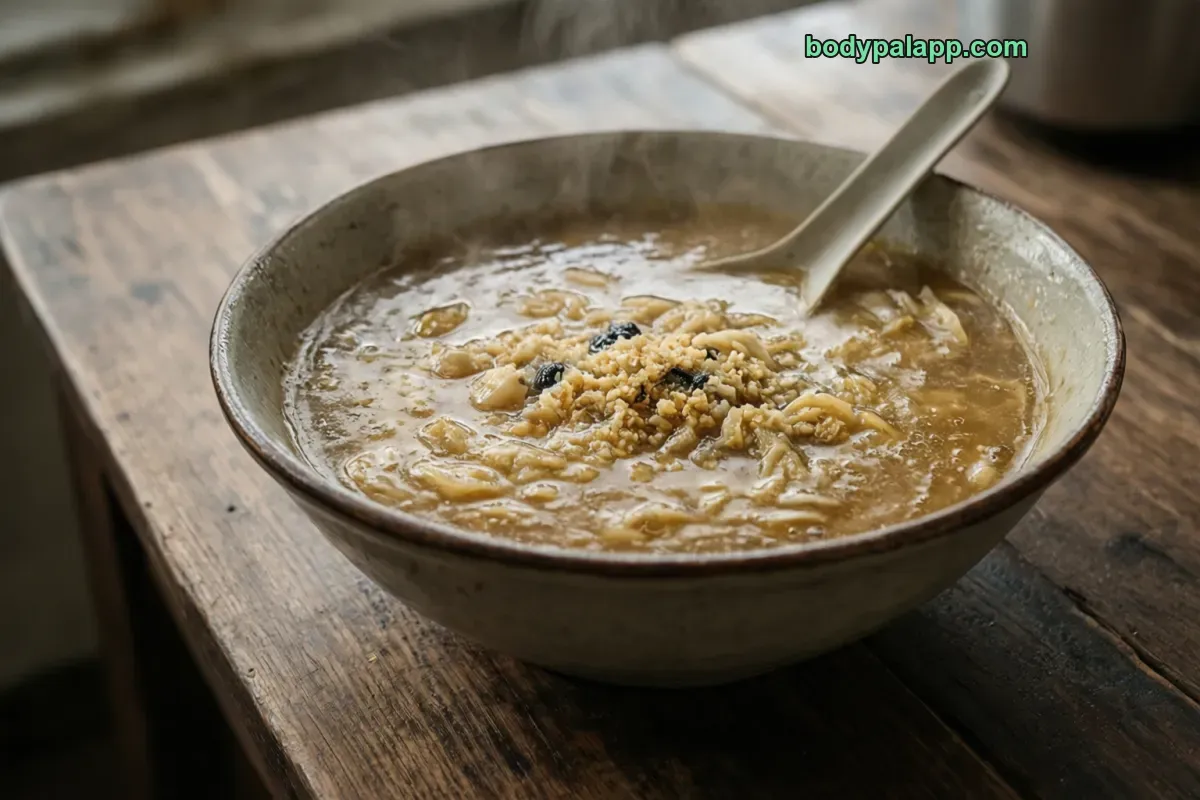
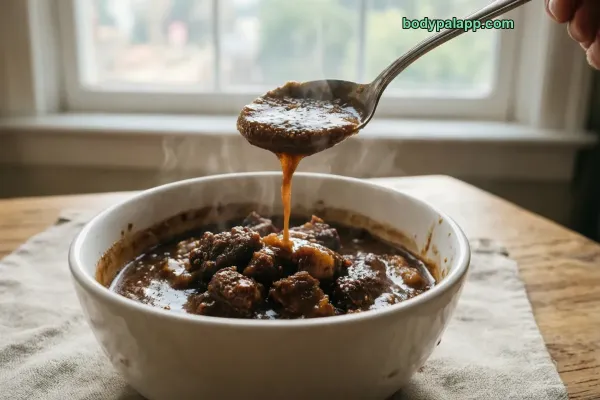
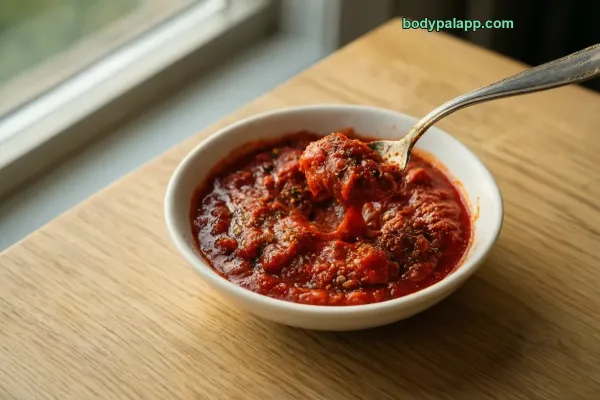
Ramen broth calories come to 39 for 1 cup (244 g) of dashi-style broth, or 16 per 100 g. The calories barely register. The sodium does: that same cup carries 488 mg, 21% of the daily value, and a chicken-based broth pushes it to 924 mg. Drink the whole bowl and salt, not energy, is what adds up.
39kcal
1 cup · 244 g, dashi style, ready to serve
53%protein
4.9 gProtein
1 gCarbs
1.5 gFat
How to burn off 39 kcal
—Walking, brisk
—Jogging
—Cycling, moderate
—Swimming
Skip the math. BodyPal counts these calories from your steps and workouts automatically.
Nutrition facts
Dashi style, ready to serve · per 244 g
Calories
39 kcal
Protein
4.9 g
Carbohydrate
1 g
Fat
1.5 g
Saturated fat
0.3 g
Cholesterol
0 mg
Sodium
488 mg
Potassium
210 mg
Iron
0.5 mg
Source: USDA FoodData Central
🛡️
Verified nutrition data
Numbers on this page come from USDA FoodData Central, the U.S. Department of Agriculture’s food composition database, and from manufacturer labels where a branded product is named. Last verified September 2026. How we verify our data →
Ramen broth: calories, protein and sodium by serving
Percent of daily value uses the FDA reference of 2,000 kcal a day.
Serving
kcal
Protein
Carbs
Fat
Sodium
% DV kcal
1 cup (244 g)
39
4.9 g
1 g
1.5 g
488 mg
2%
Chicken based (249 g)
15
1.6 g
1.1 g
0.5 g
924 mg
1%
100 g
16
2 g
0.4 g
0.6 g
200 mg
1%
3 × 1 cup (244 g)
117
14.6 g
1,464 mg
5 × 1 cup (244 g)
195
24.4 g
2,440 mg
Two cups of broth add up to just 78 calories
A single cup (244 g) of dashi-style ramen broth has 39 calories, only 2% of the daily value for energy. Most restaurant bowls hold more liquid than that, so think of the cup as a measuring unit rather than a realistic serving. Double it and you reach 78 calories with 9.8 g of protein. Three cups come to 117 calories.
The total climbs slowly because the broth is mostly water. Even 5 cups, about 1,220 g of liquid, land at only 195 calories and 24.4 g of protein. Few foods let you scale a portion fivefold with so little effect on the day's energy total.
So the volume you drink matters less for calories than for sodium, which scales at exactly the same pace. If you sip the broth to the bottom of the bowl, log it. If you leave half behind, the savings are small in calories and much larger in salt.
Protein supplies more than half the calories
Per 100 g, ramen broth carries 2 g of protein, 0.6 g of fat and 0.4 g of carbohydrate. Small numbers, but the split is lopsided: protein accounts for 53% of the calories, fat for 36% and carbs for just 11%. That profile comes from the USDA fish broth row behind this page, which matches a dashi-style base.
In a cup, that works out to 4.9 g of protein, 10% of the daily value, alongside 1.5 g of fat and 1 g of carbs. Sugar is negligible at 0.2 g per cup, and fiber is 0. Saturated fat sits at 0.1 g per 100 g, and cholesterol is 0.
Don't mistake the protein share for a protein source. A cup's 4.9 g is a modest contribution, high as a percentage only because there is so little else in the liquid. The broth's job is flavor and volume. The egg, tofu, pork or chicken you add on top is what carries the protein load.
Sodium is the row to watch
At 200 mg per 100 g, ramen broth is salty for something so light. One cup delivers 488 mg of sodium, 21% of the daily value, while contributing only 2% of the day's calories. That gap is the whole story of this food.
The numbers stack fast. Two cups bring 976 mg, three cups 1,464 mg, and 5 cups 2,440 mg, which is past the full daily value from broth alone. Seasoning packets, soy sauce, miso and tare stirred into a real bowl add more on top of these figures.
Chicken-based broth is the extreme case: 924 mg in a 249 g serving, or 40% of the daily value. If you watch sodium, leaving part of the broth in the bowl is the simplest lever you have, and it costs you very little protein.
Chicken-based broth trades calories for salt
This page's default is a dashi-style broth, ready to serve. A chicken-based version from USDA lands differently: 15 calories in 249 g, with 1.6 g of protein, 0.5 g of fat and 1.1 g of carbs. That is fewer calories than the dashi cup's 39, and far less protein.
The catch is sodium. The chicken serving's 924 mg is nearly double the dashi cup's 488 mg. It also has a touch more sugar, 1.1 g against 0.2 g. Neither calorie difference matters much for weight, but if you are choosing a broth for salt, dashi style comes out ahead.
Packaged options vary too. Brands such as Ocean's Halo, Yamasa and Cook! SF sell miso and shio versions, and concentrates like Acid League's need diluting before the label matches what ends up in your bowl. Check the serving size on the carton against what you actually pour. BodyPal can log the whole bowl from a photo, broth included.
How does ramen broth compare?
Here is how ramen broth stacks up against vinegar and mango salsa, per 100 g and per usual serving.
Verdict: Ramen broth is the lightest of the three at 16 calories per 100 g, against 21 for vinegar and 29 for mango salsa, and it is the only one with real protein at 2 g. For sodium, vinegar wins easily at 5 mg per 100 g, while mango salsa's 711 mg makes it the saltiest gram for gram.
Most popular ramen broth brands in the United States
Concentrates and broth bombs are measured by the tablespoon before water is added, so they read far higher per 100 g than the ready-to-serve cartons. Source: manufacturer labels / USDA FoodData Central.
Ramen broth FAQs
How many calories are in a cup of ramen broth?
A 1 cup serving (244 g) has 39 calories. Per 100 g the broth is 16 calories.
Is ramen broth low in calories?
Yes, a cup is 39 calories with 1.5 g of fat, but it also carries 488 mg of sodium.
Ramen broth vs chicken bouillon: which has more calories?
Per 100 g ramen broth is 16 calories and dry chicken bouillon is 267 calories, because the bouillon is a concentrate. One 4 g bouillon cube works out to 11 calories.
How much protein is in ramen broth?
About 4.9 g of protein in a cup (244 g), which is 2 g per 100 g.
How much sodium is in a cup of ramen broth?
One cup (244 g) of dashi-style ramen broth has 488 mg of sodium, 21% of the daily value. Two cups bring that to 976 mg, so a full bowl of broth adds up quickly.
Does chicken ramen broth have fewer calories than dashi-style broth?
Yes. A chicken-based serving of 249 g has 15 calories, against 39 in a cup of dashi-style broth. It is much saltier, though, at 924 mg of sodium, or 40% of the daily value.
How many calories are in 2 cups of ramen broth?
Two cups (488 g) of dashi-style ramen broth have 78 calories and 9.8 g of protein. The same amount carries 976 mg of sodium, which matters more than the calories for most readers.
Is ramen broth high in fat?
No. A cup has 1.5 g of fat, and 100 g has 0.6 g with 0.1 g saturated. Fat still makes up 36% of the calories simply because the broth has so little of anything else.
Does ramen broth have sugar or fiber?
Barely any sugar: 0.2 g per cup of dashi-style broth, and 1.1 g in a chicken-based serving. Fiber is 0 per 100 g, so the broth adds no fiber to the bowl.