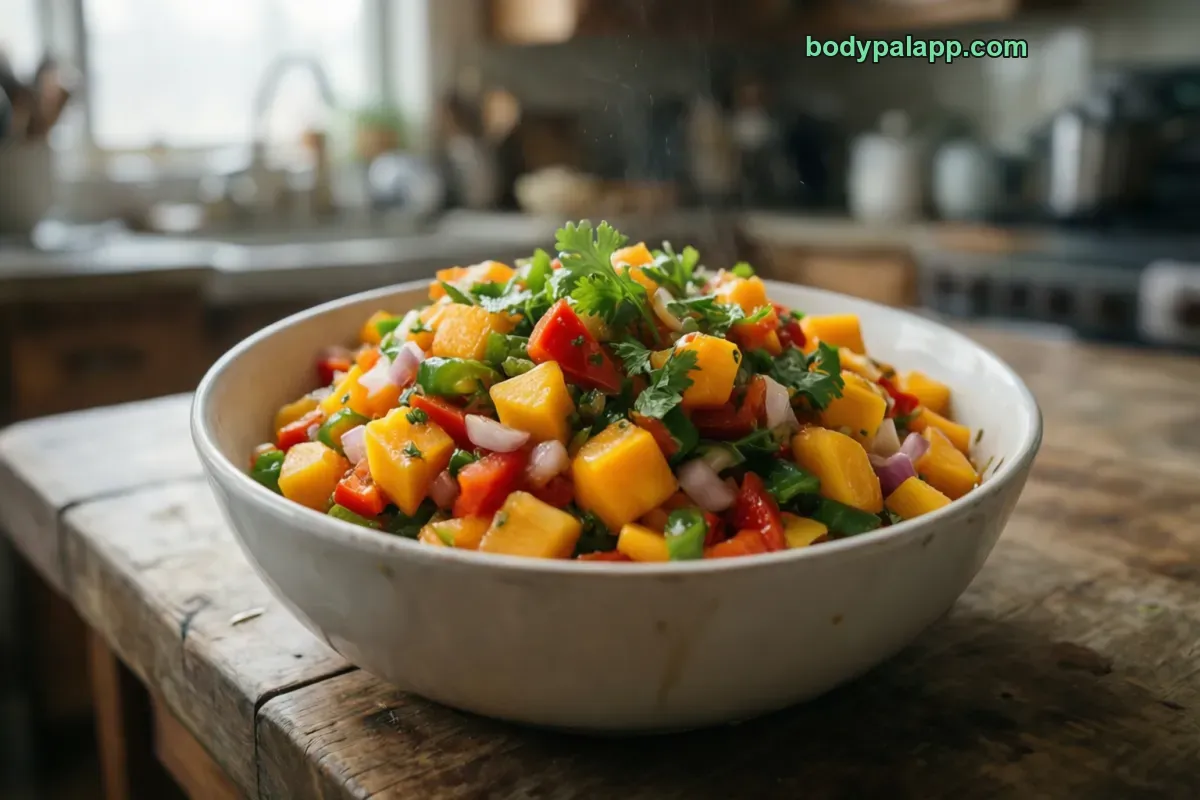
Mango salsa calories come to 10 for a 2 tbsp (36 g) spoonful and 29 per 100 g. Calories are not the number to notice here. Sodium is: that same 2 tbsp carries 256 mg, or 11% of the daily value, while the calories barely register at 1%.
Skip the math. BodyPal counts these calories from your steps and workouts automatically.
Nutrition facts
Mango variety, ready-to-serve · per 36 g
Calories
10 kcal
Protein
0.5 g
Carbohydrate
2.4 g
Fat
0.1 g
Saturated fat
0 g
Cholesterol
0 mg
Sodium
256 mg
Potassium
99 mg
Iron
0.2 mg
Source: USDA FoodData Central
🛡️
Verified nutrition data
Numbers on this page come from USDA FoodData Central, the U.S. Department of Agriculture’s food composition database, and from manufacturer labels where a branded product is named. Last verified September 2026. How we verify our data →
Mango salsa: calories, protein and sodium by serving
Percent of daily value uses the FDA reference of 2,000 kcal a day.
Serving
kcal
Protein
Carbs
Fat
Sodium
% DV kcal
2 tbsp (36 g)
10
0.5 g
2.4 g
0.1 g
256 mg
1%
Half cup (130 g)
38
2 g
8.6 g
0.2 g
924 mg
2%
1 cup (259 g)
75
3.9 g
17.2 g
0.4 g
1,841 mg
4%
100 g
29
1.5 g
6.6 g
0.2 g
711 mg
1%
3 × 2 tbsp (36 g)
31
1.6 g
768 mg
5 × 2 tbsp (36 g)
52
2.7 g
1,280 mg
A half cup of mango salsa is only 38 calories
The label serving of 2 tbsp (36 g) is 10 calories, which is close to nothing. Few people stop there, though. A spoon over tacos or a scoop beside grilled fish is often a half cup (130 g), and that comes to 38 calories. Even a full 1 cup (259 g) lands at just 75 calories, only 4% of a 2,000-calorie daily value.
Counting by spoonfuls shows how slowly the calories climb. Two servings (72 g) add up to 21 calories, three servings (108 g) reach 31, and five servings (180 g) total 52. You would need to eat a lot of mango salsa before it mattered to your calorie budget.
So the portion question for this food is not really about calories. It is about what rides along with each spoonful. The same five servings that cost you 52 calories also bring 1,280 mg of sodium, and that number moves much faster than the calorie count. If you track one row for mango salsa, make it that one.
Carbs supply 78% of the calories
Mango salsa is a carb food, mostly from fruit and vegetables. Of its calories, 78% come from carbohydrates, 18% from protein and only 4% from fat. Per 100 g that works out to 6.6 g of carbs, 1.5 g of protein and 0.2 g of fat.
Of those 6.6 g of carbs, 4 g are sugars and 1.9 g are fiber. A 2 tbsp (36 g) serving gives you 1.4 g of sugars and 0.7 g of fiber, small amounts either way. A full 1 cup (259 g) brings 10.4 g of sugars and 4.9 g of fiber, which is where the mango sweetness starts to show up in the numbers.
Fat is almost absent. Saturated fat is 0 and cholesterol is 0 per 100 g, so mango salsa adds flavor without adding fat to a plate. Protein is real but minor: 0.5 g per 2 tbsp and 3.9 g in a full cup. Don't count on salsa to fill you up. The protein in the meal has to come from whatever you spoon it over.
Sodium is the row to watch
Per 100 g, mango salsa has 711 mg of sodium, 31% of the 2,300 mg daily value, for just 29 calories. That ratio is the main fact on this page. Calories and sodium are badly out of step here: the label serving is 1% of daily calories but 11% of daily sodium.
Portion size makes the gap wider. A half cup (130 g) carries 924 mg of sodium, 40% of the daily value, for 38 calories. A full 1 cup (259 g) reaches 1,841 mg, or 80% of the daily value, in a bowl that costs only 75 calories. Someone treating salsa as a free vegetable side could eat most of a day's sodium without noticing.
If you watch sodium, measure the salsa rather than the chips or the protein it goes with. Mango salsa does bring 275 mg of potassium per 100 g, but that does not offset the salt on the label. Brands differ, too. Products like Pacific Coast Fruit Organic Mango Salsa, Garden Fresh Gourmet Mango Salsa, Mild or Farmstand Mango Salsa each print their own sodium figure, so check the jar you actually buy.
Use it as a swap for richer toppings
Mango salsa works best when it replaces something heavier. On fish tacos, grilled chicken or a rice bowl, it brings sweetness and acid where you might otherwise use a creamy sauce, cheese or a buttery glaze. With 0.2 g of fat per 100 g, the swap cuts calories in the topping without making the dish taste plain.
The catch is what you scoop it with. Tortilla chips can easily cost more calories than the salsa itself, so the dip can end up as the light half of a heavy snack. Pairing it with lean protein, cucumber slices or bell pepper strips keeps the whole plate close to the salsa's own profile.
Because the salsa itself barely adds calories, the useful habit is noticing it on days that are already salty. A meal with cured meats, cheese or a restaurant sauce plus a big scoop of salsa stacks sodium fast. If you snap a photo of the plate, BodyPal can log the mango salsa along with everything under it.
How does mango salsa compare?
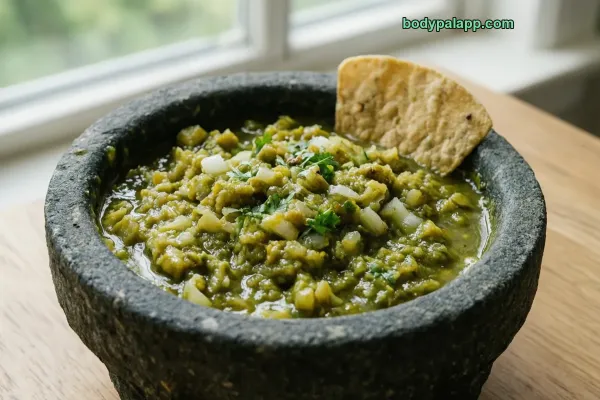
Here is how mango salsa compares with regular salsa and salsa verde, per 100 g and per usual serving.
Verdict: Mango salsa and regular salsa are identical in this data, at 10 calories per 2 tablespoons and 711 mg of sodium per 100 g, so choose by taste. Salsa verde runs about 1.3 times the calories at 38 per 100 g and carries more sodium at 906 mg, so if you watch salt, pick the mango version.
Most popular mango salsa brands in the United States
Ranked by popularity in the BodyPal database
# Productkcal / 100 g
1Pacific Coast Fruit Organic Mango Salsa1/2 cup · 140 g57 kcal
6Joy's Gourmet Spicy Mango Salsa1/2 cup · 112 g40 kcal
7Farmstand Mango Salsa2 Tbsp · 30 g67 kcal
8Santa Barbara Mango Salsa With Peach, Medium2 Tbsp · 30 g83 kcal
Jarred mango salsas carry added fruit and sugar, so their labels read 36 to 89 calories per 100 g against 29 for plain ready-to-serve salsa. Source: manufacturer labels / USDA FoodData Central.
Mango salsa FAQs
How many calories are in mango salsa?
Two tablespoons (36 g) come to 10 calories, and a half cup (130 g) is 38 calories. Per 100 g the count is 29 calories.
Is mango salsa good for weight loss?
A 2 tablespoon serving adds 10 calories and the sauce holds only 0.2 g of fat per 100 g. Jarred mango versions range from 36 to 89 calories per 100 g, so the jar label decides how much it adds.
Mango salsa vs regular salsa: which is lower in calories?
Plain ready-to-serve salsa is 29 calories per 100 g and salsa verde is 38, while jarred mango salsa labels run from 36 to 89 calories per 100 g.
How much sugar is in mango salsa?
Per 100 g there are 4 g of sugars within 6.6 g of carbs, so two tablespoons hold about 1.4 g of sugars.
How many calories are in a cup of mango salsa?
A 1 cup (259 g) serving of mango salsa has 75 calories, about 4% of the daily value. The same cup also carries 1,841 mg of sodium, which is 80% of the daily value.
How much sodium is in mango salsa?
Mango salsa has 256 mg of sodium per 2 tbsp (36 g), or 11% of the daily value. Per 100 g it is 711 mg, and a half cup (130 g) reaches 924 mg, 40% of the daily value.
Does mango salsa have any protein?
Mango salsa has 0.5 g of protein per 2 tbsp and 1.5 g per 100 g. Protein supplies 18% of its calories, but even a full cup holds only 3.9 g.
Is mango salsa high in fat or cholesterol?
No. Mango salsa has 0.2 g of fat per 100 g, with 0 g saturated fat and 0 mg cholesterol. Fat makes up only 4% of its calories.
How much fiber is in mango salsa?
A 2 tbsp (36 g) serving of mango salsa has 0.7 g of fiber. Per 100 g it is 1.9 g, and a full 1 cup (259 g) provides 4.9 g.