Chicken bouillon calories come to 11 for one 4 g cube and 267 per 100 g of the dry product. The calories hardly matter. Sodium is the real story: that single cube carries 955 mg, or 42% of the daily value, before you add anything else to the pot.
11kcal
1 cube · 4 g, dry cube
25%protein
0.7 gProtein
1 gCarbs
0.6 gFat
How to burn off 11 kcal
—Walking, brisk
—Jogging
—Cycling, moderate
—Swimming
Skip the math. BodyPal counts these calories from your steps and workouts automatically.
Nutrition facts
Dry cube · per 4 g
Calories
11 kcal
Protein
0.7 g
Carbohydrate
0.7 g
Fat
0.6 g
Saturated fat
0.1 g
Cholesterol
1 mg
Sodium
955 mg
Potassium
12 mg
Iron
0 mg
Source: USDA FoodData Central
🛡️
Verified nutrition data
Numbers on this page come from USDA FoodData Central, the U.S. Department of Agriculture’s food composition database, and from manufacturer labels where a branded product is named. Last verified September 2026. How we verify our data →
Chicken bouillon: calories, protein and sodium by serving
Percent of daily value uses the FDA reference of 2,000 kcal a day.
Serving
kcal
Protein
Carbs
Fat
Sodium
% DV kcal
1 cube (4 g)
11
0.7 g
0.7 g
0.6 g
955 mg
1%
1 teaspoon (2 g)
5
0.3 g
0.4 g
0.3 g
478 mg
0%
1 cup prepared (241 g)
10
0.7 g
0.7 g
0.6 g
966 mg
0%
100 g
267
16.7 g
18 g
13.9 g
23,875 mg
13%
3 × 1 cube (4 g)
32
2 g
2,865 mg
5 × 1 cube (4 g)
53
3.3 g
4,775 mg
One cube is 11 calories, and extra cubes add up slowly
Bouillon is almost never eaten by the spoonful, so the serving that counts is the one you dissolve. One 4 g cube gives 11 calories, 0.7 g of protein and 0.6 g of fat. A teaspoon of granules weighs 2 g and lands at 5 calories. Made up as directed, a cup of prepared bouillon (241 g) comes to just 10 calories.
Doubling up for a stronger broth barely moves the calorie line. Two cubes total 21 calories, three cubes 32, and five cubes 53. Even a heavy-handed pot of soup gets only a small calorie bump from the bouillon itself.
The 100 g figure of 267 calories looks alarming, but nobody uses that much at once. It is useful only for comparing bouillon with other dry seasonings by weight. For logging, count cubes or teaspoons, and let the vegetables, noodles, rice or meat you add carry the real calorie load.
Sodium is the row to watch, not calories
Here the numbers flip. One cube holds 955 mg of sodium, which is 42% of the daily value, and a teaspoon adds 478 mg, or 21%. A cup of prepared bouillon delivers 966 mg, also 42%. That is a lot of salt for a drink with 10 calories.
Stacking cubes is where it gets steep. Two cubes reach 1,910 mg, three cubes reach 2,865 mg, and five cubes total 4,775 mg. Three cubes already pass a full day's daily value for sodium. Per 100 g the dry product carries 23,875 mg, which works out to 1,038% of the daily value, a reminder that bouillon is mostly a salt delivery system with flavor attached.
If you watch sodium, treat bouillon as seasoning rather than a base. Use half a cube or a level teaspoon, taste, and build flavor with herbs, garlic, onion and lemon before reaching for more. Skip extra salt in any dish that already has a cube in it.
Fat supplies nearly half of the few calories
Per 100 g of dry bouillon there are 16.7 g of protein, 18 g of carbs and 13.9 g of fat. Split by calories, fat leads at 47%, carbs give 27% and protein 25%. Most of the carbs are sugars, at 17.4 g per 100 g, with 0 g of fiber.
Those shares sound meaningful until you shrink them to a real serving. A cube has 0.7 g of protein, 0.7 g of carbs and 0.6 g of fat. That is too little of anything to count toward a protein goal or worry about as a sugar source. Saturated fat sits at 3.4 g and cholesterol at 13 mg per 100 g, again tiny at cube scale.
So bouillon is not a protein food, despite the chicken on the label. It flavors water. Anything nourishing in the bowl has to come from what you put into it.
Bouillon works best as a cheap flavor base for filling food
Because a cup of prepared bouillon is only 10 calories, it is a handy way to make low-calorie volume taste like something. Simmer vegetables, lentils or shredded chicken in it, or use it to cook rice or grains so the seasoning is built in. A warm mug between meals adds almost nothing to a calorie log.
The tradeoff is always sodium. On a day with salty foods like cured meats, cheese or takeout, a bouillon-based soup can push the total well past the daily value. Balancing it with plain, unsalted sides and fresh produce keeps the day in check.
Brands such as Knorr, Shurfine and Hy-Vee sell cubes and granules, and labels vary, so check yours for the sodium line. BodyPal can log the bowl from a photo, which helps when bouillon is just one part of a bigger soup.
How does chicken bouillon compare?
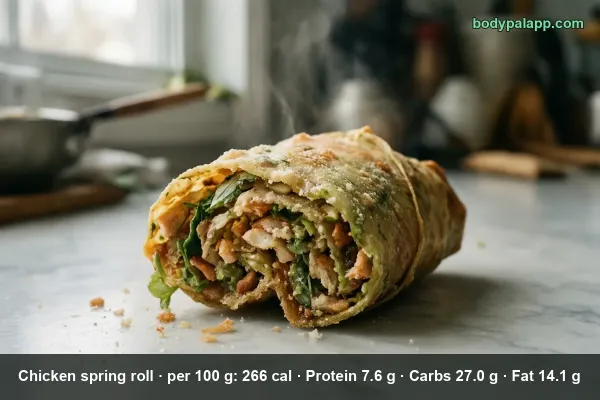
Here is how chicken bouillon stacks up against chicken stock, a chicken spring roll and a buffalo chicken wing, per 100 g and per usual serving.
Verdict: If sodium matters, pick chicken stock: it carries 143 mg per 100 g, though a cup (240 g) costs 86 calories, far more than bouillon. Spring rolls at 266 per 100 g and buffalo wings at 272 are meals, not broth swaps, so do not judge bouillon against them on calories alone.
Most popular chicken bouillon brands in the United States
Label figures cover the dry cube or teaspoon rather than the prepared cup, and brands round the tiny serving on the label, so they sit below the 267 calories per 100 g of dry bouillon above. Source: manufacturer labels / USDA FoodData Central.
Chicken bouillon FAQs
How many calories are in one chicken bouillon cube?
About 11 calories for a 4 g dry cube. A cup made from it with water comes to 10 calories.
Is chicken bouillon good for weight loss?
A prepared cup is 10 calories, so it adds almost nothing to a day's total. The same cup carries about 966 mg of sodium.
Chicken bouillon vs chicken stock: which has fewer calories?
Bouillon prepared with water is 4 calories per 100 g, against 36 calories per 100 g for chicken stock. The dry powder itself is 267 calories per 100 g.
How much sodium is in chicken bouillon?
A 4 g cube holds about 955 mg of sodium, since dry bouillon runs 23,875 mg per 100 g. A prepared cup is about 966 mg.
Does chicken bouillon have any calories?
Yes, but very few: one 4 g cube has 11 calories and a teaspoon of granules has 5. Those calories come mostly from fat, with small amounts of carbs and protein.
What are the nutrition facts for chicken bouillon per 100 g?
Per 100 g, dry chicken bouillon has 267 calories, 16.7 g protein, 18 g carbs, 13.9 g fat and 23,875 mg sodium. Sugars are 17.4 g and fiber is 0 g.
How many calories are in a cup of prepared chicken bouillon?
A cup of prepared bouillon (241 g) has 10 calories, with 0.7 g protein and 0.6 g fat. It also carries 966 mg of sodium, which is 42% of the daily value.
How many calories are in a teaspoon of chicken bouillon powder?
A teaspoon (2 g) of chicken bouillon has 5 calories. The bigger number is sodium: 478 mg, or 21% of the daily value, in that single teaspoon.
How many calories are in several chicken bouillon cubes?
Two cubes have 21 calories, three have 32 and five have 53. Sodium climbs much faster, reaching 2,865 mg at three cubes and 4,775 mg at five.