
How many calories are in a chicken spring roll?
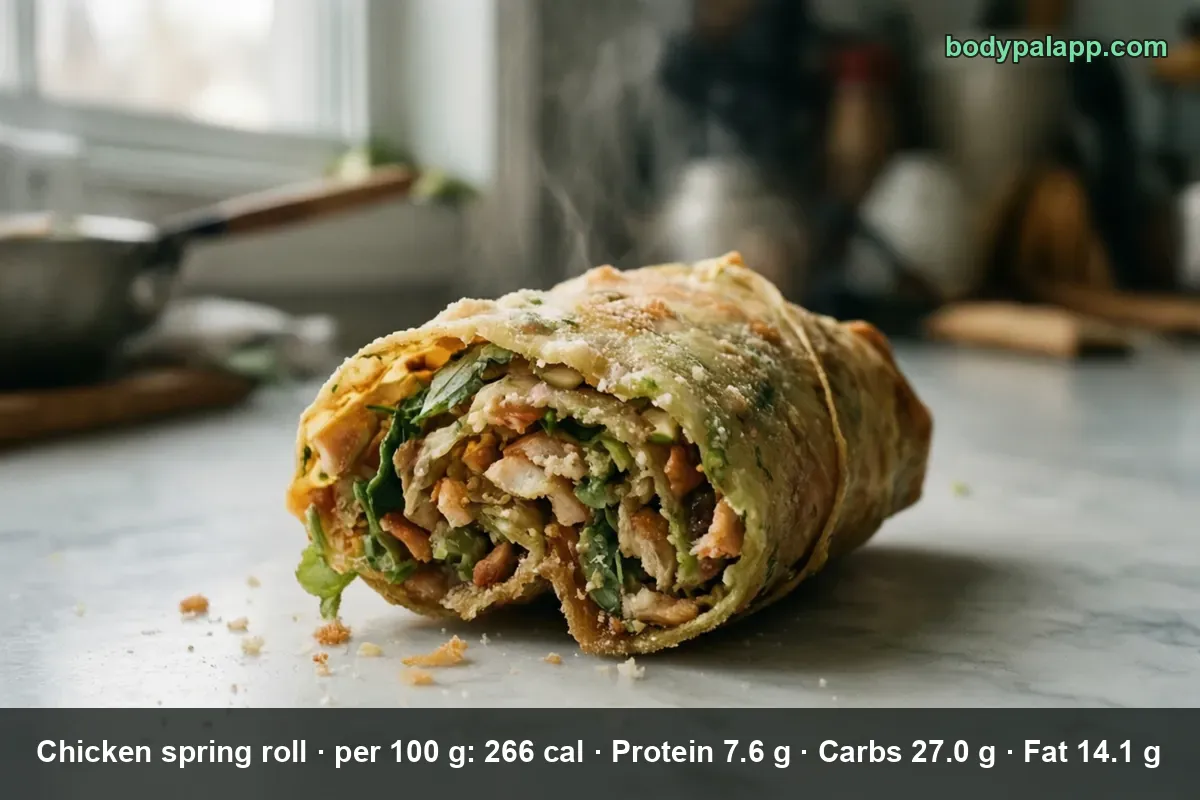
One fried chicken spring roll weighs 64 g and carries 170 calories, which works out to 266 calories per 100 g. The calories in a chicken spring roll sit mostly in the wrapper rather than the meat, because that thin shell soaks up frying oil. Two rolls, the way they usually land on a plate, come to 340.
On this page
- Chicken spring roll quick facts
- US servings, from one roll to a full cup
- Pork, shrimp, meatless and the refrigerated version
- Sodium climbs faster than protein
- How does a chicken spring roll compare?
- Most popular chicken spring roll brands
- FAQ
Chicken spring roll quick facts
The record behind every number on this page is FNDDS 2708703, "Egg roll, with chicken or turkey". In American kitchens and on American takeout menus, "spring roll" and "egg roll" are used for the same deep-fried, chicken-filled cylinder, and that is what USDA measured here. It is also what most people are holding when they look up the number: a fried roll from a Chinese-American takeout box, a food court tray, or a bag pulled out of the freezer.
There is a second useful record, SR Legacy 172104, "Egg rolls, chicken, refrigerated, heated". It describes a chilled retail roll reheated rather than dropped in a fryer, and it lands far lower. It gets its own row further down instead of being blended in; averaging the two would hide the single biggest thing that moves this food.
| Nutrient | Per 100 g | Per 1 spring roll (64 g) | % Daily Value |
|---|---|---|---|
| Calories | 266 | 170 | — |
| Total fat | 14.09 g | 9.0 g | 12% |
| Saturated fat | 2.13 g | 1.4 g | 7% |
| Carbohydrate | 27.02 g | 17.3 g | 6% |
| Dietary fiber | 2 g | 1.3 g | 5% |
| Total sugars | 5.07 g | 3.2 g | — |
| Protein | 7.59 g | 4.9 g | 10% |
| Sodium | 449 mg | 287 mg | 12% |
% Daily Value is based on a 2,000-calorie diet.
Verified nutrition data
Numbers on this page come from USDA FoodData Central, the U.S. Department of Agriculture’s food composition database, and from manufacturer labels where a branded product is named. Last verified September 2026. How we verify our data →
Two rows you would expect from a package label are missing on purpose. USDA does not publish added sugars or trans fat for this FNDDS mixed-dish record, so there is nothing honest to put in those cells. Cholesterol and potassium are published: one roll carries 7 mg of cholesterol (2% DV) and 138 mg of potassium (3% DV). Total sugars have no Daily Value on the US label, which is why that cell is a dash rather than a percentage.
US servings, from one roll to a full cup
| Serving | Weight | Calories |
|---|---|---|
| 1 miniature spring roll | 13 g | 35 kcal |
| 1 oz | 28 g | 75 kcal |
| One spring roll | 64 g | 170 kcal |
| Two spring rolls | 128 g | 340 kcal |
| 1 cup | 125 g | 333 kcal |
| Per 100 g | 100 g | 266 kcal |
The miniature roll, the full-size roll and the cup are USDA household measures for this record. The 1 oz line and the two-roll line are our own arithmetic from the USDA 100 g figure, not USDA servings, but they are the two shapes people actually log.
The cup is the trap. A cup of cut spring rolls weighs 125 g and costs 333 calories, which is nearly two whole rolls, so anyone who logs "1 cup" after eating a single roll almost doubles the entry. Go the other way and the same mistake shows up at party trays, where six miniature rolls at 13 g each add up to 210 calories and feel like nothing at all. Weigh the piece if you can; count pieces if you cannot. Dipping sauce sits outside every number here.
Pork, shrimp, meatless and the refrigerated version
| Version | Per 100 g | Typical piece | Calories |
|---|---|---|---|
| Chicken (this page) | 266 kcal | 1 spring roll, 64 g | 170 kcal |
| Pork or beef egg roll | 272 kcal | 1 oz, 28 g | 77 kcal |
| Vegetable (meatless) spring roll | 270 kcal | 1 oz, 28 g | 77 kcal |
| Shrimp spring roll | 258 kcal | 1 oz, 28 g | 73 kcal |
| Refrigerated chicken egg roll, heated | 197 kcal | 1 roll, 80 g | 158 kcal |
| Fried wonton or pot sticker | 192 kcal | 1 oz, 28 g | 54 kcal |
| Frozen store chicken spring rolls | 225 kcal | 2 rolls, 80 g | 180 kcal |
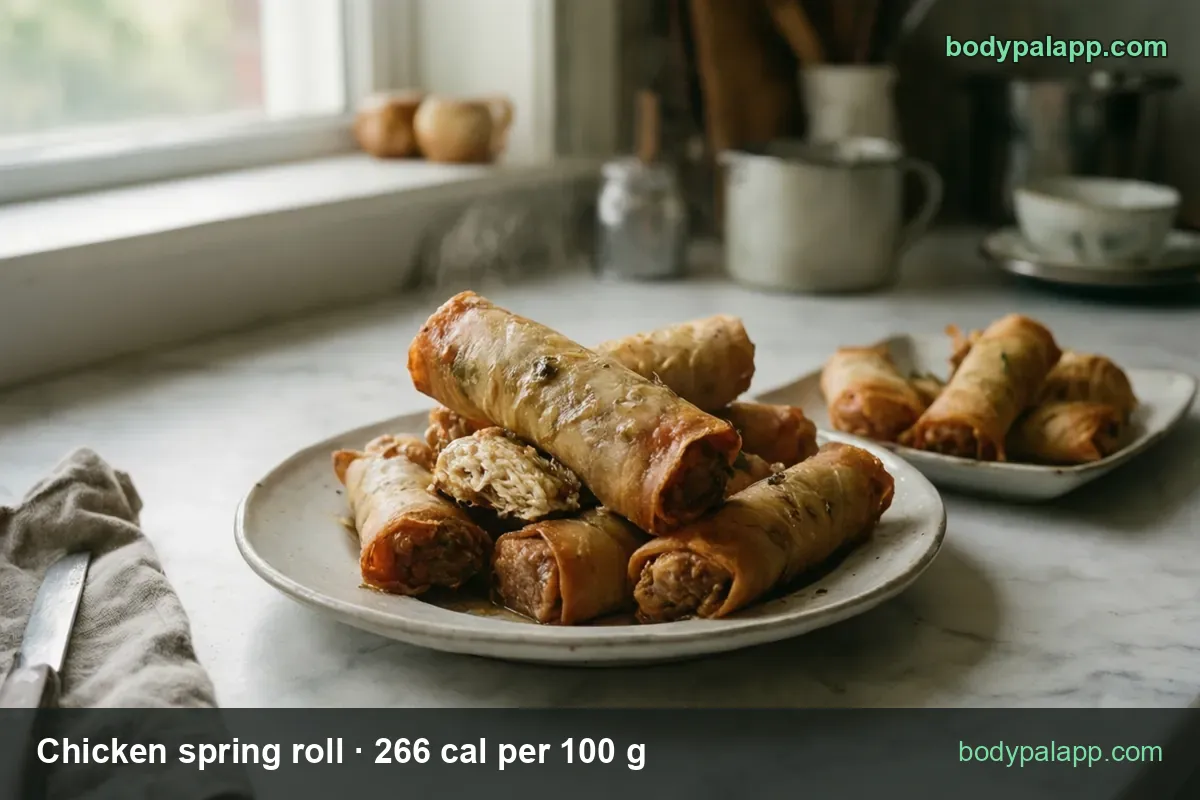
The meatless roll is the surprise. At 270 calories per 100 g it beats the chicken version, because pulling the meat out leaves more cabbage, noodle and starch inside the same fried shell. Shrimp is the only egg-roll filling in USDA's fried set that drops under 260 per 100 g, and even that is a difference of eight calories per 100 g, roughly five per roll. Choosing a filling barely changes the total.
Cooking method changes everything. The refrigerated chicken roll that gets heated rather than deep fried runs 197 calories per 100 g, and its fat is 4.51 g per 100 g against 14.09 g for the fried record. That is the whole story of this food in two numbers: same dough, same chicken, three times the fat once it hits the oil. The 80 g piece in that record is bigger than the fried 64 g roll and still lands lower, at 158 calories.
Frozen retail rolls sit between the two. USDA's Branded records show Spring Kitchen chicken spring rolls at 225 calories per 100 g, with a label serving of two rolls (80 g) at 180 calories, while Imperial Garden lists 148 per 100 g and Harris Teeter's buffalo style version 234. Those are the numbers before you fry or air-fry them yourself, so treat the package figure as a floor rather than a finished plate.
Sodium climbs faster than protein
One roll delivers 287 mg of sodium, 12% of the 2,300 mg Daily Value the FDA sets for the Nutrition Facts label. That is about an eighth of a teaspoon of table salt hiding in a piece of food that takes three bites. Eat three rolls, 192 g, and you are at 862 mg, 37% of the day, next to 14.6 g of protein, or 29% of the protein Daily Value. Salt outruns protein at every serving size on this page.
Protein is the reason people reach for the chicken version over the vegetable one, and it does show up: 4.9 g per roll, 7.59 g per 100 g. It is still a modest amount for something this calorie-dense. MyPlate's protein foods guidance points at lean meat, beans, eggs and seafood as the everyday sources, and a fried roll is closer to a starchy side than to a protein serving. If you are watching sodium, the refrigerated heated roll is the better pick on calories but not on salt, since it runs 478 mg per 100 g against 449 mg for the fried record.
Fiber is quietly decent for a fried snack at 2 g per 100 g, which is 1.3 g and 5% of the Daily Value in one roll, courtesy of the cabbage and carrot inside. Saturated fat stays low too: 1.4 g per roll, 7% of the day, because the frying oil is usually vegetable oil. The Dietary Guidelines for Americans put the ceiling for saturated fat at 10% of calories, and spring rolls are not what pushes people past it. Sodium is.
How does a chicken spring roll compare?
| Roll | Per 100 g | US serving | Calories |
|---|---|---|---|
| Chicken spring roll | 266 kcal | 1 roll, 64 g | 170 kcal |
| Pork or beef egg roll | 272 kcal | 1 oz, 28 g | 77 kcal |
| Meatless spring roll | 270 kcal | 1 oz, 28 g | 77 kcal |
| Shrimp spring roll | 258 kcal | 1 oz, 28 g | 73 kcal |
Our take: the four fried fillings sit within 14 calories per 100 g of each other, so picking chicken over pork or over the vegetable roll is not a calorie decision. If you want the number down, change the cooking, not the filling. Reheating a refrigerated roll instead of frying one takes you from 266 to 197 per 100 g, which is the only move on this page worth more than a rounding error. For a snack with a real protein return, a fried wonton at 192 per 100 g is lighter per gram but smaller per bite, so two rolls and a pile of vegetables beats a plate of either.
Most popular chicken spring roll brands in the United States
Ranked by how widely each product appears among foods sold in the United States, from the BodyPal food database of over 3.3 million products. Calories are the figures printed on each Nutrition Facts label, checked against USDA FoodData Central.
| Product | Calories (per 100 g) |
|---|---|
| Spring Kitchen Chicken Spring Rolls | 225 cal |
| Kahiki Chicken Spring Roll Bites | 188 cal |
| Martin Purefoods Chicken Spring Roll | 179 cal |
| Imperial Garden Chicken Spring Rolls | 148 cal |
| Wegmans Basil Chicken Spring Rolls | 193 cal |
| Harris Teeter Buffalo Style Chicken Spring Rolls | 234 cal |
Brand popularity: BodyPal food database. Nutrition: manufacturer labels / USDA FoodData Central.
Chicken spring roll FAQs
How many calories are in one chicken spring roll?
One fried chicken spring roll is 170 calories at a USDA weight of 64 g, which is 266 calories per 100 g. Inside that roll are 9.0 g of fat, 17.3 g of carbohydrate and 4.9 g of protein. A miniature party-size roll of 13 g is 35 calories.
How many calories in 2 chicken spring rolls?
Two rolls come to 340 calories at 128 g, our own arithmetic from the USDA 100 g figure rather than a USDA serving. That pair also carries 574 mg of sodium, a quarter of the day's Daily Value, plus 9.8 g of protein and 18.0 g of fat. Sauce is extra.
Are chicken spring rolls healthy?
One roll is 170 calories with 287 mg of sodium, 12% of the Daily Value, and only 4.9 g of protein. That ratio makes it a side, not a protein serving. Fiber is respectable at 1.3 g and saturated fat is low at 1.4 g, so the row worth watching is salt.
How much protein is in a chicken spring roll?
4.9 g per 64 g roll, or 7.59 g per 100 g, which is 10% of the 50 g Daily Value. Three rolls give 14.6 g. The meatless version drops to 5.62 g per 100 g and the shrimp version sits at 6.68 g, so chicken is the higher-protein filling but not by much.
How many carbs are in a chicken spring roll?
17.3 g of carbohydrate per roll, 6% of the Daily Value, from 27.02 g per 100 g. Fiber accounts for 1.3 g of that and total sugars for 3.2 g. The wrapper does most of the work here, which is why the meatless roll carries more carbohydrate, at 30.02 g per 100 g.
Are baked chicken spring rolls lower in calories than fried?
USDA publishes no baked record, but the closest stand-in, a refrigerated chicken egg roll heated rather than deep fried, runs 197 calories per 100 g against 266 fried. Fat falls from 14.09 g to 4.51 g per 100 g. Skipping the fryer is the single biggest calorie lever on this food.
How many calories in frozen chicken spring rolls?
It depends on the brand, and the spread is wide. USDA Branded data lists Spring Kitchen at 225 calories per 100 g, with two rolls (80 g) at 180 calories, Harris Teeter buffalo style at 234, Wegmans basil chicken at 193 and Imperial Garden at 148. Read the bag before you log it.
What is the difference between a spring roll and an egg roll?
In US data there is none worth 170 calories arguing over: USDA files the fried chicken roll under "egg roll" and Americans order the same thing as a spring roll. Egg rolls usually have a thicker, bubblier wrapper. Fresh rice-paper rolls are a different dish and are not covered by this record.
Similar foods
- Bread — 75 cal per medium slice
- Bread And Butter — 219 cal per thick slice with butter
- Burger Bun — 139 cal per bun
- Whole Grain Bread — 69 cal per slice
- Hamburger Bun — 139 cal per bun
- Hot Dog Roll — 120 cal per roll
Count it without the math
Point the camera at the plate and BodyPal counts the rolls for you, wrapper and filling together.


How long does it take to burn off 170 kcal of chicken spring roll?
One spring roll (64 g) is 170 kcal. Enter your weight and the amount you ate to see how long it takes you to burn that off:
lb
| Activity | Time to burn 170 kcal |
|---|---|
| Walking, brisk | 34 min |
| Cycling, moderate | 21 min |
| Swimming, moderate | 24 min |
| Jogging | 20 min |
| Weight training, moderate | 38 min |
Times are for a 155 lb adult at a steady pace; change the weight to see yours. The amount is set to the portion in the text (64 g); change it to what you actually ate. BodyPal works this out from your steps automatically.
Burning it off is one side of it. The other is knowing your number: work out how many calories you need a day, with macros and a goal date.