
How many calories are in bread and butter?
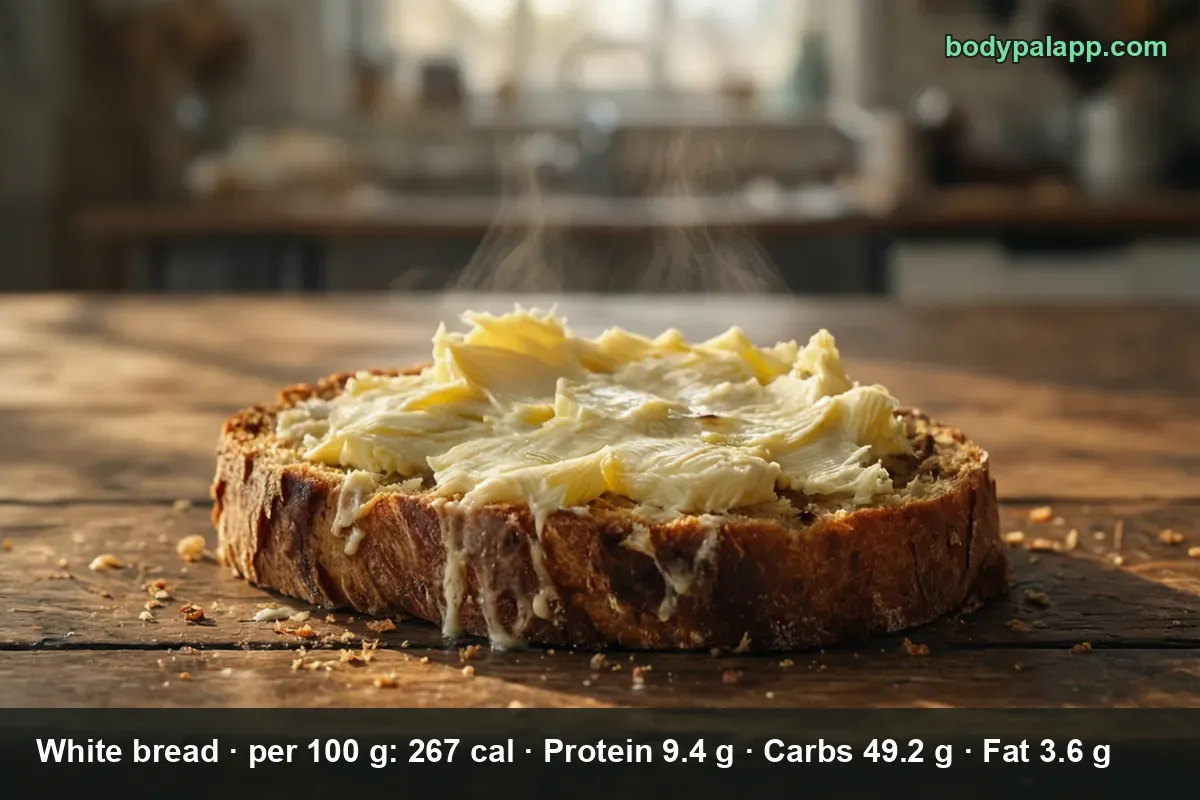
A medium slice of white bread with the USDA's own butter allowance, 7 g, comes to 127 calories: 75 from the bread and 52 from the butter. White bread alone runs 267 calories per 100 g, butter runs 743. That thin yellow layer is a fifth of the weight and 41% of the calories.
On this page
- Bread and butter quick facts
- US servings, from one slice to two on a plate
- Toast, sourdough and other breads under the butter
- Saturated fat is the row butter moves
- How does bread and butter compare?
- Most popular bread and butter brands
- FAQ
Bread and butter quick facts
There is no single USDA record called "bread with butter," so this page builds the plate from the two records that actually make it. The base is FNDDS 2707598, "Bread, white", whose household measure is one medium or regular slice at 28 g. The spread is FNDDS 2710154, "Butter, NFS", and that record carries its own measure that fits this page perfectly: a guideline amount of 7 g per slice of bread or roll.
Start with the bread on its own.
| Nutrient | Per 100 g | Per 1 medium slice (28 g) | % Daily Value |
|---|---|---|---|
| Calories | 267 | 75 | — |
| Total fat | 3.59 g | 1.0 g | 1% |
| Saturated fat | 0.821 g | 0.2 g | 1% |
| Carbohydrate | 49.2 g | 13.8 g | 5% |
| Dietary fiber | 2.3 g | 0.6 g | 2% |
| Total sugars | 5.34 g | 1.5 g | — |
| Protein | 9.43 g | 2.6 g | 5% |
| Sodium | 450 mg | 126 mg | 5% |
% Daily Value is based on a 2,000-calorie diet.
Verified nutrition data
Numbers on this page come from USDA FoodData Central, the U.S. Department of Agriculture’s food composition database, and from manufacturer labels where a branded product is named. Last verified September 2026. How we verify our data →
The slice also carries 0 mg of cholesterol and 117 mg of potassium per 100 g, which is 33 mg in a slice, or 1% of the Daily Value. Two rows you would expect on a package label are missing here, added sugars and trans fat, because this edition of FNDDS does not publish either one for bread or for butter, and inventing them would be worse than leaving them out.
Now the butter, at the 7 g the USDA itself puts on a slice.
| Nutrient | Per 100 g | Per 1 slice's worth of butter (7 g) | % Daily Value |
|---|---|---|---|
| Calories | 743 | 52 | — |
| Total fat | 82.2 g | 5.8 g | 7% |
| Saturated fat | 45.6 g | 3.2 g | 16% |
| Carbohydrate | 0.06 g | 0.0 g | 0% |
| Dietary fiber | 0 g | 0 g | 0% |
| Total sugars | 0.58 g | 0.0 g | — |
| Protein | 0.85 g | 0.1 g | 0% |
| Sodium | 524 mg | 37 mg | 2% |
% Daily Value is based on a 2,000-calorie diet.
Add the two together and you get the thing you are actually holding. The totals below are our own arithmetic from the two USDA records, not a USDA serving of its own, because the database does not publish a combined row.
| Nutrient | One slice with butter (35 g) | % Daily Value |
|---|---|---|
| Calories | 127 | — |
| Total fat | 6.8 g | 9% |
| Saturated fat | 3.4 g | 17% |
| Carbohydrate | 13.8 g | 5% |
| Dietary fiber | 0.6 g | 2% |
| Total sugars | 1.5 g | — |
| Protein | 2.7 g | 5% |
| Sodium | 163 mg | 7% |
% Daily Value is based on a 2,000-calorie diet.
Look at what the butter does and does not do. It adds 52 calories and 3.2 g of saturated fat to a slice that had almost none. It adds nothing to the carbohydrate line, because butter is 0.06 g of carbohydrate per 100 g. And it moves sodium from 126 mg to 163 mg, which is less than most people expect from something that tastes salty.
US servings, from one slice to two on a plate
| Serving | Weight | Calories |
|---|---|---|
| 1 thin slice, no butter | 24 g | 64 kcal |
| 1 medium slice, no butter | 28 g | 75 kcal |
| 1 oz of bread, no butter | 28.35 g | 76 kcal |
| 1 cup of bread cubes, no butter | 40 g | 107 kcal |
| 1 medium slice with 7 g butter | 35 g | 127 kcal |
| 2 medium slices with 14 g butter | 70 g | 254 kcal |
| 1 thick slice with 14 g butter | 57 g | 219 kcal |
| Per 100 g of plain white bread | 100 g | 267 kcal |
The thin, medium and cup rows are USDA household measures for record 2707598. The three buttered rows and the ounce are our own arithmetic from the USDA per-100-g figures, not USDA servings.
Two of those rows deserve a second look. A cup of bread cubes is 40 g, so measuring bread by volume gets you 107 calories where a slice gets you 75 for what looks like less food on the counter. And the thick slice with a full tablespoon of butter, 219 calories, is roughly what three plain slices of white bread would cost you, 225. It is 1.7 times the standard buttered slice, from the same loaf and the same butter dish.
That 14 g tablespoon is worth knowing about, because it is the number on the butter package. Land O'Lakes, Challenge and Organic Valley salted butter all list 714 calories per 100 g and 100 calories per 1 Tbsp (14 g) serving, double the USDA's 7 g slice guideline. Bread labels drift the other way: a Dave's Killer Bread organic white slice is 40 g and 110 calories, while Bimbo Soft White lists 2 slices (47 g) at 120 and Stroehmann 2 slices (41 g) at 110. If your loaf slices thicker than 28 g, scale the bread line up before you argue with the butter.
Toast, sourdough and other breads under the butter
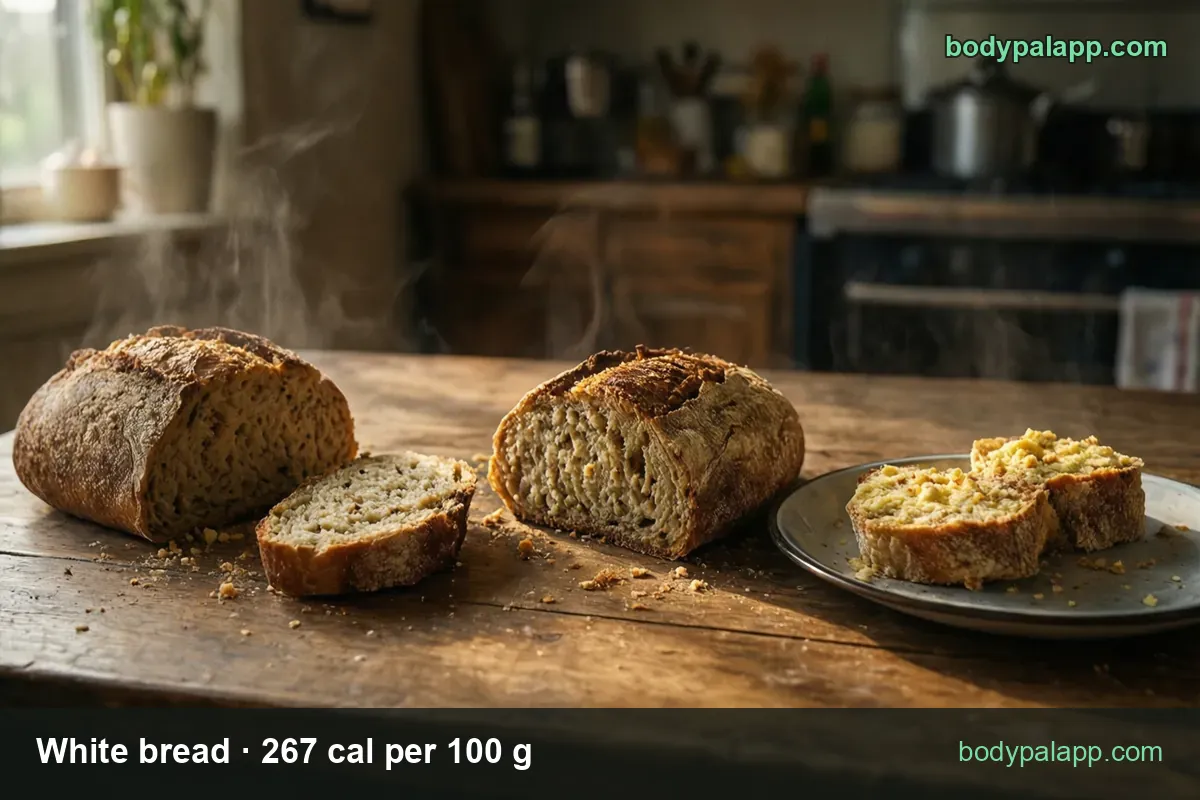
The butter is the constant. Swap the bread and the slice weight changes more than the bread itself does.
| Version | Per 100 g | Typical slice | Slice alone | With 7 g butter |
|---|---|---|---|---|
| Buttered toast, white | 293 kcal | 25 g | 73 kcal | 125 kcal |
| Whole wheat bread and butter | 254 kcal | 36 g | 91 kcal | 143 kcal |
| Sourdough with butter | 272 kcal | 31 g | 84 kcal | 136 kcal |
| French or Vienna bread with butter | 272 kcal | 64 g | 174 kcal | 226 kcal |
| Italian or rustic loaf with butter | 259 kcal | 31 g | 80 kcal | 132 kcal |
| White slice with 7 g light butter | 267 kcal | 28 g | 75 kcal | 110 kcal |
Toast is the one people get wrong. Toasted white bread is denser per 100 g than untoasted, 293 against 267, but that is water leaving the crumb, not calories arriving. The USDA slice for toast weighs 25 g instead of 28, so buttered toast lands at 125 calories, two below the untoasted slice. Toasting your bread does not cost you anything.
Whole wheat is the trade most people are actually looking for. Its slice is heavier at 36 g, so the buttered total is 143 rather than 127, but it brings 6.0 g of fiber per 100 g against white bread's 2.3 g. You pay 16 calories for roughly two and a half times the fiber.
French or Vienna bread is where the arithmetic gets away from you. The bread is unremarkable at 272 calories per 100 g, but the USDA slice weighs 64 g, more than twice a sandwich slice, and the buttered piece comes to 226 calories. A rustic Italian loaf sliced thin at 31 g is 132 with butter, so the same style of bread swings by 94 calories, 70% more, depending on how the knife falls. Light butter, which is butter cut with water at 499 calories per 100 g, drops the buttered slice from 127 to 110, our own arithmetic from record 2710157.
Saturated fat is the row butter moves
Calories are not the interesting story on this plate. Saturated fat is. A plain slice of white bread carries 0.2 g, or 1% of the Daily Value. Put the USDA's 7 g of butter on it and that slice carries 3.4 g, or 17% of the FDA Daily Value of 20 g. Two buttered slices at breakfast are 34% of the day's saturated fat before anything else is on the plate.
The Dietary Guidelines for Americans advise keeping saturated fat under 10% of daily calories, which on a 2,000-calorie day is about 22 g. Nothing about a buttered slice breaks that on its own. It is simply a bigger claim on that budget than most people assume from a smear of butter.
Sodium behaves better than its reputation. The bread supplies 126 mg and the butter 37 mg, for 163 mg per slice, 7% of the Daily Value. That is about a sixteenth of a teaspoon of table salt. If you are watching sodium, note that the bread, not the butter, is the bigger contributor, and that French, Vienna and Italian breads run 602 to 618 mg per 100 g against white bread's 450.
For what it is worth, the protein and fiber are thin: 2.7 g and 0.6 g per buttered slice, 5% and 2% of the Daily Value. MyPlate's grains guidance is to make at least half your grains whole, and on this page that is the single change that moves the nutrition rather than the calorie count.
How does bread and butter compare?
| Bread | Per 100 g | US serving | Calories |
|---|---|---|---|
| White bread (this page) | 267 kcal | 1 medium slice, 28 g | 75 kcal |
| White bread, toasted | 293 kcal | 1 medium slice, 25 g | 73 kcal |
| Whole wheat bread | 254 kcal | 1 medium slice, 36 g | 91 kcal |
| French or Vienna bread | 272 kcal | 1 medium slice, 64 g | 174 kcal |
Our take: the four breads sit inside a 39-calorie band per 100 g, from 254 to 293, so the loaf you choose barely matters. The slice does. Between the toasted 25 g slice at 73 calories and the French 64 g slice at 174, the bread choice swings the plate by 101 calories before a knife touches the butter dish. Since the 7 g of butter is a flat 52 calories on every one of them, the fastest way to cut a buttered slice down is to cut the slice thinner, and the fastest way to improve it is whole wheat, which costs 16 calories more per slice for 6.0 g of fiber per 100 g instead of 2.3 g.
Most popular bread and butter brands in the United States
Ranked by how widely each product appears among foods sold in the United States, from the BodyPal food database of over 3.3 million products. Calories are the figures printed on each Nutrition Facts label, checked against USDA FoodData Central.
| Product | Calories (per 100 g) |
|---|---|
| Land O'Lakes Sweet Cream Salted Butter | 714 cal |
| Challenge Grade AA Salted Butter | 714 cal |
| Organic Valley Organic Salted Butter | 714 cal |
| Dave's Killer Bread Organic White Bread | 275 cal |
| Bimbo Soft White Bread | 255 cal |
| Stroehmann White Bread | 268 cal |
Brand popularity: BodyPal food database. Nutrition: manufacturer labels / USDA FoodData Central.
Bread and butter FAQs
How many calories are in a slice of bread with butter?
127 calories for a medium 28 g slice of white bread with the USDA's 7 g guideline amount of butter. The bread is 75 of that and the butter 52. Spread it heavier, a full 14 g tablespoon, and the same slice becomes 179 calories.
How many calories in 2 slices of bread and butter?
254 calories for two medium slices of white bread with 14 g of butter between them, our own arithmetic from the USDA records. That is 150 from the bread and 104 from the butter, plus 6.8 g of saturated fat, which is 34% of the Daily Value.
How much butter goes on one slice of bread?
7 g, according to the USDA's own guideline amount per slice of bread or roll, and that works out to 52 calories. The tablespoon printed on a butter package is 14 g and 100 calories on the label, so a package serving is double what the database assumes.
Does toasting bread change the calories?
No: toasted white bread reads 293 calories per 100 g against 267 untoasted, but that is water leaving the crumb, not calories arriving. The USDA toast slice weighs 25 g rather than 28, so a buttered slice of toast is 125 calories, two fewer than untoasted.
How many calories in whole wheat bread with butter?
143 calories for one medium 36 g slice with 7 g of butter. Whole wheat is actually lighter per 100 g than white, 254 against 267, but the USDA slice is heavier. In exchange you get 6.0 g of fiber per 100 g instead of white bread's 2.3 g.
How many carbs are in bread and butter?
13.8 g of carbohydrate per buttered slice, 5% of the Daily Value, and all of it comes from the bread. Butter is 0.06 g of carbohydrate per 100 g, so the 7 g on your slice rounds to zero. Two buttered slices come to 27.6 g.
Is butter or light butter lower in calories on bread?
Light butter, by 17 calories a slice. The USDA light butter record is 499 calories per 100 g against 743 for regular, so 7 g on a slice is 35 calories instead of 52, dropping the buttered slice from 127 to 110. Saturated fat falls from 3.2 g to 2.4 g.
Is bread and butter a healthy breakfast?
A buttered slice is 127 calories with only 2.7 g of protein and 0.6 g of fiber, so on its own it is a light, low-satiety start. Whole wheat bread and an egg alongside fix both gaps. If you are watching saturated fat, note that one slice is already 17% of the Daily Value.
Similar foods
- Bread — 75 cal per medium slice
- Burger Bun — 139 cal per bun
- Hamburger Bun — 139 cal per bun
- Hot Dog Roll — 120 cal per roll
- Chicken Spring Roll — 170 cal per spring roll
- Whole Grain Bread — 69 cal per slice
Count it without the math
Point the camera at the plate and BodyPal counts the slice and the butter on it for you.


How long does it take to burn off bread and butter?
One buttered slice (35 g) is 127 kcal. Enter your weight and the amount you ate to see how long it takes you to burn that off:
lb
| Activity | Time to burn 127 kcal |
|---|---|
| Walking, brisk | 25 min |
| Cycling, moderate | 16 min |
| Swimming, moderate | 18 min |
| Jogging | 15 min |
| Weight training, moderate | 28 min |
Times are for a 155 lb adult at a steady pace; change the weight to see yours. The amount is set to the portion in the text (35 g); change it to what you actually ate. BodyPal works this out from your steps automatically.
Burning it off is one side of it. The other is knowing your number: work out how many calories you need a day, with macros and a goal date.