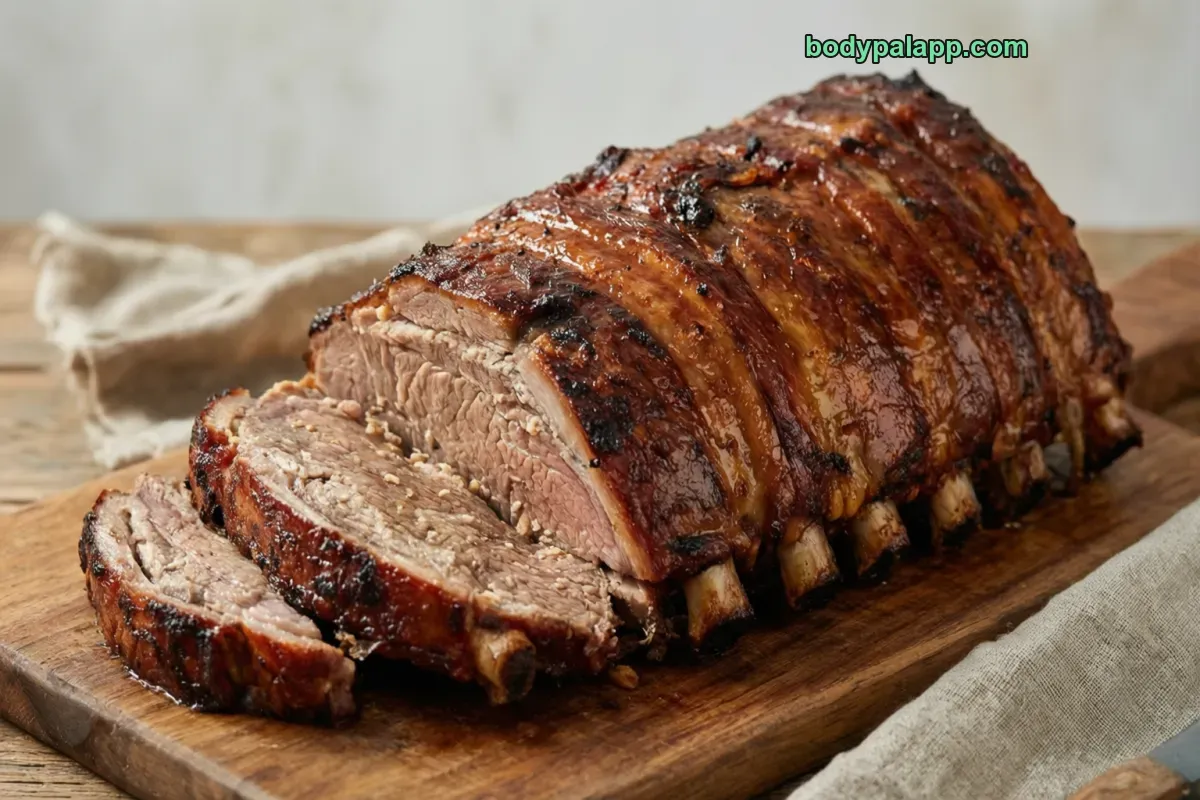
Baby back ribs calories come to 248 for a 3 oz portion (85 g) of roasted meat and 292 per 100 g. Fat supplies 68% of those calories and protein the other 32%, with 0 g of carbs before any sauce. Portion size is what really moves the total, because ribs are easy to overeat.
248kcal
1 3 oz portion · 85 g, roasted, lean and fat
32%protein
19.6 gProtein
0 gCarbs
18.3 gFat
How to burn off 248 kcal
—Walking, brisk
—Jogging
—Cycling, moderate
—Swimming
Skip the math. BodyPal counts these calories from your steps and workouts automatically.
Nutrition facts
Roasted, lean and fat · per 85 g
Calories
248 kcal
Protein
19.6 g
Carbohydrate
0 g
Fat
18.3 g
Saturated fat
6.6 g
Cholesterol
71 mg
Sodium
80 mg
Potassium
204 mg
Iron
0.8 mg
Source: USDA FoodData Central
🛡️
Verified nutrition data
Numbers on this page come from USDA FoodData Central, the U.S. Department of Agriculture’s food composition database, and from manufacturer labels where a branded product is named. Last verified October 2026. How we verify our data →
Baby back ribs: calories, protein and sodium by serving
Percent of daily value uses the FDA reference of 2,000 kcal a day.
Serving
kcal
Protein
Carbs
Fat
Sodium
% DV kcal
3 oz portion (85 g)
248
19.6 g
0 g
18.3 g
80 mg
12%
4 oz portion (113 g)
330
26 g
0 g
24.3 g
106 mg
16%
100 g
292
23 g
0 g
21.5 g
94 mg
15%
3 × 3 oz portion (85 g)
745
58.7 g
240 mg
5 × 3 oz portion (85 g)
1,241
97.8 g
400 mg
Two portions of ribs already reach 496 calories
The USDA figure here is for pork backribs, roasted, lean and fat eaten together, with the bone already out of the weight. A 3 oz portion (85 g) gives 248 calories and 19.6 g of protein, which is 12% of the daily value for calories. A 4 oz portion (113 g) lands at 330 calories and 26 g of protein.
Restaurant and backyard plates rarely stop at 3 oz of meat. Two portions (170 g) come to 496 calories, three (255 g) to 745, and five (425 g) to 1,241 calories with 97.8 g of protein. That last figure is the kind of total a long sitting at a barbecue can reach before a single side dish.
The practical move is to weigh once. A kitchen scale shows how much meat your usual pile of ribs actually holds, and that number repeats every time you eat them. If weighing at the table is not realistic, BodyPal can log ribs from a photo.
Fat supplies 68% of the calories
Per 100 g, baby back ribs carry 21.5 g of fat and 23 g of protein. The grams look even, but fat is the denser fuel, so the calorie split lands at 68% from fat and 32% from protein. Carbs sit at 0.
That makes ribs a fat-forward protein food rather than a lean one. The 3 oz portion still covers 39% of the daily value for protein, and the 4 oz portion covers 52%, so the protein is real. You simply get it alongside more fat than a leaner cut would bring.
The 0 g of carbs and 0 g of sugars apply to plain roasted meat. Sugary rubs, glazes and barbecue sauce add carbs on top, and the numbers on this page do not include them. If your ribs come sauced, log the sauce as its own item so the total stays honest.
Saturated fat is the row to watch, not sodium
Unsauced ribs are low in sodium: 94 mg per 100 g, and 80 mg in a 3 oz portion, just 3% of the daily value. Even five portions add up to only 400 mg. Salt mostly arrives through rubs, brines and sauces, none of which are part of this plain roasted row.
The number that stands out is saturated fat, at 7.8 g per 100 g against a daily value of 20 g. Cholesterol reads 84 mg per 100 g against a daily value of 300 mg. If you track either one, portion size is your main lever, since every extra 3 oz brings the same load again.
Potassium is modest at 240 mg per 100 g, and fiber is 0. Ribs deliver protein and fat and little else from the nutrition panel. The rest of the plate has to do the other work, which is where sides come in.
Build the plate around a 3 oz portion
Ribs work best as the protein of the meal, not the whole meal. A 3 oz portion at 248 calories leaves plenty of room for sides. Three portions at 745 calories take a big share of the day before anything else lands on the plate.
Because the meat has 0 g of fiber, pair it with foods that bring some: slaw, grilled vegetables, beans or a green salad. Those also fill the plate, which makes it easier to stop at one or two portions. Sweet sides and extra sauce push the total up quickly, so pick one rather than both.
If you buy pre-cooked racks such as Plumrose Fully Cooked Pork Baby Back Ribs or Roseland Original BBQ Sauce Pork Baby Back Ribs, read the label. Sauced versions are a different food from the plain roasted meat described here. Treat the sauce as the variable and the meat as the constant.
How does baby back ribs compare?
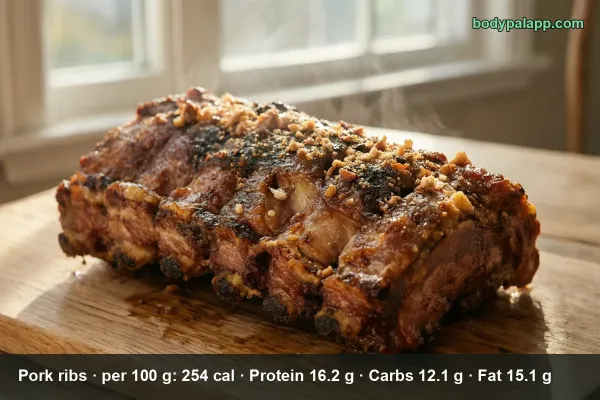
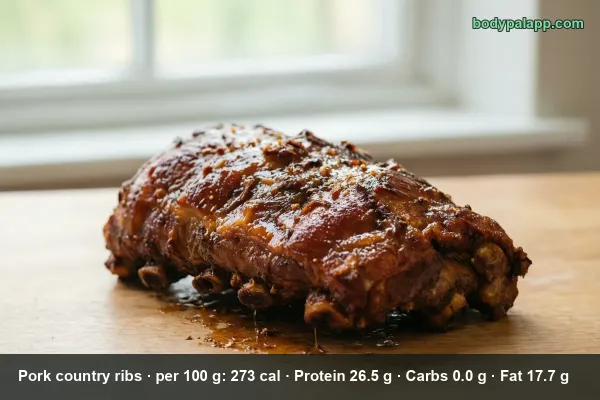
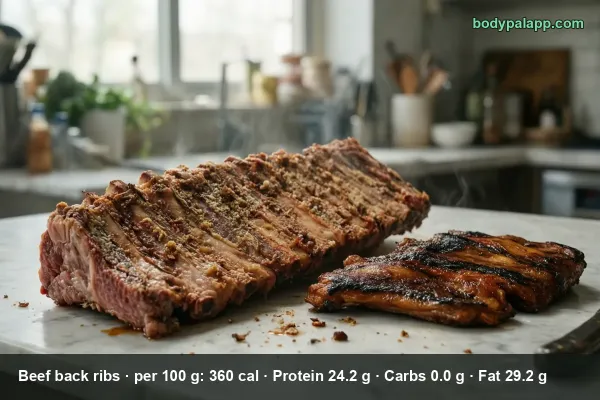
Here is how baby back ribs stack up against pork rib, pork country rib and beef back rib, per 100 g and per usual serving.
Verdict: For the cleanest trade, pick pork country rib: 273 calories per 100 g with 26.5 g of protein and 58 mg of sodium. Pork rib is lower at 254 calories but brings 12.1 g of carbs and 678 mg of sodium, and beef back rib is the heaviest at 360 calories, so baby back ribs at 292 sit in the middle.
Most popular baby back ribs brands in the United States
Ranked by popularity in the BodyPal database
# Productkcal / 100 g
1Plumrose Fully Cooked Pork Baby Back Ribs5 oz · 140 g186 kcal
2Plumrose Smokey Barbecue Sauce Baby Back Ribs5 oz · 140 g229 kcal
3Roseland Original BBQ Sauce Pork Baby Back Ribs5 oz · 140 g186 kcal
4Signature Select Barbecue Game Day Baby Back Ribs5 oz · 140 g229 kcal
5Roseland Pork Baby Back Ribs in Honey Garlic BBQ Sauce5 oz · 140 g193 kcal
6Hy-Vee Baby Back Ribs5 oz · 140 g236 kcal
7Stater Bros. Baby Back Ribs5 oz · 140 g229 kcal
8Weis Baby Back Ribs5 oz · 140 g186 kcal
Packaged ribs are labeled per portion as sold, often with sauce included, so their numbers differ from the plain roasted meat above. Source: manufacturer labels / USDA FoodData Central.
Baby back ribs FAQs
How many calories are in baby back ribs?
A 3 oz portion of roasted baby back ribs has about 248 calories, and a 4 oz portion has 330. Per 100 g it is 292 calories.
Are baby back ribs good for weight loss?
A 3 oz portion has 248 calories with 18.3 g fat, 7.8 g saturated fat per 100 g, and 0 g carbs. Most of the calories come from fat.
Baby back ribs vs country style ribs: which has fewer calories?
Country style pork ribs have 273 calories per 100 g versus 292 for baby back ribs, so 3 oz is about 232 versus 248 calories.
How much protein is in baby back ribs?
A 3 oz portion has 19.6 g protein, or 23.0 g per 100 g.
How many calories are in baby back ribs, meat only?
A 3 oz portion (85 g) of baby back rib meat has 248 calories, and 100 g has 292. These USDA values cover roasted lean and fat eaten together, weighed without the bone.
Do the calorie numbers for baby back ribs include the bone?
No. The 248 calories in a 3 oz portion (85 g) refer to edible meat only. Bone adds weight on the plate but no calories you eat, so weigh or estimate the meat itself.
How many calories are in baby back ribs without sauce?
Plain roasted baby back ribs have 292 calories per 100 g, with 0 g of carbs and 0 g of sugars. Barbecue sauce and sweet glazes add carbs and calories on top of that.
How many calories are in a big plate of baby back ribs?
Five 3 oz portions (425 g of meat) come to 1,241 calories with 97.8 g of protein. Three portions (255 g) reach 745 calories, and two portions (170 g) reach 496.
How much fat is in baby back ribs?
A 3 oz portion has 18.3 g of fat, and 100 g has 21.5 g, including 7.8 g saturated. Fat supplies 68% of the calories in baby back ribs, protein the other 32%.