
How many calories are in a Bartlett pear?
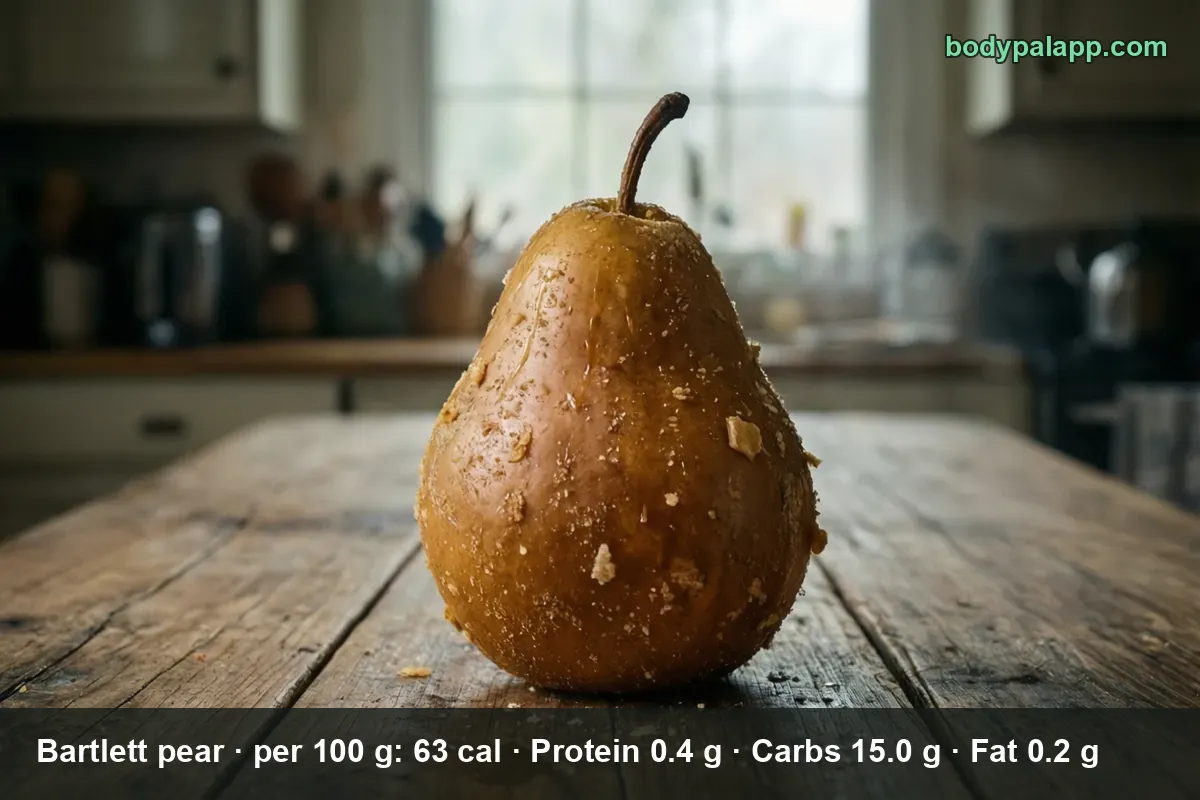
A medium Bartlett pear weighs 177 g and carries 112 calories. Per 100 g it is 63. A small pear comes to 96, a large one to 143, and a cup of slices cut from that medium fruit is 88. The calorie count is the least interesting row on the label, though. One medium Bartlett delivers 5.5 g of fiber, a fifth of an entire day.
On this page
- Bartlett pear quick facts
- US serving sizes, small to large
- The cup of slices is smaller than the pear
- One pear, two USDA calorie numbers
- Which pear you picked barely matters
- Canned, dried and what syrup does
- How does a Bartlett pear compare?
- Most popular bartlett pear brands
- FAQ
Bartlett pear quick facts
The figures below are SR Legacy 167776, "Pears, raw, bartlett" — the one USDA record for this variety that carries a total sugars figure. The serving column is USDA's own medium pear, which it weighs at 177 g.
| Nutrient | Per 100 g | Per 1 medium pear (177 g) | % Daily Value |
|---|---|---|---|
| Calories | 63 | 112 | — |
| Total fat | 0.16 g | 0.3 g | 0% |
| Carbohydrate | 15.01 g | 26.6 g | 10% |
| Dietary fiber | 3.1 g | 5.5 g | 20% |
| Total sugars | 9.69 g | 17.2 g | — |
| Protein | 0.39 g | 0.7 g | 1% |
| Sodium | 1 mg | 2 mg | 0% |
| Potassium | 101 mg | 179 mg | 4% |
% Daily Value is based on a 2,000-calorie diet.
Verified nutrition data
Numbers on this page come from USDA FoodData Central, the U.S. Department of Agriculture’s food composition database, and from manufacturer labels where a branded product is named. Last verified September 2026. How we verify our data →
Three lines a US label usually shows are absent, and saying why is more useful than filling them in. Record 167776 publishes no saturated fat, no cholesterol and no added sugars value, so none appears here. Trans fat it does publish, at 0 g. With 0.16 g of total fat in 100 g of pear, a saturated fat line would round to nothing on a package anyway.
Now read the % Daily Value column top to bottom, because it is the whole argument for eating this fruit. Fiber is 20% of the FDA Daily Value of 28 g. Everything else is small change: 10% of the day's carbohydrate, 4% of its potassium, 1% of its protein, 0% of its sodium. And the calories that carry all that fiber come to 112, roughly 5.6% of a 2,000-calorie day.
A fifth of your fiber for a twentieth of your calories is a rare trade. Very few whole foods hand you one-fifth of any daily target in a single object you can eat over a sink.
US serving sizes, small to large
| Serving | Weight | Calories |
|---|---|---|
| 1 oz | 28 g | 18 |
| 1 cup, sliced | 140 g | 88 |
| 1 small pear | 152 g | 96 |
| 1 medium pear | 177 g | 112 |
| 1 large pear | 227 g | 143 |
| 100 g | 100 g | 63 |
Small, medium, large and the cup of slices are USDA's own household measures for record 167776, not our estimates. That matters more than it sounds. Another USDA record for the same variety weighs its pears at 148, 178 and 230 g, and mixing those weights with these calories would quietly cross two sources: a small pear would drop from 96 to 93, a large one climb from 143 to 145. Weights and energy come from one record here, which is why the small pear on this page is 152 g.
Cooked pears are a different question with a different answer, and USDA files them separately. Nobody bakes a Bartlett to eat it plain. The canned and dried forms have their own records and their own section further down; they are not variations on this table.
The useful headline is the spread. From a small pear to a large one you travel 96 to 143 calories, a 47-calorie gap on a food most people log as "a pear." That is nearly a 50% swing depending on what the store had in the bin that week.
The cup of slices is smaller than the pear
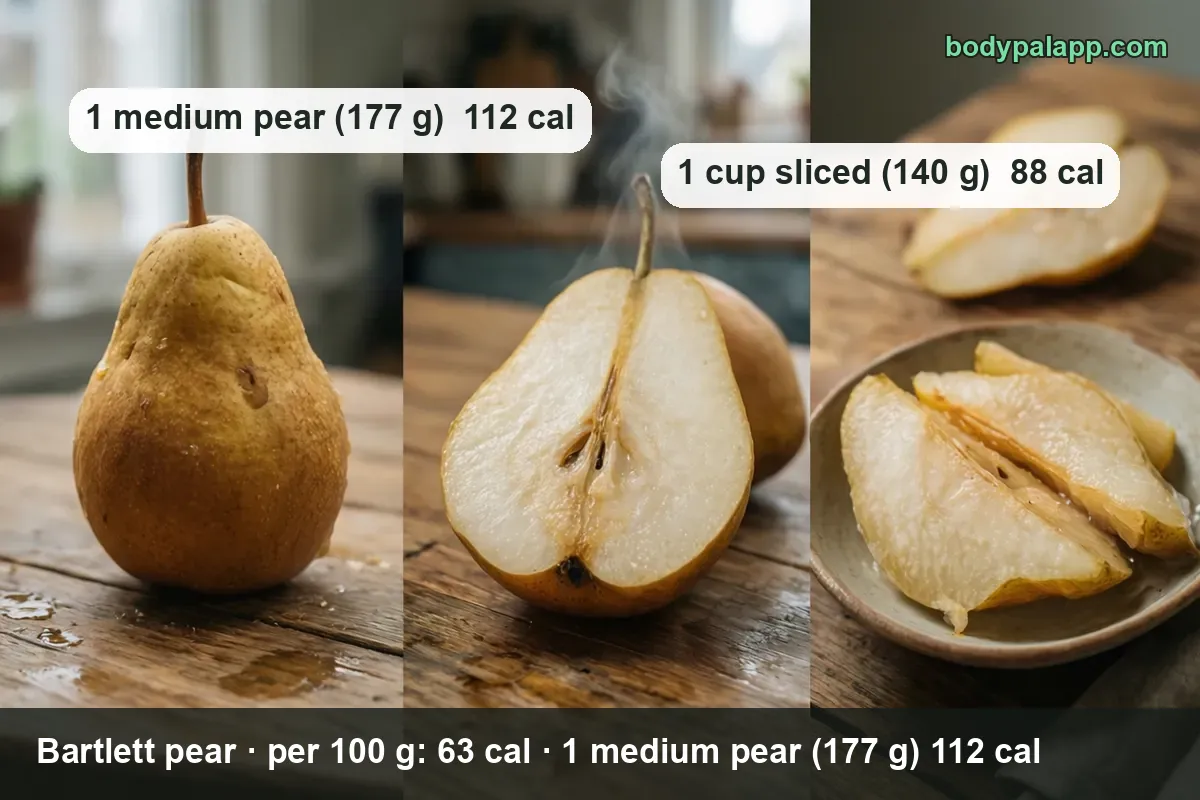
| What is in front of you | Weight | Calories |
|---|---|---|
| 1 cup, sliced | 140 g | 88 |
| 1 medium pear | 177 g | 112 |
| 1 large pear | 227 g | 143 |
Here is the trap that costs pear-eaters the most calories, and it runs in the opposite direction to the one people expect.
Slice a medium Bartlett and it does not fill one cup. It fills about a cup and a quarter, because USDA's cup of slices weighs 140 g and the fruit you cut up weighed 177. So the person who slices a pear into yogurt, looks at the bowl and logs "1 cup" is 24 calories short of the fruit they actually used.
Twenty-four calories is nothing on its own. The habit behind it is not. Cups are containers, and containers describe your bowl rather than your food; the pear is an object, and objects describe themselves. When the food is denser than a pear the same reflex costs far more than 24.
The fix takes no arithmetic: if the whole fruit went in, log the whole fruit. Save the cup for the times you sliced two pears and ate half.
One pear, two USDA calorie numbers
Search this fruit and you will meet 57 calories per 100 g somewhere, which flatly contradicts the 63 on this page. Both are USDA. Both are correct. Neither is a measurement of a different pear.
The Foundation record for the same variety publishes 57, and it publishes 63 as well, inside the same entry. The difference is arithmetic convention. Specific Atwater factors calculate energy from the particular proteins, fats and carbohydrates in that food and give 57; general Atwater factors use the standard 4/9/4 and give 63. One fruit, two ways of adding up what is in it.
This page leads with 63 for a plain reason: it is the number attached to the record that also reports total sugars, and a fruit page without a sugar row has a hole in it. Carry the other convention through instead and a medium pear reads about 10% lighter. What does not happen is averaging the two into a third figure that describes nothing.
Two more records are worth knowing about. One is a re-issue of that Foundation analysis under USDA's Food Distribution Program label, identical figure for figure. The other is the generic "Pears, raw" entry covering all varieties, at 57 calories per 100 g with 9.75 g of sugars — a useful check on our 9.69, since the all-variety average and the single variety land within a rounding error of each other. Its own reference serving, 166 g, comes to 95 calories.
Which pear you picked barely matters
| Variety | Per 100 g | USDA medium fruit | Calories | Sugars per 100 g |
|---|---|---|---|---|
| Bartlett | 63 | 177 g | 112 | 9.69 g |
| Bosc | 67 | 179 g | 120 | 10.23 g |
| Green Anjou | 66 | 202 g | 133 | 9.73 g |
| Red Anjou | 62 | 157 g | 97 | 9.54 g |
| Asian | 42 | 122 g | 51 | 7.05 g |
Per 100 g the four European pears sit inside an 8% band, from 62 to 67. Per fruit they run 97 to 133, a 36-calorie spread. Every calorie of that spread is size. A green Anjou is not a richer pear than a red one; USDA's green Anjou simply weighs 202 g and its red Anjou 157.
Sugars tell the same story. Across the four, total sugars move from 9.54 to 10.23 g per 100 g — under a gram of daylight between the sweetest and the least sweet. Nobody can taste that, and no calorie tracker should care.
The Asian pear is the genuine outlier at 42 calories per 100 g, a third lighter than the rest, and its USDA fruit is a modest 122 g. That combination puts one at 51 calories, less than half a Bartlett. If a low number is the goal, that is the pear to buy, and it is the only choice on this table that changes anything.
Canned, dried and what syrup does
| Form | Per 100 g | USDA serving | Calories |
|---|---|---|---|
| Fresh Bartlett, raw | 63 | 1 medium pear (177 g) | 112 |
| Canned, water pack | 29 | 1 cup halves (244 g) | 71 |
| Canned, juice pack | 50 | 1 cup halves (248 g) | 124 |
| Canned, heavy syrup pack | 74 | 1 cup (266 g) | 197 |
| Dried, sulfured | 262 | 1 cup halves (180 g) | 472 |
A cup of pears is 71 calories or 197 calories, and the pear had nothing to do with it. Water pack against heavy syrup is a factor of nearly three on the same fruit in the same bowl, because what you are eating in the second case is partly sugar solution.
Halves make the choice easier to see. One half with its liquid weighs 76 g, which is 22 calories in water, 38 in juice pack and 56 in heavy syrup. Two halves in water cost less than one in syrup.
Sugar is where the gap really opens. Fresh Bartlett is 9.69 g of sugars per 100 g and the juice pack is essentially the same at 9.7. Heavy syrup runs 15.2 g. That extra sugar is added sugar, and added sugar is the one FDA puts a Daily Value on — 50 g a day. The 17.2 g in a fresh pear has no percentage next to it at all, because there is nothing added to count.
Dried pears are the other end of the scale and they surprise people: 262 calories per 100 g, 62.2 g of sugars, 472 calories for a cup of halves. Nothing was added, water was simply removed, and a single dried half at 18 g is 47 calories — more than two canned halves in water. Both federal fruit guides, MyPlate and the Dietary Guidelines for Americans, point the same way: most of your fruit should be whole fruit.
How does a Bartlett pear compare?
| Fruit | Per 100 g | Carbs per 100 g | Protein per 100 g | US serving | Calories |
|---|---|---|---|---|---|
| Bartlett pear, raw (this page) | 63 | 15.0 g | 0.4 g | 1 medium (177 g) | 112 |
| Bosc pear, raw | 67 | 16.1 g | 0.4 g | 1 medium (179 g) | 120 |
| Apple, raw, with skin | 52 | 13.8 g | 0.3 g | 1 medium, 3" (182 g) | 95 |
| Banana, raw | 89 | 22.8 g | 1.1 g | 1 medium, 7" (118 g) | 105 |
| Orange, raw | 47 | 11.8 g | 0.9 g | 1 fruit, 2-5/8" (131 g) | 62 |
The banana is the row that breaks people's intuition. Per 100 g it is the heaviest fruit here by a wide margin, 89 against 63, and yet per fruit it lands below the pear at 105 calories. USDA's medium banana weighs 118 g and its medium Bartlett 177. Density and portion disagree, and the portion wins.
Our take: for the smallest number in a lunch bag, the orange at 62 calories is the pick and nothing else here is close. It leads on food per calorie too, 131 g for 62 calories, with the apple next at 182 g for 95. The Bartlett's case is fiber — 177 g of fruit for 112 calories, with a fifth of the day's fiber, is the reason a pear holds off a mid-afternoon snack better than an apple does. And if you want protein from your fruit, stop looking; the best row here is the banana at 1.1 g per 100 g, which is nobody's protein source.
Most popular bartlett pear brands in the United States
Ranked by how widely each product appears among foods sold in the United States, from the BodyPal food database of over 3.3 million products. Calories are the figures printed on each Nutrition Facts label, checked against USDA FoodData Central.
| Product | Calories (per 100 g) |
|---|---|
| Seneca Bartlett Pear Halves | 62 cal |
| Essential Everyday Bartlett Pear Halves in Water | 33 cal |
| Food Lion Bartlett Pear Halves | 48 cal |
| Hannaford Bartlett Pear Halves in 100% Juice | 48 cal |
| Wegmans Bartlett Pears | 60 cal |
| Tops Bartlett Pear Slices | 48 cal |
Brand popularity: BodyPal food database. Nutrition: manufacturer labels / USDA FoodData Central.
Bartlett pear FAQs
How many calories are in a Bartlett pear?
112 calories in one medium Bartlett, which USDA weighs at 177 g, or 63 calories per 100 g. A small pear is 96 and a large one 143. That medium fruit also carries 26.6 g of carbohydrate, 5.5 g of fiber, 17.2 g of natural sugars and 179 mg of potassium.
How many calories are in a cup of sliced pears?
88 calories for USDA's cup of sliced Bartlett, which weighs 140 g. That is 24 fewer than the whole medium pear the slices came from, because a 177 g fruit fills about a cup and a quarter. If the whole pear went into the bowl, log the pear rather than the cup.
How much sugar is in a Bartlett pear?
17.2 g of total sugars in a medium 177 g pear, from 9.69 g per 100 g. None of it is added sugar, so the % Daily Value column stays empty — FDA assigns a Daily Value to added sugars only. The same fruit canned in heavy syrup runs 15.2 g of sugars per 100 g.
How many carbs are in a Bartlett pear?
26.6 g of carbohydrate in a medium Bartlett, which is 10% of the 275 g Daily Value, from 15.01 g per 100 g. Of that total, 5.5 g is fiber and 17.2 g is sugars. A small pear works out at 96 calories and a large one at 143.
How much fiber is in a Bartlett pear?
5.5 g in a medium 177 g pear, which is 20% of the 28 g Daily Value, from 3.1 g per 100 g. Those 5.5 g arrive inside 112 calories, about 5.6% of a 2,000-calorie day, so a Bartlett returns roughly three and a half times more of the day's fiber than of its energy.
Bartlett or Bosc pear — which has fewer calories?
The Bartlett, at 112 calories for a medium 177 g fruit against 120 for a 179 g Bosc. Per 100 g the two are 63 and 67, a gap under 7%. Variety is not what moves the number here; the size of the pear in your hand is.
How many calories are in canned Bartlett pears?
Between 71 and 197 calories a cup, decided by the packing liquid. Halves in water are 29 calories per 100 g, so a 244 g cup is 71. In juice they are 50 per 100 g and a 248 g cup is 124. In heavy syrup, 74 per 100 g and a 266 g cup is 197.
Are Bartlett pears good for weight loss?
A medium Bartlett is 112 calories carrying 5.5 g of fiber, a fifth of the day's fiber for about 5.6% of a 2,000-calorie day. Federal advice favors whole fruit at MyPlate and in the Dietary Guidelines for Americans. The form to watch is dried, at 472 calories a cup.
Similar foods
- Bing Cherries — 97 cal per cup without pits
- Cherries — 97 cal per cup, pitted
- Fresh Cherries — 97 cal per cup
- Cherries With The Pits — 87 cal per cup with pits
- Fuji Apple — 121 cal per medium apple
- Rainier Cherries — 97 cal per cup
Count it without the math
Skip the scale and the slicing arithmetic: point a phone at the fruit bowl and BodyPal records the whole pear, the cup of slices or the canned half for you.


How long does it take to burn off a Bartlett pear?
A medium pear (177 g) is 112 kcal. Enter your weight and the amount you ate to see how long it takes you to burn that off:
lb
| Activity | Time to burn 112 kcal |
|---|---|
| Walking, brisk | 22 min |
| Cycling, moderate | 14 min |
| Swimming, moderate | 16 min |
| Jogging | 13 min |
| Weight training, moderate | 25 min |
Times are for a 155 lb adult at a steady pace; change the weight to see yours. The amount is set to the portion in the text (177 g); change it to what you actually ate. BodyPal works this out from your steps automatically.
Want the bigger picture? Calculate your daily calorie needs — your maintenance figure, a target for losing or gaining, and the date you get there.