Beef tongue calories come to 241 for a 3 oz portion (85 g) and 284 per 100 g, cooked by simmering. What stands out is where they come from: 72% of those calories are fat and 28% are protein, with zero carbs. Tongue eats like a rich cut, not a lean organ meat.
241kcal
1 3 oz portion · 85 g, cooked, simmered
28%protein
16.4 gProtein
0 gCarbs
19 gFat
How to burn off 241 kcal
—Walking, brisk
—Jogging
—Cycling, moderate
—Swimming
Skip the math. BodyPal counts these calories from your steps and workouts automatically.
Nutrition facts
Cooked, simmered · per 85 g
Calories
241 kcal
Protein
16.4 g
Carbohydrate
0 g
Fat
19 g
Saturated fat
6.9 g
Cholesterol
112 mg
Sodium
55 mg
Potassium
156 mg
Iron
2.2 mg
Source: USDA FoodData Central
🛡️
Verified nutrition data
Numbers on this page come from USDA FoodData Central, the U.S. Department of Agriculture’s food composition database, and from manufacturer labels where a branded product is named. Last verified September 2026. How we verify our data →
Beef tongue: calories, protein and sodium by serving
Percent of daily value uses the FDA reference of 2,000 kcal a day.
Serving
kcal
Protein
Carbs
Fat
Sodium
% DV kcal
3 oz portion (85 g)
241
16.4 g
0 g
19 g
55 mg
12%
4 oz portion (113 g)
321
21.8 g
0 g
25.2 g
73 mg
16%
100 g
284
19.3 g
0 g
22.3 g
65 mg
14%
Raw (113 g)
253
16.8 g
4.2 g
18.2 g
78 mg
13%
3 × 3 oz portion (85 g)
724
49.2 g
166 mg
5 × 3 oz portion (85 g)
1,207
82 g
276 mg
A 3 oz slice is 241 calories, a 4 oz plate is 321
Tongue is usually simmered whole for hours, peeled and sliced, so portions are easy to misjudge. The USDA reference serving is a 3 oz portion (85 g) at 241 calories, 16.4 g protein and 19 g fat. Step up to a 4 oz portion (113 g) and you land at 321 calories, about 16% of a 2000-calorie day.
Tacos de lengua and sandwich fillings stack up fast. Two 3 oz portions (170 g) reach 483 calories with 32.8 g protein. Three portions, 255 g, hit 724 calories. A whole tongue shared at the table disappears quickly, and five portions, 425 g, total 1,207 calories.
The practical move is to weigh your slices once. A kitchen scale turns a vague "a few slices" into a number you can actually log, and it teaches your eye what a 3 oz portion looks like on the plate. If weighing is not practical, BodyPal can log the food from a photo.
Fat supplies 72% of the calories
Per 100 g, cooked tongue has 22.3 g fat, 19.3 g protein and 0 g carbs. Fat carries more calories per gram than protein, so the split ends up lopsided: 72% of the energy is fat and 28% is protein. That surprises people who expect every organ meat to be lean.
Protein is still respectable. A 3 oz portion gives 16.4 g, about 33% of the 50 g daily value, and a 4 oz portion gives 21.8 g, or 44%. Per calorie, though, you are buying a lot of fat to get that protein.
If you track macros, treat tongue as a fat source with protein attached rather than the other way around. There is no sugar, no fiber and no starch in the meat, so any carbs on the plate come from the tortilla, bread, rice or sides you serve it with. Plan the rest of the meal around that fat load.
Saturated fat and cholesterol are the rows to watch
Sodium is not the issue here. Plain simmered tongue has 55 mg in a 3 oz portion, just 2% of the 2300 mg daily value, and even five portions only reach 276 mg. Salt arrives through the cooking liquid, salsa or pickling, not the meat itself.
The numbers that deserve attention are saturated fat and cholesterol. Per 100 g there is 8.1 g saturated fat, set against a 20 g daily value, and 132 mg cholesterol against a 300 mg daily value. A 4 oz plate weighs more than 100 g, so it carries more of both.
If you are keeping saturated fat in check, smaller portions are the simplest lever. Pairing tongue with beans, grilled vegetables or a fresh salsa keeps the rest of the meal light without giving up the dish. Potassium is modest at 184 mg per 100 g, so it is not a reason to choose tongue either way.
Raw and cooked tongue log differently by weight
If you weigh tongue before cooking, use the raw values. Raw tongue at 113 g is 253 calories with 16.8 g protein, 18.2 g fat and 4.2 g carbs. The same 113 g after simmering is 321 calories, because simmering removes water and each gram of cooked meat ends up denser.
Mixing the two states is the most common logging error. Weighing raw and logging cooked overcounts; weighing a cooked slice and logging raw undercounts. Pick one state and stick with it for the whole recipe, especially when you cook a full tongue and eat it over several days.
The USDA row covers plain simmered tongue. Lengua crisped on a griddle with oil, or tongue served in a creamy or buttery sauce, will run higher than the figures here, since the added fat counts too. Log the cooking fat separately if you use it.
How does beef tongue compare?
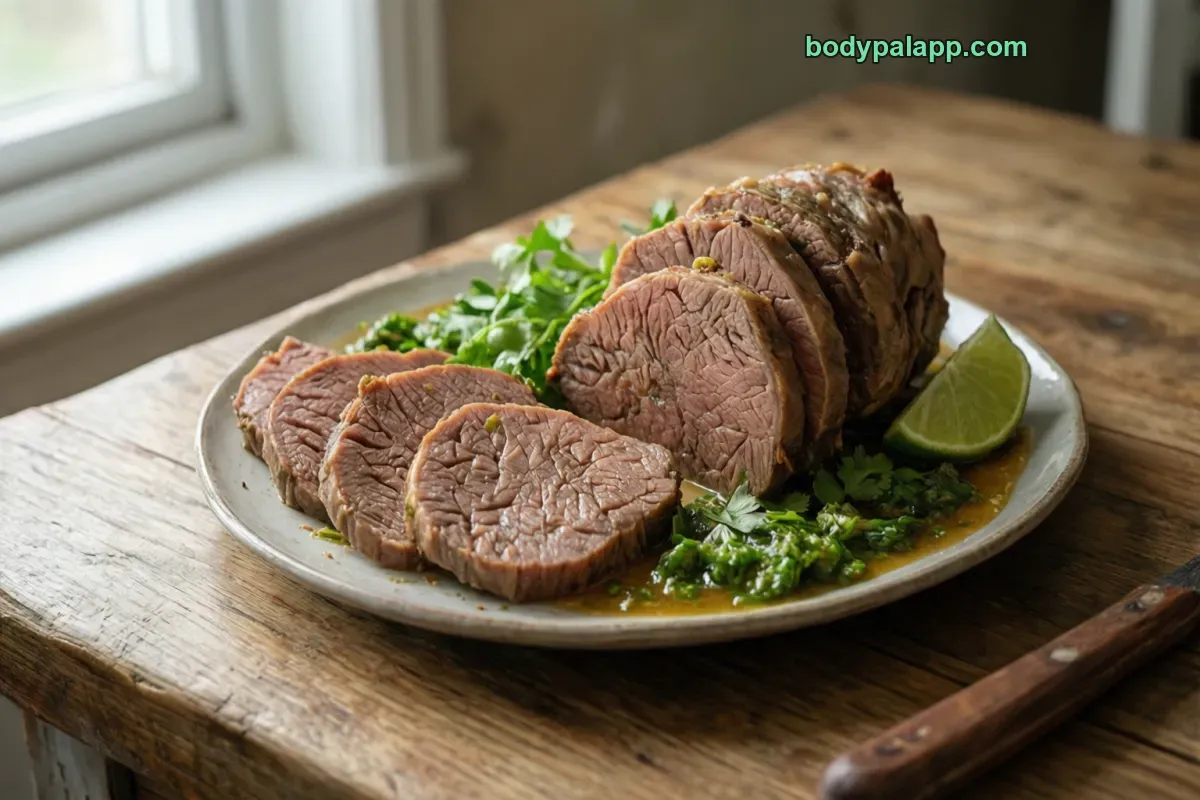
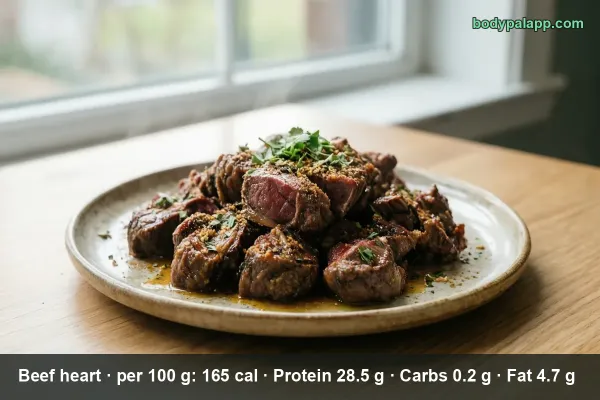
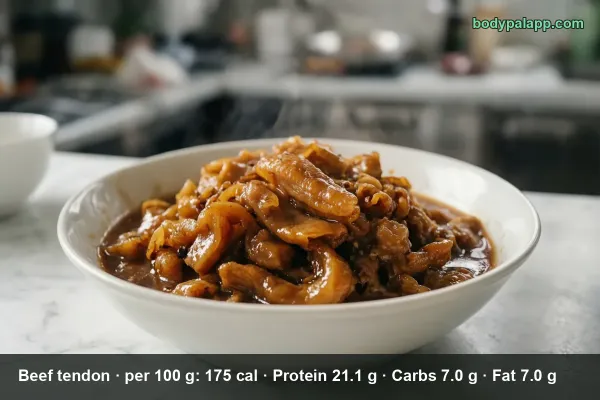
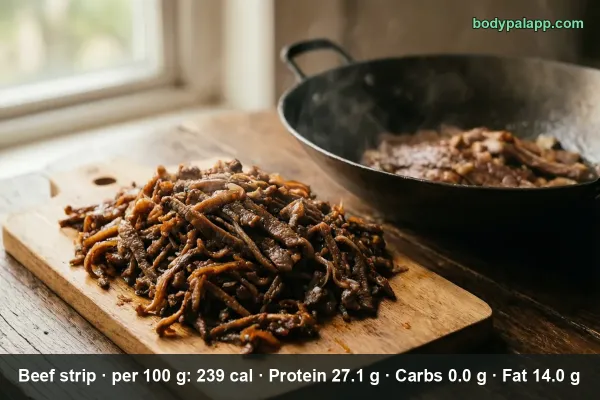
Here is how beef tongue stacks up against beef heart, beef tendon and beef strip, per 100 g and per usual serving.
Verdict: For weight loss, beef heart is the clear pick at 165 calories and 28.5 g protein per 100 g, against 284 for tongue. Beef tendon is also lighter at 175 calories but carries 1,175 mg sodium per 100 g, so tongue's 65 mg wins if salt is your concern.
Beef tongue FAQs
How many calories are in beef tongue?
A 3 oz portion of simmered beef tongue is 241 calories. Per 100 g it is 284 calories.
Is beef tongue good for weight loss?
It is one of the fattier beef cuts at 284 calories per 100 g, of which 22.3 g is fat. A 3 oz portion is 241 calories, against 140 for the same weight of beef heart.
Beef tongue vs beef heart: which has fewer calories?
Beef heart has 165 calories per 100 g and beef tongue 284, so a 3 oz portion is 140 calories against 241.
How much protein is in beef tongue?
Simmered beef tongue has 19.3 g of protein per 100 g, or 16.4 g in a 3 oz portion. That same portion also carries 19.0 g of fat.
Does beef tongue have a lot of fat?
Yes. Cooked tongue has 22.3 g fat per 100 g, and fat supplies 72% of its calories. A 3 oz portion carries 19 g fat, more than its 16.4 g of protein.
What are the macros for beef tongue?
Per 100 g of simmered beef tongue you get 284 calories, 19.3 g protein, 22.3 g fat and 0 g carbs. By calories that works out to 28% protein, 72% fat and 0% carbs.
Are cow tongue and ox tongue the same as beef tongue for calories?
Yes, they are names for the same cut, so the same figures apply: 284 calories per 100 g cooked, or 241 for a 3 oz portion. Raw, a 113 g piece is 253 calories.
What are the full nutrition facts for beef tongue per 100 g?
Per 100 g cooked: 284 calories, 19.3 g protein, 22.3 g fat including 8.1 g saturated, 0 g carbs, sugar and fiber, 65 mg sodium, 132 mg cholesterol and 184 mg potassium.
How many of beef tongue's calories come from protein?
About 28% of beef tongue's calories come from protein, with the other 72% from fat. That is 16.4 g protein in a 241-calorie 3 oz portion, a decent amount but not a lean ratio.