
How many calories are in beef heart?
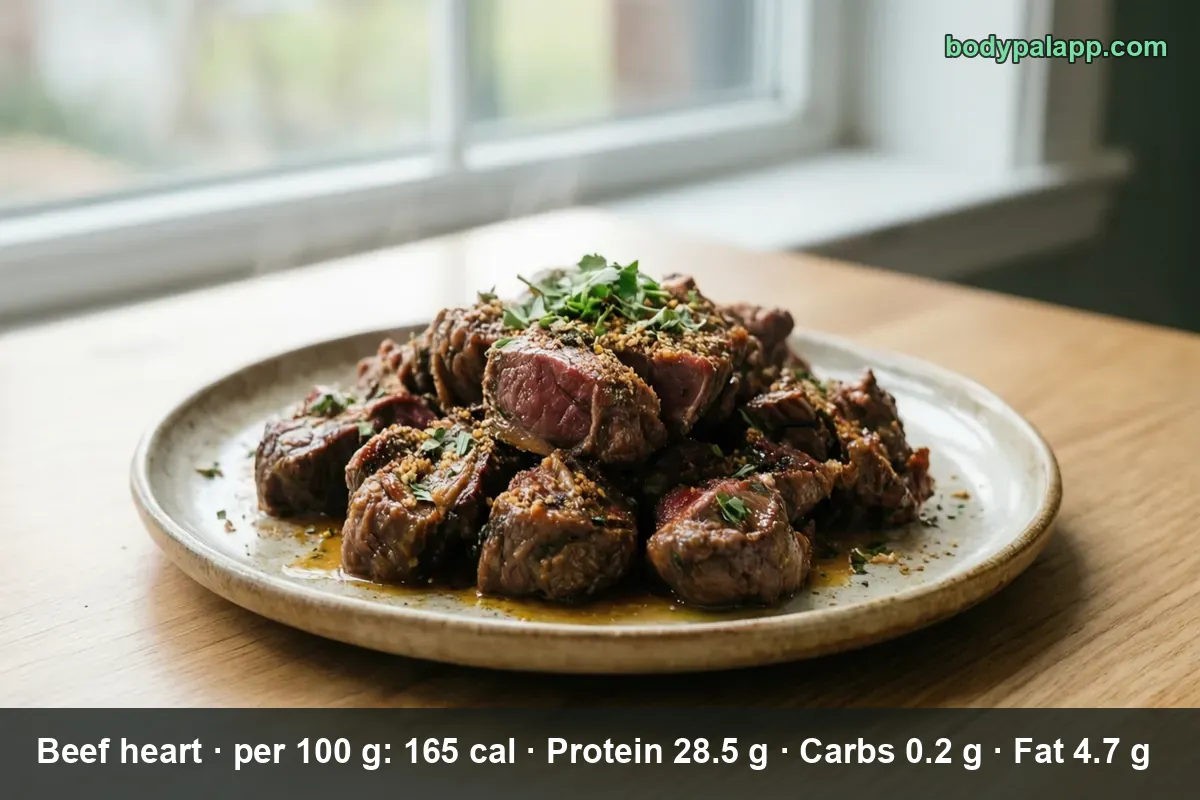
A 3 oz cooked portion of beef heart is 140 calories, and 100 g of it runs 165 calories. That is a modest number for a cut carrying 24.2 g of protein in the same three ounces. Weighed raw, before any water cooks out, the same meat sits at only 112 calories per 100 g.
On this page
- Beef heart quick facts
- US servings, from one ounce to a six-ounce plate
- Raw, boiled and store-label beef heart
- Cholesterol is the row to watch, not sodium
- How does beef heart compare?
- Most popular beef heart brands
- FAQ
Beef heart quick facts
The record behind every number on this page is USDA SR Legacy 169448, "Beef, variety meats and by-products, heart, cooked, simmered". That choice is deliberate. Anyone searching for this is usually looking at heart that has already been simmered, braised or seared, and 169448 is the domestic cooked record. The raw entry has its own line further down, because the two are not interchangeable.
USDA's serving for this record is 3 oz (85 g), which is close to what a normal portion of organ meat looks like next to a starch and a vegetable.
| Nutrient | Per 100 g | Per 3 oz (85 g) | % Daily Value |
|---|---|---|---|
| Calories | 165 | 140 | — |
| Total fat | 4.73 g | 4.0 g | 5% |
| Saturated fat | 1.4 g | 1.2 g | 6% |
| Carbohydrate | 0.15 g | 0.1 g | 0% |
| Dietary fiber | 0 g | 0 g | 0% |
| Total sugars | 0 g | 0 g | — |
| Protein | 28.48 g | 24.2 g | 48% |
| Sodium | 59 mg | 50 mg | 2% |
| Cholesterol | 212 mg | 180 mg | 60% |
| Potassium | 219 mg | 186 mg | 4% |
% Daily Value is based on a 2,000-calorie diet.
Verified nutrition data
Numbers on this page come from USDA FoodData Central, the U.S. Department of Agriculture’s food composition database, and from manufacturer labels where a branded product is named. Last verified September 2026. How we verify our data →
There is no added sugars row here, because the SR Legacy release does not carry that field, and plain heart has no added sugar anyway. Total sugars are zero, so the empty added-sugars line would have told you nothing. Fiber is zero as well, which is normal for muscle meat of any kind.
The line that stands out is protein against calories. Just under half a day's protein Daily Value arrives with 140 calories, and the fat that comes along is 4.0 g. Percentages here follow the FDA Daily Values used on the Nutrition Facts label.
US servings, from one ounce to a six-ounce plate
| Serving | Weight | Calories |
|---|---|---|
| 1 oz cooked | 28.4 g | 47 kcal |
| 3 oz cooked | 85 g | 140 kcal |
| 4 oz cooked | 113 g | 186 kcal |
| 6 oz cooked | 170 g | 281 kcal |
| Per 100 g cooked | 100 g | 165 kcal |
Only the 3 oz line is a USDA household measure. The 1 oz, 4 oz and 6 oz rows are our own arithmetic from the USDA 100 g figure, not USDA servings, so treat them as clean scaling rather than separate measurements.
Six ounces is where this stops being a light plate. At 281 calories it is still leaner than most steak portions of the same weight, but it also delivers well past a day's cholesterol allowance, which is the section below. Most people who cook heart cube it, so a heaping cup of cubes lands somewhere between the 4 oz and 6 oz rows depending on how tightly it packs, which is our own estimate rather than a USDA household measure.
Raw, boiled and store-label beef heart
| Version | Per 100 g | Typical serving | Calories |
|---|---|---|---|
| Cooked, simmered (main record) | 165 kcal | 3 oz (85 g) | 140 kcal |
| Raw | 112 kcal | 4 oz (113 g) | 127 kcal |
| Raw, small piece | 112 kcal | 1 oz (28.35 g) | 32 kcal |
| New Zealand imported, raw | 105 kcal | 4 oz (113 g) | 119 kcal |
| New Zealand imported, boiled | 179 kcal | 3 oz (85 g) | 152 kcal |
| Store label, raw (Tyson, Meijer) | 116 kcal | 4 oz (112 g) | 130 kcal |
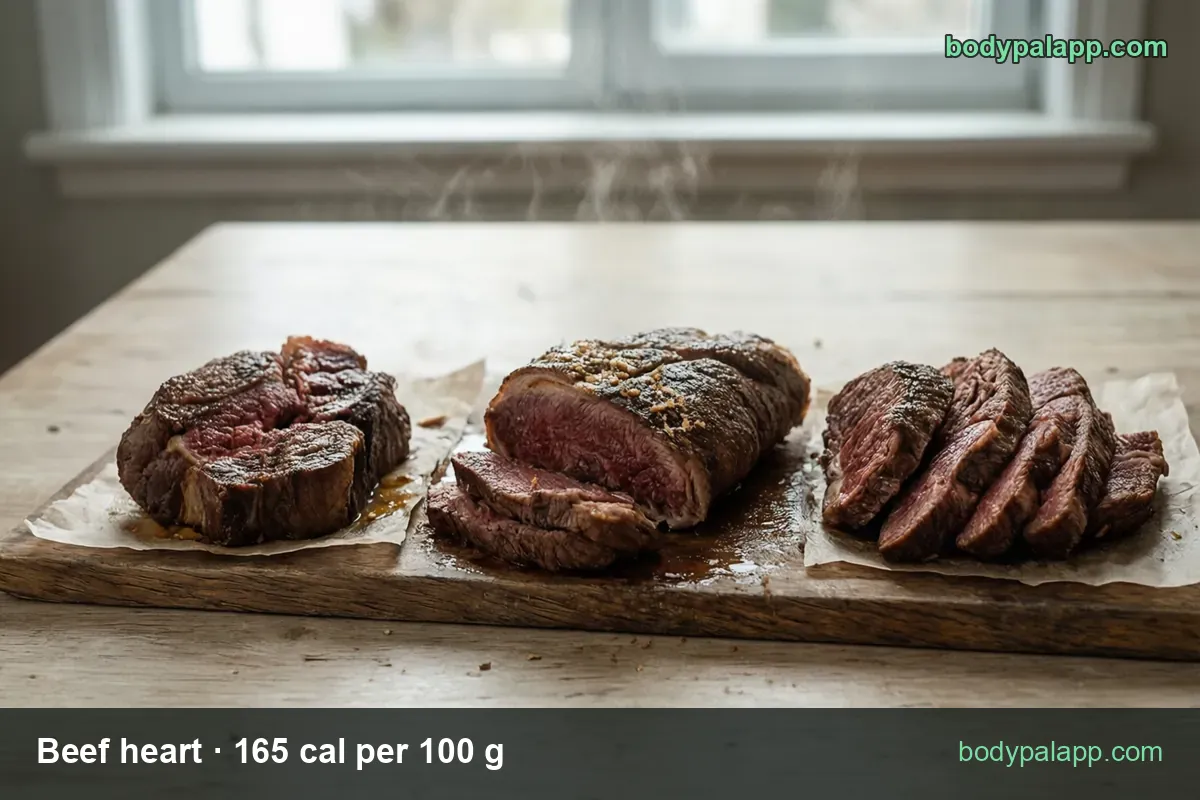
Cooking does not add anything to heart. It takes water out. That is the whole story of the 112 to 165 jump per 100 g: the protein figure climbs the same way, from 17.72 g raw to 28.48 g cooked, and the fat only moves from 3.94 g to 4.73 g. Nothing was poured in. The gram simply got denser.
The imported New Zealand records show the same effect at a wider spread. Raw, that grass-fed heart is the lightest entry on the page at 105 calories per 100 g with 3.4 g of fat. Boiled, it is the heaviest heart record here at 179, with 31.29 g of protein per 100 g. Boiling drove off more water than simmering did, so it is the only heart version here that outweighs the domestic cooked record per gram.
Store labels are a third trap. The packages from Tyson and Meijer both work out to 116 calories per 100 g, or 130 calories for their 4 oz (112 g) label serving, and both are describing raw meat. If you log the package number and then eat the cooked result, you are logging the wrong state of the food. One blended product, a paleo grind of beef with heart and liver, runs 232 calories per 100 g, but that is ground beef doing the work, not heart.
Cholesterol is the row to watch, not sodium
People come to organ meat expecting a sodium problem. There isn't one. A 3 oz cooked serving carries 50 mg of sodium, 2% of the Daily Value, which is roughly a fiftieth of a teaspoon of table salt's worth. Whatever salt ends up in the dish, you put it there.
Cholesterol is the honest constraint. The same 3 oz brings 180 mg, which is 60% of the 300 mg Daily Value, and 100 g brings 212 mg. Eat a 6 oz plate and you have crossed the Daily Value with one dish. That is not a reason to skip it, but it is the number that decides how often heart shows up in the week, and it is the one competitors almost never put next to the calorie count.
The upside sits in the same serving: 24.2 g of protein for 140 calories, or 48% of the protein Daily Value. MyPlate counts organ meats inside the protein foods group, and by calories per gram of protein, heart is one of the cheapest entries in it. If you are building a 350 to 450 calorie dinner around protein, this cut leaves a lot of room for the rest of the plate.
How does beef heart compare?
| Version | Per 100 g | US serving | Calories |
|---|---|---|---|
| Beef heart, cooked, simmered | 165 kcal | 3 oz (85 g) | 140 kcal |
| Beef heart, raw | 112 kcal | 4 oz (113 g) | 127 kcal |
| New Zealand beef heart, raw | 105 kcal | 4 oz (113 g) | 119 kcal |
| New Zealand beef heart, boiled | 179 kcal | 3 oz (85 g) | 152 kcal |
Our take: log the cooked domestic record at 165 per 100 g and stop worrying about which heart you bought. The four records here span 105 to 179 calories per 100 g, and almost all of that spread is water content rather than a real difference in the meat, so chasing the exact entry buys you very little. For weight loss, the raw 4 oz portion at 127 calories is the easiest way to plan a meal before you cook it. For appetite, cook it first and weigh 3 oz: 140 calories with 24.2 g of protein holds better than anything you can build out of the same calories in starch.
Most popular beef heart brands in the United States
Ranked by how widely each product appears among foods sold in the United States, from the BodyPal food database of over 3.3 million products. Calories are the figures printed on each Nutrition Facts label, checked against USDA FoodData Central.
| Product | Calories (per 100 g) |
|---|---|
| Tyson ibp Trusted Excellence Beef Hearts | 116 cal |
| Markets of Meijer Beef Heart | 116 cal |
| Carman Ranch Paleo Blend of Beef, Beef Heart & Beef Liver | 232 cal |
Brand popularity: BodyPal food database. Nutrition: manufacturer labels / USDA FoodData Central.
Beef heart FAQs
How many calories are in beef heart?
A 3 oz cooked serving is 140 calories, and 100 g is 165 calories. Raw beef heart is lighter at 112 calories per 100 g, because simmering drives off water and concentrates what is left behind. The cooked figure is the one to log if the meat is already on your plate.
How much protein is in 3 oz of cooked beef heart?
3 oz of cooked beef heart carries 24.2 g of protein, which is 48% of the 50 g Daily Value, for only 140 calories. Per 100 g the USDA record reads 28.48 g. That ratio of protein to calories is why people training hard keep heart in the rotation.
Is beef heart high in cholesterol?
Yes, a 3 oz cooked serving has 180 mg, which is 60% of the 300 mg Daily Value, and 100 g has 212 mg. Sodium, by contrast, is only 50 mg, or 2% of the Daily Value. If you are watching cholesterol, portion size is what does the work here.
Raw vs cooked beef heart - which calorie number should I log?
Log 165 calories per 100 g if the meat is cooked, and 112 if you weighed it raw. USDA keeps the two as separate records, measured separately, so they do not scale neatly into each other. Weigh after cooking when you can, because that is the food you actually eat.
How many calories are in 4 oz of beef heart?
4 oz of cooked beef heart is 186 calories, which is our own arithmetic from the USDA 100 g figure of 165 rather than a USDA serving. Raw, 4 oz (113 g) comes to 127 calories. Store labels print the raw number, so check which state your four ounces is in.
Is beef heart a red meat or an organ meat?
Both, in practice - heart is an organ, but it is cardiac muscle, so it eats like a lean red meat: 28.48 g of protein and 4.73 g of fat per 100 g, with 0.15 g of carbohydrate. MyPlate counts organ meats inside the protein foods group.
Is beef heart good for a low-carb or carnivore diet?
Carbohydrate is 0.15 g per 100 g and 0.1 g in a 3 oz serving, which rounds to 0% of the Daily Value, with no fiber and no sugar at all. At 140 calories and 24.2 g of protein per 3 oz, it fits a low-carb plate without any arithmetic.
How much does beef heart shrink when cooked?
Enough that a raw 4 oz piece (113 g, 127 calories) lands close to 3 oz on the plate. The USDA raw record is 112 calories per 100 g and the cooked one is 165, and that gap is water leaving rather than fat arriving. Weigh it cooked and the guessing stops.
Similar foods
- Chicken Breast (4 Oz) — 186 cal per 4 oz
- Chicken Breast — 284 cal per breast, bone and skin removed
- Pork Liver — 140 cal per 3 oz
- Tandoori Chicken — 248 cal for 3 pieces
- Turkey Meatball — 46 cal per meatball
- Corned Beef Hash — 361 cal per cup
Count it without the math
Point the camera at the plate and BodyPal counts the beef heart for you, cubes and sauce included.


How long does it take to burn off beef heart?
A 3 oz (85 g) cooked serving is 140 kcal. Enter your weight and the amount you ate to see how long it takes you to burn that off:
lb
| Activity | Time to burn 140 kcal |
|---|---|
| Walking, brisk | 28 min |
| Cycling, moderate | 18 min |
| Swimming, moderate | 20 min |
| Jogging | 16 min |
| Weight training, moderate | 31 min |
Times are for a 155 lb adult at a steady pace; change the weight to see yours. The amount is set to the portion in the text (85 g); change it to what you actually ate. BodyPal works this out from your steps automatically.
One food is easy to picture; a whole day is harder. See how many calories you need a day and what a deficit actually looks like.