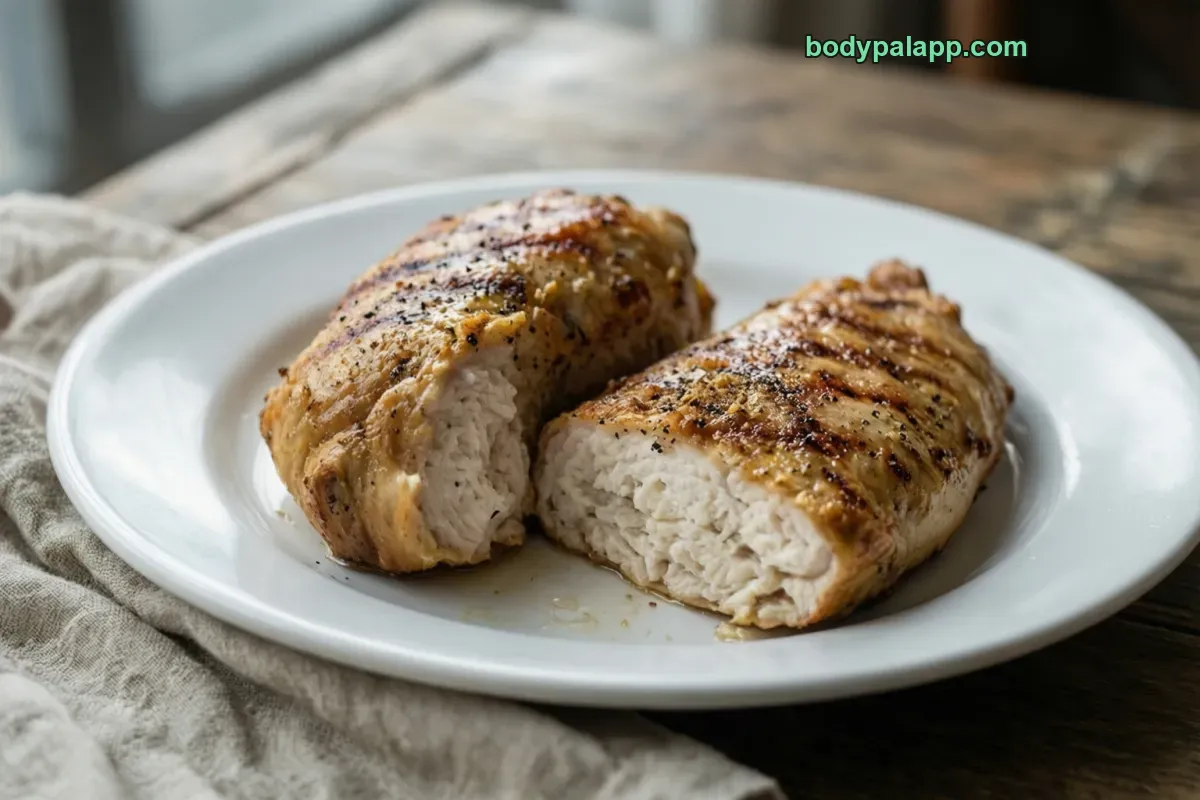
Chicken breast (4 oz) calories come to 186 for a roasted, skinless 4 oz portion (113 g), or 165 per 100 g. The number to notice is protein: 35.1 g in that portion, about 70% of the daily value, with 0 g of carbs and just 4 g of fat. Leaving the skin on lifts the count to 223.
186kcal
1 4 oz portion · 113 g, roasted, meat only
79%protein
35 gProtein
0 gCarbs
4 gFat
How to burn off 186 kcal
—Walking, brisk
—Jogging
—Cycling, moderate
—Swimming
Skip the math. BodyPal counts these calories from your steps and workouts automatically.
Nutrition facts
Roasted, meat only · per 113 g
Calories
186 kcal
Protein
35 g
Carbohydrate
0 g
Fat
4 g
Saturated fat
1.1 g
Cholesterol
96 mg
Sodium
84 mg
Potassium
289 mg
Iron
1.2 mg
Source: USDA FoodData Central
🛡️
Verified nutrition data
Numbers on this page come from USDA FoodData Central, the U.S. Department of Agriculture’s food composition database, and from manufacturer labels where a branded product is named. Last verified September 2026. How we verify our data →
Chicken breast: calories, protein and sodium by serving
Percent of daily value uses the FDA reference of 2,000 kcal a day.
Serving
kcal
Protein
Carbs
Fat
Sodium
% DV kcal
4 oz portion (113 g)
186
35.1 g
0 g
4 g
84 mg
9%
With skin (113 g)
223
33.7 g
0 g
8.8 g
80 mg
11%
Half breast (86 g)
142
26.7 g
0 g
3.1 g
64 mg
7%
100 g
165
31 g
0 g
3.6 g
74 mg
8%
3 × 4 oz portion (113 g)
559
105.2 g
251 mg
5 × 4 oz portion (113 g)
932
175.3 g
418 mg
Two 4 oz portions add up to 373 calories
The default serving is a 4 oz portion (113 g) of roasted breast meat with the skin removed. It lands at 186 calories, about 9% of the daily value, and delivers 35.1 g of protein. A half breast (86 g) is lighter at 142 calories and 26.7 g of protein, a sensible size for a lunch salad or a wrap.
Because the meat holds almost nothing but protein and a little fat, the total climbs in a straight line as the plate gets bigger. Two 4 oz portions (226 g) reach 373 calories. Three portions (339 g) reach 559. Five portions (565 g), the kind of tray you might roast for a week of lunches, reach 932 calories and 175.3 g of protein.
The real swing comes from how big your piece is, not from the chicken itself. Whole breasts vary a lot in size, so a single one can easily be two portions on this page. If you track, weigh your usual piece once after cooking. These figures are for cooked meat, and raw weight will read higher than the cooked number on your scale.
Protein supplies 79% of the calories
Per 100 g, roasted chicken breast carries 31 g of protein, 3.6 g of fat and 0 g of carbs. In calorie terms that splits into 79% protein and 21% fat. There is no sugar, no fiber and no starch, so every calorie comes from just two sources.
That split is the whole appeal. A 4 oz portion covers about 70% of the daily value for protein while using only 9% of the daily value for calories. Saturated fat stays small too, at 1 g per 100 g against a daily value of 20 g. Few everyday foods give you this much protein for so little fat without any processing.
The flip side is that chicken breast alone is not a complete meal. With 0 g of fiber and 0 g of carbs, it leaves the rest of the plate wide open, and what you put there decides whether the meal is light or heavy. Lean protein is the base; the sides set the final total.
Leaving the skin on turns 186 into 223
The USDA row behind this page is breast meat only, roasted. Keep the skin on the same 113 g and the count rises to 223 calories, about 11% of the daily value instead of 9%. That is the single biggest change you can make to plain chicken breast without adding breading, oil or sauce.
Nearly all of the extra calories come from fat. The skinless portion has 4 g of fat; with skin it has 8.8 g, more than double. Protein actually dips a little, from 35.1 g to 33.7 g, because skin is fattier than the muscle under it. Sodium barely moves, at 84 mg without skin and 80 mg with it.
If you love crisp skin, the cost for one portion is modest, but it repeats at every meal. A practical middle path is to roast the breast with the skin on, which helps keep the meat moist, and peel it off before eating. The meat-only numbers on this page then apply to what you actually eat.
Low sodium leaves room for the rest of the plate
Plain roasted breast has 84 mg of sodium per 4 oz portion, just 4% of the daily value. Anything you add, such as a brine, a spice rub or a bottled sauce, will set the final sodium number. If you watch sodium, check those labels rather than worrying about the chicken.
Cholesterol is the one row worth a glance if you track it: 85 mg per 100 g, against a daily value of 300 mg. Potassium comes in at 256 mg per 100 g, a small contribution rather than a major source.
Since the breast brings protein and very little else, pair it with what it lacks. Vegetables or beans add fiber, rice, potatoes or bread add carbs, and a little olive oil, avocado or cheese adds fat if you want more staying power. BodyPal can log the whole plate from a photo, which helps when the sides end up carrying more calories than the chicken.
How does chicken breast compare?
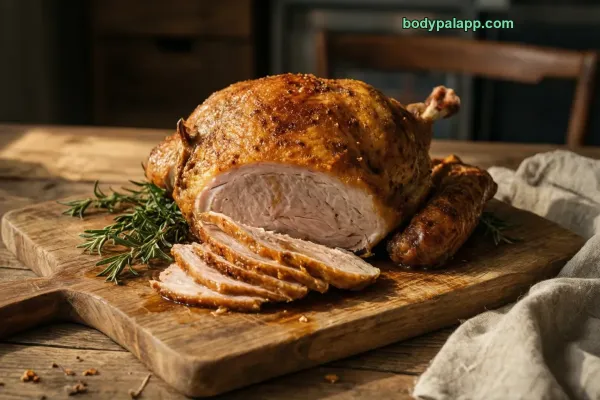
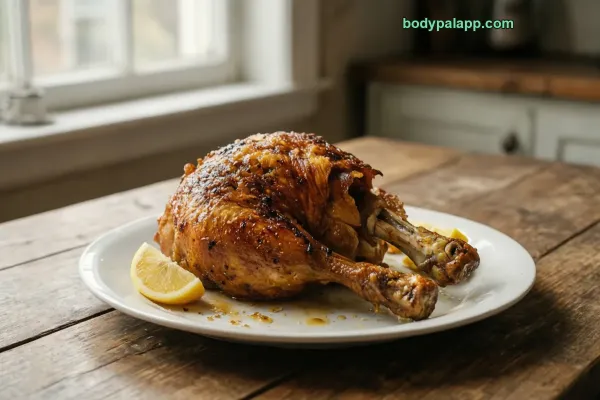
Here is how roasted chicken breast stacks up against turkey breast, chicken tenders and chicken leg, per 100 g and per usual serving.
Verdict: For the leanest plate, turkey breast edges ahead at 147 calories per 100 g versus 165, but chicken breast gives more protein at 31 g against 30.1 g. Skip the tenders if you are cutting: at 271 calories and 769 mg of sodium per 100 g, they carry about 1.6 times the calories of plain breast.
Chicken breast FAQs
How many calories are in 4 oz of chicken breast?
A 4 oz (113 g) portion of roasted, skinless chicken breast has 186 calories. With the skin on, the same 113 g comes to 223 calories.
How much protein is in 4 oz of chicken breast?
About 35 g of protein, with 4 g of fat and no carbs. Per 100 g that is 31 g of protein.
Is 4 oz of chicken breast good for weight loss?
A 4 oz portion is 186 calories with 35 g of protein and 4 g of fat. Leaving the skin on adds 37 calories to the same weight.
Does the cooking method change the calories in chicken breast?
For the same 4 oz of skinless meat, roasted is 186 calories, stewed 171 and fried 211.
How many calories are in 100 g of chicken breast?
Roasted chicken breast meat has 165 calories per 100 g, with 31 g of protein, 3.6 g of fat and 0 g of carbs. Protein supplies 79% of those calories and fat the remaining 21%.
What are the nutrition facts for 4 oz of chicken breast?
A 4 oz portion (113 g) of roasted, skinless breast has 186 calories, 35.1 g of protein, 4 g of fat, 0 g of carbs, 0 g of sugar and 84 mg of sodium. That covers about 70% of the daily value for protein.
Are the 4 oz chicken breast calories for cooked or raw meat?
They are for cooked meat: 186 calories for 4 oz (113 g) of roasted breast without skin. Raw chicken weighs more than the cooked piece it becomes, so weigh after cooking to match these numbers.
Is 4 oz of chicken the same as 4 oz of chicken breast?
Not quite. Roasted breast meat is 165 calories per 100 g, while chicken leg with skin is 184 per 100 g. Skin matters too: 4 oz of breast with skin is 223 calories instead of 186.
How many calories are in half a chicken breast?
A half breast (86 g) of roasted meat has 142 calories, 26.7 g of protein and 3.1 g of fat. That is about 7% of the daily value for calories and 53% for protein.