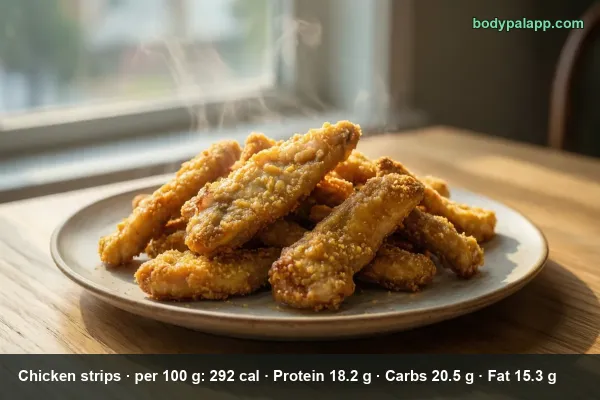
Chicken tenders calories come to 136 for one 50 g tender and 271 per 100 g, based on the USDA row for breaded and fried tenders or strips. The thing to notice is how quickly a plate adds up: tenders are rarely eaten one at a time, and sodium climbs right alongside the calories.
136kcal
1 tender · 50 g, breaded and fried
28%protein
9.6 gProtein
9 gCarbs
7 gFat
How to burn off 136 kcal
—Walking, brisk
—Jogging
—Cycling, moderate
—Swimming
Skip the math. BodyPal counts these calories from your steps and workouts automatically.
Nutrition facts
Breaded and fried · per 50 g
Calories
136 kcal
Protein
9.6 g
Carbohydrate
8.6 g
Fat
7 g
Saturated fat
1.2 g
Cholesterol
24 mg
Sodium
385 mg
Potassium
187 mg
Iron
0.4 mg
Source: USDA FoodData Central
🛡️
Verified nutrition data
Numbers on this page come from USDA FoodData Central, the U.S. Department of Agriculture’s food composition database, and from manufacturer labels where a branded product is named. Last verified September 2026. How we verify our data →
Chicken tender: calories, protein and sodium by serving
Percent of daily value uses the FDA reference of 2,000 kcal a day.
Serving
kcal
Protein
Carbs
Fat
Sodium
% DV kcal
1 tender (50 g)
136
9.6 g
8.6 g
7 g
385 mg
7%
Frozen strip (40 g)
96
5.8 g
5.9 g
5.4 g
211 mg
5%
1 cup (140 g)
379
26.9 g
24.2 g
19.5 g
1,077 mg
19%
100 g
271
19.2 g
17.3 g
14 g
769 mg
14%
3 × 1 tender (50 g)
407
28.8 g
1,154 mg
5 × 1 tender (50 g)
678
48.1 g
1,923 mg
Three tenders make a 407-calorie plate
One 50 g tender carries 136 calories, about 7% of a 2000-calorie daily value. That sounds modest until you count the basket. Two tenders weigh 100 g and land at 271 calories. Three come to 407, and five, a common restaurant or party portion, reach 678 calories at 250 g.
Size matters as much as count. A frozen strip from the supermarket weighs about 40 g in the USDA data and lists 96 calories, so a bag of thinner strips can look like more food for fewer calories per piece. A loose cup of tenders, around 140 g, comes to 379 calories, or 19% of the daily value. If the pieces on your plate look larger than a typical 50 g tender, count each one as more than one.
The simplest control is deciding the number before you start eating. Plating three tenders and putting the rest away keeps the meal near 407 calories. Eating straight from the box or a shared platter usually does not, because nobody keeps count past the second piece.
Fat is the smallest macro by weight but supplies nearly half the calories
Per 100 g, chicken tenders carry 19.2 g of protein, 17.3 g of carbs and 14 g of fat. Fat is the smallest of the three by weight, yet it supplies 46% of the calories, against 28% from protein and 25% from carbs. The chicken inside is lean; the breading and the frying oil reshape the profile.
Plain chicken breast makes the point. It lists 31 g of protein and 3.6 g of fat per 100 g, so coating and frying add calories while diluting the protein. Saturated fat stays moderate at 2.5 g per 100 g, and cholesterol sits at 48 mg.
Protein is still a real asset here. One tender gives 9.6 g, about 19% of the daily value, and three tenders deliver 28.8 g. The carbs are almost all breading: fiber is just 1.2 g and sugars only 0.4 g per 100 g, so the coating adds energy without much else.
Sodium is the row to watch
At 769 mg per 100 g, sodium is the number that stands out on this label. A single tender brings 385 mg, which is 17% of the daily value, before any sauce touches it. Two tenders reach 769 mg, or 33%.
Portions push it up fast. Three tenders come to 1,154 mg and five reach 1,923 mg, which uses most of a day's sodium allowance in one sitting. A cup of tenders lists 1,077 mg, 47% of the daily value. Frozen strips run lower per piece at 211 mg, mostly because each piece is smaller, not because the recipe is lighter.
If you watch sodium, the extras are the lever you control. Seasoned breading is already salted, so adding salt or a salty dipping sauce stacks on top of numbers that are high to begin with. Counting pieces does double duty here: fewer tenders means fewer calories and less sodium at the same time.
Tenders work best as the protein, not the whole meal
Tenders fit a day of eating most easily as the protein part of a plate. Two tenders at 271 calories or three at 407 leave room for vegetables, a salad or fruit, which add volume and the fiber the tenders lack at 0.6 g per piece.
Fries are the default partner, and they turn the meal into fried food on fried food. A side salad, roasted vegetables, corn or a baked potato changes the balance without much effort. Creamy dips stack more calories on top; a thin coat of mustard or hot sauce adds flavor more lightly.
Packaged options such as Perdue Breaded Chicken Tenders or Golden Platter Chicken Tenders vary in size and coating, so the weight on the package is your best guide to how many pieces make a serving. If you track your meals, BodyPal can log tenders from a photo, which helps when the pieces are bigger than the 50 g reference.
How does chicken tender compare?
Here is how chicken tenders stack up against chicken strips, chicken nuggets and plain chicken breast, per 100 g and per usual serving.
Verdict: For weight loss, plain chicken breast wins clearly at 165 calories and 31 g of protein per 100 g, against 271 calories for tenders. Among the breaded options, tenders beat strips at 292 and nuggets at 307, and they carry more protein than either at 19.2 g per 100 g.
Most popular chicken tender brands in the United States
Packages are labeled before frying, and plain boneless tenderloins carry no breading at all, so they read lower than the fried numbers above. Source: manufacturer labels / USDA FoodData Central.
Chicken tender FAQs
How many calories are in one chicken tender?
A breaded, fried chicken tender of 50 g is about 136 calories. Three tenders come to about 407 calories.
Are chicken tenders good for weight loss?
Three tenders (150 g) are 407 calories and 20.9 g of fat, much of that from the breading and the frying oil. Plain boneless tenderloins run 98 calories per 100 g before any coating.
Chicken tenders vs chicken nuggets: which has fewer calories?
Tenders are 271 calories per 100 g and nuggets 307. Tenders also hold more protein, 19.2 g per 100 g against 15.9 g.
How much protein is in chicken tenders?
One 50 g tender has 9.6 g of protein, and 100 g of tenders has 19.2 g. The same 100 g also carries 17.3 g of carbs from the breading.
How many calories are in two chicken tenders?
Two chicken tenders have 271 calories, since two 50 g tenders weigh 100 g together. That pair also brings 19.2 g of protein and 769 mg of sodium, about 33% of the daily value.
How many grams of protein are in 3 chicken tenders?
Three 50 g chicken tenders provide 28.8 g of protein along with 407 calories. That is a solid protein serving, though the same plate also carries 1,154 mg of sodium.
How many calories are in 100 g of fried chicken tenders?
Breaded, fried chicken tenders have 271 calories per 100 g, with 19.2 g of protein, 17.3 g of carbs and 14 g of fat. That 100 g is roughly two standard tenders.
Are chicken tenders fattening?
Fat supplies 46% of the calories in chicken tenders, at 14 g of fat per 100 g, largely from the breading and frying. Whether they fit your calorie goal depends on the count: three tenders are 407 calories, five are 678.