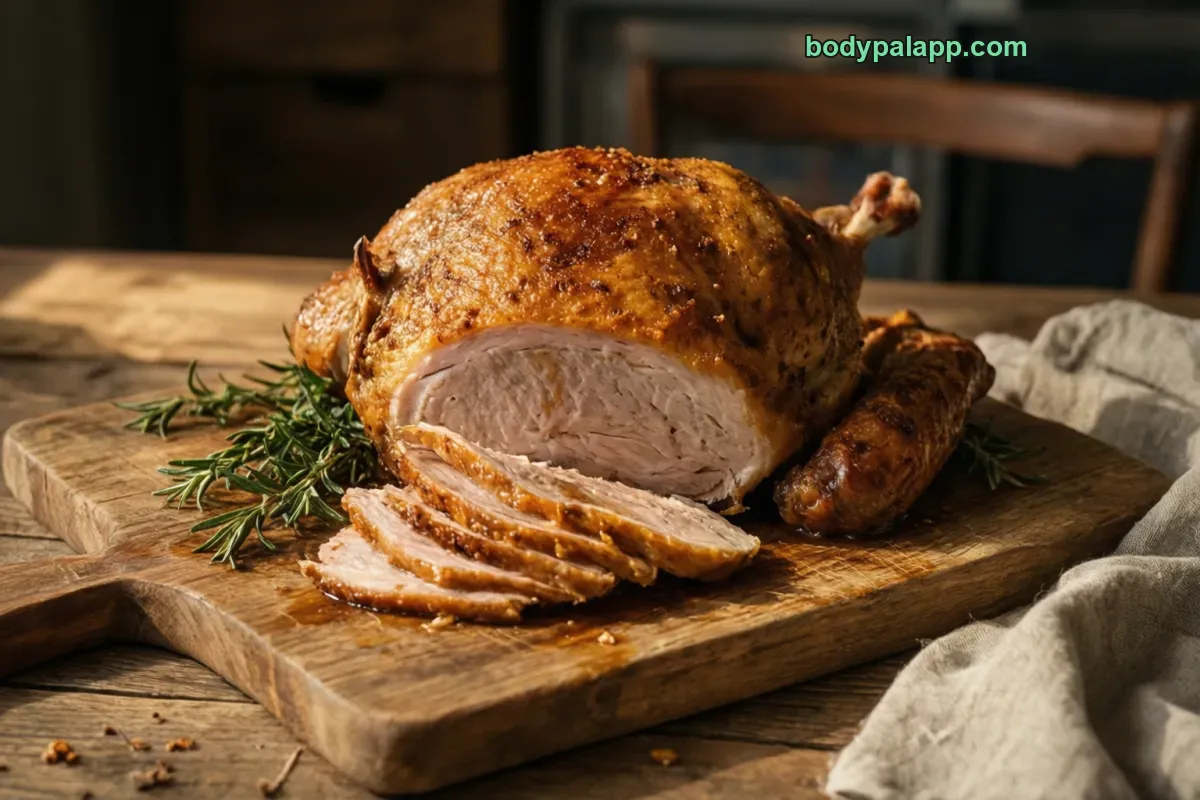
Turkey breast calories come to 125 for a 3 oz portion (85 g) of roasted meat without skin, and 147 per 100 g. Protein is the headline: 87% of those calories come from it, and that one portion covers 51% of the daily value for protein with just 1.8 g of fat.
125kcal
1 3 oz portion · 85 g, roasted, meat only
87%protein
26 gProtein
0 gCarbs
1.8 gFat
How to burn off 125 kcal
—Walking, brisk
—Jogging
—Cycling, moderate
—Swimming
Skip the math. BodyPal counts these calories from your steps and workouts automatically.
Nutrition facts
Roasted, meat only · per 85 g
Calories
125 kcal
Protein
26 g
Carbohydrate
0 g
Fat
1.8 g
Saturated fat
0.5 g
Cholesterol
68 mg
Sodium
84 mg
Potassium
212 mg
Iron
0.6 mg
Source: USDA FoodData Central
🛡️
Verified nutrition data
Numbers on this page come from USDA FoodData Central, the U.S. Department of Agriculture’s food composition database, and from manufacturer labels where a branded product is named. Last verified September 2026. How we verify our data →
Turkey breast: calories, protein and sodium by serving
Percent of daily value uses the FDA reference of 2,000 kcal a day.
Serving
kcal
Protein
Carbs
Fat
Sodium
% DV kcal
3 oz portion (85 g)
125
25.6 g
0 g
1.8 g
84 mg
6%
With skin (85 g)
161
24.4 g
0 g
6.3 g
54 mg
8%
Deli slices (57 g)
62
12.4 g
2 g
0.5 g
440 mg
3%
100 g
147
30.1 g
0 g
2.1 g
99 mg
7%
3 × 3 oz portion (85 g)
375
76.8 g
252 mg
5 × 3 oz portion (85 g)
625
128.1 g
421 mg
A 3 oz portion is a 125-calorie serving that scales cleanly
The standard 3 oz portion weighs 85 g and lands at 125 calories, about 6% of a 2,000-calorie reference day. It is roughly the size of a deck of cards, which is smaller than most people carve for themselves at dinner. If you plate by eye, weigh the meat a couple of times to calibrate.
Because turkey breast has almost no fat to throw the math off, the total climbs in a straight line. A double portion of 170 g is 250 calories with 51.2 g of protein. Three portions, 255 g, reach 375 calories and 76.8 g of protein. A generous holiday plate of five portions, 425 g, comes to 625 calories and 128.1 g of protein.
Sliced turkey works differently. A 57 g serving of deli slices is only 62 calories, so a sandwich stacked with two servings stays modest on energy. The trade-off shows up in the sodium column, not the calorie column, which is covered below.
Nearly every calorie is protein
Per 100 g, roasted turkey breast carries 30.1 g of protein, 2.1 g of fat and 0 g of carbohydrate. That puts 87% of its calories in protein and the remaining 13% in fat. There is no sugar and no fiber, so the number on the label is driven almost entirely by muscle protein.
Saturated fat is low at 0.6 g per 100 g. Cholesterol sits at 80 mg per 100 g, a figure worth knowing if you track that row, while potassium adds 249 mg. Sodium in the plain roasted meat is only 99 mg per 100 g, or 4% of the daily value.
This profile is why turkey breast keeps showing up in high-protein eating plans. You get 25.6 g of protein in a 3 oz portion for 125 calories, a ratio few whole foods match. The flip side: with zero carbs and little fat, a plate of turkey alone will not feel like a full meal for long.
Skin adds fat, deli slicing adds sodium
Leave the skin on and the same 85 g portion rises from 125 to 161 calories. Protein barely moves, 24.4 g versus 25.6 g, but fat jumps from 1.8 g to 6.3 g. If you want the lean version, peel the skin after roasting; the meat underneath still benefits from the moisture it held in.
Deli turkey is the bigger shift. A 57 g serving of slices carries 440 mg of sodium, 19% of the daily value, compared with 84 mg and 4% for a full 3 oz portion of roasted breast. The slices also pick up 2 g of carbohydrate and 2 g of sugar from processing.
Packaged lines such as Oscar Mayer Oven Roasted Turkey Breast or Oscar Mayer Carving Board Oven Roasted Turkey Breast vary by recipe, so check the label on the pack you buy. If you watch sodium, roasting a breast at home and slicing it yourself is the simplest fix.
Pair it with carbs and fat to make a real meal
Turkey breast does one job very well: it delivers protein at a low calorie cost. A balanced plate needs what it lacks. Add a starch such as potatoes, rice or whole-grain bread, a pile of vegetables for fiber, and a little fat from olive oil, avocado or cheese.
Gravy and stuffing are where holiday plates usually gain their calories, not the meat itself. Keep the turkey portion honest and measure the sides, and the total stays predictable.
For quick lunches, roasted breast sliced at home works in wraps, salads and grain bowls. If you log meals, BodyPal can recognize turkey breast from a photo and add it to your diary, which makes portion tracking easier on busy days.
How does turkey breast compare?
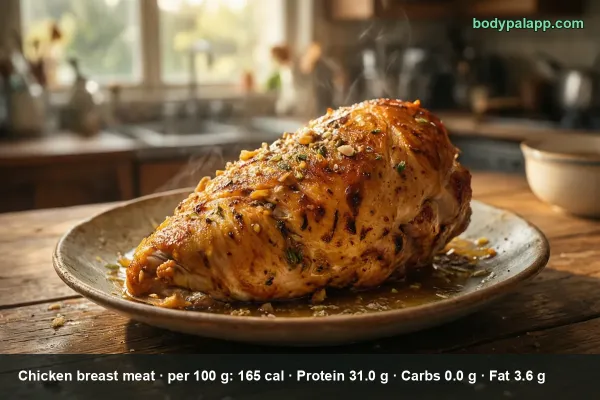
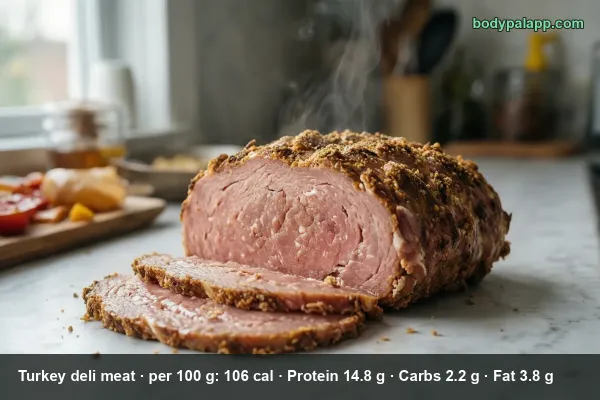
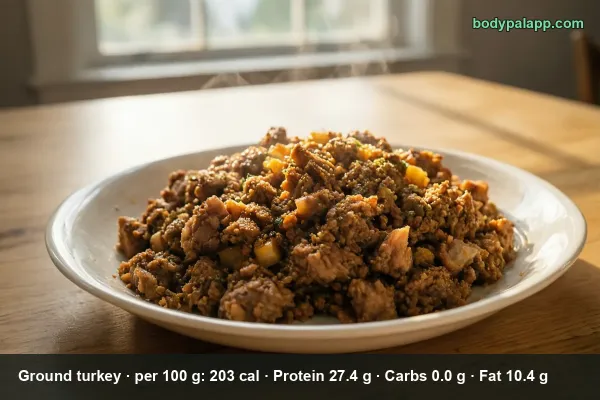
Here is how roasted turkey breast stacks up against chicken breast meat, turkey deli meat and ground turkey, per 100 g and per usual serving.
Verdict: For the most protein per calorie, pick turkey breast at 147 calories per 100 g over chicken breast meat at 165, and skip ground turkey at 203 with its 10.4 g of fat if you are cutting. Turkey deli meat looks lightest at 106, but its 810 mg of sodium per 100 g makes it the one to limit if you watch salt.
Most popular turkey breast brands in the United States
6Oscar Mayer Oven Roasted Turkey Breast Browned With Caramel Color2 oz · 56 g89 kcal
Deli packs are sliced from breast cured with added water, so their per 100 g numbers read below plain roasted breast. Source: manufacturer labels / USDA FoodData Central.
Turkey breast FAQs
How many calories are in turkey breast?
A 3 oz portion of roasted turkey breast is 125 calories, and 4 oz is 166. Per 100 g it works out to 147 calories.
Is turkey breast good for weight loss?
A 3 oz portion carries 125 calories, 25.6 g of protein and 1.8 g of fat, with zero carbs. Leaving the skin on raises the same portion to 161 calories.
Turkey breast vs chicken breast: which has fewer calories?
Roasted turkey breast has 147 calories per 100 g against 165 for chicken breast, a difference of 18 calories.
How much protein is in turkey breast?
100 g of roasted turkey breast has 30.1 g of protein, so a 3 oz portion gives 25.6 g and a 4 oz portion 34 g.
What is the full nutrition for 3 oz of turkey breast?
A 3 oz portion (85 g) of roasted turkey breast has 125 calories, 25.6 g of protein, 0 g of carbs, 1.8 g of fat and 84 mg of sodium. That is 51% of the daily value for protein.
How much fat is in turkey breast?
Roasted turkey breast without skin has 2.1 g of fat per 100 g, of which 0.6 g is saturated. A 3 oz portion carries 1.8 g, rising to 6.3 g if you eat the skin.
What are the macros of turkey breast?
Per 100 g, turkey breast has 30.1 g of protein, 0 g of carbs and 2.1 g of fat. That means 87% of its calories come from protein and 13% from fat.
How many calories are in 100 grams of turkey breast?
100 g of roasted turkey breast meat has 147 calories and 30.1 g of protein, which is 60% of the daily value for protein and 7% of daily calories.
How many calories are in sliced deli turkey breast?
A 57 g serving of deli turkey breast slices has 62 calories and 12.4 g of protein. It also carries 440 mg of sodium, 19% of the daily value.
Does roast turkey breast with skin have more calories?
Yes. An 85 g portion with skin has 161 calories versus 125 without it, mostly because fat rises from 1.8 g to 6.3 g.