
How Many Calories in Turkey Deli Meat?
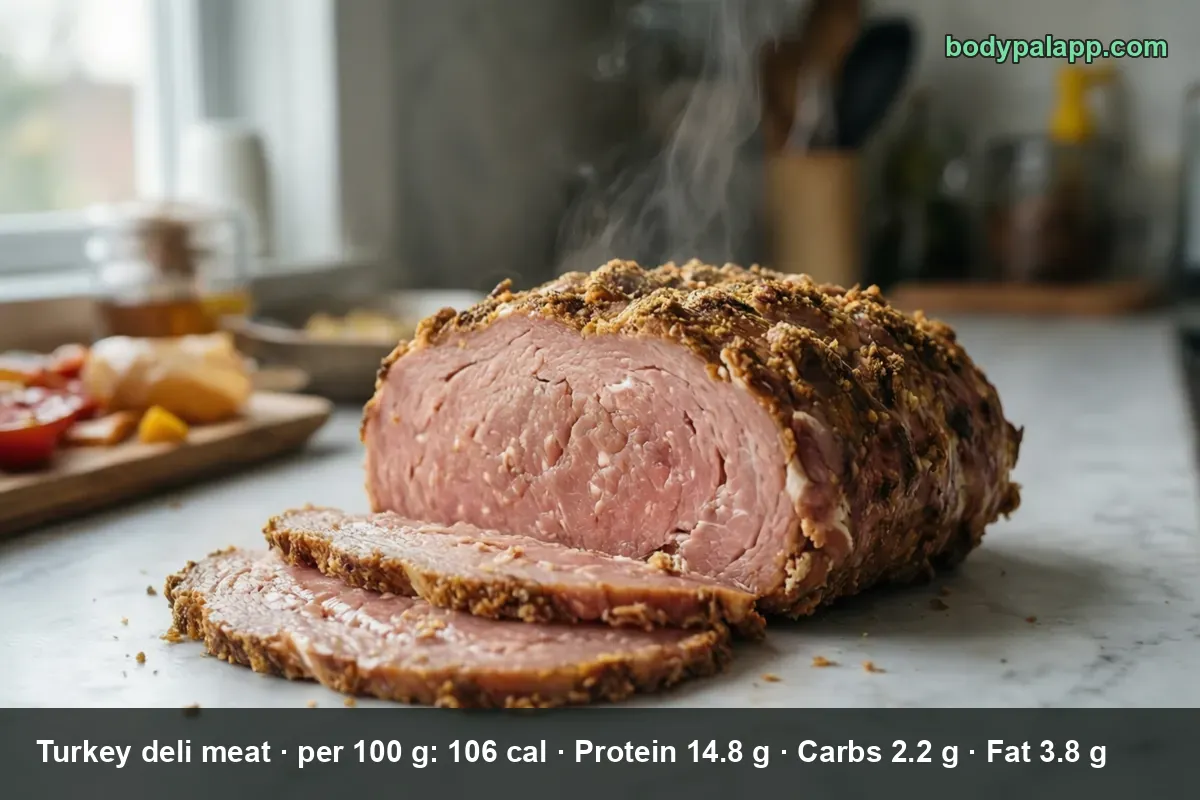
Two slices of turkey deli meat, 56 g and the guideline amount on a regular sandwich, come to 59 calories, or 106 calories per 100 g. A single slice is 30 calories. The number worth reading twice sits on the other side of the label: those same two slices carry 454 mg of sodium.
On this page
- Turkey deli meat quick facts
- Sodium is the ceiling, not the calories
- US portions, slice by slice
- The cup is the number that ruins a salad
- Reduced sodium, turkey ham and low-salt breast
- The cut moves the protein, not the calories
- Deli turkey is not a zero-carb food
- How does turkey deli meat compare?
- FAQ
Turkey deli meat quick facts
The reference here is the packet most people are actually holding: prepackaged or deli-counter sliced turkey, sold ready to eat, no low-sodium claim on the front. That is USDA entry 2706215, and the serving is two slices, 56 g, which is what USDA treats as the amount that goes on a regular sandwich.
| Nutrient | Per 100 g | Per 2 slices (56 g) | % Daily Value |
|---|---|---|---|
| Calories | 106 kcal | 59 kcal | — |
| Total fat | 3.77 g | 2.1 g | 3% |
| Saturated fat | 0.91 g | 0.5 g | 3% |
| Carbohydrate | 2.2 g | 1.2 g | 0% |
| Dietary fiber | 0 g | 0 g | 0% |
| Total sugars | 0.91 g | 0.5 g | — |
| Protein | 14.81 g | 8.3 g | 17% |
| Sodium | 810 mg | 454 mg | 20% |
% Daily Value is based on a 2,000-calorie diet.
Verified nutrition data
Numbers on this page come from USDA FoodData Central, the U.S. Department of Agriculture’s food composition database, and from manufacturer labels where a branded product is named. Last verified September 2026. How we verify our data →
There is no added sugars row and no trans fat row on this page, and that is deliberate. The USDA survey release that carries the deli meat entries publishes neither value for this record, so there is nothing to quote and the rows have been left out rather than filled with an estimate.
Two figures sit outside the label block. Cholesterol is 49 mg per 100 g, which puts two slices at 27 mg. Potassium is 371 mg per 100 g, a useful amount for a food this light.
Sodium is the ceiling, not the calories
Line the two columns up and the whole food changes character.
Two slices are 59 calories, about 3% of a 2,000-calorie day. The same two slices are 20% of the sodium Daily Value. Deli turkey costs you roughly seven times more of your day's sodium than of your day's calories, and it does it in the quietest possible way, because nothing about two thin slices of white meat looks like a salty food.
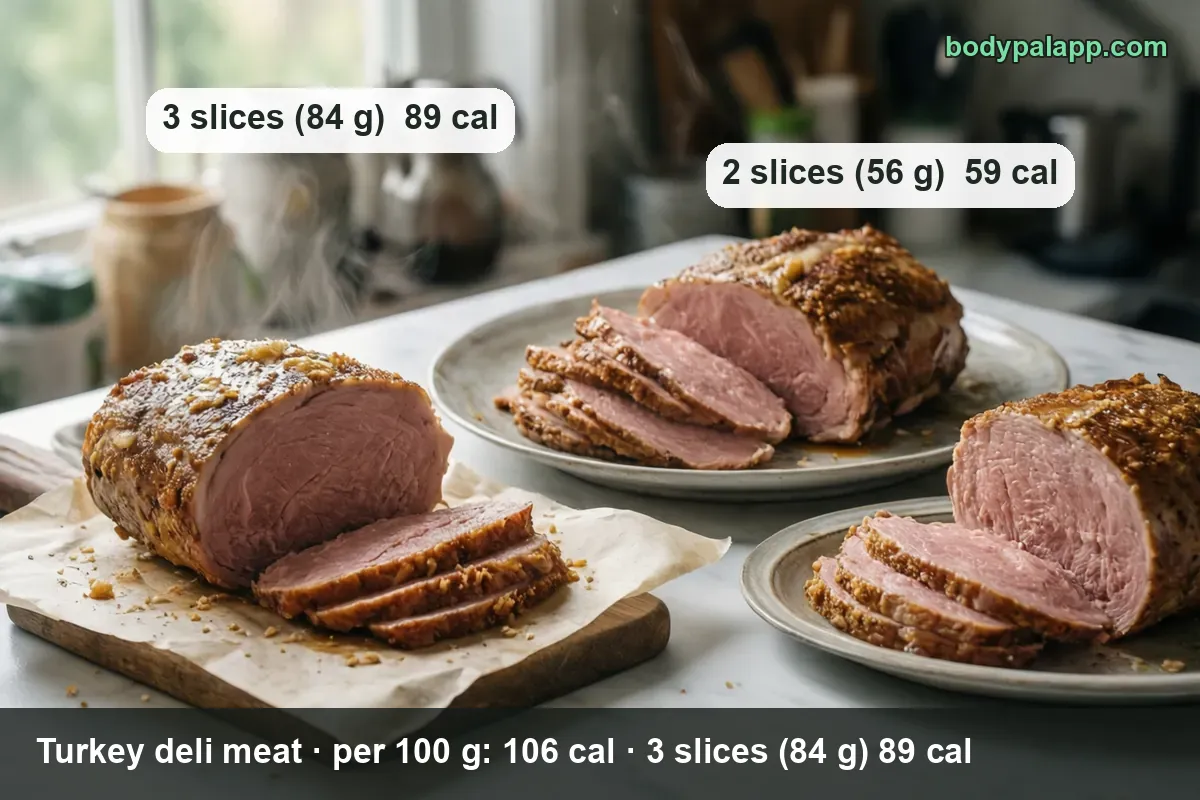
The FDA sets the sodium Daily Value at 2,300 mg for adults, the same ceiling the Dietary Guidelines for Americans work from. A three-slice sandwich, 84 g, is 89 calories and 680 mg of sodium — 30% of that ceiling before the bread, the cheese or the mustard have said anything.
This is the pattern CDC describes for sodium in packaged food: most of it arrives from processing rather than the shaker. Turkey breast is not a salty animal. The brine, the curing solution and the phosphate blend that keep sliced meat pink and moist for two weeks in a refrigerator are what put 810 mg into every 100 g.
So the useful way to log deli turkey is upside down. The calories take care of themselves. Count the slices for the sodium.
US portions, slice by slice
| Portion | Weight | Calories | Sodium |
|---|---|---|---|
| 1 slice | 28 g | 30 cal | 227 mg |
| 1 oz | 28.35 g | 30 cal | 230 mg |
| 2 slices, regular sandwich | 56 g | 59 cal | 454 mg |
| 3 slices, large sandwich | 84 g | 89 cal | 680 mg |
| 1 cup, pieces | 140 g | 148 cal | 1134 mg |
| 100 g | 100 g | 106 cal | 810 mg |
Every gram weight above comes from the USDA portion table for the same record, so the slice is a real average slice rather than a rounded guess. It also lands almost exactly on an ounce, which makes the arithmetic easy: one slice, one ounce, 30 calories, near enough.
Raw versus cooked, the trap on most meat pages, does not exist here. Deli turkey is sold fully cooked, so the weight on the scale is the weight on the sandwich. That is the one thing this food makes genuinely simple.
Protein tracks the slices at a steady rate too: 4.1 g in one slice, 8.3 g in two, 12.4 g in three. A three-slice sandwich filling delivers a quarter of the protein Daily Value for 89 calories, which is why deli turkey earns its place in the protein foods group MyPlate builds a plate around.
The cup is the number that ruins a salad
USDA lists one more portion, and it is the one nobody weighs: 1 cup of pieces, 140 g.
Torn into a chef's salad or a wrap bowl, a cup of sliced turkey is 148 calories. Still modest. Still, by any calorie logic, a smart lunch. Then read the other column: 1,134 mg of sodium, 49% of the Daily Value, from a single cup of cold meat that takes ten seconds to add and does not feel like a portion at all.
That is the difference between counting food and counting calories. Two slices on bread feel like a decision, so people make it consciously. A cup of pieces feels like a garnish. It carries two and a half times the sodium of the sandwich.
If you build salads this way often, the fix is not smaller portions of turkey. It is knowing that the cup is where the day's sodium budget goes, and spending the rest of the day accordingly.
Reduced sodium, turkey ham and low-salt breast
| Version | Per 100 g | 2 slices (56 g) | Sodium per 100 g | Sodium, 2 slices |
|---|---|---|---|---|
| Regular deli turkey | 106 cal | 59 cal | 810 mg | 454 mg |
| Reduced sodium | 106 cal | 59 cal | 610 mg | 342 mg |
| Turkey ham, deli | 106 cal | 59 cal | 810 mg | 454 mg |
| Low-salt turkey breast | 109 cal | 61 cal | 772 mg | 432 mg |
The 56 g columns are our own scaling of each 100 g figure to the same two-slice sandwich, because 56 g is a USDA portion for the generic slice rather than for every variant on the list.
The reduced-sodium row is the one to act on, and the reason is what it does not change. Calories are identical at 106 per 100 g. Protein, fat, carbohydrate: identical. The only thing the manufacturer changed is the brine, and it takes two slices from 454 mg to 342 mg, from 20% of the day to 15%. Five percentage points of sodium for zero calories is about as cheap as a swap gets.
Turkey ham deserves an honest note rather than a paragraph of invented difference. In this USDA release it is modeled with the same nutrient profile as regular deli turkey, right down to the decimal: 106 calories, 14.81 g of protein, 810 mg of sodium. The name describes the cure and the shape, not a different set of numbers.
The row that should surprise you is the last one. A product labeled low salt turns out to run 772 mg per 100 g against the regular 810 — a drop of under 5%. The one labeled reduced sodium drops by 25%. Two similar-sounding claims, five times the difference in what they deliver. The claim on the front of the packet is not the number; the number is on the back.
The cut moves the protein, not the calories
Put the generic deli slice next to the low-salt turkey breast and the calories barely move: 106 against 109 per 100 g. Everything else moves a lot.
| Per 100 g | Deli turkey | Turkey breast |
|---|---|---|
| Calories | 106 cal | 109 cal |
| Protein | 14.81 g | 21.81 g |
| Total fat | 3.77 g | 0.83 g |
| Saturated fat | 0.91 g | 0.2 g |
| Carbohydrate | 2.2 g | 3.51 g |
Same calories, 47% more protein, and a fifth of the fat. That is not two opinions about one food. It is two different products: one is whole breast muscle sliced thin, the other is a formed, chopped-and-pressed luncheon meat that happens to be made of turkey.
Per 56 g the breast gives 12.2 g of protein for 61 calories, against 8.3 g for 59. If you eat sandwiches five days a week, that gap is worth more than any calorie saving on this page, and it costs you nothing on the calorie side to take it. Look for whole breast in the description rather than "luncheon meat", and check the protein line: anything near 20 g per 100 g is the real cut.
Deli turkey is not a zero-carb food
Turkey has no carbohydrate. Deli turkey has 2.2 g per 100 g, with 0.91 g of it as sugars.
The gram-and-a-bit does not come from the bird. It comes from the curing solution — dextrose, sugar or corn syrup solids used alongside the salt, which is standard practice in cured meat and is why a slice tastes faintly sweet against plain roast turkey.
At sandwich scale it is trivial: 1.2 g of carbohydrate in two slices, 0% of the Daily Value, and 0.5 g of sugars. Nobody's day turns on that. It is worth knowing for one reason only, which is that it explains the label. If you are tracking carbohydrate closely and wondering why the packet reads 1 g instead of 0 g, the brine is the answer, and rounding is why some brands print zero anyway.
Fiber is a genuine zero here, at 0 g. That is not a gap in the data. Meat has no fiber, so the row is honest.
How does turkey deli meat compare?
Every row below is a prepackaged or deli-counter cold cut from the same USDA release, measured the same way, so the differences are the animal and the process rather than the method. The per-56 g column is our own scaling of each 100 g row to the same sandwich filling.
| Cold cut, per 100 g | Calories | Protein | Carbs | Fat | Per 56 g |
|---|---|---|---|---|---|
| Chicken, deli | 98 cal | 17.4 g | 2.92 g | 1.86 g | 55 cal |
| Ham, deli | 101 cal | 16.7 g | 0.27 g | 3.73 g | 57 cal |
| Turkey, deli | 106 cal | 14.81 g | 2.2 g | 3.77 g | 59 cal |
| Turkey breast, low salt | 109 cal | 21.81 g | 3.51 g | 0.83 g | 61 cal |
| Beef, deli | 115 cal | 18.62 g | 0.64 g | 3.69 g | 64 cal |
The reputation does not survive the table. Turkey is the sandwich meat America reaches for when it wants the light option, and it lands in the middle of the pack on calories and last on protein — 14.81 g per 100 g, below sliced chicken, ham and beef. The eight-calorie gap between chicken and turkey is nothing. The 2.6 g protein gap in chicken's favor, at fewer calories, is real.
Our take: for a plain calorie count, sliced chicken wins at 98 calories per 100 g with 17.4 g of protein — more food value per calorie than turkey, from a nearly identical product. For anyone eating deli meat most days, the low-salt turkey breast is the pick of the whole table, because 21.81 g of protein for 109 calories beats everything here by a distance and the fat is a rounding error at 0.83 g. And if you want the largest protein hit outside that breast row, beef deli meat delivers 18.62 g, though it is also the heaviest at 115 calories.
One caveat covers all five rows. These are cured, brined products, every one of them, and none of them is a low-sodium food. The 810 mg per 100 g verified above is the turkey figure specifically; treat the others as being in the same neighborhood rather than assuming one of them is an escape route.
Turkey deli meat FAQs
How many calories in turkey deli meat?
59 calories in two slices (56 g), the guideline amount on a regular sandwich, at 106 calories per 100 g. One slice is 30 calories and three are 89. A full cup of pieces reaches 148. The sodium is the number that moves fastest: 454 mg in those two slices.
How many calories in 1 slice of deli turkey?
30 calories for one 28 g slice, which is also what an ounce (28.35 g) comes to. That slice carries 4.1 g of protein, about 1 g of fat and 227 mg of sodium, roughly 10% of the Daily Value. One slice, one ounce, 30 calories is close enough to log from memory.
How many calories in 2 slices of turkey lunch meat?
59 calories for 56 g of prepackaged or deli sliced turkey. That comes with 8.3 g of protein, 2.1 g of fat and 1.2 g of carbohydrate. Sodium is 454 mg, or 20% of the 2,300 mg Daily Value, which is the only line on the label doing real damage.
How much protein is in turkey deli meat?
8.3 g in two slices and 14.81 g per 100 g, so a three-slice sandwich filling gives 12.4 g. Low-salt turkey breast does far better at 21.81 g per 100 g for almost the same calories, 109 against 106. A cup of pieces delivers 20.7 g.
How much sodium is in deli turkey?
810 mg per 100 g, so 454 mg in two slices, which is 20% of the 2,300 mg Daily Value. Three slices reach 680 mg, or 30%. A cup of pieces in a salad hits 1,134 mg, 49% of the day. The salt is in the curing brine, not the bird.
Is turkey deli meat good for weight loss?
Two slices are 59 calories, about 3% of a 2,000-calorie day, with 8.3 g of protein, so the calorie side is genuinely easy. Sodium is the limit rather than energy: the same two slices use 20% of the day. Low-salt turkey breast gives 47% more protein for the same calories.
Turkey vs chicken vs ham deli meat - which has fewer calories?
Chicken is lightest at 98 calories per 100 g, then ham at 101, turkey at 106 and beef at 115. Across a 56 g sandwich filling that is 55, 57, 59 and 64 calories. Chicken also carries more protein than turkey, 17.4 g against 14.81 g, so it wins on both counts.
Is reduced-sodium deli turkey lower in calories?
No. It is 106 calories per 100 g and 59 for two slices, identical to the regular version, with the same protein, fat and carbohydrate. Only the brine changes: 610 mg of sodium per 100 g against 810, so two slices fall from 454 mg to 342 mg, or 20% of the day down to 15%.
Similar foods
- Turkey Ham — 59 cal for 2 slices
- Curried Chicken — 257 cal per cup
- Deli Ham — 30 cal per slice
- Pork And Beans — 273 cal per cup
- Turkey Tenderloin — 120 cal per 4 oz
- Chicken Souvlaki — 160 cal per cup
Count it without the math
Point the camera at the open packet and BodyPal counts the slices, logs the calories and the protein, and keeps the sodium running alongside them.


How long does it take to burn off turkey deli meat?
A 2-slice (56 g) serving is 59 kcal. Enter your weight and the amount you ate to see how long it takes you to burn that off:
lb
| Activity | Time to burn 59 kcal |
|---|---|
| Walking, brisk | 12 min |
| Cycling, moderate | 7 min |
| Swimming, moderate | 8 min |
| Jogging | 7 min |
| Weight training, moderate | 13 min |
Times are for a 155 lb adult at a steady pace; change the weight to see yours. The amount is set to the portion in the text (56 g); change it to what you actually ate. BodyPal works this out from your steps automatically.
Want the bigger picture? Calculate your daily calorie needs — your maintenance figure, a target for losing or gaining, and the date you get there.